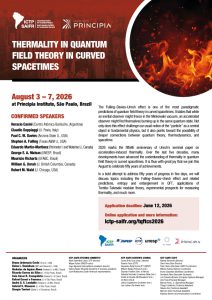
Thermality in Quantum Field Theory in Curved Spacetimes

August 3 – 7, 2026
Principia Institute, São Paulo, Brazil
ID Zoom: 842 5494 1887
Password: quantum
Home
The Fulling–Davies–Unruh effect is one of the most paradigmatic predictions of quantum field theory in curved spacetimes. It states that while an inertial observer might freeze in the Minkowski vacuum, an accelerated observer might find themselves burning up in the same quantum state. Not only does this effect challenge our usual notion of the “particle” as a central object in fundamental physics, but it also points toward the possibility of deeper connections between quantum theory, thermodynamics, and spacetime.
2026 marks the fiftieth anniversary of Unruh’s seminal paper on acceleration-induced thermality. Over the last five decades, many developments have advanced the understanding of thermality in quantum field theory in curved spacetimes. It is thus with great joy that we join this August to celebrate fifty years of achievements.
In a bold attempt to address fifty years of progress in five days, we will discuss topics including the Fulling–Davies–Unruh effect and related predictions, entropy and entanglement in QFT, applications of Tomita–Takesaki modular theory, experimental prospects for measuring thermality, and much more.
Organizers:
- Bruno Arderucio Costa (Troy University, USA)
- Daine L. Danielson (MIT and Harvard University, USA)
- Níckolas de Aguiar Alves (Federal University of ABC, Brazil)
- Ricardo Correa da Silva (University of São Paulo, Brazil)
- Caio César Rodrigues Evangelista (Federal University of Ceará, Brazil)
- Rafael Grossi e Fonseca (University of São Paulo, Brazil)
- André G. S. Landulfo (Federal University of ABC, Brazil)
- Gabriel Santos Menezes (University of São Paulo, Brazil)
- Giorgio Torrieri (State University of Campinas, Brazil)
Announcement:
Application is now closed
Participants list here
Click here for satisfaction survey
Speakers
Speakers
- João C. A. Barata (USP, Brazil)
- Marion Cromb (U. Nottingham and U. Manchester, UK) – Accelerated observers in superfluid helium
- Claudio Dappiaggi (U. Pavia, Italy) – Local and global ground and KMS Hadamard States with Robin boundary conditions on half-Minkowski spacetime
- Daine L. Danielson (MIT and Harvard University, USA) – Measuring the Acceleration-Dependent Temperature of the Minkowski Vacuum
- Paul C. W. Davies (Arizona State U., USA) – Horizons, demons and the generalized second law: open questions
- Vitorio A. De Lorenci (UNIFEI, Brazil) – Chronology protection in a locally flat spacetime
- Lawrence Ford (Tufts U., USA) – Frequency Spectra and Probability Distributions of Quantum Field Fluctuations
- Stephen A. Fulling (Texas A&M U., USA) – The best reason to have a “D” in “FDU”
- Renata Zukanovich Funchal (USP, Brazil) – Testing Primordial Black Hole Explosions with Ultra-High-Energy Neutrinos and Multi-Messenger Precursors
- Jorma Louko (U. Nottingham, UK) – Back-action of an Unruh-DeWitt detector in causal covariant perturbation theory
- Eduardo Martín-Martínez (Perimeter Institute and Waterloo U., Canada)
- George E. A. Matsas (UNESP, Brazil) – Unruh effect – 50 years – quo vadis
- Maurício Richartz (UFABC, Brazil) – Superradiance in Analogue Gravity: beyond the irrotational approximation
- Nami Svaiter (CBPF, Brazil) – Effective field theory for the Schottky anomaly in liquids
- William G. Unruh (U. British Columbia, Canada) – Black hole – Entropy container or creator
- Robert M. Wald (U. Chicago, USA) – Black Holes Decohere Quantum Superpositions
Registration
Program
Posters
- Almeida De Paula, João Paulo (Federal University of ABC, Brazil): Thermodynamic stability in an Einstein universe
We calculate the Feynman propagator at finite temperature in an Einstein universe for a neutral massive scalar field arbitrarily coupled to the Ricci curvature. Then, the propagator is used to determine the mean square fluctuation, the internal energy, and pressure of a scalar blackbody radiation as functions of the curvature coupling parameter ξ. By studying thermodynamics of massless scalar fields, we show that the only value of ξ consistent with stable thermodynamic equilibrium at all temperatures and for all radii of the universe is 1/6, i.e., corresponding to the conformal coupling. Moreover, if electromagnetic and neutrino radiations are present at the regime of high temperatures and/or large radii, we show that at least one scalar field must also be present to ensure thermodynamic stability.
- Amancio Barbosa Oliveira, Eduardo (Institute of Theoretical Physics – Sao Paulo State University, Brazil): A spacetime-covariant approach to relativistic quantum clocks in first quantization: global and local unitarity and “quantum time dilation”
It is expected that a quantum theory of gravity will radically alter our current notion of spacetime geometry. However, contrary to what was commonly assumed for many decades, quantum gravity effects could manifest in scales much larger than the Planck Scale, provided that there is enough coherence in the superposition of geometries. Quantum Clocks, i.e. quantum mechanical systems whose internal dynamics can keep track of proper-time lapses, are a very promising tool for probing such low-energy quantum gravity effects. In this work, we contribute to this subject by proposing a spacetime-covariant formalism to describe clocks in first quantization. In particular, we account for the possibility of dynamically accelerated clocks via suitable couplings with external fields. We find that a particular decomposition of the (quadratic) clock Hamiltonian into positive- and negative-mass sectors, when attainable, enables one to compute the evolution of the system directly in terms of the clock’s proper-time while maintaining explicit covariance. When this decomposition is possible, the evolution obtained is always unitary, even with couplings with external fields used to, e.g., accelerate the clocks. We then apply this formulation to compute the joint time evolution of a pair of quantum clocks in two cases: (i) inertial clocks with relative motion and (ii) charged clocks accelerated by a uniform magnetic field. In both cases, when our clocks follow quasiclassical histories, or “worldfunctions”, we find a conditional time dilation observable whose probabilities peak exactly at the classical expected value. However, when they are prepared in coherent superpositions of such worldfunctions, we find a quantum-coherent time dilation profile which both displays proper-time interference and allows the realization of operations in indefinite causal order.
- Balbino, Matheus De Miranda (Centro Brasileiro de Pesquisas Físicas – CBPF-RJ, Brazil): Structural glasses model using disorder fields: the boson peak from local ground states
We show the emergence of a contribution characteristic of {the} boson peak in the spectral density of structural glasses. To model the vitreous state, we consider static density-fluctuation fields coupled to a multiplicative quenched disorder. Performing an ensemble average over all disorder realizations, a functional series representation of the average free energy is obtained. In this series representation of the average free energy for the glassy state of matter, we identify in the function space effective actions. These effective actions present a large number of metastable states and ground states. Random first-order transition, widely discussed in the literature as a description of the transition from the supercooled liquid to the glassy state of matter, emerges naturally in our formalism. {We establish the connection between the use of hyperbolic differential equations with random coefficients and the presence of many ground states in the average free energy. This connection allows us to study emergent excitations in such amorphous materials.
- Barbosa, Leonardo Gonçalves (Federal University of Santa Catarina, Brazil): Vacuum polarization in the Schwarzschild black hole with a global monopole
We investigate vacuum polarization on the event horizon of a Schwarzschild black hole carrying a global monopole. For a massless scalar field $\Psi$ in the Hartle-Hawking state and with arbitrary curvature coupling, we compute the renormalized vacuum expectation value $\langle \Psi^2 \rangle_{\textrm(ren}}$. The monopole produces a solid-angle deficit and makes the spacetime non-Ricci-flat. Working perturbatively in the monopole parameter $\eta$ and retaining terms through $0(leta^ 2)$, we find that $|langle \Psi^2 \rangle_f\textrm(ren}}$ on the horizon splits into two contributions: a genuinely monopole-induced term evaluated at the horizon and the usual Schwarzschild result—with the event horizon radius modified by the presence of $\eta$. We also investigate whether an analogous decomposition holds for $\langle T^{mu} {phantom<|mu}\mu}|rangle\textrm{ren}$ when it is determined by this method. Our result parallels earlier analyses of Schwarzschild black holes pierced by a cosmic string.
- Basso, Marcos Leopoldo Wayhs (Universidade Estadual de Campinas, Brazil): Fluctuation theorems for localized quantum systems in curved spacetime
Fluctuation theorems, such as the Crooks and Jarzynski relations, extend the second law of thermodynamics to nonequilibrium processes by constraining the statistics of work fluctuations and linking them to equilibrium free energy differences. In the quantum regime, these relations are typically formulated within the two-point measurement protocol, in which work is defined through projective energy measurements performed at the beginning and end of the process. Here, we discuss extensions of these relations to quantum systems in relativistic settings. In particular, we present recent results obtained in Ref. [Phys. Rev. Lett. 134, 050406 (2025)], in which the fluctuation relations are formulated for nonrelativistic quantum systems, such as Unruh–DeWitt particle detectors, in curved spacetimes using Fermi normal coordinates, thereby establishing a connection between spacetime curvature and entropy production.
- Becerra, Manuel (Universidad de Los Andes, Colombia): Emergent gauge symmetries on the fuzzy sphere
Balachandran et al. (2020) showed that the non-uniqueness of the decomposition of a finite-dimensional GNS representation into irreducible components gives rise to entropy-increasing quantum operations governed by an emergent gauge symmetry. This construction links algebraic ambiguities directly to irreversible dynamics and entropy production. We extend these ideas to noncommutative geometries arising from the quantization of compact homogeneous manifolds Q=G/H, where G is a compact Lie group. Using the covariance algebra associated with such spaces and the Tomita-Takesaki modular theory, we identify emergent gauge groups that generalize the finite-dimensional construction. As a concrete example, we analyze the fuzzy sphere, the canonical noncommutative deformation of the classical sphere, and construct the corresponding emergent gauge symmetries. We compare these symmetries with the classical gauge group U(1) of S^2=SU(2)/U(1) and discuss their implications for entropy and the algebraic description of quantum geometry.
- Benique Sarayasi, Luis Fernando (Instituto de Física (IF-UFRJ)-Universidade Federal do Rio de Janeiro (UFRJ), Brazil): Quark Matter in the Holographic D3-D7 Model and Neutron Stars
The AdS/CFT correspondence establishes that, in the large- limit and for strong ’t Hooft coupling, the N = 4 Super Yang–Mills (SYM) theory admits a holographic description in terms of classical type IIB supergravity on an 5 ×5 geometry. Within this framework, we review the top-down holographic D3-D7 model, which incorporates flavor degrees of freedom through the inclusion of D7-branes and is used to study quark matter in the zero-temperature and high baryon density regime, associated with the deconfined phase. On this basis, known results of the D3-D7 model in the case = = 3 are reviewed, with the aim of establishing a connection with Quantum Chromodynamics (QCD). The holographic equation of state (EoS) at zero temperature derived from the D3-D7 system is considered, and a hybrid approach is adopted, in which this holographic EoS is matched with nuclear matter equations of state obtained from extrapolations of chiral effective theory (CET), in particular the Hebeler–Lattimer–Pethick–Schwenk (HLPS) soft, intermediate, and hard equations of state, valid in the low-density regime. The matching between both descriptions is performed at an intermediate density determined by the condition of equal pressure, which allows the definition of an effective transition between nuclear and quark matter. From these hybrid equations of state, the Tolman–Oppenheimer–Volkoff (TOV) equations are solved, obtaining the mass–radius relations of neutron stars.
- Burton Villalobos, Andrés Ignacio (Universidad de Tarapacá – UTA, Chile): Stochastic Inflation in the Presence of Spacetime Torsion.
Working on it
- Cruz, Thales Willian (University of Campinas, Brazil): Exploring light propagation in nonlinear electrodynamics: phase and group velocities and related phenomena
“Nonlinear electrodynamics has been an important area of research for a long time. Investigations based on nonlinear Lagrangians, such as Euler–Heisenberg and Born– Infeld, are instrumental in exploring the limits of classical and quantum field theories, providing valuable insights into strong-field phenomena. In this context, this work considers how light propagates in strong-field environments, where such nonlinearities play significant roles, offering a way to investigate events in high-energy astrophysics, quantum optics, and fundamental physics beyond classical Maxwell’s framework. Here, several aspects of light propagation in nonlinear electrodynamics are discussed. Phase and group velocities are derived and several interesting behaviors are unveiled, such as birefringence, non-reciprocal propagation, and asymmetries between phase and group velocities in special configurations. Specific solutions based on commonly studied nonlinear theories are also investigated, and phenomena like slow-light and one-way propagation are discussed.” (This poster will be based on my article with the same title)
- Da Silva, Jefferson Monção (Unicamp, Brazil): Effects of Boundary Conditions on the Quantum Detection
In this work, the research explores how boundary conditions affect the response function of an Unruh-DeWitt detector coupled to a scalar field. The spacetime used to probe these effects is geometrically divided into an inner flat region and an outer region with a conical metric, separated by a singular cylindrical shell. By utilizing a two-interval Sturm-Liouville problem, the study demonstrates that the choice of self-adjoint boundary conditions on the singular surface directly influences the quantum response. This highlights vacuum non-locality, as the detector effectively “feels” the combined effect of the boundary and the outer conical geometry even in the absence of classical interaction with the shell.
- Ferreira Jr, Alexsandre Leite (Universidade Federal do Rio de Janeiro, Brazil): Thermal aspects of geodesically complete cosmologies
Recently, we established a theorem providing necessary and sufficient conditions for the completion of flat Friedmann–Lemaître–Robertson–Walker (FLRW) spacetimes [PRD 111, 123531 (2025)]. In the present work, I investigate the thermodynamic properties of the complete cosmologies allowed by this theorem. By classifying all possible completions, I analyze their associated horizon temperatures, entropies, and asymptotic thermal states. This provides a characterization of the thermodynamics of complete FLRW universes and sheds light on the relationship between spacetime completeness and cosmological thermodynamics.
- Ferreira Vieira, Arthur (Universidade do Estado do Rio de Janeiro, Brazil): Towards Perturbative Unimodular Poincaré Gauge Theories with Propagating Torsion
Poincaré Gauge Theories constitute a metric-compatible sector of Metric-Affine Gravity in which the Lorentz connection, or equivalently torsion, is treated as an independent dynamical field. We analyze the effect of imposing the unimodular constraint on the one-loop structure of a restricted class of such theories, formulated in the Einstein representation and truncated to quadratic torsion dynamics. Focusing on the propagating axial and vector torsion sectors, and working on maximally symmetric backgrounds with vanishing torsion, we compare the standard and unimodular formulations at the level of the gauge-fixed one-loop partition function. We find that the residual functional determinants coincide in the two formulations. It follows that the local logarithmically divergent part of the one-loop effective action is reproduced by the unimodular theory in the sectors considered, within this restricted but nontrivial setting. We also identify the assumptions underlying this equivalence and discuss extensions to torsionful backgrounds and nonminimal fluctuation operators.
- Ferreira, Matheus Curado (Brazilian Center of Physical Research, Brazil): Non-Linear Cosmological Bootstrap: Higher-Derivatives & Meijer G-functions
We study the cosmological bootstrap for the exchange of a massive spectator with ghost-condensate dispersion. The exchanged field is not a negative-norm ghost, but a stable spectator degree of freedom whose short-distance propagation is governed by a nonlinear dispersion relation. This simple modification changes the analytic structure of scalar-exchange correlators in a sharp way. In the ordinary de Sitter bootstrap the scalar-exchange seed is governed by a second-order Fuchsian equation with regular singular points at the soft, folded and factorization loci. For a pure ghost spectator, the same bootstrap logic instead leads to a fourth-order equation. The collapsed point becomes an irregular singular point, while the infinity is a regular singular point and positive/minus one are ordinary points of the homogeneous equation. We construct the local homogeneous sectors, showing that the equation contains two collider branches and two WKB branches. The physical collapsed seed selects the collider branches and projects out the WKB sectors. We further show, using a regular-singular basis at infinity, Meijer-G functions and Mellin–Barnes representations, that the collider branches arise as residues of specific pole towers. Finally, we construct the non-homogeneous solution and compare its hypergeometric tower structure with the ordinary de Sitter case.
- Figueroa, Miguel (Federico Santa María Technical University, Chile): Analysis of the black-hole quantum atmosphere
Black holes emit particles of all species at a temperature inversely proportional to their mass. However, the emission spectrum differs from that of a black body at the same temperature due to backscattering by the gravitational potential. It has also been recently suggested that Hawking radiation originates from an effective atmosphere extending beyond the black hole horizon. In this work, we recalculate the emission power for different particle species and analyze the effective radius of this emitting atmosphere. Within a semiclassical framework, we show that a black hole can be understood as a tiny black body whose emission remains quasi-thermal despite the effects of backscattering. Finally, we discuss why the Stefan–Boltzmann and Wien displacement laws are not satisfied in this context.
- Fontana, Rodrigo Dal Bosco (UFRGS, Brazil): Superspinning Kerr-like objects: perturbations
We study the black hole gravitacional waves of a Kerr-like object limiting the existence of high spin spacetimes through geometric perturbations.
- Furtado, Tarcio (IME – INSTITUTO MILITAR DE ENGENHARIA, Brazil): Análise de Estados Quânticos em Sistemas de Spin: Modelagem de Qubit Aplicado como Sensor de Rotação
Este trabalho apresenta a modelagem e simulação computacional de um sensor quântico de rotação baseado em centros de vacância de nitrogênio (NV) em diamante. Utilizando o framework QuTiP (Quantum Toolbox in Python), foi implementado um sistema de spins eletrônico e nuclear (14N,I = 1) acoplados, submetido a um protocolo de interferometria de Ramsey. A dinâmica do sistema foi descrita por um Hamiltoniano que incorpora interações de desdobramento em campo zero, termos Zeeman e acoplamento hiperfino. A sensibilidade `a rotação foi modelada através da inclusão do Hamiltoniano de acoplamento spin-rotação (Mashhoon) durante o tempo de evolução livre. As simulações demonstram que as rotações mudam o estado quântico do sistema (fase) resultando em variações mensuráveis nas populações dos estados de spin nuclear, validando o protocolo de controle e a viabilidade do modelo como ferramenta preditiva para o desenvolvimento de detectores quânticos de rotação. Palavras-chave: Centros NV, qubit, Sensoriamento Quântico, QuTiP, Interferometria de Ramsey, Spins Nucleares.
- Grechko, Agata (Universidade de São Paulo, Brazil): Celestial Compton amplitudes and Celestial KMOC formalism
Two main directions of my research in celestial holography now is, firstly, studying the IR properties of soft limit of massive Compton scattering amplitudes after integral transformation and how the spurious poles affects the soft expansion of it, and secondly, how to formulate well-established in amplitude physics KMOC formalism for massive states in order to obtain some classical limits for the celestial observables. This is what I would like to present on a poster session.
- Haiashi, Lucas (University of São Paulo, Brazil): NLO Angular Impulse and Leading Singularities for Kerr Black Holes
We derive the complete Next-to-Leading Order (NLO) angular impulse, or spin kick, for the scattering of two spinning compact objects at order G2 in the Post- Minkowskian expansion. Utilizing the Kosower-Maybee-O’Connell (KMOC) formalism, we extract this classical observable from the one-loop gravitational scattering amplitude of two Kerr black holes. A key feature of our derivation is the systematic application of the Leading Singularity to isolate the classical contributions from the triangle topologies. Our results provide a unified covariant expression that incorporates three distinct physical effects: conservative rotational torques, worldline recoil shifts arising from the spin-induced center of mass, and dissipative radiation reaction forces. We demonstrate that the inclu- sion of the virtual recoil term, often omitted in leading-order treatments, is essential for preserving the covariant spin constraint. Furthermore, we evaluate the radiation reaction sector through the unitarity cuts of the box amplitude, identifying the characteristic scaling of the dissipative impulse. This work provides a component for high-precision waveform modeling and the study of the transition from scattering to bound-state dynamics in binary systems.
- Meert, Pedro (IFT – UNESP, Brazil): Choked thermal emission in scalar DBI analogue geometries
Fluctuations of the scalar Dirac-Born-Infeld (DBI) action can be mapped to a scalar field propagating in an effective acoustic geometry, providing a novel framework within analogue gravity. We investigate the causal structure and thermal properties of this analogue spacetime when sourced by a smeared $\propto r^{-2}$ density profile. Unlike standard acoustic black holes, we demonstrate that the infinite redshift surface in this model does not correspond to an event horizon, but rather to a time-like naked singularity. In the fluid dictionary, this corresponds to a strictly subsonic flow ($c_{s}^{2}-v_{0}^{2}=1$) where the fluid density locally vanishes. Numerical estimation of greybody factors reveals that the effective potential exhibits a mass gap at the singularity. This mass gap acts as a geometric high-pass filter, severely choking the thermal emission and effectively trapping low-energy radiation. Furthermore, we show that the thermal suppression factor at the threshold energy is universally scale-invariant.
- Montoli, Sebastián (Facultad de Ciencias, Uruguay): Two dimensional gravity and holography
Recently, considerable attention has been devoted to understanding holography at finite radial cutoff. In particular, it has been conjectured that gravity defined on a finite region of an asymptotically AdS spacetime is dual to a deformed boundary theory. A central piece of evidence for this proposal is that the flow equation satisfied by the deformed boundary theory can be identified with the radial Wheeler–DeWitt equation of the bulk gravitational theory. In this context, we studied two-dimensional Jackiw–Teitelboim gravity from the perspective of canonical quantization. The goal was to investigate the structure of the solutions of the radial Wheeler–DeWitt equation and their interpretation in terms of a holographic theory defined at finite cutoff. Working in the first-order formalism, we found that imposing Dirichlet boundary conditions on the canonical fields at the cutoff boundary allows the path integral representation of the Wheeler–DeWitt wavefunction to be reduced to an ordinary integral. This construction can be interpreted as defining a deformed quantum mechanical theory at the boundary. Remarkably, the resulting deformation is closely analogous to the TTbar deformation procedure for two-dimensional quantum field theories, establishing a connection between two-dimensional gravity, holography at finite cutoff, and the thermodynamics of the dual quantum mechanical system.
- Moura, Leonardo Martins (Universidade Federal de Santa Catarina, Brazil): Black holes solution by gravitational decoupling
In general relativity solving analytically the Einstein field equations is in most cases a very hard task due to its non-linearity. Spherically symmetric solutions are well known such as Schwarzschild and Tolman-Oppenheimer-Volkoff, for example. In this work we investigate a method for solving the field equations by decoupling the system of PDE into two simpler systems. Starting from a known solution generated by a known source, we add a new source which deforms the known solution in such a way that we get two independent systems of PDE, one for each source. The fact that the field equations decouple into two systems means that the sources don’t exchange energy and momentum and their interaction is purely gravitational. This method is called minimal geometric deformation, if the deformation is only in the radial component of the metric tensor, or extended geometric deformation, if the deformation is in the radial and temporal component of the metric tensor, and it’s useful to get known solutions, especially for black holes which are of interest in this work. Regarding that, we shall consider the metric for a perfect fluid and decouple the field equations by adding a generic source, then we consider the Schwarzschild solution for a black hole and look for the conditions for the source to generate a physically acceptable new solution for a black hole. Finally, we examine the horizon structure for the new solution and compare it to the Schwarzschild solution.
- Nunes Dos Santos, Luis Cesar (Universidade Federal de Santa Catarina, Brazil): Effects of Rotation on the Casimir Energy in Higher-Dimensional Compactified Space-Time
We investigate the quantization of a massless scalar field in a rotating frame. In particular, we derive the Casimir energy in a space-time with one extra compactified dimension from the perspective of a rotating observer. We consider a uniformly rotating system on the circle (S^1) and obtain an equation for spin-0 bosons in which noninertial effects are taken into account. We show that the scalar-field spectrum depends on the angular velocity of the rotating system, allowing the definition of positive- and negative-energy modes through a suitable choice of the angular velocity. Furthermore, we demonstrate that noninertial effects restrict the physical region of the space-time accessible to particles and shift the Casimir energy associated with the compactified extra dimension. In addition, we point out that rotational effects modify the effective length of the extra dimension for a co-rotating observer in this class of space-times.
- Pais, Pablo (Universidad Austral de Chile (UACh), Chile): Generalized Uncertainty Principle in three-dimensional black holes and its thermodynamics
We study the thermodynamic implications of a gravity-induced Generalized Uncertainty Principle (GUP) in three-dimensional black hole spacetimes. We observe that the event horizon of the $M\neq0$ Bañados-Teitelboim-Zanelli (BTZ) black hole suggests a consistent scale $R_{g}$ acting as a minimal length for the localization process. We also consider the extremal $M=0$ case as an alternative scenario and discuss a potential condensed matter analogue realization. Inspired by recent works on the GUP and statistical mechanics, we explore a simple mapping of this framework into a deformed phase-space geometry to examine how this quantum-gravitational cutoff might introduce temperature-dependent corrections to standard thermodynamic quantities.
- Parida, Subrat (Independent Researcher Currently, India): On Super-Hyperbolic Wormhole Geometries and their Deformations
In this study, we developed a unified geometric and relativistic framework for a new family of traversable wormholes constructed from a super-hyperbolic deformation of the classical catenoid, whose geometric embedding is governed by the Mittag-Leffler-based super-hyperboloid deformation function ${\mathfrak{S}C}_{\alpha} (v)$, where the fractional parameter $0<\alpha<1$ continuously regulates the throat curvature and produces a smooth interpolation between the minimal-surface geometry and fractional curvature spacetime structure. Allowing a non-constant redshift $\Phi(r)$, we systematically evaluate closed analytical expressions for the shape function, curvature tensors, matter sources, and junction conditions, culminating in an exact thin-shell equation of motion and stability criterion. This work establishes a mathematically consistent and physically viable framework for the extension of wormhole theory, providing a new avenue for exploring exotic geometries within general relativity and achieving stable traversable configurations.
- Pérez Graterol, Rafael José (Simón Bolívar University of Venezuela (USB), Venezuela): Hamiltonian Formulation of Gauge Theories
In a gauge theory, not all canonical variables are observable; instead, relationships between them called constraints exist that limit the phase space. The primary constraints of the theory are obtained from the definition of the canonical momentum. The total Hamiltonian is defined as the sum of the canonical Hamiltonian plus a linear combination of the primary constraints. The preservation of a primary constraint can lead to a secondary constraint, the determination of a multiplier, or an identity. Gauge transformations are transformations of the fields induced by arbitrary multipliers. First-class constraints are used to construct the generator of gauge transformations. If the final set of constraints is first-class, additional constraints, called gauge fixations, must be added to ensure that the new set of constraints is second-class. The equations of motion are obtained using the Dirac bracket that take into account the second-class constraints and projecting the brackets onto the surface of the second-class constraints.
- Ribeiro, Rodrigo Mendes (Universidade de São Paulo (USP), Brazil): On the construction of asymptotics states in Quantum Field Theory in Curved Spacetimes
This work investigates the mathematical foundations of scattering theory within the framework of Algebraic Quantum Field Theory (AQFT), focusing on the formal construction of asymptotic particle states. In Minkowski spacetime, the rigorous connection between local interacting fields and free asymptotic particles is established by the Haag-Ruelle scattering theory. By relying strictly on the Wightman axioms and the presence of a positive mass gap in the energy-momentum spectrum or, more generally, on the algebraic aproach of the Quantum Field Theory, the Haag-Ruelle formalism guarantees the strong convergence of quasi-local creation operators without perturbative expansions. However, the extension of this framework to curved spacetimes has structural obstructions, primarily due to the loss of global Poincaré invariance and the standard definition of the total momentum operator. Therefore, we analyze a geometric setup featuring a compact support metric perturbation, where the curvature is strictly confined to a bounded region of spacetime.
- Rodriguez, Jheny Katherine (Universidad Nacional de Colombia, Colombia): Nature of Field Modes on the Schwarzschild Black Hole Spacetime.
This work studies the behavior of scalar field modes in different spacetime geometries in order to understand their structure in the presence of horizons and during gravitational collapse. The analysis begins in Minkowski spacetime, where the modes associated with inertial observers are constructed and compared with those defined by uniformly accelerated observers using Rindler coordinates, highlighting the observer dependence in the definition of vacuum states. The study is then extended to Schwarzschild spacetime and to its maximal Kruskal extension. In this context, the Boulware and Hartle–Hawking field modes are analyzed and their relation with modes defined in flat spacetime is discussed. Particular attention is given to how these mode decompositions reflect the causal structure introduced by the event horizon. Finally, scalar field modes are considered in the spacetime of a black hole formed through gravitational collapse. Using the Thermo Field Dynamics formalism, certain quantum states are interpreted as entangled configurations between causally disconnected regions. These results help clarify the role of scalar field modes in spacetimes with horizons within the semiclassical framework of quantum field theory in curved spacetime.
- Salmen, Sasa (IFUSP, Brazil): Peripheral Algebras and Asymptotic Dynamics of Quantum Channels on Type II von Neumann Algebras
The asymptotic dynamics of finite-dimensional quantum channels is strongly constrained by the structure of their peripheral eigenoperators, leading to the emergence of noiseless subsystems, cyclic dynamics, and decomposition theorems for the peripheral algebra. In the infinite-dimensional setting, however, many of these structural results are no longer automatic, particularly for quantum channels acting on type II von Neumann algebras. In this work, we investigate possible extensions of the finite-dimensional structure theory of peripheral algebras to semifinite von Neumann algebras. Motivated by the decomposition theory of von Neumann algebras and by results of Wolf and García on the structure of cycles of quantum channels, we study how the peripheral algebra may decompose through its center into measurable families of factors. Special attention is given to the interplay between the action of a quantum channel on the center of the peripheral algebra and the resulting dynamics on the associated fibers. We discuss conditions under which the peripheral space acquires a von Neumann algebra structure, analyze the role of automorphism and detailed balance assumptions, and explore the distinction between deterministic fiber permutation and more general mixing behavior induced by completely positive maps. Examples involving type II_1 and type II_infty algebras are considered as guiding models for the theory. This project aims to provide a framework for understanding asymptotic quantum dynamics in infinite dimensions through the structure of peripheral algebras and their central decomposition.
- Semião, Artur Matos (Centro Brasileiro de Pesquisas Físicas, Brazil): Semiclassical evolution of a dynamically formed spherical black hole with an inner horizon
In this work we obtain a numerical self-consistent spherical solution of the semiclassical Einstein equations representing the evaporation of a trapped region which initially has both an outer and an inner horizon. The classical matter source used is a static electromagnetic field, allowing for an approximately Reissner–Nordström black hole as the initial configuration, where the charge sets the initial scale of the inner horizon. The semiclassical contribution is that of a quantum scalar field in the ‘in’ vacuum state of gravitational collapse, as encoded by the renormalised stress-energy tensor in the spherical Polyakov approximation. We analyse the rate of shrinking of the trapped region, both from Hawking evaporation of the outer apparent horizon, as well as from an outward motion of the inner horizon. We also observe that a long-lived anti-trapped region forms below the inner horizon and slowly expands outward. A black-to-white-hole transition is thus obtained from purely semiclassical dynamics.
- Souza, William Araújo (Universidade Estadual de Londrina, Brazil): Gauge Choices and Linear Regime for Cosmological Perturbations in Bounce Models
This work investigates the validity of the linear regime of scalar cosmological perturbations in bounce models. During the contraction phase, the Bardeen potential Φ amplifies, becoming nonlinear (∣Φ∣≫1) near the bounce point. We discuss this violation and explore the validity regime under stronger conditions, namely, for metric perturbations (∣δgμν∣≪1) and for the linearized Einstein equations (∣δGμν∣≪∣Gμν∣). To define the vacuum state for the perturbations, we adopt an adiabatic vacuum state imposed on the Mukhanov-Sasaki variable in the remote past of the contraction phase. We analyze this issue across different cosmological gauges to assess which gauges are physically realizable in the models under study.
- Tavares, Guilherme Roberto (Unicamp, Brazil): Vaccum Fluactuations of the Spinning Cosmic String
This work investigates the vacuum fluctuations of a massless scalar field in the presence of a cylindrical boundary in the spacetime of a spinning cosmic string. The boundary condition serves to shield the causal region from the acausal one, with the aim of computing the two-point function and the vacuum fluctuations of the field.
- Vargas, Ángela (Universidad Nacional de Colombia, Colombia): Quantum ECO Closeness Parameter from the Entanglement Entropy Approach for a Slowly Rotating Black Shell Model
The Bekenstein–Hawking entropy can be understood from the perspective of a fiducial observer (FIDO) as an entanglement entropy associated with quantum fields near a collapsing surface very close to the horizon. However, its dependence on the number of field species and the introduction of an ad hoc cutoff remains a fundamental challenge in this approach. In this sense, a thin, collapsing dust layer (Black Shell) is considered an Exotic Compact Object (ECO) model, whose closeness parameter provides a physical interpretation of the cutoff. Near the gravitational radius, this parameter acquires a quantum contribution associated with the quasi-stationary phase of the collapse. In this regime, the entropy of the thermal atmosphere surrounding the shell exhibits area-law behavior, while both the proximity parameter and the finite observation time of the FIDO play a crucial role in regulating divergences. Furthermore, the effects of slow rotation of the black shell in the Kerr regime (J/M^2 << 1) on the closeness parameter and the associated entropy are calculated and analyzed.
- Vasconcelos, Genivaldo (IFUSP, Brazil): Geometric Properties of Thermal states in Static spacetimes
I want to present a revision poster based on the work of Ko Sanders in characterizing the KMS condition for stationary spacetimes from an algebraic perspective, showing results of existence and uniqueness. I also want to present a rigorous version of the so called Wick Rotation for static spacetimes which allow us to see the KMS condition from a geometric perspective.
- Vaz E Silva, João Pedro (Universidade Federal Fluminense, Brazil): Radiative dynamics of massive gauge fields in the maximal abelian gauge: probing Abelian dominance with scalar fields
The infrared regime of the non-abelian Yang-Mills theories have been a very important research topic due to the non-perturbative effects such as color confinement. Lattice results along with other non-perturbative approaches, such as the functional renormalization group, have found some success in describing the dynamics at the infrared scale. Those methods have inspired refined models for perturbation theory which attempt to replicate the non-perturbative results by means of a minimal modification, such as the introduction of effective mass terms for the gluon propagator. The most famous of these is the Curci-Ferrari model, that found a consistent effective mass scale by fitting the massive propagator to the lattice results.This model has beed defined and developed in the Landau Gauge. This approach has recently been extended for other gauges. Different choices of gauge can help in identifying key properties regarding non perturbative dynamics of matter and gauge fields. As a case study, the maximal Abelian gauge (MAG) treats diagonal and off-diagonal components of the colored fields differently, defining a suitable setup to probe the so-called Abelian dominance conjecture. In order to explore the effects of a massive gauge field in the MAG, and its relations to Abelian dominance we introduce a mass term as an effective correction to the gauge fixed Yang-Mills Lagrangian and introduce a minimally coupled color covariant scalar field in the adjoint representation of $SU(2)$. From the first order self-energies of the fields we derive constraints capable of fitting well to the Abelian dominance conjecture as solutions of a transcendental equation. A graphical exploration is presented and followed by numerical methods to estimate the mass relation. We find that the abelian component’s mass is undisturbed by first order renormalization and from the 1-loop effective mass we arrive at a constraint with hints of confinement with, however, some non-trivial consequences, such as the introduction of imaginary masses for the gauge fields.
- Wang, Qingdi (Xi’an Jiaotong University, China): Oscillating Away Singularities and the Vacuum Catastrophe
Spacetime singularities and the vacuum catastrophe, also known as the cosmological constant problem, are two crises that are usually regarded as unrelated. Here we show that treating them together may resolve both: the mechanisms underlying them generate opposing effects that dynamically balance one another through generic, chaotic, quasi-ergodic Mixmaster-like oscillations.
- Xavier, Vanessa Do Nascimento (Centro Brasileiro de Pesquisas Físicas, Brazil): Bouncing completion of eternal inflation
Using a purely kinematical argument, the Borde-Guth-Vilenkin (BGV) theorem states that any maximal space-time with average positive expansion is geodesically incomplete, hence past eternal inflation would be necessarily singular. Recently, discussions about the broadness of this theorem have been resurfaced by applying it to new models and/or challenging the space-time maximality hypothesis. In the present work, we use reference frames of non co-moving observers and their kinematical properties in order to inquire into the nature of such possible singular beginnings. Using the spatially flat de Sitter (dS) space-time as a laboratory, this approach allows us to exhaust all possibilities bounded by the BGV theorem in the case of general spatially flat Friedmann-Lemaître-Robertson-Walker (FLRW) geometries. We show that either there exists a scalar or parallelly propagated curvature singularity, or the space-time must be past asymptotically dS (with a definite non-zero limit of the Hubble parameter when the scale factor becomes null, hence excluding certain cyclic models) in order to be extensible. We are able to present this local extension without violating the null energy condition, and we show that this extension must contain a bounce. This is a mathematical result based on purely kinematical arguments and intuition. The possible physical realization of such extensions are also discussed. As a side product, we present a new chart that covers all de Sitter space-time.
Short talks
- Alencar Caribé, João Gabriel (Universidade do Estado do Rio de Janeiro, Brazil): Quantum Scalar Field correlations across the Horizon in a (3+1)-D Schwarzschild spacetime
Hawking radiation is an emblematic phenomenon predicted in the framework of Quantum Field Theory on Curved Spacetimes. In (1+1)-D, this effect leaves a typical imprint in the correlations across the horizon, in the form of a local maximum in the momentum-momentum field correlations (Schützhold & Unruh, 2010; Balbinot & Fabbri, 2022). However, these are not particularly apparent in the field-field correlations given by the Wightman function. In this work, we analyze these correlations across the horizon in the full (3+1)-D Schwarzschild spacetime. In contrast to the (1+1)-D case, we have found an intriguing local minimum in the field-field correlations across the horizon in both the Unruh and Hartle-Hawking states, that can be attributed to genuinely non-local correlations across the horizon.
- Alencar, Victor (UFRJ, Brazil): Quantum Scattering in Schwarzschild Spacetime: Hawking Radiation and Black Hole Atmospheres
We investigate scattering of a scalar field around a Schwarzschild black hole through its $S$-matrix. Within this framework, we obtain a novel derivation of Hawking radiation by computing the emission rate, which yields a Bose–Einstein distribution with temperature $T_H=(8\pi GM)^{-1}$, the Hawking temperature. In addition to Hawking radiation, the S-matrix exhibits antibound states, corresponding to excitations at the threshold to become scattering (bound) states if the potential is decreased (increased). We interpret these excitations as constituents of the black hole quantum atmosphere: a thermalized region outside the event horizon, which is the source of the Hawking radiation. Using the spectrum of antibound states, we found the atmospheric radius, $r_{\text{Atm}} \approx 2.77 r_{s}$, which is in good agreement with previous results in the literature obtained through other methods. Our results indicate that, at the macroscopic level, the quantum atmosphere behaves like an ordinary thermalized gas at the Hawking temperature
- Alves, Felipe Dilho (Instituto de Física da Universidade de São Paulo, Brazil): A generalization of the Fredenhagen-Haag derivation of Hawking radiation for a class of Vaidya space-times.
The seminal derivation of Hawking radiation by Fredenhagen and Haag (1990) provided a rigorous, structurally transparent framework for understanding the origin of black hole radiance within algebraic quantum field theory (AQFT), bypassing the traditional reliance on asymptotic past infinity ($\mathscr{I}^-$) by using local, short-distance scaling limits near the forming horizon. However, the original proof was restricted to static or stationary backgrounds, such as the Schwarzschild geometry, where the event horizon is a fixed killing horizon. In this paper, we generalize the Fredenhagen-Haag approach to a dynamical setting by considering a broad class of spherically symmetric, globally hyperbolic Vaidya space-times modeling a collapsing null fluid.
- Barbosa, Matheus Goulart (Instituto de Física de São Carlos, Brazil): Light cone thermodynamics
Inspired by black hole thermodynamics and other results that suggest an intrinsic connection between general relativity and thermodynamics, this work aims to establish quasi-local thermodynamic analogues in general spacetimes. With this purpose, we generalize the Bondi-Sachs formalism to past light cones associated with an arbitrary worldline. This generalization allows us to demonstrate the emission of Hawking radiation in a quasi-local context for a few examples, suggesting that it may occur under relatively weak conditions. Then, we argue that an “irreversible inequality” holds for typical gravitational systems, indicating that an analogue of the second law can be established. Together with a definition of internal energy based on the Landau-Lifshitz pseudotensor, these results help us to find analogues of the laws of thermodynamics that originate from the Einstein field equations.
- Facundes Da Silva, Augusto (Universidade Estadual de Campinas, Brazil): Rotating Quantum Systems: Active and Passive Transformations
In classical physics, rotations of a system and rotations of the reference frame can lead to different physical interpretations, as illustrated by Newton’s bucket thought experiment. In quantum theory, this distinction appears as the difference between active rotations generated by the Hamiltonian and passive rotations associated with changes of the reference frame, or detector. In this work, we investigate this distinction in quantum systems, extending previous results for single particles to many-body systems. In particular, we explore how these different notions of rotation affect the structure and correlations of quantum states, including aspects related to entanglement.
- Good, Michael Good (Nazarbayev University, United States): Planckian radiation from beta decay
I will discuss how Planckian radiation can arise from classical, non-uniform acceleration, without assuming equilibrium thermodynamics, horizons, or quantum detailed balance. In particular, beta decay provides a striking setting: the accelerated charged particle produces a far-field photon spectrum with an exact one-dimensional Planck factor, allowing a temperature scale to be inferred kinematically from the radiation itself. I will connect this result to observed radiative beta-decay data, including the RDKII experiment, and explain why it offers a concrete laboratory clue about acceleration thermality. The talk will emphasize the physical meaning of “thermal” radiation in an out-of-equilibrium setting and its relation to moving mirrors, classical electrodynamics, and Planckian spectra.
- Guerreiro, Thiago (PUC-Rio, Switzerland): Searching for gravitons
In this talk, we will show that detecting single quanta is not the only way of witnessing inherently quantum mechanical features of a field. In this respect, there is hope for detecting the quantum nature of gravity through observing quantum features of gravitational waves, provided we do it smartly.
- Junior, Sidney Natzuka (IFT – Unesp, Brazil): Entanglement Dynamics of Two Rotating Unruh-DeWitt Detectors
The relationship between non-inertial vacuum states and quantum resources remains a subtle problem in quantum field theory in curved spacetimes. While non-inertial effects typically induce decoherence, they can counterintuively promote and preserve quantum entanglement. In this work, we investigate the entanglement production and degradation within a system of two rigidly rotating Unruh-DeWitt detectors linearly coupled to a massless scalar field. Utilizing the Born-Markov approximation, we derive a time-local Master equation in the Lindblad form to evolve the detectors’ density operator. We show that the rotational motion can induce an asymmetric decay process between the detectors, driving the spontaneous creation of quantum entanglement.
- Labun, Lance (University of Texas, Austin, United States): Thermality of accelerated electron fluctuations and QED corrections
To relate the prediction of thermal fluctuations in an accelerated frame to experimental observables, we consider an electron’s low-momentum transverse fluctuations, which are compatible with the symmetry and thermalize by interaction with the radiation field. General arguments in the accelerated frame suggest thermalization and a fluctuation-dissipation relation but leave underdetermined the magnitude of either the fluctuation or the dissipation. Lab frame analysis reproduces the radiation losses, described by the classical Lorentz-Abraham-Dirac equation, and reveals a classical stochastic force. We derive the fluctuation-dissipation relation between the radiation losses and stochastic force as well as equipartition from classical electrodynamics alone. Since high accelerations are necessary for these dynamics to become important, we compare classical results for the relaxation and diffusion times to strong-field quantum electrodynamics results. Experimental realization will require development of more precise observables: even wakefield accelerators, which offer the largest linear accelerations available in the lab, will require improvement over current technology and high statistics to distinguish an effect.
- Lauridsen Ribeiro, Pedro (Centro de Matemática, Computação e Cognição – Universidade Federal do ABC, Brazil): Causal Wedges in General Spacetimes
It has been observed that several space-times possess regions of a certain kind, called causal wedges, which model a causally complete piece of the exterior of a black hole. Such regions play a key role in several investigations of quantum field theory in curved space-times, ranging from the Unruh and Hawking effects to the AdS/CFT correspondence. In this talk, I will present a proposal for such a definition in arbitrary, strongly causal space-times, which encompasses all special cases studied so far in the literature. This definition is completely intrinsic and does not rely on the existence of a given asymptotic structure at infinity. I also intend to show how to obtain global properties of the space-time from properties of its causal wedges.
- Murk, Sebastian (Faculty of Mathematics and Physics, Charles University, Czechia): Thermodynamics of regular black holes in anti-de Sitter space
Black hole thermodynamics is usually studied using solutions with singular interiors. In this talk, I will discuss what changes when the singularity is replaced by a regular core, focusing on asymptotically anti-de Sitter black holes in higher-curvature gravity. I will explain how these solutions can be constructed in D ≥ 5 dimensions with minimally coupled matter, and compare the cases of Maxwell and nonlinear electrodynamics. In the nonlinear electrodynamics case, both the spacetime geometry and the electromagnetic field can be made regular. I will present the thermodynamic properties of these solutions, including the extended first law, the Smarr relation, the equation of state, and the role of the regularization parameter. The main result is that resolving the singularity changes the thermodynamic behavior in a controlled way. In particular, the equation of state resembles that of a fluid with finite molecular volume, giving a clear interpretation of how the regular core modifies black hole thermal behavior. [Based on https://doi.org/10.1007/JHEP11(2025)121]
- Paraizo, Daniel (Penn State, United States): Radiative fluxes and evaporating black holes
In asymptotically-flat spacetimes, there is a clear distinction between radiative fluxes and Coulombic charges, and their relation is encoded in balance laws. We identify at the classical level the radiative energy flux for a minimally-coupled massless scalar field in 3+1 dimensions using the Wald-Zoupas prescription, and then investigate the balance law for the Bondi mass in black hole evaporation. In the usual spherically-symmetric model, the semiclassical balance law for the radiative flux implies that the Bondi mass receives a quantum correction due to the Hawking radiation. Furthermore, the renormalized expectation value of the radiative flux turns out to be manifestly positive. We clarify the relation of this result to the standard Fulling-Davies formula for moving mirror models.
- Pêgas, Juan Vitor (Instituto de Física Teórica, Brazil): Emission of pairs of Minkowski photons through the lens of the Unruh effect
We discuss the emission of pairs of photons by charges with generic worldlines in the Minkowski vacuum from the viewpoint of inertial observers and interpret them from the perspective of Rindler observers. We show that the emission of pairs of Minkowski photons—commonly referred to as Unruh radiation—corresponds, in general, to three distinct processes according to Rindler observers: scattering, and emission and absorption of pairs of Rindler photons. In the special case of uniformly accelerated charges, the radiation observed in the inertial frame can be fully described by the scattering channel in the Rindler frame. This radiation is distinct from conventional Larmor radiation and may be directly observable under laboratory conditions. Our results gain relevance in light of the remarkable advances in high-intensity laser technology, which open new possibilities for experimental investigations of acceleration-induced quantum radiation.
- Perche, Rick (Stockholm University, Sweden): Bose polarons as relativistic Unruh-DeWitt detectors: Entanglement harvesting from Bose-Einstein condensates
We show that a bound impurity in a Bose-Einstein condensate can be directly mapped to an Unruh-DeWitt detector interacting with a relativistic quantum field. We provide explicit experimental parameters for an implementation using 39K impurities coupled to a 87Rb condensate via finite-time Feshbach tuning. As an application, we study the extraction of vacuum entanglement from distant regions of the condensate and find viable parameters for the implementation of entanglement harvesting.
- Prokhorov, Georgii (Joint Institute for Nuclear Research, Russia): The Unruh Effect and the Minimum Viscosity Bound
The Minkowski vacuum, perceived by an accelerated observer, behaves like a fluid that has not only a finite temperature due to the Unruh effect, but also a finite viscosity, which is believed to be related to entanglement. We explicitly derive the corresponding shear and bulk viscosities in terms of universal spectral densities, and demonstrate that the unitarity of quantum field theory, through the positivity of spectral functions, underlies thermodynamic irreversibility for a subsystem separated by the Rindler horizon, in direct analogy with the irreversibility of renormalization-group flows. Moreover, globally, for any conformal field theory, we show that the integrated shear viscosity saturates the celebrated Kovtun-Son-Starinets bound for minimal viscosity. Locally, however, the viscosity satisfies a novel relation involving the speed of sound, thereby establishing a direct connection between the minimal viscosity bound and relativistic causality. Finally, we demonstrate that the isotropy of thermal radiation in the Rindler space leads to a new sum rule relating spin-0 and spin-2 fundamental spectral densities, which we verify explicitly for conformal fields and massive Dirac fields in arbitrary dimensions.
- Santos Felipe, Bruno (CMCC – UFABC, Brazil): Quantization of unstable bound states using the rigged Hilbert space formalism
Quantum field equations in non-trivial gravitational backgrounds often support unstable modes (bound states) with purely imaginary frequencies. Classically, these modes lead to an exponential growth in time, causing pathological divergences that cannot be accommodated within the standard Hilbert space framework. In this work, we present a quantization scheme for these states by employing the Rigged Hilbert Space (RHS) formalism. We show that the unstable modes can be mapped onto generalized eigenstates (Gamow vectors) governed by temporal semi-group dynamics. Consequently, the unstable modes are reinterpreted as resonant states whose imaginary energies dictate the finite mean lifetime of the vacuum fluctuations, effectively curing the classical divergence at the quantum level. To provide an operational interpretation, we probe this regularized vacuum using an Unruh-DeWitt detector.
- Sorella, Silvio Paolo (Uerj- State University of Rio, Brazil): The Bell-CHSH inequality in Relativistic Quantum Field Theory
The maximal violation of the Bell-CHSH in the vacuum state of a relativistic Quantum-Field-Theory is revised in wedge regions. Use of the Bisognano-Whichmann results and of the modular theory enables us to capture the saturation of Tsirelson’s bound for free Fermi fields. The role of the Majorana spinors is highlighted.
Videos and Files
-
09:30 - Stephen A. Fulling (Texas A&M U.):
The best reason to have a “D” in “FDU”
-
11:00 - Rick Perche (Stockholm University):
Bose polarons as relativistic Unruh-DeWitt detectors: Entanglement harvesting from Bose-Einstein condensates
-
11:30 - Jorma Louko (U. Nottingham):
Back-action of an Unruh-DeWitt detector in causal covariant perturbation theory
-
14:00 - Marion Cromb (U. Nottingham and U. Manchester):
Accelerated observers in superfluid helium
-
15:00 - Maurício Richartz (UFABC):
Superradiance in Analogue Gravity: beyond the irrotational approximation
-
09:00 - Robert M. Wald (U. Chicago):
Black Holes Decohere Quantum Superpositions
-
10:00 - Silvio Paolo Sorella (Uerj- State University of Rio):
The Bell-CHSH inequality in Relativistic Quantum Field Theory
-
11:00 - Felipe Dilho Alves (Instituto de Física da Universidade de São Paulo):
A generalization of the Fredenhagen-Haag derivation of Hawking radiation for a class of Vaidya space-times.
-
11:30 - Claudio Dappiaggi (U. Pavia):
Local and global ground and KMS Hadamard States with Robin boundary conditions on half-Minkowski spacetime
-
14:00 - Pedro Lauridsen Ribeiro (Centro de Matemática, Computação e Cognição - Universidade Federal do ABC):
Causal Wedges in General Spacetimes
-
14:30 - Bruno Santos Felipe (CMCC - UFABC):
Quantization of unstable bound states using the rigged Hilbert space formalism
-
15:00 - Eduardo Martín-Martínez (Perimeter Institute and Waterloo U.):
Entangling Interactions and the meaning of Quantumness
-
09:00 - William G. Unruh (U. British Columbia):
Black hole – Entropy container or creator
-
10:00 - George E. A. Matsas (UNESP):
Unruh effect – 50 years – quo vadis
-
11:00 - Michael Good Good (Nazarbayev University):
Planckian radiation from beta decay
-
11:30 - Juan Vitor Pêgas (Instituto de Física Teórica):
Emission of pairs of Minkowski photons through the lens of the Unruh effect
-
14:00 - Lance Labun (University of Texas, Austin):
Thermality of accelerated electron fluctuations and QED corrections
-
14:30 - Thiago Guerreiro (PUC-Rio):
Searching for gravitons
-
15:00 - Daine L. Danielson (MIT and Harvard University):
Measuring the Acceleration-Dependent Temperature of the Minkowski Vacuum
-
16:00 - Stephen A. Fulling, William G. Unruh (Texas A&M U., U. British Columbia):
Panel: FDU 50 Years Later
-
10:00 - João Gabriel Alencar Caribé (Universidade do Estado do Rio de Janeiro):
Quantum Scalar Field correlations across the Horizon in a (3+1)-D Schwarzschild spacetime
-
10:30 - Matheus Goulart Barbosa (Instituto de Física de São Carlos):
Light cone thermodynamics
-
11:00 - Renata Zukanovich Funchal (USP):
Testing Primordial Black Hole Explosions with Ultra-High-Energy Neutrinos and Multi-Messenger Precursors
-
11:30 - Sidney Natzuka Junior (IFT - Unesp):
Entanglement Dynamics of Two Rotating Unruh-DeWitt Detectors
-
14:00 - Augusto Facundes Da Silva (Universidade Estadual de Campinas):
Rotating Quantum Systems: Active and Passive Transformations
-
14:30 - Daniel Paraizo (Penn State):
Radiative fluxes and evaporating black holes
-
15:00 - Sebastian Murk (Faculty of Mathematics and Physics, Charles University):
Thermodynamics of regular black holes in anti-de Sitter space
-
09:00 - Lawrence Ford (Tufts U.):
Frequency Spectra and Probability Distributions of Quantum Field Fluctuations
-
10:00 - Vitorio Alberto de Lorenci (UNIFEI):
Chronology protection in a locally flat spacetime
-
11:00 - Nami Svaiter (CBPF):
Effective field theory for the Schottky anomaly in liquids
-
11:30 - Georgii Prokhorov (Joint Institute for Nuclear Research):
The Unruh Effect and the Minimum Viscosity Bound
-
14:00 - Victor Alencar (UFRJ):
Quantum Scattering in Schwarzschild Spacetime: Hawking Radiation and Black Hole Atmospheres
-
14:30 - Paul C. W. Davies (Arizona State U.):
Horizons, demons and the generalized second law: open questions
asdasdasd
Photos

Additional Information
Attention! Some participants in ICTP-SAIFR activities have received email from fake travel agencies asking for credit card information. All communication with participants will be made by ICTP-SAIFR staff using an e-mail “@ictp-saifr.org”. We will not send any mailings about accommodation that require a credit card number or any sort of deposit. Also, if you are staying at Hotel Intercity the Universe Paulista, please confirm with the Uber/Taxi driver that the hotel is located at Rua Pamplona 83 in Bela Vista (and not in Jardim Etelvina).
BOARDING PASS: All participants, whose travel has been provided or will be reimbursed by ICTP-SAIFR, should bring the boarding pass upon registration. The return boarding pass (PDF, if online check-in, scan or picture, if physical) should be sent to secretary@ictp-saifr.org by e-mail.
Visa information: Nationals from several countries in Latin America and Europe are exempt from tourist visa. Nationals from Australia, Canada and USA are required to apply for a tourist visa.
Accommodation: Participants, whose accommodation will be provided by the institute, will stay at Hotel Intercity the Universe Paulista. Hotel recommendations are available here.
Power outlets: The standard power outlet in Brazil is type N (two round pins + grounding pin). Some European devices are compatible with the Brazilian power outlets. US devices will require an adapter.
Poster presentation: Participants who are presenting a poster MUST BRING A PRINTED BANNER . The banner size should be at most 1 m (width) x 1,5 m (length). We do not accept A4 or A3 paper.
Badge: You will receive an identification badge upon registration, which must be used during the entire event. Without the badge, it may not be possible to enter the venue.
Security issues: Although São Paulo is a relatively safe city, be careful when using cellphones on the street, avoid isolated areas at night, and be aware when crossing the street that cars may not stop for pedestrians. Also, please do not leave valuable items like laptops unattended even for short breaks. At the IFT-UNESP, there are storage lockers available and keys can be obtained with our secretaries.