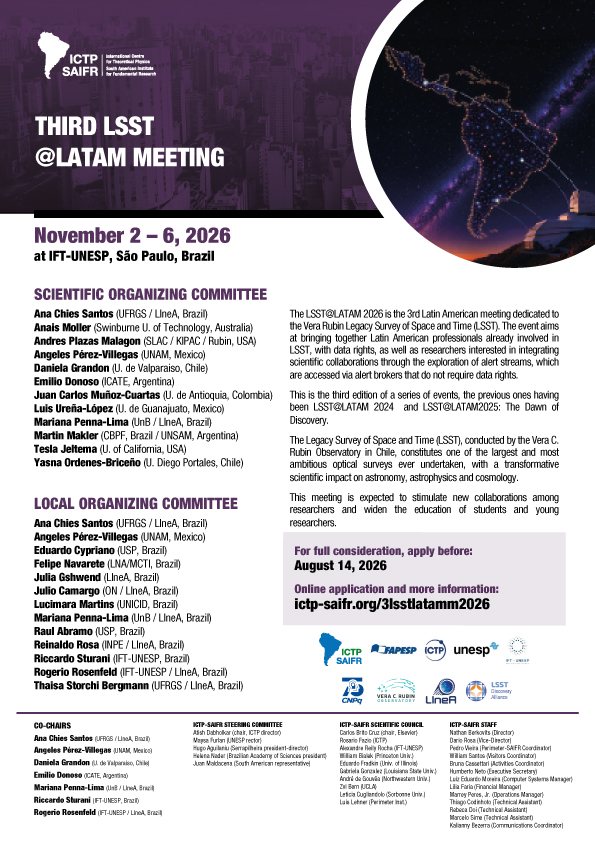
3rd LSST@LATAM Meeting


November 2 – 6, 2026
São Paulo, Brazil
ICTP-SAIFR/IFT-UNESP
Home
The LSST@LATAM 2026 is the 3rd Latin American meeting dedicated to the Vera Rubin Legacy Survey of Space and Time (LSST). The event aims at bringing together Latin American professionals already involved in LSST, with data rights, as well as researchers interested in integrating scientific collaborations through the exploration of alert streams, which are accessed via alert brokers that do not require data rights.
This is the third edition of a series of events, the previous ones having been LSST@LATAM 2024 and LSST@LATAM2025: The Dawn of Discovery.
The Legacy Survey of Space and Time (LSST), conducted by the Vera C. Rubin Observatory in Chile, constitutes one of the largest and most ambitious optical surveys ever undertaken, with a transformative scientific impact on astronomy, astrophysics and cosmology.
This meeting is expected to stimulate new collaborations among researchers and widen the education of students and young researchers.
Code of conduct
Guidelines for chairs
Scientific Organizing Committee:
- Ana Chies Santos (UFRGS / LIneA, Brazil) – co-chair
- Emilio Donoso (ICATE, Argentina) – co-chair
- Daniela Grandon (U. de Valparaiso, Chile) – co-chair
- Tesla Jeltema (U. of California, Santa Cruz, USA)
- Martin Makler (CBPF, Brazil / UNSAM, Argentina)
- Anais Moller (Swinburne University of Technology, Australia)
- Juan Carlos Muñoz-Cuartas (U. de Antioquia, Colombia)
- Yasna Ordenes-Briceño (U. Diego Portales, Chile)
- Mariana Penna-Lima (UnB / LIneA, Brazil) – co-chair
- Angeles Pérez-Villegas (UNAM, Mexico) – co-chair
- Andres Plazas Malagon (SLAC / KIPAC / Rubin, USA)
- Luis Ureña-López (U. de Guanajuato, Mexico)
Local Organizing Committee:
- Raul Abramo (USP, Brazil)
- Julio Camargo (ON / LIneA, Brazil)
- Ana Chies Santos (UFRGS / LIneA, Brazil)
- Eduardo Cypriano (USP, Brazil)
- Julia Gshwend (LIneA, Brazil)
- Lucimara Martins (UNICID, Brazil)
- Felipe Navarete (LNA/MCTI, Brazil)
- Mariana Penna-Lima (UnB / LIneA, Brazil)
- Angeles Pérez-Villegas (UNAM, Mexico)
- Reinaldo Rosa (INPE / LIneA, Brazil)
- Rogerio Rosenfeld (IFT-UNESP / LIneA, Brazil) – co-chair
- Thaisa Storchi Bergmann (UFRGS / LIneA, Brazil)
- Riccardo Sturani (IFT-UNESP, Brazil) – co-chair
Outreach:
Announcement:
Application is now closed
Speakers
- Alan Strauss (National Optical-Infrared Astronomy Research Laboratory, USA)
- Alejandra Muñoz Arancibia (ALeRCE/UdeC/CMM, Chile)
- Bernardo Fraga (Brazilian Center for Research in Physics, Brazil)
- Bob Blum (Rubin Observatory, Chile)
- Chris Hernandez (University of Pittsburgh, USA)
- Clécio de Bom (CBPF, Brazil)
- David San Martin (National Optical-Infrared Astronomy Research Laboratory, USA)
- Fernanda Urutia (National Optical-Infrared Astronomy Research Laboratory, USA)
- Jeno Sokoloski (Columbia University, USA)
- Kristen Dage (Curtin University, Australia)
- Melissa DeLucchi (Carnegie Mellon University, USA)
- Melissa Graham (Rubin Observatory / University of Washington, USA)
- Michel Aguena (OATs-INAF/LIneA, Italy/Brazil)
- Pedro Bernardinelli (USP, Brazil)
- Sugata Kaviraj (University of Hertfordshire, UK)
- Timo Anguita (Universidad Andres Bello, Chile)
- Yusra AlSayyad (Rubin Observatory / Princeton, Chile)
- W. Niel Brandt (Pennsylvania State University, USA)
Registration
Program
Participants
Participants
Remote participants
Posters
1st POSTER SESSION
(Monday – Wednesday)
Flash talks of this poster session will take place on Monday.
AGN
- 1. Da Costa, Gabriel Scheffel (Universidade Federal do Rio Grande do Sul, Brazil): Active Galactic Nuclei Variability in the Era of Large Surveys: From ZTF to LSST
Active Galactic Nuclei are extremely energetic and bright objects powered by the accretion of matter onto supermassive black holes. One of their most prominent features is variability, and studying this allows us to infer fundamental properties such as the size of the emitting regions. Our work aims to investigate how the physical properties of AGNs affect their observed variability. To achieve this, we use photometric data from the Zwicky Transient Facility (ZTF) applied to the BAT AGN Spectroscopic Survey (BASS) sample, a rich dataset containing fundamental properties of nearby AGNs. The methodology is based on constructing light curves and calculating variability using the F_var parameter, which quantifies the deviation of data points from a mean flux. We seek to establish correlations between the measured variability and the intrinsic properties of the BASS sample in order to reproduce and validate literature results. Ultimately, this study aims to consolidate a robust light curve analysis methodology that will serve as a foundation for future applications using data from the LSST.
- 2. De Castro Araujo, Bruna Lorrany (Instituto de Física, Universidade Federal do Rio Grande Sul – UFRGS, Brazil): PFS × LSST: Linking AGN Variability to Host-Galaxy Properties and Environment
Active galactic nuclei (AGNs) are thought to play an important role in galaxy evolution, but the interplay between AGN activity, host-galaxy properties, and the large-scale environment is not yet fully understood. We propose to explore this connection by combining spectroscopy from the Subaru Prime Focus Spectrograph (PFS) with imaging and time-domain data from the Vera C. Rubin Observatory Legacy Survey of Space and Time (LSST). We will identify AGNs among the low-redshift (z < 2) galaxy population observed with PFS and construct a statistically robust control sample of non-active galaxies matched in stellar mass and redshift. PFS spectroscopy will provide measurements of emission-line properties, gas excitation, metallicity, kinematics, star-formation rates, and stellar populations. These properties will be compared between AGN hosts and control galaxies and investigated in relation to their environments. A particularly promising synergy is provided by the COSMOS field, which is covered by both the PFS and LSST surveys. We will initially focus on this common field, where PFS spectroscopy can be combined with Rubin multi-band and multi-epoch observations. Rubin data will allow us to characterize the morphology and structural properties of the host galaxies and, importantly, to investigate optical variability as a complementary probe of AGN activity. We will explore whether AGN variability is related to spectroscopic properties such as emission-line excitation, star-formation activity, and gas kinematics, and whether these relations depend on the host-galaxy environment. Subaru Hyper Suprime-Cam (HSC) imaging will provide an additional complementary dataset for identifying merger signatures and characterizing the local and large-scale environments of the galaxies. Rubin’s early data, including the first data products from the survey, will therefore provide an important new dimension to the PFS analysis by adding multi-band and time-domain information to the spectroscopic characterization of AGN hosts. As the Rubin survey progresses and its temporal baseline increases, we expect the expanding light curves and improved variability characterization to enable increasingly detailed studies of the connection between AGN activity and galaxy evolution. This project will thus serve as a pilot study of the scientific potential of combining PFS spectroscopy with Rubin’s early and time-domain data, with the COSMOS field providing an initial testbed for this PFS–Rubin synergy.
- 3. Güez, Vítor (Universidade Federal do Rio Grande do Sul (UFRGS), Brazil): Power Spectra of 0.4 < z < 0.5 Quasars from ZTF light curves: relations with Black Hole Mass, Accretion Rate and Inclination.
We present an analysis of the Power Spectral Density (PSD) obtained from ZTF (Zwicky Tran-sient Facility) light curves of approximately ? quasars at redshifts 0.4
- 4. Ramos Vieira, Lucas (UFSM, Brazil): From MaNGA to Rubin: Broad-Line Variability in AGN for Rubin First Data
We present the selection and characterization of a sample of broad-line active galactic nuclei (AGN) from the MaNGA survey. We extracted integrated spectra from the central 3 arcsec of all 10,235 galaxy datacubes in the MaNGA survey. AGN candidates were identified using the BPT and WHAN diagnostic diagrams resulting in a sample of 258 objects. Type 1 AGNs displaying visually significant broad-line emission were selected from the whole MaNGA sample, resulting in a sample of 91 galaxies. By comparing the MaNGA integrated spectra with archival SDSS-III spectra of the same objects, we identified around 30 AGNs exhibiting noticeable broad-line region (BLR) variability, including eight Changing-Look AGN (CLAGN) candidates showing the appearance or disappearance of broad Balmer emission and transitions between Type 1 and Type 2-like spectral states. This spectroscopically selected sample provides an excellent opportunity to investigate how BLR variability and Changing-Look events manifest in the time-domain data that will become available with the Vera C. Rubin Observatory. As a next step, we will identify which objects are covered by Rubin early observations and explore their photometric variability through multi-band light curves, variability amplitudes, colors, and temporal behavior. These analyses will help assess the capability of Rubin First Data (DP2) to identify variable AGNs and Changing-Look candidates from photometric observations, providing a valuable bridge between spectroscopic discoveries and large-scale time-domain surveys.
- 5. Sheeba, Sarath Satheesh (Universidad Andres Bello/ Universidad Diego Portales, Chile): LSST AGN Science Collaboration Watchlist Task Force
The Vera C. Rubin Observatory/LSST will issue on the order of ten million alerts per night, a data rate no team can inspect by hand. Buried in that stream is the activity of millions of known active galactic nuclei (AGN) — changing-look transitions, blazar outbursts, tidal disruption events, and extreme variability — science-critical signals easily lost among unrelated alerts. Watchlists address this: curated catalogs of known sources that community alert brokers cross-match against the incoming stream, flagging in real time when a listed object becomes active. The LSST Alerts Watchlist Task Force of the AGN Science Collaboration coordinates this capability for the AGN community. Its aims are to curate authoritative watchlists of known and candidate AGN, define scientifically motivated selection and alerting criteria, and establish the interfaces linking these lists to Rubin alert brokers, so that AGN activity can be identified and followed up promptly from the earliest phase of the survey. This poster outlines the Task Force’s motivation, scope, and roadmap: the watchlists being assembled, the broker and infrastructure connections under development, and the science cases — from changing-look AGN to real-time accretion studies — that watchlist monitoring will enable. We invite Science Collaboration members to contribute target lists and science use cases.
Galaxies
- 6. Schweder Souza, Nicholas (Universidade Tecnológica Federal do Paraná (UTFPR), Brazil): Simulations of galaxies undergoing ram-pressure stripping to characterize their low-surface-brightness stellar tails and constrain detectability by Rubin/LSST
When galaxies travel through an intra-cluster medium (ICM) they experience ram-pressure stripping (RPS), eventually leading to quenching. Nevertheless if the right conditions are met, stars can still form throughout the gaseous tails of these so-called jellyfish galaxies, creating low-surface-brightness (LSB) structures which contribute to the intra-cluster light (ICL). The advent of the Rubin/LSST holds high expectations particularly towards LSB science due to its unprecedented optical photometric depths across a vast footprint. Upcoming Rubin DP2 data will allow us to start tackling questions such as: How are the properties of the LSB stellar tails connected to those of their progenitors and environments? How much does RPS contribute to the ICL build-up across different galaxy clusters? How to discern between LSB features formed due to RPS and due to tidal stripping? To help answer these questions, we simulate disc galaxies undergoing RPS in a wind tunnel setup with AREPO, taking into account subgrid models for gas cooling and star formation. We vary the structural parameters of the galaxy and the ICM density to study how each of these relate to the global properties of the resulting stellar tail. We will also use SKIRT to create and analyze Rubin mock images of the simulated jellyfish galaxies at various photometric depths as a way to provide reliable detectability predictions. So far, with a mass resolution of 5 x 10⁴ solar masses, we report both diffuse and clumpy star formation within the gaseous tails of galaxies with initial f_gas ~ 15%, traveling at 1000 km/s, through gas boxes with ρ ≥ 5 x 10⁻²⁸ g cm⁻³. We will extend our analysis to fully characterize the gas-rich regime, as well as to further investigate the hypothesis that some of the star forming clumps might give rise to globular clusters.
Solar System
- 7. Perroni, Bruno Miguel (Instituto de Astronomia, Geofísica e Ciências Atmosféricas – Universidade de São Paulo, Brazil): How fast do space rocks spin? (Minor Body Parameterization using LSST First Look Data)
Understanding small bodies in our Solar System is crucial to our knowledge of planetary formation, as the properties we observe today are a combination of large-scale events in the history of our Solar System and the evolution of each object over the 4.5 billion years since the Solar System’s formation. Of particular importance are photometric studies, as they provide crucial information for understanding the sizes, surface compositions, and shapes of these minor planets. This year, the Vera C. Rubin Observatory initiated the Legacy Survey of Space and Time (LSST), a revolutionary survey that brings a massive increase in the number of objects, along with significantly more data available per object. This project relies on a combination of already public First Look commissioning data from the LSST and future survey data to extract detailed physical characterizations from the photometric time series of each object, enabling new discoveries such as new super-fast rotator asteroids in our Solar System.
SMWLV
- 8. Dos Santos Lima, Laisi Vitória (Universidade Federal de Lavras, Brazil): Galactic Rotation Curves and Dark Matter: Prospects for Data Analysis in Large Astronomical Surveys
Dark matter is one of the major open problems in contemporary astrophysics, with galaxy rotation curves providing an important observational signature of its presence. This work proposes the development of a computational methodology to investigate the relationship between observed rotational velocities and the contributions of baryonic matter, initially using publicly available data from the SPARC (Spitzer Photometry and Accurate Rotation Curves) catalog. The analysis aims to quantify the discrepancy between observed galactic dynamics and those expected from visible matter, and to investigate how this behavior varies across different galactic systems. As an initial step, data from different SPARC galaxies were inspected to identify the variables, units, and data structures required for the implementation of the computational analysis. In this context, SPARC provides a controlled dataset for the development and validation of a methodology that may subsequently be adapted to the analysis of much larger observational samples. This perspective establishes a connection with the Vera C. Rubin Observatory and the Legacy Survey of Space and Time (LSST), which will produce large volumes of galaxy images and catalogs relevant to studies of the distribution of matter in the Universe. Although LSST will not directly provide spectroscopic rotation curves, its data will enable the characterization of photometric and structural properties across large galaxy populations and may, in the future, be combined with kinematic information from complementary surveys. The expected outcome is the establishment of a reproducible methodology for quantitatively characterizing the relationship between galactic dynamics and the distribution of baryonic matter, while identifying patterns across different types of galaxies. The experience gained through the analysis of SPARC data may thus provide a foundation for the future integration of Rubin/LSST photometric data with complementary kinematic observations, expanding the investigation of dark matter in the era of large astronomical surveys.
- 9. Margheim, Steven (NSF-DOE Vera C Rubin Observatory/NSF NOIRLab, Chile): Finding Final-Flash Stars with Rubin/LSST (poster)
Born-again (final-flash) stars—post-Asymptotic Giant Branch objects undergoing a Very Late Thermal Pulse (VLTP)—are among the fastest-evolving stars known. However, only three convincing Galactic examples have been observed in real time (FG Sge, V605 Aql, V4334 Sgr). Here, we present a literature-calibrated feasibility study predicting the high-purity yield of born-again stars expected from the 10-year Vera C. Rubin Observatory Legacy Survey of Space and Time (LSST) Wide-Fast-Deep campaign. Using a 3D spatially resolved Galactic disk model convolved with realistic LSST ugrizy cadences, depth, saturation constraints (r ~ 16), and empirical light-curve templates anchored on FG Sge and V4334 Sgr, we find a classifiable yield of ~10 born-again stars, roughly tripling the known population. Crucially, we demonstrate that photometric classification alone suffers from severe contamination by R Coronae Borealis (RCB) stars. We show that cross-matching candidates against planetary nebula (PN) catalogs within a 2″-5″ gate serves as an empirically verified discriminant, yielding zero false positives among 177 confirmed Galactic RCB stars while retaining high purity for born-again targets. We also present ongoing efforts to construct a dedicated real-time filter for LSST alert brokers, targeting color evolution ((g-i) rates), deep irregular R CrB-like dust declines, and spatial coincidence with cataloged PNe.
- 10. Montaguth, Gissel (USP, Brazil): Structural transformation of galaxies in dense environments: From S-PLUS to Rubin LSST
A key open question in environmental galaxy evolution is which structural component carries the imprint of transformation. Transition galaxies (TGs)—red systems with low Sérsic indices—are particularly informative because they lie at the interface between star-forming discs and quiescent spheroids, making them sensitive tracers of environment-driven change. Using S-PLUS imaging, we identified TGs as the only morphological class showing strong environmental dependence in the stellar mass–size relation: TGs in progressively denser environments follow steeper mass–size relations compared to the field, and are significantly more compact at fixed mass below log(M⋆/M⊙) ~10.5, with higher incidence of morphologically perturbed discs. These results provide compelling evidence for accelerated structural transformation in dense environments. To extract the physical mechanisms driving this transformation, we adapted the MorphoPLUS multi-band structural fitting pipeline to Rubin Observatory LSST. Using DP1, we validated the pipeline on LSST data; with DP2, we will analyze the stellar mass-size relation of TGs as a function of local density, extracting robust bulge–to–total ratios, disc scale-lengths, and low-surface-brightness residuals across the full environmental spectrum. This will test whether observed density-dependent compaction arises from bulge growth, disc stripping, or morphological perturbation.
SMWLV/Galaxies
- 11. Floriano, Pedro Ribeiro (UFRGS, Brazil): Bridging the Spectrum: Stress-Testing Stellar Population Models with Optical–NIR Spectroscopy of M31 Globular Clusters
Globular clusters (GCs) are among the most powerful tracers of galaxy assembly, encoding the imprints of early star formation and chemical enrichment. The LIBERTY project has recently shown the power of near-infrared (NIR) spectroscopy to detect GC systems in galaxies such as Centaurus A. Here, we extend this framework to the GC system of the Andromeda Galaxy, combining optical and NIR spectroscopy for the same clusters. We analyze 317 M31 GCs with optical spectra, complemented by a pilot NIR sample of 19 GCs observed with GNIRS on Gemini Observatory. Using full spectral fitting with the STARLIGHT code, we derive ages and metallicities and directly assess the consistency of stellar population models across wavelength regimes. Our optical results show good agreement with the literature (∼77% in age and ∼80% in metallicity), establishing a robust baseline for extending the comparison into the NIR. This pilot study paves the way for a statistically significant optical–NIR dataset for M31 GCs. By bridging these spectral windows, we aim to constrain the role of evolved stellar phases and improve stellar population synthesis models for unresolved systems. These results are particularly relevant in the era of the Vera C. Rubin Observatory’s LSST, whose optical photometry, combined with the NIR coverage of Euclid and the Roman Space Telescope, will enable the characterization of stellar populations across a broad wavelength range. Our optical–NIR spectroscopic benchmark provides an empirical test of SSP models that will underpin the interpretation of these forthcoming multi-wavelength datasets. In this context, M31 provides a crucial benchmark, linking the NIR advances from LIBERTY with the rich legacy of optical studies and preparing the ground for stellar population studies with LSST DP2, Euclid, and Roman.
- 12. López Santamaría, Miguel Angel (Instituto Nacional de Astrofísica, Óptica y Electrónica, Mexico): The infalling to Virgo W-group: resolved stellar populations and globular clusters with Rubin
Groups falling into clusters are where many galaxies begin to be transformed, yet their assembly histories are rarely studied as a whole. The W group, dominated by the giant elliptical galaxy NGC 4261, is a background group roughly twice as distant as the Virgo core and falling into the cluster. Its history is written in two complementary records: the diffuse light of its members, including tidal streams and intragroup light, and their globular cluster (GC) systems. Using imaging from Rubin Data Preview 2, we have built deep, PSF-matched u, g, r and i mosaics covering the full ≈ 75′ field of the group at a common resolution of 1.34”. These mosaics already reveal shells, tidal debris and diffuse light around several members. As a next step, we will apply SAGUI, an SED-based segmentation method, to partition every galaxy and the light between them into spectrally homogeneous regions, whose fits will map ages, metallicities and dust across the group. In parallel, we will build a homogeneous catalog of GC candidates selected by color, magnitude and compactness, to be confirmed with spectroscopic follow-up. Together, these studies will reveal hints on how this infalling group was assembled.
- 13. Pacheco, Thayse (Universidade Federal do Rio Grande do Sul, Brazil): Multi-survey photometric systems for extragalactic globular cluster identification in Rubin-era
Identifying globular clusters (GCs) in nearby galaxies from broad-band photometry is limited by the strong similarity between the integrated spectral energy distributions (SEDs) of old stellar populations and those of foreground late-type stars. We investigate how complementary photometric surveys can be combined to improve this separation, using NGC 2403 as a benchmark system with J-PLUS, CFHT, Pan-STARRS, and Euclid coverage. We construct homogeneous multi-survey SEDs and compare observed sources with synthetic SEDs from stellar population and stellar atmosphere models. The results show that dense optical sampling provides substantial discriminatory power, while near-infrared photometry provides complementary constraints. As a concrete pre-Rubin benchmark, we combine CFHT u and g bands with Pan-STARRS r, i, z, and y bands into a homogeneous six-band optical system, demonstrating how archival data can be assembled into a Rubin-like photometric baseline. The full multidimensional color space is further explored using nonlinear dimensionality reduction to identify candidates with photometric properties similar to confirmed GCs. Although NGC 2403 is outside the Rubin DP2 footprint, the methodology is directly applicable to Rubin-covered galaxies. More generally, the construction of homogeneous multi-survey SEDs provides a physically consistent framework for combining complementary photometric datasets with stellar and SSP models, offering a practical strategy for GC candidate prioritization in the J-PAS, Rubin, Euclid, and Roman era.
- 14. Sánchez García, Osbaldo (Universidade de São Paulo, Brazil): Mapping the Internal Structure of Nearby Galaxies with S-PLUS: Unveiling the Impact of Galactic Bars
Galactic bars can play an important role in the secular evolution of galaxies by redistributing stars and gas and affecting star formation in galactic disks. We present an ongoing study of nearby galaxies using the 12-band photometry from S-PLUS. We use spectral energy distribution (SED) fitting and spatially resolved analysis to study the impact of bars on the physical properties of different galactic components. We analyze the galaxies at two different spatial scales. At the regional scale, we integrate the flux from individual structural components, such as the complete bar, and use SED fitting to obtain their properties. At sub-kiloparsec scales, we perform SED fitting pixel by pixel. This allows us to study how the properties change across the bulge, bar, disk, and spiral arms. We compare properties such as stellar ages, specific star formation rates, and other stellar population properties between the different regions. The depth, spatial resolution, and large sky coverage of the Rubin Legacy Survey of Space and Time (LSST) will make it possible to extend this type of analysis to much larger samples of nearby galaxies. Based on our experience with S-PLUS, we want to explore how similar approaches can be used with LSST data to study the impact of galactic bars and other structures on stellar populations and star formation. This work can provide a way to contribute to the scientific use of the early Rubin data and to develop new collaborations within the LSST community.
EPO
- 15. Burgoa Rosso, Karen Luz (Universidade Federal de Lavras UFLA, Brazil): Preparing the Next Generation for the Rubin Era: A Longitudinal Astronomy Education Pathway Supported by Artificial Intelligence
The Vera C. Rubin Observatory is transforming astronomy into a data-intensive science, requiring a new generation of researchers capable of combining astronomical knowledge, computational thinking, and artificial intelligence. While the Rubin Legacy Survey of Space and Time (LSST) will provide unprecedented opportunities for discovery, its scientific impact will also depend on preparing students and educators to effectively engage with these massive datasets. We are developing an educational research framework that investigates how artificial intelligence can function as a scientific partner during the early stages of undergraduate research. Rather than focusing on AI as a tool for automating data analysis, our approach explores how generative AI can support students in learning Python, understanding astronomical datasets, formulating scientific questions, designing reproducible computational workflows, and interpreting results while preserving critical scientific reasoning. Our first case studies are based on publicly available precursor datasets and computational workflows designed to prepare students for Rubin Observatory data, with an initial focus on galaxy dynamics and dark matter. By integrating authentic astronomical datasets with AI-assisted programming and scientific inquiry, we seek to reduce technical barriers that often prevent undergraduate students from engaging with frontier astronomical research. Rubin First Data (DP2) will provide an ideal opportunity to validate and expand this educational framework using real survey observations. Beyond undergraduate research, this initiative is part of a broader longitudinal educational pathway that begins with inquiry-based astronomy experiences for children, continues through professional development for K–12 teachers, and culminates in undergraduate scientific research. Within this perspective, Rubin Observatory data are viewed not only as a research resource but also as a catalyst for scientific literacy, computational thinking, and data-driven inquiry across different educational stages. We expect this work to contribute to astronomy education, undergraduate research training, and the development of educational strategies that prepare future scientists for the era of data-intensive astronomy while strengthening the connection between cutting-edge astronomical research and science education.
Informatics and Statistics
- 16. Rosa, Reinaldo Roberto (INPE, Brazil): Beyond Amplitude Fluctuations: Gradient-Domain Analysis for Galaxy Morphology and Transient Classification in the Rubin LSST Era
The unprecedented volume, complexity, and temporal diversity of data from the Vera C. Rubin Observatory Legacy Survey of Space and Time (LSST) require scalable methods capable of extracting astrophysical information while providing interpretable representations of complex structures and variability. Within the Brazilian Participation Group (BPG-LSST), and in connection with activities in the LSST Galaxies Science Collaboration (GSC) and Informatics and Statistics Science Collaboration (ISSC), our group has been developing computational approaches for galaxy morphology and transient classification based on Gradient Pattern Analysis (GPA). Rather than relying exclusively on statistical descriptions of amplitude fluctuations, GPA explores information encoded in the gradient domain, characterizing spatial and temporal patterns through local variations in magnitude and direction. This provides a complementary representation for astronomical images and time series and a framework for combining gradient-based descriptors with modern machine-learning methods. In this contribution, we present recent advances in the application of GPA to galaxy morphology and transient classification, including its integration with Deep Learning architectures and the assessment of classification performance. We further explore Explainable Artificial Intelligence (XAI) techniques, particularly SHAP and LIME, to investigate how gradient-domain information contributes to classification decisions and to identify the strengths, biases, and limitations of the resulting models. Beyond the methodological developments, we discuss computational tools and pipelines designed to make these approaches applicable to Rubin-scale datasets, including their integration into an application pipeline being prepared for deployment on the LINeA Science Platform. We highlight current scientific and computational challenges, as well as opportunities for connecting these developments to the broader LSST science ecosystem. Our results demonstrate the potential of combining gradient-domain analysis, Deep Learning, and explainability as a complementary framework for scalable and interpretable characterization of galaxy structure and time-domain phenomena in the LSST era.
- 17. Schiavolim, Vittória Leme (USP – Universidade de São Paulo, Brazil): Bridging Spectroscopy and Imaging: N(z) Recovery from DESI x Rubin data with Neural Networks
We are developing a machine-learning pipeline to estimate photometric redshifts (photo-z) from Rubin imaging, producing full redshift probability distributions P(z) with a 60-bin neural-network classifier and recovering the ensemble redshift distribution N(z) by stacking. Using DESI spectroscopy as ground truth, we benchmark against established estimators and, crucially, correct the non-representativeness of spectroscopic training samples via density-ratio reweighting in color-magnitude space. As a proof of concept on Rubin DP1, we built a matched DESI x DP1 sample and quantified the spectroscopic selection bias, since performance degrades markedly from the bright spectroscopic set (sigmaNMAD ~ 0.07) to the photometric population (sigmaNMAD ~ 0.13), which the reweighting mitigates. We can now apply this pipeline directly to DP2. DP1 was limited to ~15 deg² with incomplete filter coverage and negligible DESI overlap. DP2’s ~3000 deg² of full-camera ugrizy imaging, with substantial DESI overlap, removes both limitations: it enables genuine six-band P(z) estimation and, for the first time on Rubin data, a representative, reweighting-calibrated recovery of N(z) for a realistic LSST photometric sample. This establishes an early, testable framework for the redshift-distribution calibration that will underpin LSST cosmology!
2nd POSTER SESSION
(Wednesday – Friday)
Flash talks of this poster session will take place on Wednesday.
DESC
- 1. Brando De Oliveira, Guilherme (CBPF – Brazilian Center for Research in Physics, Brazil): Modelling the matter and galaxy power spectrum in small scales for beyond-LCDM theories
Upcoming Stage-IV cosmological surveys will probe the large-scale structure of the Universe with unprecedented precision, pushing much of the cosmological information into the non-linear regime where accurate theoretical modelling becomes challenging, particularly in beyond-ΛCDM scenarios. In this talk, I will review recent progress in modelling the matter and galaxy power spectra beyond the standard cosmological model. I will discuss how approximate \textit{N}-body simulations can efficiently provide accurate predictions for the matter power spectrum, and how these can be combined with perturbative approaches through the Hybrid Effective Field Theory (HEFT) framework, which merges Lagrangian perturbation theory with simulation-based information. I will also present recent applications of this approach to modified gravity theories and its relevance for upcoming weak lensing and galaxy clustering surveys
- 2. Carlos Ribeiro, Sanderson (Universidade Estadual de Londrina (UEL), Brazil): Model-Independent Reconstruction of the Deceleration Function and the Dark Energy Equation of State in the LSST Era
The nature of dark energy remains a central puzzle in modern cosmology. It is traditionally investigated using parametric models, which may restrict the range of possible dynamical behaviors. To address this limitation, we implement a model-independent reconstruction framework in this work to constrain the deceleration function q(z) and the dark energy equation-of-state parameter w(z) using complementary observational datasets, including Type Ia supernovae, Baryon Acoustic Oscillations, and Cosmic Chronometers. The reconstruction of q(z) provides a kinematic description of the cosmic expansion, requiring only assumptions about the spacetime metric and allowing us, for example, to identify the transition from decelerated to accelerated expansion. For the reconstruction of w(z), we assume General Relativity and the presence of a dark energy component, but do not impose any a priori functional form for its redshift dependence. In the LSST era, the increasing volume and precision of cosmological data will provide an opportunity to test further the expansion history and the nature of dark energy. In this work, we present results obtained from current Type Ia supernovae, Baryon Acoustic Oscillations, and Cosmic Chronometers datasets, together with forecasts for the LSST era, allowing us to compare the current and expected future constraints on the cosmic expansion history and the nature of dark energy.
- 3. Da Cunha, Disrael Camargo Neves (Instituto de Fisica, Brazil): CCL and NumCosmo cross-check
The project aims to cross-check the Core Cosmology Library (CCL) and the Numerical Cosmology Library (NumCosmo). It will produce a set of jupyter notebooks to test, validate, benchmark and improve CCL functionalities.
- 4. Demétrio, Luiz Felipe (Universidade Estadual de Londrina, Brazil): Statistical Properties of Standard Deviations of Galaxy Cluster Richness
Poster Abstract, results associated to DESC Project 418: Galaxy clusters provide important constraints on Cosmology through their abundance as a function of mass and redshift. Since the cluster mass is not a direct observable quantity, one must use proxy quantities to infer the mass, such as richness. Therefore, we study the statistical properties of the standard deviation of cluster richness when binned in intervals of mass and redshift. More specifically, we fix the functional form of the probability distributions as a function of the number of clusters per bin by applying hypotheses testing to the CosmoDC2 simulation data. Therefore, this works paves the way to to a more precise understanding of cluster richness in Rubin data by implementing and callibrating statistical and computational tools on simulations.
- 5. Demétrio, Luiz Felipe (Universidade Estadual de Londrina, Brazil): Richness-Mass Distribution in DC2 Catalog: Beyond Simple Log-Normal Modeling
Talk Abstract, based in DESC Project 418: In this work we examine the functional form of the richness-mass scaling relation, focusing on mass and redshift dependencies through linear and quadratic models. A key issue in the literature is the improper handling of selection cuts on richness, where additional, unmodeled cuts (e.g., on mass or redshift) are imposed to compensate for truncated data, leading to unnecessary sample reduction. We address this by integrating selection cuts directly into the likelihood framework, preserving the full constraining power of the data. Our goal is to demonstrate that correctly modeling these cuts can significantly reduce the required model complexity, allowing a linear relation in mass and redshift in most cases. This improvement leads to an enhance statistical power, refines mass estimation, and clarifies the role of selection biases in richness-threshold samples. We apply the approach to the DC2 Catalog and study the impact of said selection cuts on cluster cosmology.
- 6. Dias-Santos, Lucca Lopes (Instituto de Física da UnB, Brazil): Observational Confrontation of Energy Condition Bounds in f(R) Theories: an Application to the Hu-Sawicki Model
The dark energy component in the Standard Model of Cosmology accounts for the recent accelerated expansion of the universe. An alternative approach involves geometric modifications to general relativity, leading to modified theories of gravity. When applied to a gravity theory, energy conditions impose constraints on the Ricci and energy-momentum tensors, which translate into inequalities. These constraints can be expressed in terms of cosmographic functions, such as the Hubble, deceleration, jerk, and snap functions. In this work, we derive the equations of motion for a general f(R) gravity model and evaluate the energy conditions within the Hu-Sawicki f(R) theory, obtaining bounds on its parameters in terms of these cosmographic functions. We then use Type Ia supernovae, cosmic chronometers, and baryon acoustic oscillations data to reconstruct these functions using cubic splines, thereby constraining the theory’s parameters by confronting the bounds with observational data. At present, the Rubin First Data (DP2) are not directly applicable to this work, since, at the current stage of our research, we require larger Type Ia supernova catalogs. Nevertheless, in later stages of the project, we intend to use the Vera Rubin Year 1 data, applying the cubic spline reconstruction method to them. In this context, we expect that subsequent Vera Rubin data releases will significantly push the development of our research by providing a broader observational basis for the analysis and reconstruction of cosmographic functions and, in later stages, for the multi-probe reconstruction of galaxy cluster density profiles.
- 7. Fernandes, Guilherme De Souza (IFT-Unesp, Brazil): Dark Energy Survey Y6 Results: 3x2pt Analysis in Harmonic Space
We present cosmological constraints from the joint analysis of galaxy clustering and weak gravitational lensing ($3 \times 2$ pt) using the Dark Energy Survey Year 6 (DES Y6) data in harmonic space. In a nutshell, cosmological $3 \times 2$ point analysis is the joint analysis of $3$ 2-point correlation functions, galaxy clustering, galaxy-galaxy lensing and cosmic shear. This analysis utilizes over 140 million source galaxies and 9 million lens galaxies, covering approximately 5000 deg$^2$. As the LSST will have much wider sky coverage and a more powerful camera, it is the perfect survey to continue the efforts of the DES.
- 8. Lemes Silva, Ranier Menote (UNESP, Brazil): Connecting gravitational waves and galaxies for cosmology
Gravitational-wave observations combined with galaxy surveys offer complementary routes to probing cosmic expansion. We present CosmoDC2_BCO, a synthetic catalogue of compact binary mergers associated with galaxies in the CosmoDC2 LSST catalogue, incorporating gravitational-wave detectability, parameter uncertainties, and electromagnetic counterparts. Using this framework, we forecast cosmological constraints from bright sirens for current and next-generation detector networks. Under the adopted population and observational assumptions, third-generation networks can achieve sub-percent precision on the Hubble constant within a few years, while their combination with Type Ia supernovae improves constraints on dynamical dark energy. We also outline ongoing work investigating how the BBH mass distribution affects observed gravitational-wave–galaxy correlations, including through mass-dependent detection selection. This investigation explores the role of population modelling in cosmological analyses based on the statistical association between gravitational-wave sources and galaxies.
- 9. Lettieri, Henrique (universidade estadual de londrina, Brazil): Richness-Mass Distribution in DC2 Catalog: Beyond Simple Log-Normal Modeling
This DESC project investigates the functional form of the richness-mass scaling relation, probing its mass and redshift dependencies through linear and quadratic models. A key limitation in the existing literature is the mishandling of selection cuts on richness: standard analyses impose additional, unmodeled cuts on other quantities (e.g., mass or redshift) to compensate for improperly truncated data, discarding significant portions of the sample in the process. In contrast, we incorporate the selection cuts directly into the likelihood framework, avoiding ad hoc data removal and preserving the full constraining power of the observations. This project is motivated by the RedMaPPer cluster finder run on the CosmoDC2 dark matter catalog, which mimics Rubin Observatory data. To compare the resulting catalogs, we developed a software pipeline that matches objects between them, enabling a systematic study of the cluster finder’s completeness and purity. Together, these modeling efforts are crucial for deriving cosmological constraints from cluster number counts and cluster clustering with Rubin data in the precision cosmology era.
- 10. Lima De Oliveira, Caio (Departamento de Física da Universidade Estadual de Londrina, Brazil): Desheared Weak Lensing: Cluster Masses from Unlensed Galaxy Statistics
Galaxy cluster masses are among the largest systematic uncertainties in cluster cosmology, and weak gravitational lensing provides the most direct way to calibrate them. The standard approach averages the measured shapes of background galaxies in concentric radial bins around the cluster. This raises the signal-to-noise ratio, but discards information about the shape distribution of the individual galaxies. Unbinned methods recover part of that information by building a likelihood for each galaxy, but they rely on a linearised relation between the intrinsic and the observed shape of a source. We present a cluster mass inference method built instead on the exact nonlinear transformation between intrinsic and observed ellipticities. Inverting this transformation deshears each background galaxy, so that the likelihood can be written directly in terms of unlensed per-galaxy quantities, while marginalising over the photometric redshift distribution of every source. We describe the method, its validation on mock catalogues built by resampling real Subaru Hyper Suprime-Cam observations across a wide range of cluster masses and source counts, and its application to a sample of 61 confirmed clusters, comparing it throughout with the standard binned estimator and with the linearised unbinned approach. We close with the extensions that deshearing makes possible: measuring the intrinsic shape distribution of background galaxies, and jointly inferring the cluster centre together with its mass.
- 11. Machado, Paula Andréia Da Silva (UNESP, Brazil): Fisher Matrix Forecasts for LSST 3x2pt Analyses: Validation against MCMC and Projections from Y1 to Y10
The Vera C. Rubin Observatory’s Legacy Survey of Space and Time (LSST) will soon deliver its first official data release, offering an unprecedented opportunity to constrain cosmological parameters via large-scale structure probes. In this work, we present forecast analyses for LSST early data (Year 1) using the 3x2pt correlation function — which combines galaxy clustering, galaxy–galaxy lensing, and cosmic shear — to extract maximal cosmological information. We employ two complementary statistical approaches: the Fisher information matrix and Markov Chain Monte Carlo (MCMC) methods. The early data will allow us to calibrate our analysis choices, identify which statistical approach (Fisher vs. MCMC) is most resilient in the face of real data, and establish best-practice protocols that will maximize the scientific return of subsequent data releases.
- 12. Nogales Vera, Jose Alberto Casto (UFLA, Brazil): From Geometric Nonconservation to Observable Dark-Sector Cosmology
We investigate a Ricci–trace deformation of Einstein gravity in which energy–momentum nonconservation is interpreted as particle production in the dark sector. The theory predicts a modified cosmological dilution law and a particle-production branch for negative values of the deformation parameter. For cold dark matter, we show that the simplest adiabatic effective-fluid closure is not perturbatively viable on this branch, as it leads to a negative effective sound speed squared and subhorizon gradient instabilities. This result motivates a nonadiabatic open-system thermodynamic closure in which the creation pressure modifies the cosmological background while the created dark matter remains pressureless in its rest frame. The resulting prescription preserves the modified background evolution and provides a perturbatively viable framework for structure formation. The next stage of this work will constrain the model’s cosmological parameters and investigate its implications for both dark matter and dark energy. Future measurements of cosmic expansion, matter clustering, and gravitational lensing from the Vera C. Rubin Observatory may provide particularly important tests of this scenario. These results establish Ricci–trace nonconservation as a testable connection between gravitational dynamics, particle production, and dark-sector cosmology.
- 13. Opazo Pino, Matías Fernando (Universidad de Chile, Chile): Neural Networks for fast Cosmological Matter Power Spectrum Prediction
Accurate predictions of the cosmological matter power spectrum are essential for testing cosmological models and interpreting observations of the large-scale structure of the Universe. However, evaluating the matter power spectrum over large cosmological parameter spaces remains computationally expensive, motivating the development of fast and accurate emulators. My current research focuses on using deep neural networks to predict the matter power spectrum, P(k,z) directly from cosmological parameters. A dataset of 12,000 cosmologies generated with CAMB was used to train and compare three architectures: a multilayer perceptron (MLP), a CNN-based decoder, and a physically motivated bidirectional LSTM (Bi-LSTM). Among these, the Bi-LSTM achieved the highest predictive accuracy while reducing inference times by more than two orders of magnitude compared to traditional numerical calculations. This work is directly relevant to Rubin’s First Data Preview (DP2): weak lensing and large-scale structure measurements from Rubin will require fast, accurate theoretical predictions of P(k,z) for cosmological parameter inference, which is precisely the bottleneck our emulator addresses. While our current model is trained on CAMB simulations, DP2’s early data will let us test whether the emulator generalizes to real observational constraints and identify where retraining or architecture changes are needed. More broadly, as Rubin’s data volume grows toward full LSST depth, the demand for emulators fast enough to run within high-dimensional MCMC or simulation-based inference pipelines will only increase — pushing development toward more efficient and physically robust architectures like the Bi-LSTM presented here.
- 14. Ruiz Montoya, Juliana (Universidad de Antioquia, Colombia): The host galaxies of FRBs in Rubin’s DP2
Fast Radio Bursts (FRBs) are millisecond-duration radio transients that serve as unique cosmological probes. However, their physical nature and utility in mapping baryonic matter depend on the precise identification of their host galaxies. This project presents the development of an automated Python-based pipeline designed to crossmatch and associate host galaxies to FRBs early data products from the Vera C. Rubin Observatory. The work directly uses early Rubin DP2 data to perform spatial crossmatching in the Southern Hemisphere. Our methodology involves a comparative analysis of Rubin’s photometric models to establish robust host characterization and handle missing flux data. To address radio localization uncertainties, we are implementing the Probabilistic Association of Transients to their Hosts (PATH) algorithm, leveraging Rubin’s sub-arcsecond resolution (~0.7″) to assign Bayesian probabilities to potential host candidates. We predict that Rubin will be extremely helpful for FRB host associations, as its unprecedented depth (mag ~27) provides the ability to identify faint host populations previously “invisible” to shallower optical surveys. Ultimately, this pipeline establishes the groundwork for automated, large-scale host association during LSST’s full data releases and pushes the development of FRB-based cosmology.
- 15. Sousa Nogueira, Bruno Henrique (Instituto de Física da Universidade de Brasília, Brazil): Mapping the Directional Expansion History of the Universe in Bianchi I Cosmology with Type Ia Supernovae
The standard cosmological model is based on the assumption of large-scale spatial homogeneity and isotropy, an approximation strongly supported by observations of the cosmic microwave background. Nevertheless, it remains important to investigate the limits of this approximation and to explore cosmological models that allow departures from isotropy. Current observational tensions, such as the discrepancy between early- and late-Universe determinations of the Hubble constant, motivate studies of extensions to the standard cosmological framework. In this work, we investigate the dynamics of the anisotropic Bianchi I spacetime by deriving and solving Einstein’s equations for different cosmological fluids. Using a formulation based on directional Hubble parameters, we obtain analytical solutions for universes dominated by matter, a cosmological constant, and by both components. The resulting directional scale factors naturally separate into isotropic and anisotropic contributions, allowing a direct characterization of the expansion dynamics. We further derive expressions for the redshift and luminosity distance in Bianchi I cosmology, providing a connection between the exact solutions and observable quantities. In all cases considered, the anisotropic contribution decays with cosmic expansion, leading to an asymptotic approach to the standard Friedmann–Lemaître–Robertson–Walker behavior.
- 16. Cypriano, Eduardo (USP): Galaxy Cluster Science with LSST
In this poster, I will present a series of ongoing projects regarding the astrophysics of Galaxy Clusters that I intend to continue and amplify with LSST data
Strong Lensing
- 16. Aristizabal-Duarte, Juan (Universidad de los Andes, Chile): Stochastic Process Modeling and Mutual Information applied to light curves in gravitational lensing effect
The aim of this research is to estimate the time delay of selected gravitational lensing systems while accounting for the stochastic nature of the AGN source. To achieve this, the Ornstein–Uhlenbeck (O–U) process will be employed to model the stochastic behavior of light curves. Recent studies have shown that this approach can accurately model the variability of the gravitational lensing effect light curves with low uncertainty. These investigations have used Bayesian frameworks to link the parameters of the O–U process to the time delays present in lensing systems. Additionally, information theory, previously applied to estimate periods in stellar light curves, has proven to be an innovative and precise methodology. In this context, the present research seeks to integrate the parameters that define the stochastic nature of the O–U process with an information-theoretic approach, specifically through mutual information. This measure, by evaluating the similarity between probability distributions, provides a robust criterion for identifying temporal and magnitude shifts between light curves. When combined with a stochastic model, mutual information acts as a maximization function over the time-delay, offering a principled and data-driven strategy for time-delay estimation in complex lensing scenarios. In the same vein, the proposed framework will be applied to light curves expected to be obtained by the Vera Rubin Observatory in the coming decade, thereby enhancing the statistical foundation for Hubble parameter estimation. As an additional outcome, this research intends to perform a statistical assessment to define and constrain the sample sizes required for reliable time-delay measurements. By integrating these applications, the proposed methodology not only refines existing time-delay estimates but also contributes to a more robust determination of the Hubble constant.
- 17. Callejas Tavera, Alvaro (Instituto de Astronomía UNAM, Mexico): From Binary to Multiclass: Galaxy Classification with a Three-Stage Self-Organizing Map Using LSST Photometry
The Rubin Observatory Legacy Survey of Space and Time (LSST) will provide an unprecedented volume of multi-band photometric data, opening new opportunities for the automated classification of astronomical sources. In this work, we explore a Self-Organizing Map (SOM)-based approach for galaxy classification using photometric information from the LSST bands. Our methodology is designed as a three-stage classification framework, initially addressing the binary classification problem and providing a path toward a more detailed multiclass classification of galaxies. The current stage of the project focuses on evaluating the ability of the SOM-based classifier to distinguish between two galaxy classes using LSST-like photometric information. The next stage will extend the framework to multiclass classification, allowing a more detailed characterization of galaxy populations while maintaining the hierarchical structure of the proposed approach. Rubin’s early data, including the Data Preview 2 (DP2), will provide an important opportunity to test and refine this methodology under realistic survey conditions and at the scale expected for LSST. The increased depth, multi-band coverage, and volume of Rubin data will allow us to investigate the robustness and scalability of the classifier, identify limitations in the current binary stage, and guide the development of the multiclass framework. Ultimately, this work aims to contribute toward efficient and scalable machine-learning approaches for exploiting the large galaxy samples expected from the Rubin survey.
- 18. Henrique Bessa, Pedro (Centro Brasileiro de Pesquisas Físicas – CBPF): Modeling Strong Gravitational Lensing with Machine Learning in the LSST era: Results from the Rubin Static Strong Lensing Data Challenge
The advent of the Vera C. Rubin Observatory and its Legacy Survey of Space and Time (LSST) will dramatically increase the volume and complexity of imaging data, offering unprecedented opportunities for the discovery and modeling of Strong Lensing. To address the challenge of analysing and processing such amount of data, we present the Rubin Static Strong Lensing Data Challenge (RSLDC), a Strong Lensing Science Collaboration initiative designed to benchmark automated galaxy-galaxy strong-lens discovery and modeling tasks. The RSLDC provides a controlled benchmark for comparing algorithms on LSST-like classification and regression tasks, providing real and simulated Strong Lens images based on DP0 and HSC images. In this talk, we present the results and provide a thorough analysis of the modeling part of the Data Challenge. We detail the successful architectures used to model Strong Lensing parameters, the main parameters such architectures were able to properly model and discuss systematics related to modeling. At the end, we discuss prospects for the future of Machine Learning Regression in Strong Lens modeling
Flash talks
Monday
- Burgoa Rosso, Karen Luz (Universidade Federal de Lavras UFLA, Brazil): Preparing the Next Generation for the Rubin Era: A Longitudinal Astronomy Education Pathway Supported by Artificial Intelligence
- Da Costa, Gabriel Scheffel (Universidade Federal do Rio Grande do Sul, Brazil): Active Galactic Nuclei Variability in the Era of Large Surveys: From ZTF to LSST
- De Castro Araujo, Bruna Lorrany (Instituto de Física, Universidade Federal do Rio Grande Sul – UFRGS, Brazil): PFS × LSST: Linking AGN Variability to Host-Galaxy Properties and Environment
- Dos Santos Lima, Laisi Vitória (Universidade Federal de Lavras, Brazil): Galactic Rotation Curves and Dark Matter: Prospects for Data Analysis in Large Astronomical Surveys
- Floriano, Pedro Ribeiro (UFRGS, Brazil): Bridging the Spectrum: Stress-Testing Stellar Population Models with Optical–NIR Spectroscopy of M31 Globular Clusters
- López Santamaría, Miguel Angel (Instituto Nacional de Astrofísica, Óptica y Electrónica, Mexico): The infalling to Virgo W-group: resolved stellar populations and globular clusters with Rubin
- Pacheco, Thayse (Universidade Federal do Rio Grande do Sul, Brazil): Multi-survey photometric systems for extragalactic globular cluster identification in Rubin-era
- Sánchez García, Osbaldo (Universidade de São Paulo, Brazil): Mapping the Internal Structure of Nearby Galaxies with S-PLUS: Unveiling the Impact of Galactic Bars
- Schiavolim, Vittória Leme (USP – Universidade de São Paulo, Brazil): Bridging Spectroscopy and Imaging: N(z) Recovery from DESI x Rubin data with Neural Networks
- Schweder Souza, Nicholas (Universidade Tecnológica Federal do Paraná (UTFPR), Brazil): Simulations of galaxies undergoing ram-pressure stripping to characterize their low-surface-brightness stellar tails and constrain detectability by Rubin/LSST
- Vizcaino, Ernesto (Universidad Autónoma de San Luis Potosí., Mexico): Scalable Multiclass Classification of Periodic Variable Stars in Preparation for Rubin LSST
Wednesday
- Callejas Tavera, Alvaro (Instituto de Astronomía UNAM, Mexico): From Binary to Multiclass: Galaxy Classification with a Three-Stage Self-Organizing Map Using LSST Photometry
- Da Cunha, Disrael Camargo Neves (Instituto de Fisica, Brazil): CCL and NumCosmo cross-check
- Demétrio, Luiz Felipe (Universidade Estadual de Londrina, Brazil): Statistical Properties of Standard Deviations of Galaxy Cluster Richness
- Dias-Santos, Lucca Lopes (Instituto de Física da UnB, Brazil): Observational Confrontation of Energy Condition Bounds in f(R) Theories: an Application to the Hu-Sawicki Model
- Fernandes, Guilherme De Souza (IFT-Unesp, Brazil): Dark Energy Survey Y6 Results: 3x2pt Analysis in Harmonic Space
- Lemes Silva, Ranier Menote (UNESP, Brazil): Connecting gravitational waves and galaxies for cosmology
- Lettieri, Henrique (universidade estadual de londrina, Brazil): Richness-Mass Distribution in DC2 Catalog: Beyond Simple Log-Normal Modeling
- Sousa Nogueira, Bruno Henrique (Instituto de Física da Universidade de Brasília, Brazil): Mapping the Directional Expansion History of the Universe in Bianchi I Cosmology with Type Ia Supernovae
- Ruiz Montoya, Juliana (Universidad de Antioquia): The host galaxies of FRBs in Rubin’s DP2
- Cypriano, Eduardo (USP): Galaxy Cluster Science with LSST
- Henrique Bessa, Pedro (Centro Brasileiro de Pesquisas Físicas – CBPF): Modeling Strong Gravitational Lensing with Machine Learning in the LSST era: Results from the Rubin Static Strong Lensing Data Challenge
- Fermiano, Vitor (Universidad de Valparaíso): Survey VVV-RENEW: Extending Rubin’s View of Galactic Variability into the Infrared
- Dos Santos Lima, Laisi Vitória (Universidade Federal de Lavras, Brazil): Galactic Rotation Curves and Dark Matter: Prospects for Data Analysis in Large Astronomical Surveys
Tutorials
Click to check the list of participants.
Monday
- Sagui: From Multiband Images to Resolved Galaxy Physics: Photometric Cubes, SED-aware Segmentation – Rafael S. de Souza & Andressa Wille (DRH)
- IDAC-BR I: Registration and Access to the HPC Environment – Nubia Garcia & Carlos Adean (public) + IDAC-BR V: Solar System Science – Rodrigo Carlos Boufleur (public)
Tuesday
- Tue – IDAC-BR II: Access to DP2 Catalogs – Julia Gschwend (public)
- Tue – FINK Broker tutorial – Bernardo Fraga (public)
- Tue – Firecrown for Rubin Cosmology: From Observables to Cosmological Inference – Sandro Vitenti (public)
- Tue (5 PM – 6 PM) – Data access with the Rubin Science Platform – Melissa Graham (DRH)
Wednesday
- Wed – Simulating (microlensing) light curves for Rubin at the image level – Karen Nowogrodzki (DRH)
- Wed – IDAC-BR III: Image Visualization – Rodrigo Carlos Boufleur (public)
- Wed – ALeRCE Broker – Alejandra Muñoz Arancibia (public)
Thursday
- Thu – Exploring Strong Lensing data and science with an eye on Rubin – Martin Makler (public)
- Thu – How to filter LSST alerts using the ANTARES broker – Sebastian Vicencio (public)
- Thu – IDAC-BR IV: Photometric Redshifts – Luigi Lucas De Carvalho Silva (public)
Friday
- Fri – IDAC-BR VI: How to Use the HPC Cluster – Nubia Garcia & Carlos Adean (public)
- Fri – Pitt-Google Broker tutorial – Chris Hernandez (public)
Videos and Files
Flash talks 1 Tutorials and Discussion
2026-11-02- 09:30 - Bob Blum (Rubin Observatory): Opening and Director for LSST Operations
-
10:00 - David San Martin (National Optical-Infrared Astronomy Research Laboratory):
From Early Operations to Survey-Quality Images: Rubin’s Image Quality at the Start of LSST
- 11:00 - Pedro Bernardinelli (USP): Solar System SC
- 11:30 - Valerio Carruba, Maria Mastropietro (UNESP, Faculdade de Engenharia e Ciências da UNESP): Contributed Talks 1
- 14:00 - Melissa Graham (Rubin Observatory / University of Washington): Rubin's community science resources for learning and support
- 14:30 - Julia Gschwend (LIneA, Brazil): Accelerating Your LSST Research: A Complete Guide to IDAC-BR Services
- 17:00 - Fernanda Urrutia (National Optical-Infrared Astronomy Research Laboratory): Education & Public Outreach
- 17:30 - Tatiana Acero Cuellar (University of Delaware): Rubin Difference Detectives – Zooniverse project for the ML reliability model for Rubin
- 09:00 - Kristen Dage (Curtin University): SMWLV SC
- 09:30 - Steven Margheim, Bolivia Cuevas Otahola, Yasna Ordenes (NSF-DOE Vera C Rubin Observatory/NSF NOIRLab, Instituto de Astronomía, Universidad Nacional Autónoma de México, Universidad Diego Portales, Chile): Contributed Talks 3
- 11:00 - Sugata Kaviraj (University of Hertfordshire): Galaxies SC
-
11:30 - Pedro Dos Santos Lopes, Andressa Wille, Niranjana Prashantha, Rosa Amelia Gonzalez-Lopezlira (Universidade Federal do Rio Grande do Sul, UFRGS, UFRGS, UNAM Instituto de Radioastronomía y Astrofísica):
Contributed Talks 4
- 14:00 - Yusra AlSayyad (Rubin Observatory / Princeton): LSST Science Pipelines
-
14:30 - Carlos Eduardo Falandes, Vitor Sampaio (National Institute for Space Research, USM):
Contributed talks 5
- 09:00 - Jeno Sokoloski (Columbia University): LSST-DA Chief Scientist
- 09:30 - Clara Amorim Navarro, Zhen Guo, Felipe Navarete (IAG/USP, Universidad de Valparaíso, LNA/MCTI, Brazil): Contributed talks 6
- 11:00 - Clécio de Bom (CBPF): Transient & Variable Stars SC
-
11:30 - Karen Nowogrodzki, Cesar Briceño, Swayamtrupta Panda Panda (Universidad Nacional de San Martín - ICAS - ICIFI, SOAR Telescope?NSF's NOIRLab, International Gemini Observatory, NSF NOIRLab):
Contributed talks 7
-
14:00 - Melissa DeLucchi (Carnegie Mellon University):
LINCC Frameworks software for analysis of large Astronomy catalogs
-
17:00 - Rafael Da Silva De Souza, Carolina Inés Villalon, Mariana Rubet Da Costa (University of Hertfordshire/UFRGS/UNC, IATE, CONICET, Observatório Nacional):
Contributed talks 8
-
09:00 - William Niel Brandt (Pennsylvania State University):
The LSST AGN Science Collaboration: Opportunities in the Rubin Data Era
-
09:30 - Luiz Matheus Dourado Sanches, Lilianne Nakazono (Universidade Federal do Rio Grande do Sul, ON):
Contributed talks 9
-
11:00 - Bruno Quint, Sarath Satheesh Sheeba (NSF's NOIRLab Vera Rubin Observatory, Universidad Andres Bello/ Universidad Diego Portales):
Contributed talks 10
-
11:30 - Michel Aguena (OATs-INAF/LIneA):
LSST-DESC
-
12:00 - André Zamorano Vitorelli, Camila Paiva Novaes (IAG/USP, Instituto Nacional de Pesquisas Espaciais):
Contributed talks 11
-
14:00 - Ozgen Tunc Turker, Caio Lima De Oliveira, Pedro Henrique Costa Ribeiro, Tiago Batalha De Castro (Federal University of Espírito Santo, Departamento de Física da Universidade Estadual de Londrina, Universidade Federal do Rio de Janeiro, USP):
Contributed talks 12
-
17:00 - L. Raul Abramo, João Victor Silva Rebouças (USP, University of Arizona):
Contributed talks 13
-
09:00 - Timo Anguita (Universidad Andres Bello):
Strong Lensing SC
-
09:30 - Ana Esteban Gutierrez, João Paulo França, Jose Salvador Negrete Serrato (CBPF, Brazilian Centre for Physics Research (CPBF), Universidad de Guanajuato):
Contributed talks 14
-
14:30 - Matias Espinoza, David Trilling (Universidad Andres Bello, Northern Arizona University):
Contributed talks 15
asdasdasd
Outreach
1. Tuesday, November 3rd: Rubin in a bar
2. Wednesday, November 4: Rubin´s streaming of the Universe at the São Paulo Planetarium
3. Saturday, November 7: Workshop for high school teachers
Exploring the Universe in a classroom with Rubin´s scientist Fernanda Urrutia
9h30 to 13h00 at IFT-UNESP
Venue
Venue: The event will be held at IFT-UNESP, located at R. Jornalista Aloysio Biondi, 120 – Barra Funda, São Paulo. The easiest way to reach us is by subway or bus, See arrival instructions here.
Accommodation: Participants whose accommodation will be provided by the institute will stay at Mercure Barra Funda OR at Hotel Intercity the Universe Paulista. Hotel recommendations are available here.
Attention! Some participants in ICTP-SAIFR activities have received email from fake travel agencies asking for credit card information. All communication with participants will be made by ICTP-SAIFR staff using an e-mail “@ictp-saifr.org”. We will not send any mailings about accommodation that require a credit card number or any sort of deposit. Also, if you are staying at Hotel Intercity the Universe Paulista, please confirm with the Uber/Taxi driver that the hotel is located at Rua Pamplona 83 in Bela Vista (and not in Jardim Etelvina).
Additional Information
Attention! Some participants in ICTP-SAIFR activities have received email from fake travel agencies asking for credit card information. All communication with participants will be made by ICTP-SAIFR staff using an e-mail “@ictp-saifr.org”. We will not send any mailings about accommodation that require a credit card number or any sort of deposit.
BOARDING PASS: All participants, whose travel has been provided or will be reimbursed by ICTP-SAIFR, should bring the boarding pass upon registration. The return boarding pass (PDF, if online check-in, scan or picture, if physical) should be sent to secretary@ictp-saifr.org by e-mail.
Visa information: Nationals from several countries in Latin America and Europe are exempt from tourist visa. Nationals from Australia, Canada and USA are required to apply for a tourist visa. Check for some helpful information here.
Power outlets: The standard power outlet in Brazil is type N (two round pins + grounding pin). Some European devices are compatible with the Brazilian power outlets. US devices will require an adapter.
Badge: You will receive an identification badge upon registration, which must be used during the entire event. Without the badge, it may not be possible to enter the venue.
Security issues: Although São Paulo is a relatively safe city, be careful when using cellphones on the street, avoid isolated areas at night, and be aware when crossing the street that cars may not stop for pedestrians. Also, please do not leave valuable items like laptops unattended even for short breaks. At the IFT-UNESP, there are storage lockers available and keys can be obtained with our secretaries.