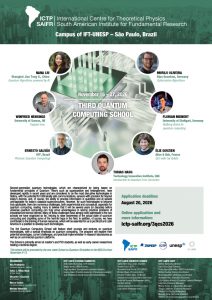
3rd Quantum Computing School

November 16 – 27, 2026

ICTP-SAIFR, São Paulo, Brazil
IFT-UNESP Auditorium
Home
Second-generation quantum technologies, which are characterized by being based on fundamental principles of Quantum Theory such as superposition and entanglement, have developed rapidly in recent years and are considered to be the most disruptive technologies in history, with the potential for intrinsically safe communications, sensors with precision far beyond today’s devices, and, of course, the ability to process information in quantities and at speeds unimaginable for today’s classical supercomputers. However, for such technologies to become truly applicable, there are numerous challenges, both experimental and conceptual, especially for quantum computing, leading many to believe that it will be several years (or decades) before universal quantum computing can truly prove advantageous in solving practical problems of industrial/commercial interest. Many of these challenges have already been addressed in the two schools we have organized so far, helping to raise awareness of the actual state of quantum computing and dispelling some of the harmful hype in the field. In addition, of course, we have contributed to the training of human resources, which will be essential for us to put Brazil and Latin America in a position to develop such technologies.
The 3rd Quantum Computing School will feature short courses and lectures on quantum technologies, with a special emphasis on quantum computing. The program will explore their potential advantages, current challenges, and practical implementation in research laboratories as well as on commercial quantum platforms.
The School is primarily aimed at master’s and PhD students, as well as early-career researchers holding a doctoral degree.
The school will be preceded by the one-week School on Quantum Simulation in the NISQ Era from November 9-13 at ICTP-SAIFR. And the school will be followed by the 3-day event Quantum Computing and Sustainability: Hackathon and Workshop from November 30 – December 2 at CBPF in Rio de Janeiro. Students are encouraged to apply before August 20 to the 3-day event in Rio de Janeiro, which will give preference to students who attend the 3rd Quantum Computing School in São Paulo, as well as cover the travel from São Paulo and housing expenses of accepted participants.
- Ana Predojevic (Stockholm University, Sweden)
- Celso J. Villas-Boas (UFSCar, Brazil)
- Eduardo I. Duzzioni (UFSC, Brazil)
- Marco Cerezo (Los Alamos National Laboratory, USA)
- Markus Hennrich (Stockholm University, Sweden)
Announcement:
Application is now closed
Lectures
Lecturers
- Elie Gouzien (Alice & Bob, France) – QEC with Cat Qubits
- Ernesto Galvão (UFF, Brazil) – Photonic Quantum Computing
- Florian Meinert (University of Stuttgart, Germany) – Rydberg atoms for quantum computing
- Alejandro Gomez Cadavid (Kipu Quantum, Germany) – Optimization Algorithms
- Nana Liu (Shanghai Jiao Tong University, China) – Quantum Algorithms powered by AI
- Tobias Haug (TII, Abu Dhabi, UAE) – Introduction to Quantum Error Correction
- Winfried Hensinger (University of Sussex, UK) – Trapped ions
Registration
Program
Participants
Posters
Tuesday
November 17
- 1. Agorio, Leopoldo (Universidad de la República, Uruguay): Quantum Optimization Approaches for Binary Motion Planning Problems
Many engineering problems involve binary decision variables that naturally lead to Mixed-Integer Linear Programs (MILPs). Such formulations frequently arise in robotics, including multi-robot motion planning, task allocation, and scheduling, but quickly become computationally challenging as the problem size increases. This poster presents an approach to reformulate a class of MILPs arising in multi-agent motion planning into forms compatible with current quantum optimization algorithms. Starting from a Benders decomposition, the original problem is transformed into a bilinear formulation that can be expressed as a Quadratic Unconstrained Binary Optimization (QUBO) problem. This enables the use of quantum optimization techniques such as the Quantum Approximate Optimization Algorithm (QAOA) and Quantum Annealing (QA). The proposed framework is illustrated through safe multi-robot trajectory planning problems. We also discuss how the same methodology can be extended to other combinatorial optimization problems relevant to robotics, such as the Traveling Salesman Problem (TSP). The goal is to demonstrate how practical optimization problems in robotics and control can be reformulated to exploit emerging quantum computing paradigms while highlighting both their current potential and limitations.
- 2. Albuquerque Lisboa, Miguel Antônio (Venturus, Brazil): Resource Theory of Tomographically-Nonlocal Entanglement
Tomographically nonlocal theories feature global degrees of freedom that cannot be accessed by local tomography, giving rise to a notion of entanglement distinct from its tomographically local counterpart. We develop a resource theory of this tomographically-nonlocal entanglement within the framework of generalized probabilistic theories. We identify the corresponding free states and free transformations and characterize the resulting structure of state convertibility. We introduce resource monotones that quantify tomographically-nonlocal entanglement and establish their basic properties under the free operations. This provides a systematic framework for quantifying and manipulating the part of entanglement that originates specifically from the failure of tomographic locality.
- 3. Alfred, Favour (Africa Quantum Consortium & Ladoke Akintola University of Technology, Nigeria): Noise-Aware Quantum Computing: Investigating the Effects of Decoherence on Quantum Circuit Performance
Quantum computers operate under physical conditions that differ substantially from the idealized models used to describe quantum algorithms. In particular, interactions with the environment can introduce decoherence and relaxation, progressively altering quantum states and affecting computational outcomes. Understanding these effects is therefore important for assessing the practical limitations of near-term quantum computation. This work investigates the effect of common noise processes on quantum circuit behavior using Qiskit-based simulations. Ideal quantum circuits are compared with circuits subjected to relaxation and dephasing noise, with particular attention to how increasing circuit depth and environmental noise influence the preservation of quantum information and the resulting measurement distributions. The simulations provide an intuitive view of how non-ideal dynamics progressively alter computational behavior. The study interprets noise not merely as an implementation error, but as a fundamental physical constraint that must be considered when developing practical quantum computing systems. The results provide insight into the relationship between circuit design, environmental effects, and the need for techniques such as error mitigation and quantum error correction in the development of scalable quantum computers.
- 4. Amaral, Cesar Augusto Do (Universidade Federal de Santa Catarina, Brazil): An Efficient Quantum Inspired Approach with Tensor Network Methods for Two-Asset Spread Option Pricing
This work investigates tensor-network methods for pricing two-asset spread options under the correlated Black–Scholes model. The non-smooth and non-separable structure of the spread-option payoff makes its numerical representation challenging, especially when fine multidimensional grids are required. The discretized pricing function is represented as a Matrix Product State, using quantized tensorization. The differential operator is represented as a Matrix Product Operator. The formulation incorporates the correlation between the underlying assets, mixed-derivative terms, and the required boundary conditions directly within the tensor-network structure. Time evolution is performed using an implicit finite-difference scheme. At each time step, the resulting linear system is solved through tensor-network sweep algorithms, avoiding the explicit construction of the full dense operator and solution vector. This allows the computation to be carried out through smaller local optimization problems. The study evaluates pricing accuracy, tensor ranks, memory consumption, compression, and computational runtime in comparison with conventional dense-grid approaches. More broadly, the project examines tensor networks as efficient representations for multidimensional financial models and as a bridge between classical numerical methods, quantum-state representations, and future quantum algorithms for partial differential equations.
- 5. Andrade, Bárbara (LaBRI – Université de Bordeaux, Spain): Dynamic Induction of Lattice Gauge Theories on a Quantum Computer
Gauge invariance is central to modern physics and underpins quantum simulations of lattice gauge theories (LGTs). Existing quantum simulation approaches employ Gauss’s law either to energetically suppress gauge-violating processes in analog platforms or to detect and discard gauge-violating outcomes in digital devices. Here we introduce a third paradigm, in which Gauss’s law is used to dynamically generate the gauge theory itself from a substantially simpler Hamiltonian. Starting from a readily programmable three-body XXX model, we employ experimentally efficient single-qubit U(1) gauge symmetry-generator terms that induce the dynamics of a U(1) LGT. We implement this approach using 101 qubits on a 156-qubit IBM quantum processor and observe real-time dynamics in quantitative agreement with the target LGT while reducing the entangling-gate depth per Trotter step by a factor of five compared with a direct implementation. Our results establish gauge protection as a resource for Hamiltonian engineering rather than merely symmetry preservation, opening a scalable resource-efficient route towards digital quantum simulations of increasingly complex gauge theories in higher spatial dimensions.
- 6. Araújo Pereira, Davi José (Gleb Wataghin Institute of Physics, State University of Campinas (UNICAMP), Brazil): Quantum Reservoir Computing and Quantum Feature Maps on Rydberg Atom Platforms for Machine Learning
This master’s research project proposes the development and implementation of Quantum Reservoir Computing (QRC) and Quantum Feature Maps (QFM) methods using Rydberg atom systems, with emphasis on the experimental platform of QuEra Computing. The research explores the natural dynamics of highly correlated quantum systems as computational resources for machine learning (ML) tasks, avoiding the need for deep quantum circuits and complex variational approaches. The work investigates strategies for encoding classical data into quantum systems and readout protocols based on local and correlated observables, aiming at applications in pattern classification and time-series forecasting problems. The performance of the proposed approaches will be evaluated against classical methods, while also considering the hardware constraints of Rydberg atom platforms, including noise, connectivity, and coherence limitations. The project is expected to contribute to the advancement of quantum machine learning (QML) methods based on near-term quantum hardware, particularly in the development of scalable and experimentally feasible quantum reservoir computing architectures for real world data processing tasks.
- 7. Audi, Gabriel Nogueira (University of São Paulo (USP), Brazil): Quantum Noise Spectroscopy in Non-Markovian Dynamics and Non-Equilibrium Environments
Environmental noise characterization is essential for efficient noise mitigation and optimal quantum control in high-fidelity quantum technologies. Most recent developments in the field determine the pure-dephasing noise spectrum through free coherence decay in Ramsey interferometry. However, these protocols often rely on thermal-equilibrium assumptions to infer the spectral asymmetry, while methods incorporating quantum control to measure the asymmetry experimentally usually assume a Markovian regime through Lindblad equations. In this work, we combine free induction decay and driven control approaches to reconstruct the noise spectrum in non-Markovian regimes without requiring thermal-equilibrium assumptions.
- 8. Bellizotti Souza, José Carlos (IFGW, Brazil): Optimization via FALQON Extended with Imaginary Time Evolution
We propose an extension of the Feedback-based ALgorithm for Quantum OptimizatioN (FALQON) based on quantum channels, referred to as CITE-FALQON, by incorporating imaginary time evolution into FALQON as an interaction with the environment, modeled using the operator-sum representation. We investigate its performance in ground-state preparation using the ANNNI model and the MaxCut problem. The results show that CITE-FALQON is robust against random initial states, successfully preparing ground states for the investigated ANNNI parameter sets, while FALQON exhibits strong sensitivity to the initial state. For MaxCut, CITE-FALQON achieves convergence to the ground state and higher approximation ratios than FALQON. Furthermore, CITE-FALQON consistently requires fewer circuit layers than FALQON, with some systems requiring up to five times more layers when using FALQON. These results demonstrate that the quantum-channel implementation of imaginary time evolution can improve the robustness and convergence of feedback-based quantum optimization. Future investigations will consider larger systems, the effects of noise, and other optimization problems.
- 9. Bertuzzi, Leticia (UFSC, Brazil): Time rescaling for second-order feedback-based quantum optimization
This work investigates strategies to improve the performance of the Feedback-based Algorithm for Quantum Optimization (FALQON) in solving the MaxCut problem, with a focus on accelerating convergence and achieving high approximation ratios with reduced circuit depth. The proposed approach combines two complementary techniques: a formulation based on a second-order expansion of the algorithm dynamics and a time-rescaling strategy. This combination leads to the TR-HY-FALQON variant, whose performance is compared with other FALQON formulations and with the Quantum Approximate Optimization Algorithm (QAOA). The analysis is carried out on different classes of graphs, including 3-regular graphs, which are commonly used as benchmarks in the literature, and Erdős–Rényi graphs, allowing the behavior of the algorithm to be investigated in less symmetric structures that remain relatively unexplored in the context of FALQON. The results show that the combined approach achieves superior performance among the analyzed variants, reaching high approximation ratios, low dispersion across different instances, and, for specific graph configurations, a significant reduction in the number of layers required to reach solutions close to the theoretical reference. This reduction in circuit depth helps bring the algorithm closer to the practical constraints of quantum devices in the NISQ era. In addition to combining time rescaling with higher-order formulations, this study also opens the possibility of investigating new feedback laws associated with the time-rescaling procedure. At present, the rescaling functions are predefined analytically, and a natural extension of this work is to explore feedback mechanisms capable of dynamically determining or adapting this behavior during the evolution of the algorithm. This perspective broadens the possibilities for controlling FALQON dynamics and may contribute to the development of even more efficient formulations. Overall, these results constitute an in-depth study of FALQON and are currently being developed along two complementary research directions, with the potential to result in two scientific articles and, consequently, two distinct contributions for poster presentation.
- 10. Blessed-Agboola, Jesujoba (African Quantum Consortium (AQC), Nigeria): Performance Analysis of QAOA for Combinatorial Optimization: Effects of Problem Size, Circuit Depth, and Sampling
The Quantum Approximate Optimization Algorithm (QAOA) is a hybrid quantum-classical algorithm designed to address combinatorial optimization problems using parameterized quantum circuits. Its performance, however, can be influenced by problem size, circuit depth, parameter optimization, and the number of measurements performed. This study investigates the performance of QAOA for small combinatorial optimization problems using the Max-Cut problem as a representative case. Quantum circuits will be implemented and simulated using Qiskit, with experiments conducted across different graph sizes, QAOA depths, and measurement-shot configurations. Performance will be evaluated using metrics including approximation ratio, probability of obtaining the optimal solution, and computational resource requirements. The results will be compared with the corresponding classical optimal solutions to assess the effectiveness of QAOA under different experimental conditions. The study aims to provide a practical assessment of how key implementation parameters influence QAOA performance and to identify conditions under which the algorithm is most effective for small optimization problems.
- 11. Borgarello, Franco Elías (Instituto Balseiro, Argentina): Development of a Microwave Kinetic Inductance Detector readout system with FPGA.
Microwave Kinetic Inductance Detectors (MKIDs) are superconducting resonators whose resonant frequency and quality factor shift in response to absorbed photons. Because each resonator can be assigned a distinct frequency, large arrays can be probed and read out through a single coaxial line using frequency-division multiplexing — a comb of microwave tones is transmitted through the array, and the amplitude and phase of each returning tone are demodulated to recover the state of every resonator in real time. This work presents a heterodyne IQ readout system for up to 16 MKIDs, built on a commercial System-on-Chip development board (Xilinx Zynq). Real-time tone generation and demodulation are performed digitally at intermediate frequency, while external analog mixers and a shared local oscillator handle up- and down-conversion to the GHz band where the resonators live. Per-tone in-phase and quadrature components are continuously extracted and streamed to the processor for calibration and analysis. Although developed for photon-counting MKID arrays, this readout scheme is directly applicable to superconducting qubit readout. Dispersive readout of transmon qubits relies on the same underlying principle: coupling a qubit to a microwave resonator and inferring its state from the amplitude and phase of a transmitted probe tone, and frequency-multiplexed architectures used to scale up qubit readout in circuit QED processors share an essentially identical signal chain. This project thus doubles as an accessible, low-cost platform for prototyping the real-time multiplexed readout techniques that underlie current superconducting quantum computing hardware.
- 12. Brasil, Victor (Universidade Federal da Paraiba (UFPB), Brazil): Quantum-inspired evolutionary algorithms for QAOA parameter optimization: a Max-Cut benchmark
We ask whether quantum-inspired evolutionary algorithms (QIEA) are competitive for setting quantum approximate optimization algorithm (QAOA) parameters, a step that classical optimizers find hard because the energy landscape is full of local minima. On Max-Cut over 15 random 3-regular graphs, we benchmark QIEA against single and multi-start constrained optimization BY linear approximations (COBYLA) and random search under a matched budget of circuit evaluations, at depths p = 1 and p = 2. QIEA is stable and beats random search, yet multi-start COBYLA matches or beats it on every run, and the gap widens with depth. A short local refinement of the QIEA solution recovers part of the gap, which points to a memetic hybrid as a promising direction.
- 13. Cabreira Paes Leme, Érico Antônio (São Carlos School of Engineering – University of São Paulo, Brazil): Design and Simulation of Superconducting Resonators for Quantum Information Applications
Microwave resonators are essential components of superconducting quantum computing architectures, enabling qubit control, readout, and quantum state storage. This work focuses on the design and simulation of different resonator geometries to investigate their electromagnetic properties and evaluate the advantages of each geometry for specific quantum computing applications.
- 14. Calero, Daniel Fernando (McMaster University, Canada): Seniority-Zero Canonical Transformation Theory: Error Reduction Via Late Truncation
We show how to add the effects of residual electron correlation to a reference seniority-zero wavefunction (a mean-field state) by transforming the true electronic Hamiltonian into seniority-zero form. The transformation is treated via the Baker–Campbell–Hausdorff (BCH) expansion —where instead of truncating all commutators using the recursive commutator approximation (RCA) as in our previous work \cite{ref2} and in other canonical transformation methods \cite{ref3,ref4,ref5}— we exploited the seniority-zero structure to evaluate the first three commutators exactly; the remaining contributions are handled with RCA . By choosing a seniority-zero reference and using parallel computation, this method is practical for small- to medium-sized systems. Numerical tests show high accuracy, with errors $\sim 10^{-4}$ Hartree.
- 15. Chávez, Moisés (benemérita universidad autónoma de puebla, Mexico): Adaptive Quantum Error Mitigation Guided by Quantum Correlations in NISQ Devices
Noise is a major challenge for variational quantum algorithms running on Noisy Intermediate-Scale Quantum (NISQ) devices. Current error mitigation techniques are typically applied uniformly throughout the algorithm, which can lead to unnecessary computational and experimental overhead. We propose an adaptive error mitigation framework that uses quantum correlations as indicators of quantum-state degradation. These indicators will be used to dynamically determine when error mitigation should be activated during the execution of variational algorithms such as VQE. The framework will be evaluated using Zero-Noise Extrapolation and performance will be assessed through noisy simulations. This approach aims to improve the efficiency of error mitigation by applying it only when evidence of significant noise-induced degradation is detected.
- 16. Cirino, Miquéias (Universidade Estadual de Campinas, Brazil): Percolation on Quantum Networks
Adding links generally improves classical transport by increasing the number of available paths. Here, we explore how coherent quantum transport may display the opposite behavior using continuous-time quantum walks on a percolated hierarchical small-world network, identifying a coherent overconnectivity penalty. The effect is quantified by the final-layer limiting probability. Additionally, we compare the coherent quantum behavior with the dephased and classical transport, that shows how the non-monotonic landscape is not a purely geometrical percolation effect.
Thursday
November 19
- 1. Coimbra, Lucas Giraldi Almeida (Universidade Federal de Minas Gerais – Instituto de Ciências Exatas, Brazil): Typology of Randomized Benchmarking
Randomized Benchmarking refers to a set of protocols for studying and characterizing quantum gates. A set of quantum gates is fixed, usually with a group operation, and representations of that group are used to estimate the quality of this set, in a manner resistant to SPAM (state preparation and measurement) errors. This poster aims to expose the typology of this protocols, that is, the classification into groups and the main differences of those classes, together with what is known in terms of good results for implementing them.
- 2. Costa Da Fonseca, Natasha (COPPE/UFRJ, Brazil): QUBO-WiSARD: Quantum Optimization for Compressing Weightless Neural Networks
Weightless neural networks such as WiSARD classify by summing binary votes from RAM-node discriminators, one per class, but their structure is fixed once the input mapping is defined and carries substantial redundancy. We study the structural optimization of WiSARD through quadratic unconstrained binary optimization (QUBO) in two complementary formulations. The first is post-training RAM selection: after standard training, a per-class QUBO combining a discriminative-utility term, a pairwise redundancy penalty, and a soft cardinality constraint (compression ratio κ) chooses which RAMs to keep. With thermometer encoding (T = 3, address size a = 28, 84 RAMs per class), at κ = 0.8 this removes about 20% of the RAMs while nearly preserving accuracy (EMNIST 0.9464 vs 0.9484; MNIST 0.9150 vs 0.9183), and consistently outperforms random selection at matched sparsity, most clearly under aggressive compression. A tabular protocol (Gaussian thermometer, T = 20, a = 20) reproduces the trend on PenDigits, Letter Recognition, and Satimage. These results use classical simulated annealing; the objective is Ising-compatible. The second formulation targets the explicitly quantum direction under development. Rather than compressing a trained model, it optimizes the input-bit-to-RAM assignment itself as a balanced binary partitioning QUBO, a discrete structural-design problem naturally suited to quantum optimization. We are developing this toward quantum annealing and small QAOA instances, using Walsh-truncated circuits to keep the dense, redundancy-aware QUBO tractable on NISQ hardware, and exploring a reversible qRAM/WiSARD circuit as a quantum inference representation based on superposition and entanglement. Unlike quantum weightless models that replace RAM nodes with qRAM, here the WiSARD stays classical and the quantum component acts as the optimizer of its discrete structure. The goal is to characterize formulation quality, executability, and hardware constraints.
- 3. Da Silva Junior, Silvio Jonas (Université Marie & Louis Pasteur, France): Small-world structure of Quantum Many-body Physics
We study quantum-computer hardware from a complex-network perspective, representing quantum register states and residual qubit interactions as an effective weighted network. Using the Åberg criterion, we identify a percolation transition associated with the onset of quantum chaos and dynamical thermalization. Our network approach reproduces results from exact diagonalization while allowing us to access systems of up to 30 qubits.
- 4. De Oliveira Sena, Vitor Lucas (SENAI CIMATEC, Brazil): Direct and heralded dimension-witness violation via entanglement swapping
We study how entanglement swapping affects the certification power of a dimension witness in the entanglement-assisted prepare-and-measure (EA-PAM) scenario. For a pair of partially entangled qubit states of concurrence $C$, we derive the closed-form optimal witness value $S_3^{\max}(C) = 1 + 2\sqrt{1+C^2}$, which shows a direct violation for any $C>0$, interpolating between the classical bound $S_3 = 3$ and the maximal quantum violation $1 + 2\sqrt{2}$. We then show that a Bell-state measurement on two such pairs does not increase concurrence on average, but concentrates it: conditioned on the $\Psi^{\pm}$ outcome, the heralded pair becomes maximally entangled and saturates the witness at $1 + 2\sqrt{2}$ for any $C > 0$, at the cost of a heralding probability $C^2/2$. Direct and heralded dimension-witness violation links the EA-PAM and entanglement-based measurement-device-independent (EB-MDI) scenarios as complementary primitives within a single quantum-network architecture for randomness certification and key distribution.
- 5. De Oliveira, Anderson Araujo (Instituto de Física de São Carlos, Brazil): Quantum and hybrid algorithms for microchip design automation
This PhD project proposes the development and validation of quantum algorithms applied to Electronic Design Automation (EDA), focusing on the critical phase of cell placement in microchips. As an NP-hard combinatorial optimization problem, cell placement imposes severe scalability bottlenecks and strong sensitivity to initial conditions on classical methods. To overcome these limitations, this research formulates the placement problem into Quadratic Unconstrained Binary Optimization (QUBO) representations and Constrained Quadratic Models (CQM) a hybrid solver framework developed by D-Wave that operates as an Ising-equivalent approach for constrained optimization. The methodology evolves across two complementary fronts: first, expanding and generalizing successful preliminary results obtained via Quantum Annealing and D-Wave hybrid solvers to adapt the framework to high-complexity chip architectures; second, exploring gate-based universal quantum computing through the variational Quantum Approximate Optimization Algorithm (QAOA). Practical and industry-relevant validation is ensured by directly integrating the quantum-optimized coordinates into the open-source OpenROAD design flow, adhering to physical rules from the ASAP7 (7nm) Process Design Kit (PDK). Solution performance is rigorously evaluated using standard metrics, including Half-Perimeter Wire Length (HPWL), silicon area, and power consumption. Ultimately, this work aims to consolidate a flexible and robust quantum optimization workflow, demonstrating the tangible advantages of quantum computing in evaluating and enhancing a broad range of semiconductor designs.
- 6. De Souza, Renato Dias (UNESP, Brazil): Federated Quantum Autoencoders for Poisoning Detection and Selective Unlearning in IIoT Intrusion Detection
Federated learning lets distributed IIoT gateways train a shared intrusion detector without pooling raw traffic, but it also exposes the aggregate to malicious participants: a client submitting poisoned updates can implant a backdoor that survives averaging, and simply retraining from scratch to remove it is prohibitively expensive. We investigate whether variational quantum models offer a useful handle on both problems. Our pipeline trains class-conditioned variational quantum autoencoders (QAEs) on the Edge-IIoTset benchmark under a federated protocol, using per-class reconstruction error as an anomaly score. To identify compromised clients, we combine Group-Shapley attribution over client coalitions with a geometric criterion derived from the Quantum Fisher Information Matrix: poisoned updates displace the model along directions of the Fubini–Study metric that have no classical analogue, which we exploit as a detection signal rather than relying on gradient-norm heuristics alone. Flagged clients are then subjected to selective unlearning, and we quantify residual influence through backdoor trigger success and membership-inference risk. This poster presents the model architecture, the attribution-plus-geometry detection criterion, and preliminary results under label-flipping and backdoor attacks, alongside classical baselines. We discuss circuit-depth and shot-budget constraints, and what “proof of forgetting” should mean for a quantum federated model.
- 7. Debebe, Girma Debru (Ethiopian Electric Utility, Ethiopia): Bridging Mechanical Engineering and Quantum Computing: Opportunities for Innovation and Optimization
Abstract Bridging Mechanical Engineering and Quantum Computing: Opportunities for Innovation and Optimization Mechanical engineering has continuously evolved through the integration of advanced computational methods, modeling techniques, and optimization approaches to solve complex engineering challenges. The emergence of quantum computing presents new possibilities for addressing computationally intensive problems that are difficult to solve using conventional computing approaches. This abstract explores the potential intersection between mechanical engineering and quantum computing, focusing on opportunities for innovation, optimization, and enhanced decision-making. Quantum computing technologies, particularly quantum optimization algorithms and quantum machine learning, have the potential to improve solutions in areas such as structural optimization, energy system efficiency, materials design, simulation, and complex engineering problem-solving. By leveraging principles such as superposition, entanglement, and quantum algorithms, engineers may develop new approaches for analyzing large-scale systems and identifying optimal solutions more efficiently. As a mechanical engineer with experience in infrastructure and utility management, I am interested in understanding how quantum computing can complement existing engineering practices and contribute to future digital transformation initiatives. This work aims to explore the foundational concepts of quantum computing, identify practical applications relevant to engineering disciplines, and examine pathways for integrating emerging quantum technologies into real-world engineering and industrial systems. The knowledge gained through this training will support the development of interdisciplinary capabilities, enabling engineers to contribute to innovation, improved resource utilization, and the advancement of technology-driven solutions for complex engineering challenges.
- 8. Dias, João (Instituto Militar de Engenharia, Brazil): Quantum Machine Learning for Anomaly Detection in Quantum Network Infrastructure
The security of Quantum Key Distribution (QKD) networks requires precise anomaly detection. In this work we propose a Variational Quantum Classifiers (VQCs) benchmark for anomaly detection in QKD infrastructure and it is compared with classical systems such as Isolation Forest (IF). We evaluated four datasets using the PennyLane and Ket frameworks. The results show that, although the VQC has a significantly lower parameter count and outperforms the classical NSL-KDD dataset, it did not demonstrate a clear advantage over IF in terms of data efficiency. The VQC thus stands out for its parameter efficiency and robustness in specific scenarios, representing a promising alternative for quantum monitoring.
- 9. Dos Santos Franco, Giovanni (Unesp, Brazil): Quantum Reservoir-Assisted Diffusion Models for Image Generation
Diffusion models have emerged as a powerful framework for generative learning by transforming the generation task into a sequence of iterative denoising steps. However, their computational cost motivates the exploration of alternative architectures for learning the reverse diffusion dynamics. In this work, we propose a hybrid quantum-classical diffusion model for image generation in which Quantum Reservoir Computing (QRC) is employed as a nonlinear feature-processing mechanism during the denoising process. The proposed framework follows a classical forward diffusion process, where Gaussian noise is progressively added to image data or to a compact latent representation. During the reverse process, the noisy latent variables, together with information about the diffusion timestep, are encoded into a quantum reservoir. The fixed or weakly tunable quantum dynamics transform these inputs into a high-dimensional set of quantum features obtained from measurements of selected observables. A trainable classical readout then uses these features to predict the noise component or the corresponding denoising update. Repeating this procedure allows images to be generated progressively from an initial noise distribution. By concentrating training mainly on the classical readout, the approach avoids the need to optimize deep parameterized quantum circuits at every denoising stage while exploiting the nonlinear dynamics of a quantum system. This work investigates QRC as a potential building block for quantum-enhanced generative models and explores its ability to learn the iterative dynamics required for diffusion-based image generation.
- 10. Dos Santos, Samuel (Unicamp, Brazil): Self-Configuration Algorithm in Photonic Circuits: An Example
We present an information-constraint-guided training method for optimizing state distinguishability experiments in integrated Mach-Zehnder interferometer (MZI) meshes without requiring individual calibration of phase shifters. This approach relies on relaxing conventional constraints by leveraging parametric freedom to identify noise-resilient suboptimal configurations, utilizing an informational functional minimized via Simultaneous Perturbation Stochastic Approximation (SPSA).
- 11. Durán, Kevin José (University of Los Andes (ULA) – Venezuela, Venezuela): An Initial Approach to the Use of Quantum Computers for the Calculation of Chemical System Properties, the Case of LiH
Contemporary quantum chemistry faces the challenge of exponentially growing classical computational requirements when simulating precise molecular systems. As an alternative, quantum computing offers polynomial scaling that promises to achieve the required chemical accuracy. This work presents a quantum algorithm-based approach to calculate the energetic and structural properties of the ground state of the $H_2$ and LiH chemical systems. The methodology involves formulating the molecular Hamiltonian under the Born-Oppenheimer approximation, transitioning it to the second quantization formalism, and subsequently converting it into a qubit Hamiltonian using the Jordan-Wigner transformation. By implementing the Variational Quantum Eigensolver (VQE) algorithm, the ground state energy and electronic density profiles are calculated as a function of internuclear distance. The $H_2$ system is initially used for quantum circuit calibration and hardware noise management, before extending the method to LiH. Finally, the viability and accuracy of the quantum simulations are validated through a comparative analysis against classical reference calculations executed in the ORCA software.
- 12. Fagundes, Felipe Silveira (Universidade Federal de São Carlos, Brazil): Reinforcement Learning Applied to Quantum Computing.
In this project, we will use the reinforcement learning (RL) technique to control closed and open quantum systems. Our goal is to establish effective methodologies for preparing states and designing quantum logic gates using computationally simulated environments. RL has proven to be a powerful technique for quantum control tasks, especially in the context of quantum computing, as evidenced by numerous articles in the field. The formalism of this technique consists of an agent that interacts with its surrounding environment and is capable of acting upon it. This action, in turn, alters the state of the environment, generating a reward tied to how efficient the agent’s decision was in achieving the proposed objective. Thus, the agent’s task is to maximize the cumulative reward over the course of the learning cycles. The idea behind the project is to use this technique to determine external control fields that guide the chosen quantum system from an arbitrary initial state to a desired target state. Additionally, we intend to implement 1- and 2-qubit logic gates. The methodology consists of defining the RL environment as the system to be controlled, and the action on it as the control to be implemented. The reward is designed such that the closer the evolved state is to the target state—or the higher the gate fidelity—the greater the reward. Using the methodology we have developed and the results we have obtained, we will pave the way in the future to compare quantum control via RL with other control techniques, seeking advantages that can be leveraged in the context of the study and development of quantum technologies.
- 13. Feltrin Iwakami, Arthur Kenzo (IFGW – Unicamp, Brazil): Solving covering problems with quantum computers
A covering problem is a class of combinatorial optimization problems which includes well-known cases such as Minimum Set Covering, Minimum dominating Set, Maximum Independent Set, among others. These models can be used to represent several practical problems in industry and logistics such as sensor positioning, crew scheduling, network security, and more. In this work we present approaches to solving these problems based on variational quantum algorithms such as the Quantum Alternate Operator Ansatz (QAOA), as well as their potentialities and shortcomings. We also include some preliminary results regarding their performance and viability for solving specific instances of the Minimum Dominating Set problem and Minimum Vertex Cover problem, over a range of small instance sizes.
- 14. Fernandes Da Costa Scoton, Gustavo (Universidade Federal de São Carlos, Brazil): Reverse engineering of single-qubit quantum gates
In this work, we address the problem of designing single-qubit quantum gates through the reverse engineering of a linearly polarized driving field. We show that any desired one-qubit gate corresponding to a special unitary matrix can be generated by a modulated sinusoidal field. The proposed analytical framework relies on the rotating-wave approximation (RWA). The formula for the control field is obtained by inverting the equation of motion for the evolution operator and imposing the conditions for the desired gate. We introduce a straightforward protocol to derive closed-form analytical expressions for the fields in terms of a priori chosen dynamical functions. Additionally, these dynamical functions can depend on tunable free parameters intentionally introduced to meet a desired performance criterion.
- 15. Ferreira, Leandro Nazarko (Universidade Estadual de Ponta Grossa, Brazil): Kerr Nonlinearity and Nonclassical State Generation in a Superconducting Circuit Driven by a Monochromatic Flux Pump
We investigate the quantum dynamics of a superconducting circuit with Kerr nonlinearity driven by a periodic magnetic-flux pump. The system is described by a time-dependent Hamiltonian combining parametric driving and nonlinear interactions, enabling the generation of nonclassical quantum states. We study the dynamics of the mean photon number, squeezing, and parity properties of the quantum state, while using the Wigner function to characterize its evolution in phase space. Particular attention is given to the formation of non-Gaussian states and coherent superpositions in the form of cat states, ($|\alpha \rangle \pm | – \alpha \rangle$), whose generation is investigated as a function of the pump amplitude and Kerr nonlinearity strength. Our results provide a characterization of controlled nonclassical-state generation in superconducting circuits and explore its potential for quantum information technologies.
- 16. Fonseca, Matheus Da Silva (Universidade Federal de São Carlos, Brazil): Efficient Magic State Cultivation for √T Gates
Recently, experimental and theoretical quantum error correction methodology has seen remarkable breakthroughs. In particular, magic state cultivation has been shown to simplify magic-state preparation and make it feasible for near-term devices. However, recent research on magic state cultivation has focused primarily on the cultivation of T|+⟩. Only a few other magic state cultivation methods beyond T|+⟩ have been investigated. Here, we generalize phase kickback checks for magic states at arbitrary Clifford hierarchy levels in specific codes. We provide an example of cultivation of √T|+⟩ in the doubled color code and the corresponding escape strategy using lattice surgery from the color code to large rotated surface codes. Using state vector simulation for un-grown cultivation, we observe a strong consistence between S|+⟩ and √T|+⟩ cultivation’s performance on the doubled color code. Finally, we present the application of the corresponding √T|+⟩L cultivation, incorporating the STAR architecture and T gates, for early fault-tolerant quantum computing and its potential to shorten gate synthesis in the fully fault-tolerant quantum computing era.
- 17. Zapana Choquehuanca, John Milton (Universidade Federal Fluminense, Peru): Witnessing the Quantum Mpemba Effect with a Single Observable
The Mpemba effect, in which a system farther from equilibrium relaxes faster than one closer to it, defies the intuition of nonequilibrium statistical mechanics. Here, we introduce a general framework to unambiguously witness this phenomenon based on a single observable defined for Markovian open quantum systems. The Mpemba observable bypasses full state tomography, offering utility for state preparation and thermal task optimization. We illustrate our method using local magnetization as a Mpemba signature, applying it to a qubit under generalized amplitude damping.
Tuesday
November 24
- 1. Franco Escudero, Emily Andrea (Benemerita Universidad Autonoma de Chiapas, Mexico): Optical Control of Single-Qubit Unitary Operations Using Coherent States
Precise manipulation of quantum states is a fundamental requirement for quantum information processing. In this work, we present a theoretical framework for the optical control of single-qubit unitary operations using coherent states within the Jaynes–Cummings model. The interaction between a two-level quantum system and a single quantized electromagnetic field mode is analyzed under both resonant and dispersive regimes. Based on this interaction, unitary operators associated with rotations about the X, Y, and Z axes of the Bloch sphere are derived and interpreted in terms of experimentally controllable parameters, including the interaction time, the optical field phase, and the qubit–field detuning. A conceptual implementation scheme based on coherent-state preparation and cavity quantum electrodynamics is proposed to illustrate the physical realization of these operations. Ongoing work focuses on numerical simulations using QuTiP to investigate the system dynamics, quantify qubit field entanglement, and evaluate the fidelity of the implemented operations under different interaction regimes.
- 2. Gonzales Sanchez, Pedro Antonio (Universidade Estadual de Campinas, Peru): Quantum Optimization for Microgrid Energy Management
Microgrids are local energy networks capable of islanded operation to preserve supply during blackouts, which remain frequent across Latin America. Yet their massive adoption is hindered by fragile stability stemming from high penetration of small, intermittent renewable generators. This work presents a quantum optimization approach for real-time energy injection decisions in microgrids that must jointly satisfy affordability, cleanliness, reliability, and stability. We model the decision as a multi-objective problem and encode it as a quadratic unconstrained binary optimization (QUBO) program, solved with the quantum approximate optimization algorithm (QAOA). Because the Pareto-optimal set is generally nonconvex, classical approaches scale poorly as objectives and generators grow, whereas our quantum formulation targets high-quality solutions with lower decision latency. We implemented a smallscale prototype and executed it on a real quantum computer, obtaining feasible schedules within fractions of a second, whereas a comparable classical baseline required minutes. These results suggest practical viability today and scalable advantages as quantum hardware matures.
- 3. Heredia Pardo, Diana Gabriela (University of Toulouse, Ecuador): Ligand-Controlled Electronic and Spin States in Redox-Active Chromium Complexes: DFT and Multireference Insights
The electronic structure of reduced transition-metal complexes becomes particularly challenging when redox-active ligand orbitals lie close in energy to the metal d orbitals, allowing the added electron to acquire metal-centered, ligand-centered, or mixed character. Here, we investigate a family of chromium complexes [LN4−Cr(L)2], where the monodentate ligand L tunes the relative energies of metal- and ligand-based electronic configurations. The reduced species were studied using density functional theory and multireference wave-function methods, including CASSCF and NEVPT2. Rather than treating the calculations as an end in themselves, the analysis was designed to identify theoretical descriptors that could be related to experimentally accessible signatures. Spin-state energetics, molecular geometries, spin-density distributions, natural-orbital occupations, and low-lying excited states were therefore combined to determine the localization and character of the added electron and to establish experimentally testable signatures of metal- versus ligand-involving reduction. Two distinct reduction regimes emerge. For L=CH3CN and CH3NC, the reduced triplet states are predominantly metal-centered and exhibit an electronic structure close to a t2g4 configuration. In contrast, the OAc−, TFA−, and CN− complexes show substantial participation of the redox-active ligand framework. Multireference natural-orbital occupations indicate that these states are better described as mixed metal-ligand configurations rather than purely ligand-centered radicals. This distinction is also reflected in the low-energy excited-state manifold. Predominantly metal-centered complexes exhibit three low-lying triplet states consistent with ligand-field splitting of a 3T-derived configuration, whereas ligand-involving systems display an additional low-energy triplet associated with ligand pi* configurations. These results show that ligand coordination does more than determine where the added electron is localized: it reshapes the low-energy electronic and spin-state manifold of the molecular system, controlling which electronic configurations become accessible and how strongly metal- and ligand-based states interact. From the perspective of quantum simulation, identifying these relevant low-energy degrees of freedom and their interactions is essential for constructing physically meaningful effective descriptions of complex quantum systems. More broadly, such microscopic understanding is also important for spin-based molecular quantum technologies, where chemical environment and electronic structure determine the quantum states available for manipulation.
- 4. Herrera Rodriguez, Luis Eduardo (University of Delaware, United States): Two-dimensional coherent spectrum of molecular aggregates with a quantum computing approach
Two-dimensional coherent spectroscopy is a powerful technique for probing the ultrafast dynamics of molecular systems, providing detailed insight into electronic couplings, environmental effects, and energy transfer. However, simulating nonlinear spectroscopic signals remains computationally demanding for large molecular aggregates due to the exponential scaling of the underlying quantum dynamics. In this work, we present a quantum computing approach for simulating two-dimensional coherent spectra of molecular aggregates. The system dynamics are described within the Lindblad master equation framework. To enable implementation on quantum hardware, the open-system evolution is mapped onto unitary dynamics through a dilation method. As a proof of concept, the methodology is demonstrated for a molecular dimer, illustrating the construction of the quantum algorithm and its application to nonlinear spectroscopic simulations.
- 5. Lawal, Opemipo (Ladoke Akintola University of Technology Ogbomoso, Nigeria): Detecting Anomalies with Quantum Autoencoders: A Hybrid Approach to Efficient Pattern Recognition
Anomaly detection is a core task across domains such as fraud detection, fault diagnosis, and network security, but classical approaches often struggle with high-dimensional or complex data patterns. This work explores quantum autoencoders as a hybrid quantum-classical alternative for anomaly detection and pattern recognition. By encoding data into a compressed latent representation using parameterized quantum circuits, the model learns to reconstruct “normal” patterns with high fidelity, allowing deviations — anomalies — to be identified through reconstruction error. The approach is implemented and evaluated using Qiskit and IBM Quantum hardware/simulators, and reflects a broader interest in leveraging near-term, noisy quantum devices for practical machine learning tasks. This poster presents the model architecture, training methodology, and preliminary findings, and discusses the current challenges and opportunities in applying quantum machine learning techniques to real-world anomaly detection problems.
- 6. Libois, José (UFSC, Brazil): Data Embedding in Variational Quantum Eigensolver applied to Quantum Chemistry.
Simulating quantum systems, specifically within quantum chemistry, remains one of the most highly anticipated applications for NISQ-era quantum hardware. Despite this potential, variational quantum algorithms frequently encounter optimization challenges, including barren plateaus and convergence to local minima. To mitigate these issues, we introduce a modified Variational Quantum Eigensolver (VQE) architecture that integrates low-computational-cost classical data. By explicitly embedding a non-linear mapping of the Hartree-Fock energy into the ansatz parameterization, we construct a highly guided, physics-inspired circuit. Numerical evaluations indicate a substantial reduction in the iteration count necessary to achieve ground-state convergence, highlighting the efficiency and scalability of our framework compared to standard VQE implementations.
- 7. Lopez Hernandez, Yamill Adrian (UNAM, Mexico): Algoritmos Cuánticos para Análisis de Redes Financieras y Riesgo Sistémico
Este trabajo presenta un esquema para integrar algoritmos cuánticos en el análisis de redes financieras complejas y el modelado de riesgo sistémico. Los algoritmos clásicos en grafos enfrentan limitaciones severas de memoria y complejidad temporal (problemas NP-hard) al procesar estructuras de transacciones a gran escala.Proponemos una arquitectura híbrida basada en tres microservicios cuánticos especializados:Caminatas Cuánticas de Tiempo Continuo: Para calcular la Centralidad de Intermediación exacta sin saturación de memoria RAM en el procesamiento de aristas.Búsqueda de Grover: Para obtener una aceleración cuadrática en la detección de patrones de ventas circulares y estructuras de estratificación en grafos de transacciones.Estimación de Amplitud Cuántica: Para acelerar las simulaciones estocásticas de Monte Carlo enfocadas en modelar el contagio intersectorial y el colapso sistémico ante fallas en nodos críticos.Mediante la codificación de matrices de adyacencia en circuitos cuánticos parametrizados, este modelo sustituye aproximaciones clásicas por evaluaciones exactas optimizadas para la detección de fraude y pruebas de estrés financiero.
- 8. Machado, Joao Paulo Neves Azevedo (IFGW-UNICAMP, Brazil): Comparative study of Otto cycle and quantum Otto cycle and its phenomenology
The fundamental difference between the Otto cycle and the quantum Otto cycle lies in their respective adiabatic processes: the thermodynamic process occurs rapidly enough to preclude heat exchange while maintaining system equilibrium, whereas its quantum counterpart is grounded in the Quantum Adiabatic Theorem—which drives the system out of equilibrium—and the associated implications. In this study, I suggest that despite the differences underlying these two cases, we can recover—or fail to recover—phenomenologies significant to each, thereby enabling a much more refined characterization of a non-equilibrium system.
- 9. Marques, Maurício (Instituto de Física Armando Dias Tavares – UERJ, Brazil): Using Qibo as a tool in learning Quantum Computing: A workshop proposal for undergraduate students.
Quantum Computing is an emerging field with significant potential to transform computation, simulation, and information processing. Despite its rapid international development, educational initiatives aimed at introducing undergraduate students to Quantum Computing remain relatively limited in Brazil, particularly those using accessible, open-source computational tools. This work proposes a workshop for undergraduate students centered on Qibo, an open-source Python framework for quantum computing and quantum simulation. The proposal seeks to provide an accessible introduction to fundamental concepts of Quantum Computing through practical activities, combining theoretical foundations with hands-on implementation of quantum circuits and algorithms. By using an open-source framework, the workshop aims to reduce barriers related to access to proprietary platforms and encourage students to experiment with quantum technologies in a reproducible computational environment. The educational approach is designed to connect concepts from quantum mechanics, linear algebra, and computer science with practical quantum programming, providing students with an initial pathway into the field. The project also responds to the growing need for qualified human resources in Quantum Computing in Brazil, contributing to the development of educational initiatives that can broaden participation in this emerging research and technological area. The expected outcome is a structured workshop proposal that can be implemented and evaluated with undergraduate students, providing a basis for future initiatives in Quantum Computing education in the Brazilian academic context.
- 10. Mathew, Sheryl (The Institute of Mathematical Sciences, Chennai, India): Super-Extensive Charging Power in the Absence of Global Operations
Quantum batteries provide a platform to investigate whether many-body quantum effects can enhance charging performance beyond classical limits. While superextensive charging power has been demonstrated in several models, it is commonly believed that such enhancement requires global operations or interaction orders scaling with system size. In this work, we show that this viewpoint is incomplete. We identify the g-extensivity of the Hamiltonian — the maximal cumulative interaction strength acting on a single site — as the fundamental quantity governing the scaling of charging power in direct-charging protocols. Using bounds derived from the AKLH lemma, we prove that if either the battery or charger Hamiltonian remains bounded in g, then superextensive charging power is impossible irrespective of the interaction order or participation number. In particular, commuting or non-interacting Hamiltonians with bounded g impose strict constraints on the operator norm of the charging commutator. Conversely, we demonstrate that superextensive charging power can emerge even for fixed low-locality Hamiltonians when, for instance, the interaction energy is distributed nonuniformly across sites such that g grows with system size. To illustrate this mechanism, we introduce a modified central-spin (MCS) architecture in which both the battery and charger Hamiltonians remain energy-extensive while possessing large g-extensivity. Numerical simulations reveal superextensive scaling of the commutator norm and charging power, approaching quadratic scaling for suitable initial states. Our results establish that global operations are not the essential resource for quantum advantage in direct charging. Instead, the relevant structural ingredient is the distribution of interaction energy encoded by g-extensivity. These findings provide a unified framework for understanding charging-power bounds and identifying experimentally feasible architectures capable of surpassing classical charging limits.
- 11. Matos, Guilherme Costa (Universidade Federal de São Carlos, Brazil): Quantum Coriolis Force in an Inertial Frame
We present an analog of the Coriolis and Magnus forces resulting from the effect of relative rotations in the interaction between neutral particles in the vacuum. The Lorentz force on a moving nanoparticle in the vicinity of a rotating nanoparticle is calculated, and the result depends on the angular velocity of rotation, mimicking a non-inertial effect in an inertial frame. For a nanoparticle subject to this force in a harmonic potential, the trajectory is similar to a Foucault pendulum. We show that for realistic experimental parameters, the effect is within the sensitivities of recent experimental measurements.
- 12. Mbiye Kalumbu, Bienvenu (University of Kinshasa, Democratic Republic of the Congo): Advancing Quantum Simulation Techniques for Noisy Intermediate-Scale Quantum (NISQ) Devices: Challenges and Prospects
Quantum simulation has emerged as one of the most promising applications of quantum computing, aiming to model complex quantum systems that are intractable for classical computers. With the advent of Noisy Intermediate-Scale Quantum (NISQ) devices, which contain tens to hundreds of qubits but are prone to noise and errors, the field faces unique challenges and opportunities. This work explores the current state of quantum simulation techniques tailored to the constraints and capabilities of NISQ hardware. Key methods such as variational quantum algorithms (VQA), quantum approximate optimization algorithms (QAOA), and error mitigation strategies are reviewed to assess their effectiveness in practical applications. The poster discusses the theoretical background of quantum simulation, highlighting the importance of simulating quantum chemistry, many-body physics, and materials science problems. It also addresses the limitations posed by qubit coherence times, gate fidelities, and error rates inherent in NISQ devices. Through case studies and recent experimental results, this presentation sheds light on how these challenges are being addressed by hybrid quantum-classical algorithms and improved calibration techniques. Moreover, it outlines future research directions, including scalable error correction methods and hardware improvements that could extend the capabilities of NISQ devices. The ultimate goal is to provide a comprehensive understanding of how NISQ-era quantum simulators can contribute to scientific discovery and technological innovation, particularly in developing countries where access to advanced quantum computing infrastructure is limited. This research aims to bridge the gap between theoretical quantum algorithms and their real-world implementation, offering insights valuable to researchers, educators, and policymakers interested in the quantum revolution.
- 13. Miranda Spengler, Luís Guilherme (Instituto de Física, Universidade Federal de Mato Grosso do Sul, Brazil): The Ramsey Block: A Robust Quantum Communication Protocol Guaranteed by Combinatorics
Quantum communication networks face a fundamental tradeoff between infrastructure robustness and resource efficiency. Protocols such as BB84 and Superdense Coding illustrate different priorities, but network architecture introduces another challenge: ensuring that functional communication paths exist despite the distribution of resources. We introduce the Ramsey Block, a quantum communication protocol based on Ramsey’s Theorem and the result R(3,3)=6. By considering a fully connected six-node network, we show that combinatorial structure can guarantee the existence of a functional communication channel. We analyze the resulting resource requirements and show how the protocol trades communication efficiency for guaranteed connectivity. In a distributed configuration, the architecture also exhibits security properties analogous to BB84 against eavesdropping. The Ramsey Block provides a simple model for studying the robustness-efficiency tradeoff in quantum network engineering and illustrates how combinatorial methods can contribute to the design of quantum communication architectures.
- 14. Moraes, Nara (IFUSP, Brazil): Quantum Learning of Covariance Matrices for Bayesian Inference
Correlations among experimental uncertainties can have a significant impact on statistical inference, particularly when observables are analyzed through multivariate likelihoods. In Bayesian parameter estimation, these correlations are encoded in covariance matrices and directly affect the geometry of the likelihood and, consequently, the resulting posterior distributions. However, estimating covariance structures from finite and high-dimensional datasets remains a challenging statistical problem. In this work, we investigate quantum machine learning approaches for learning classical covariance matrices and their application to Bayesian inference. Parameterized quantum circuits are employed as covariance estimators, with the goal of reconstructing correlation structures from synthetic datasets. The study is initially performed using quantum circuit simulation and datasets with controlled correlation patterns, providing a benchmark in which the true covariance matrix is known. The reconstructed covariance matrices are subsequently incorporated into multivariate likelihood functions to investigate how errors in covariance estimation propagate to Bayesian posterior distributions. Quantum estimates are then compared with classical covariance estimators in terms of estimation accuracy and their impact on the posterior distributions of inferred model parameters.
- 15. Moreno Ramos, Diego Alejandro (Institute of Fundamental Physics (IFF-CSIC), Spain): A General Lindblad Framework for Giant Artificial Molecules in Waveguide QED
Waveguide quantum electrodynamics (QED) setups have emerged as a promising platform for quantum technologies. In particular, giant artificial molecules— many-body quantum emitters coupled to a waveguide at multiple spatially separated points—exhibit interference effects that give rise to novel light–matter interactions and enhanced control over decoherence. These systems have recently attracted considerable interest due to their potential applications in modular quantum computing, quantum networks, and the engineering of protected quantum states. However, most theoretical studies have focused on simple geometries and the single-excitation regime, limiting the exploration of their full capabilities. In this work, we develop a general theoretical framework to describe giant artificial molecules with arbitrary geometries beyond the single-excitation sector. Starting from the microscopic system–waveguide interaction, we derive a Born–Markov master equation that captures both coherent and dissipative interactions induced by the waveguide. We further construct a symmetrized Lindblad formulation that preserves complete positivity while retaining the relevant microscopic information of the system. The resulting approach provides a scalable tool for investigating the dynamics of complex giant-molecule architectures and enables the study of collective effects, decoherence engineering, and entanglement generation in regimes that are difficult to access with existing analytical methods. These capabilities are particularly relevant for the development of large-scale superconducting quantum devices and modular quantum computing platforms.
- 16. Navarro Ambriz, Ronaldo (Universidad Nacional Autonoma de Mexico, Mexico): Scaling Quantum Algorithms: A Comparative Study of VQE and Classical Tensor Networks
The rapid development of quantum technologies requires robust optimization algorithms capable of running on near-term commercial quantum platforms. In this work, we investigate the performance and efficiency of the Variational Quantum Eigensolver (VQE) for simulating the ground state of anyons by implementing an occupation-dependent conditional hopping within a Bose-Hubbard model [1]. Utilizing Qiskit [2], we construct the necessary quantum circuits and optimize the variational ansatz to capture distinct anyonic statistics. To evaluate the accuracy and computational cost of this hybrid quantum-classical approach, the VQE outputs are benchmarked against classical tensor network methods. Specifically, we utilize the Density Matrix Renormalization Group (DMRG) and exact diagonalization to simulate the system. This comparative analysis highlights current optimization challenges, resource scaling, and the practical implementation of quantum algorithms for solving computational problems with high-dimensional scaling. [1] T. Keilmann, S. Lanzmich, I. McCulloch, and M. Roncaglia. Statistically induced phase transitions and anyons in 1D optical lattices. Nat. Commun., 2:361, 2011. [2] A. Javadi-Abhari, M. Treinish, K. Krsulich, C. J. Wood, J. Lishman, J. Gacon, S. Martiel, P. D. Nation, L. S. Bishop, A. W. Cross, B. R. Johnson, and J. M. Gambetta, Quantum computing with Qiskit, arXiv:2405.08810 [quant-ph] (2024).
Thursday
November 26
- 1. Obini, Jamila Uchenna (Federal university of ABC (UFABC), Brazil): Quantum Random Access Codes: Local versus Global Strategies in D=d^2
Quantum Random Access Codes (QRACs) provide a way of encoding classical information into quantum states, offering advantages over classical communication that can be exploited for quantum information processing. However, it remains important to understand how the structure of the encoding strategy, particularly the distinction between local (factored/separable) and global (entangled) strategies, affects this quantum advantage in higher dimensions. We investigate 2→1 QRACs using Semidefinite Programming (SDP) and numerical optimization, first characterizing the optimal local solutions for D=4 and then extending the analysis to dimensions D=d^2. We find that the D=4 local solutions converge to strictly separable Mutually Unbiased Bases (MUBs), while for d≥6, local strategies lose their quantum advantage and achieve a success probability below the classical limit.
- 2. Obregon Hilario, Wilber Andre (Pontificia Universidad Católica del Perú, Peru): Generalized Complementarity Relations for X States using IBM quantum devices
Decoherence transforms pure states into mixed states, leading to a redistribution of quantum information among complementary physical quantities. Understanding such complementarity relations in mixed states [1] is essential for characterizing open quantum systems and the behavior of noisy quantum devices. Complementarity relations between quantum entanglement and local information [2] have motivated the search for a unified description of mixed quantum states [3]. In this work, we introduce a generalized complementarity relation for two-qubit X states by incorporating the second-order Rényi entropy. Together, concurrence, the degree of polarization, and the second-order Rényi entropy provide a unified description of how quantum information is redistributed under decoherence. Experimentally, concurrence is obtained from quantum state tomography, the degree of polarization from local measurements, and the second-order Rényi entropy through a direct measurement protocol that we develop for two-qubit X states. Inspired by previous work on the direct measurement of the von Neumann entropy for single-qubit systems [4], our protocol avoids the need for full quantum state tomography. The proposed framework is experimentally validated on IBM superconducting quantum processors using several families of two-qubit mixed states. Our results show that the generalized complementarity relation captures how decoherence redistributes quantum information among entanglement, local information, and state mixedness. This complementarity provides a unified physical description of bipartite mixed states and offers an experimentally accessible framework for understanding and characterizing quantum resources in realistic open quantum systems and current noisy quantum hardware. References [1] N. Abe and K. Edamatsu, Opt. Express (2026). [2] X.-F. Qian, T. Malhotra, A. N. Vamivakas and J. H. Eberly, Phys. Rev. Lett. 117, 153901 (2016). [3] Y. Yugra, C. Montenegro and F. De Zela, Phys. Rev. A 105, 063710 (2022). [4] B. de Lima Bernardo, Phys. Scr. 95, 045104 (2020).
- 3. Pareja Abarca, Maria Julia (Universidad Católica Santa María, Peru): Efficiency of Positional Matrix Formulation vs. Quadratic Unconstrained Binary Optimization in Hybrid Quantum Computing
The Traveling Salesman Problem (TSP) is a canonical NP-hard combinatorial optimization problem that is commonly utilized as a benchmark for near-term quantum algorithms. In this work we compare the efficiency of a positional matrix (GPS/MPF) formulation to the traditional Quadratic Unconstrained Binary Optimization (QUBO) formulation to solve TSP in a hybrid classical-quantum computing framework. Both formulations are implemented and executed using the Quantum Approximate Optimization Algorithm (QAOA) and a Qiskit-based GPU/CUDA-accelerated simulator to explore performance under NISQ-era constraints. Here we compare the two encodings in terms of (logical) qubit count, circuit depth and space complexity, to try and identify which formulation provides a more efficient path toward near-term quantum advantage for combinatorial optimization. The analysis is of practical use for the choice of formulation for hybrid quantum-classical solvers applied to routing and logistics problems.
- 4. Pexe, Guilherme Eduardo Lopes (IFSC – Instituto de Física de São Carlos, Brazil): Preparing a Thermofield Double State with Feedback Quantum Algorithms
The efficient preparation of correlated thermal states on quantum computers is a central challenge in quantum simulation, with applications in many-body physics and holographic quantum gravity. In this work, we investigate the preparation of the ground state of two coupled Sachdev-Ye-Kitaev (SYK) systems, known as the Maldacena-Qi model, whose ground state approximates a Thermofield Double (TFD) state. We compare different feedback-based quantum algorithms, including FALQON, TR-FALQON, ITE-FALQON, and a hybrid protocol that combines imaginary-time evolution with time rescaling (ITE-TR-FALQON). Numerical simulations show that purely unitary approaches fail to converge to the target state when initialized in simple product states, whereas the hybrid method reaches the ground state with a significantly smaller number of circuit layers. These results indicate that the combination of deterministic feedback control and effectively non-unitary dynamics provides an efficient strategy for preparing highly correlated thermal states on near-term quantum devices.
- 5. Pieve, Vinicius Tinano Pieve (UFSCAR, Brazil): Coherent Control of Collective Motion and Rydberg-dependent Gates with Trapped Ions
Our work aims to investigate the control of the electronic and vibrational states of one and two ions excited to Rydberg states, simultaneously considering their quantized vibrational states and the coupling with a classical electric field inside a Paul trap. Initially, we construct the system Hamiltonian and then show how this control can be achieved for a set of theoretical parameters. However, when introducing realistic experimental parameters, important challenges arise associated with the intrinsic characteristics of Rydberg states. In particular, the breakdown of the rotating-wave approximation, a fundamental assumption in trapped-ion system to allow for the coherent control of the motional dynamics. Moreover, due to the high polarizability of Rydberg states, new terms begin to contribute to the Hamiltonian, making the simultaneous quantum control of electronic and vibrational states even more complex. Finally, by exploring in more detail the terms associated with polarizability that arise when the electronic state is in a Rydberg state, we observe a Rydberg blockade distinct from that usually reported in the literature, which is caused by the strong dipole–dipole interaction between the ions. In this case, for specific parameters and a high principal quantum number, the enormous polarizability of the Rydberg state leads to the emergence of a blockade mechanism mediated by the system’s vibrational states.
- 6. Pozo Galvis, Daniel Genary (Rheinland-Pfälzische Technische Universität Kaiserslautern-Landau, Ecuador): Tilted Dirac Cones as Photonic Gauge Fields: A 1D Route to Non-Abelian Simulation
One-dimensional photonic multilayers offer a simple and highly tunable platform for emulating effective condensed-matter Hamiltonians through geometric control. Here, Si/SiO₂ photonic crystals are investigated as a route for engineering tilted Dirac cones, motivated by the connection between spatially varying cone tilts, emergent spacetime geometries, and synthetic non-Abelian gauge fields. Using the transfer matrix method, we first characterize the emergence of Dirac crossings in conventional binary multilayers and show that variations of the relative layer thicknesses primarily shift the Dirac point in momentum space. Extending the unit cell to four layers introduces additional geometric degrees of freedom: by redistributing the thicknesses of layers made of the same material while preserving the lattice period and total optical contribution, the local dispersion can be modified while the Dirac node remains approximately fixed. An effective two-band Hamiltonian derived around the crossing provides a direct relation between the multilayer geometry, group velocities, and the resulting tilt parameter, and allows us to identify configurations in which this control remains robust against fabrication variations. These results establish a route toward spatially varying tilted Dirac cones in experimentally accessible one-dimensional photonic structures, illustrating how engineered photonic platforms can emulate effective Hamiltonians and provide a versatile setting for quantum simulation and other photonic quantum technologies.
- 7. Queiroz Ferreira, Paulo Vitor (Universidade Federal do Rio Grande do Norte, Brazil): QUANTUM PHYSICS-INFORMED NEURAL NETWORKS FOR EIKONAL EQUATION SOLVERS
The accurate computation of seismic traveltimes is a fundamental step in geophysical modeling and industrial inversion applications, such as hydrocarbon exploration. With recent computa- tional advances, machine learning has established itself as a viable approach for solving highly complex problems. Physics-Informed Neural Networks (PINNs) demonstrate the ability to solve partial differential equations by incorporating real-world physical constraints, enabling continuous, mesh-free solutions. However, classical PINNs often suffer from spectral bias and optimization stagnation when applied to highly heterogeneous media. To overcome these limitations, this work investigates the use of Quantum Physics-Informed Neural Networks (QPINNs) applied to solving the isotropic Eikonal equation. The proposed method employs a hybrid strategy where a classical neural network is utilized for nonlinear feature embedding. Rather than altering the topology of the physical grid, it preconditions the spatial coordinates by mapping them onto a learned basis of functions. This basis is subsequently multiplied by the original coordinates and embedded into a variational quantum circuit via angle encoding. This approach allows the quantum model to operate on a input space tailored to the physics of the problem. We demonstrate the effectiveness of our method by modeling wavefronts in a complex section of the Marmousi velocity model. Our results indicate that the QPINN architecture mitigates classical optimization plateaus, achieving superior accuracy in traveltime prediction using a small number of trainable parameters than equivalent classical models.
- 8. Rattighieri, Lucas Alexandre Marques (Universidade Estadual de Campinas – IFGW, Brazil): Strategies for Implementing Imaginary-Time Evolution in ITE-FALQON
Imaginary-time evolution (ITE) can be used to prepare low-energy states of quantum systems and is one of the steps used in ITE-FALQON. However, the operator $e^{-\tau H}$ is non-unitary, which prevents its direct implementation as a sequence of quantum gates. In this work, we study different ways to implement the imaginary-time evolution step of ITE-FALQON on a quantum computer. We consider approaches such as Quantum Imaginary Time Evolution (QITE) and Linear Combination of Unitaries (LCU), using ancillary qubits and post-selection when necessary. These methods are compared with the exact imaginary-time evolution for small quantum systems. The comparison considers the energy and fidelity of the prepared states, together with the resources required by each implementation, such as circuit depth, number of measurements and ancillary qubits. We also study how the choice of the imaginary-time step affects the approximation. The aim is to determine which approaches are more suitable for implementing ITE-FALQON on current quantum hardware.
- 9. Rivas Bueno, Angela Daniela (Universidad de los Andes (ULA), Venezuela): : Democratizing Early Quantum Education and Closing the STEM Gender Gap
is an educational initiative born within the framework of the Global Quantum Education & Training Project led by Womanium and supported by a microgrant from the Unitary Fund. The project addresses the gender gap in STEM and the critical shortage of teachers specialized in quantum physics and computing, focusing on training and empowering young girls aged 15 to 20 in Venezuela and France, while also opening its doors to high school students from mixed-gender groups. Its core mission is to empower underrepresented young girls in STEM by providing them with tailored educational resources and mentorship. This initiative educates and inspires, creating a ripple effect of knowledge and empowerment across Venezuela and France. Through a hybrid pedagogical methodology that combines in-person workshops, interactive virtual sessions, student-created multimedia content, and open, multilingual resources (Spanish, English, and French), key concepts such as qubits, superposition, and entanglement are introduced using accessible analogies. The results demonstrate significant conceptual mastery, the overcoming of math anxiety, and a growing vocational enthusiasm for quantum technologies. The initiative highlights early educational impact and mentorship as fundamental tools to democratize quantum sciences and shape the future leaders of scientific innovation. More info on the website: https://quantumchamitas.com
- 10. Rosa, Evandro (Universidade Federal de Santa Catarina, Brazil): The Ket Quantum Programming Platform
Ket is an open-source quantum programming platform for Python that enables the development of quantum-accelerated software. The platform allows researchers to test quantum algorithms using multithreaded or GPU-accelerated simulators or to execute them directly on QPU via the IBM Quantum and Amazon Braket interfaces. The project was proudly recognized by the Brazilian Computer Society (SBC) with the 2025 Innovation Award (Selo Inovação SBC 2025), and the continued development of its software stack is a designated project under the INCT-CQA. This poster aims to introduce the platform, highlighting its recent advancements, current research applications, and future directions.
- 11. Schucht, Victor Hugo (Universidade Estadual Paulista “Júlio de Mesquita Filho”, Brazil): Variational Quantum Circuits for ECG-Based Arrhythmia and Myocardial Infarction Detection
Machine learning has become a central tool in computer-aided diagnosis, particularly for physiological time series such as the electrocardiogram (ECG), where predictive accuracy and robustness to noise are critical. Quantum Machine Learning (QML) extends this effort by exploring high-dimensional Hilbert spaces to process information in ways that may offer advantages over purely classical models, and biomedical signal analysis has emerged as one of its most actively investigated application domains. Among QML approaches, Variational Quantum Circuits (VQCs) are particularly suited to noisy intermediate-scale quantum (NISQ) devices, as they combine parameterized quantum circuits with classical optimization to build flexible, low-depth quantum classifiers. This project investigates the application of VQCs to the classification of ECG signals from the MIT-BIH Arrhythmia Database and the PTB-XL dataset, targeting the detection of arrhythmia and myocardial infarction. Using the Qiskit and PennyLane frameworks, we study different classical-to-quantum data encoding strategies (angle, basis, and amplitude encoding) and variational circuit architectures (ansätze), evaluating their impact on classification performance and on robustness to noise and decoherence. Model performance is assessed through accuracy, F1-score, and AUROC, and compared against classical baselines such as Support Vector Machines and Multilayer Perceptrons. This work aims to contribute to the understanding of the practical viability of quantum classifiers for physiological time-series analysis, bridging quantum information theory and real-world biomedical applications.
- 12. Silva Da Costa Botelho, Cecilia (Venturus, Brazil): Comparing Quantum Reservoir Computing, Classical Reservoir Computing, and Random Feature Maps for Biomedical Classification
This poster presents an ongoing study on hybrid classical-quantum machine learning models for biomedical classification tasks, with a focus on comparing Quantum Reservoir Computing (QRC), Classical Reservoir Computing (CRC), and random nonlinear feature mappings. The main objective is to investigate whether quantum dynamics can generate informative embeddings for classification problems and how these embeddings compare with classical alternatives. In the proposed approach, classical input data are encoded into a quantum reservoir inspired by trapped-ion Hamiltonians and simulated with OQD. The resulting quantum measurements are used as features for a classical classifier. To make the evaluation more rigorous, the QRC model is compared against a classical dynamic reservoir and a random nonlinear feature-map baseline, helping to identify whether performance gains come from quantum dynamics, reservoir dynamics, or general nonlinear feature expansion. As a target application, the study considers biomedical classification, particularly breast cancer classification. The poster discusses the motivation, model design, experimental comparison strategy, and preliminary analysis of the role of reservoir parameters such as interaction strength, drive amplitude, coupling range, and measurement strategy. This work aims to contribute to the evaluation of near-term quantum machine learning methods by providing a careful comparison between quantum and classical reservoir-based approaches, avoiding premature claims of quantum advantage while exploring the potential of quantum-inspired embeddings for relevant real-world classification problems.
- 13. Silva, Leandro Matheus Morais Da (Instituto de Física de São Carlos – USP, Brazil): Adaptive Fault-Tolerant VQE: Mitigating T-Gate Overhead in Early Fault-Tolerant Architectures
In the Early Fault-Tolerant (EFTQC) regime, scale-dependent errors limit the number of useful physical qubits before error correction yields diminishing returns. Implementing the Variational Quantum Eigensolver (VQE) with a Hardware Efficient Ansatz (HEA) requires transpiling continuous rotations into discrete Clifford+T gates via the Ross-Selinger (RS) algorithm. Given the HEA’s high gate density, a fixed high precision generates a T-gate overhead that quickly exhausts the machine’s capacity. To enable larger simulations, we propose an FT-VQE with adaptive precision, incrementing the RS resolution only in the final convergence stages and using the parameter-shift rule for gradient calculations without additional T-gates. This logical overhead reduction lowers the requirements on the error-correcting code distance. Consequently, our method decreases the physical footprint of magic state distillation and extends the reach of simulable systems within EFTQC physical limitations.
- 14. Uria Valencia, Mariano (Universidad de Concepción, Chile): Continuous-Variable Quantum State Tomography Enabled by Quantum Mirrors
In quantum technologies, continuous-variable systems offer advantages over their discrete counterparts. However, continuous-variable tomography suffers from exponentially growing sample complexity. We propose protocols using quantum mirrors to transfer the complete information of incident photonic states onto a control atomic system. This enables full photonic state characterization through measurements on the control atom alone, realized via kernel functions, direct wavefunction reconstruction, and pointwise Wigner function measurements. Our approach overcomes the limitations of conventional photon counting, statistical inference, and inverse transformation, providing a robust framework for benchmarking and verifying non-Gaussian states in continuous-variable quantum optics.
- 15. W. M. Vianna, Maria Eduarda (Universidade Federal de Santa Catarina, Brazil): Quantum Software for Molecular Electronic Structure Simulation: From Fermionic Operators to Qubit Hamiltonians in Ket
Quantum simulation of molecular systems requires efficient representations of fermionic models on quantum computers. This work presents the development of a quantum software module for the Ket platform aimed at supporting molecular electronic structure simulations. The module provides tools for representing fermionic systems and mapping them to qubit-based Hamiltonians, integrating classical electronic structure methods with quantum simulation workflows. The implementation has been validated against established quantum computing software, showing consistent numerical results across different molecular systems. Ongoing development focuses on extending the framework toward variational quantum algorithms, including the Variational Quantum Eigensolver (VQE). The project contributes to the development of open quantum software for studying molecular systems and provides a practical framework for connecting computational methods with quantum simulation.
- 16. Wittmann Wilsmann, Karin (Instituto de Física, Universidade Federal do Rio Grande do Sul – UFRGS, Brazil): Integrable device models for Atomtronics
The precise control of quantum systems will play a major role in the realization of atomtronic devices. Here, we introduce a family of integrable multi-well tunneling models and focus on their applications in atomtronics, including three-well systems and four-well configurations such as ring and turntable geometries. Three-well systems allow the construction of an atomtronic switching device operating between “switched-on” and “switched-off” configurations. Four-well ring systems can be controlled to generate and encode a phase into a NOON state [1,2]. A rotating circuit of four sites arranged in a tetrahedral geometry is used to design a quantum turntable for the high-fidelity spatial transfer of entangled states, exploiting the superintegrability of the model [4]. A dynamical phase shift naturally emerges during the transfer, suggesting potential applications in quantum sensing [3]. We also discuss the physical feasibility of implementing these architectures using ultracold dipolar atoms. [1] D. Grün, L. Ymai, K. Wittmann, A. Tonel, A. Foerster, J. Links; Physical Review Letters 129, 020401 (2022). [2] D. Grün, K. Wittmann, L. Ymai, J. Links, and A. Foerster; Communications Physics 5, 36 (2022). [3] L. Ymai, K. Wittmann, A. Tonel, A. Foerster, J. Links; Newton 1 (Cell Press), 100226 (2025). [4] Supersensitive rotation sensor from superintegrability arXiv preprint arXiv:2605.09709
Venue
Venue: The event will be held at IFT-UNESP, located at R. Jornalista Aloysio Biondi, 120 – Barra Funda, São Paulo. The easiest way to reach us is by subway or bus, See arrival instructions here.
Accommodation: Participants whose accommodation will be provided by the institute will stay at Hotel Intercity the Universe Paulista. Hotel recommendations are available here.
Attention! Some participants in ICTP-SAIFR activities have received email from fake travel agencies asking for credit card information. All communication with participants will be made by ICTP-SAIFR staff using an e-mail “@ictp-saifr.org”. We will not send any mailings about accommodation that require a credit card number or any sort of deposit. Also, if you are staying at Hotel Intercity the Universe Paulista, please confirm with the Uber/Taxi driver that the hotel is located at Rua Pamplona 83 in Bela Vista (and not in Jardim Etelvina).
Additional Information
Attention! Some participants in ICTP-SAIFR activities have received email from fake travel agencies asking for credit card information. All communication with participants will be made by ICTP-SAIFR staff using an e-mail “@ictp-saifr.org”. We will not send any mailings about accommodation that require a credit card number or any sort of deposit. Also, if you are staying at Hotel Intercity the Universe Paulista, please confirm with the Uber/Taxi driver that the hotel is located at Rua Pamplona 83 in Bela Vista (and not in Jardim Etelvina).
BOARDING PASS: All participants, whose travel has been provided or will be reimbursed by ICTP-SAIFR, should bring the boarding pass upon registration. The return boarding pass (PDF, if online check-in, scan or picture, if physical) should be sent to secretary@ictp-saifr.org by e-mail.
Visa information: Nationals from several countries in Latin America and Europe are exempt from tourist visa. Nationals from Australia, Canada and USA are required to apply for a tourist visa.
Accommodation: Participants, whose accommodation will be provided by the institute, will stay at Hotel Intercity the Universe Paulista. Hotel recommendations are available here.
Power outlets: The standard power outlet in Brazil is type N (two round pins + grounding pin). Some European devices are compatible with the Brazilian power outlets. US devices will require an adapter.
Poster presentation: Participants who are presenting a poster MUST BRING A PRINTED BANNER . The banner size should be at most 1 m (width) x 1,5 m (length). We do not accept A4 or A3 paper.
Badge: You will receive an identification badge upon registration, which must be used during the entire event. Without the badge, it may not be possible to enter the venue.
Security issues: Although São Paulo is a relatively safe city, be careful when using cellphones on the street, avoid isolated areas at night, and be aware when crossing the street that cars may not stop for pedestrians. Also, please do not leave valuable items like laptops unattended even for short breaks. At the IFT-UNESP, there are storage lockers available and keys can be obtained with our secretaries.