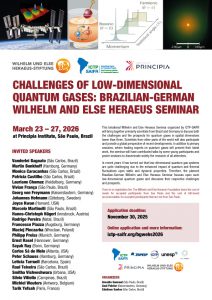
Challenges of Low-Dimensional Quantum Gases: Brazilian-German Wilhelm and Else Heraeus Seminar


March 23 – 27, 2026
ICTP-SAIFR, São Paulo, Brazil
Venue: Principia Institute
Home
This binational Wilhelm and Else Heraeus Seminar organized by ICTP-SAIFR will bring together primarily scientists from Brazil and Germany to discuss both the challenges and the prospects for quantum gases in spatial dimensions lower than three. Scientists from other parts of the world will also participate and provide a global perspective of recent developments. In addition to plenary sessions, where leading experts on quantum gases will present their latest work, the seminar will have contributed talks by some young participants and poster sessions to disseminate widely the research of all attendees.
In recent years it has turned out that low-dimensional quantum gas systems are quite challenging due to the enhanced impact of quantum and thermal fluctuations upon static and dynamic properties. Therefore, the planned Brazilian-German Wilhelm and Else Heraeus Seminar focuses upon such low-dimensional quantum gases and discusses their respective challenges and prospects. In particular we have in mind to highlight.
- two-dimensional quantum gas systems with properties, which do not exist in their three-dimensional
- counterparts as, for instance, the fractional quantum Hall effect or the Berezinskii-Kosterlitz-Thouless phase transition,
- quantum gases in a microgravity bubble trap in order to investigate how the differential geometry of a closed surface affects the system properties,
- photon Bose-Einstein condensates in dye-filled microcavities and semiconductor lasers with their potential technological applications,
- anyonic stastistics realized by bosonic or fermionic atoms in one-dimensional lattices in order to obtain a deeper understanding of the intriguing stastistical interaction, which is omnipresent in the quantum realm due to the indistingishability of identical quantum particles.
There is no registration fee. The Wilhelm and Else Heraeus-Foundation bears the cost of meals for accepted participants from Sao Paulo and the cost of full-board accommodation for accepted participants that are not from Sao Paulo.
Organizers:
Arnaldo Gammal (São Paulo, Brazil)
Axel Pelster (Kaiserslautern, Germany)
Ednilson Santos (São Carlos, Brazil)
Access the booklet (PDF) HERE
Announcement:
Application is now closed
Participants list here
Click here for satisfaction survey
Speakers
Invited speakers
- Romain Bachelard (São Carlos, Brazil) – Non-classical light from cold atomic systems
- Vanderlei Bagnato (São Carlos, Brazil) – The revival or decay during relaxation of a far-from-equilibrium Bose-Einstein Condensate
- Martin Bonkhoff (Hamburg, Germany) – Chirally-protected state manipulation by tuning one-dimensional statistics
- Flavia Braga Ramos (Natal, Brazil) – Charges on the Move: Fractional Charge Transport in Quantum Wires
- Lauriane Chomaz (Heidelberg, Germany) – Probing transitions in the two-dimensional crystalline structures of dipolar supersolids
- Sebastian Eggert (Kaiserslautern, Germany) – Floquet theory of many-body resonances
- Vivian França (São Paulo, Brazil) – Detecting Superconducting Transitions from a Single Site
- Georg von Freymann (Kaiserslautern, Germany) – 3D micro printing of potential landscapes for photonic quantum gases
- Johannes Hofmann (Göteborg, Sweden) – Mesoscopic correlations in two-dimensional Fermi gases
- Joyce Kwan (Harvard, USA) – Observation of pairing in a Pfaffian quantum Hall state of ultracold bosons
- Marcelo Martinelli (São Paulo, Brazil) – Generating entangled fields with hot and cold atoms
- Hanns-Christoph Nägerl (Innsbruck, Austria) – Exotic Quantum Statistics in Strongly Interacting 1D Bose Gases
- Rodrigo Pereira (Natal, Brazil) – Emergent dipole field theory in atomic ladders
- Maciej Pieczarka (Wroclaw, Poland) – Bose-Einstein condensation of photons in VCSELs – challenges and perspectives
- Philipp Preiss (Munich, Germany) – Building Fermionic Quantum States: Initialization, Gates, and Applications
- Sayak Ray (Bonn, Germany) – Nonequilibrium Dynamics of Interacting Composite Light-Matter Systems
- Carlos Sá de Melo (Atlanta, USA) – Creating and Detecting Weyl Bosons with Ultracold Fermi Atoms
- Peter Schauss (Hamburg, Germany) – Quantum gas microscopy of three-flavor Hubbard systems
- Lauro Tomio (São Paulo, Brazil) – Stable vortices in LHY superfluids
- Rémy Vatré (Paris, France) – Probing supersolidity through excitations in a spin-orbit-coupled Bose-Einstein condensate
- Smitha Vishveshwara (Urbana, USA) – Shell-shaped Bose-Einstein condensates: Dynamics, excitations, and thermodynamics
- Silvio Vitiello (Campinas, Brazil) – Impurities in quasi-one-dimension N spinless fermions
- Michiel Wouters (Antwerp, Belgium) – Kardar-Parisi-Zhang scaling in photonic Bose-Einstein condensates
- Tarik Yefsah (Paris, France) – Probing Spatial Correlations in 2D Fermi Gases
Contributed speakers
- Abel Beregi (Lewiston, USA) – Efficient numerical simulation of bubble-shaped Bose-Einstein condensates
- Vinicius Zampronio Pedroso (São Paulo, Brazil) – Exploring quantum phases of dipolar gases through quasicrystalline confinement
- Piotr Surówka (Wrocław, Poland) – Effective Field Theory for the Superfluid Vortex Lattice
- Isaac Tesfaye (Berlin, Germany) – Three-body bound states in the anyon-Hubbard model
- Wei Zhang (Beijing, China) – Anomalous Floquet topological phases in two-dimensional quantum gases
Application
Posters
- Attie, Jorge (São Carlos Institute of Physics – University of São Paulo, Brazil): Solitons in superfluids with curved geometries
- Bardin, Andrea (University of Padova, Italy): Quantum fluctuations in atomic Josephson junctions: the role of dimensionality
- Basilio Zárate, Andrea María (Universidad de Chile, Chile): Study of spatial correlations in entangled twin beams generated via Four-Wave Mixing
- Bekassy, Viktor (Chalmers University of Technology, Sweden): Probing Fractional Quantum Hall states in weakly interacting Fermi gases
- Belumat, Gabriel Tardin (IFSC – USP, Brazil): A 39K BEC in the dimensional crossover 3D-2D
- Bento da Silva, Daniel (University of São Paulo, Brazil): Scattering electron/particle α
- Bueno Xavier, Hernan Guillermo (ICTP/SISSA, Italy): Chiral graviton modes on lattice FQHE
- Calazans De Brito, Luis Filipe (University of São Paulo, Brazil): Evolution of localized pulses in the nonlinear Schrödinger equation
- Chakrabarti, Barnali (São Carlos Institute of Physics, Brazil): Impact of long-range interactions on dynamical localization of a weakly interacting superfluid in a quasiperiodic optical lattice
- Cook Cunha, Pedro Henrique (São Carlos Institute of Physics, Brazil): The new 39K BEC experiment in Brazil
- Costa, Erick Sutto (USP – Instituto de Física, Brazil): Preliminary Studies on Numerical Methods for Quantum Simulation
- Denega, Pedro Gabriel Ubatuba De Faria (Instituto de Física, Universidade Federal do Rio Grande do Sul, Brazil): Integrability and Physical Properties of the Bose–Hubbard Dimer with Asymmetric Hopping
- Dos Santos Silva, Gustavo Henrique (Univiversidade de São Paulo, Brazil): Numerical investigation of supersonic flow past an obstacle in a quasi-two-dimensional Lee-Huang-Yang quantum fluid
- Doran, Ryan (Newcastle University, United Kingdom): Analytic phase solution and point vortex model for dipolar quantum vortices
- Dutkiewicz, Kamil (Donostia International Physics Center, Spain): Bose-Einstein condensation in exotic lattice geometries
- Encina, Nikolas Alonso (Universidad de Chile, Chile): Multilevel atom transitions using trigonometric modulated pulses
- Figueiredo, Francisco (Centro Brasileiro de Pesquisas Físicas, Brazil): Composite-boson-superposition ansatz approach to one-dimensional trapped few-fermion systems
- Flores, Felipe Fernandes Heyden (IFUSP, Brazil): Quantum transport in aperiodic 1D chains
- Gómez Díaz, Juan Sebastián (Universidad del Valle, Colombia): Untangling the Spin-1 Bose-Hubbard model using Tensor Networks
- Gonçalves Dos Santos Filho, Marcos Alberto (Universidade Federal de São Carlos, Brazil): Vortex Dynamics in Driven–Dissipative Photon Condensates
- K, Rajaswathi (Bharathidasan University, Trichy, India): Engineering Solitons in Spin–Orbit and Rabi-Coupled Bose–Einstein Condensates
- Kaschewski, Nikolai (Rheinlandpfälzische Technische Universität Kaiserslautern-Landau, Germany): Reduction of pair correlations below the background value in ultracold Fermi gases
- Kehl Scola, Mariana (Instituto de Física – UFRGS, Brazil): Integrable models of dipolar bosons: Quantum control, device applications, and superintegrability
- Kramer, Roman (Physikalisches Institut der Universität Bonn, Germany): Driven-dissipative dynamics and stabilization of open photon Bose-Einstein condensates
- Krauß, Joshua (University of Kaiserslautern-Landau, Germany): From lasers to photon Bose-Einstein condensates: A unified description via an open-dissipative
- Kulik, Piotr Kulik (University of Warsaw, Poland): Interplay of Strong Correlations and Lattice Dynamics: Insights from the Extended Hubbard–Holstein Model
- Lima, Caio César Rocha (IFSC, Brazil): Magneto-optical trapping of Dysprosium in alternative configuration
- Lima, Rodrigo De Paula Almeida (Universidad de Castilla-La Mancha, Spain): Out-of-equilibrium dynamical properties of Bose-Einstein condensates in a ramped-up weak disorder
- Lugo-Castillo, Jose Luis (Instituto de Física, UNAM, Mexico): Towards the engineering of optical potentials for experiments in degenerate Fermi gases
- Majumder, Dwipesh (Indian Institute of Engineering Science and Technology, Shibpur (IIEST), India): Two dimensional interacting Bose-Bose droplet in presence of random impurity
- de Oliveira, Sheilla M (Rheinland-Pfälzische Technische Universität Kaiserslautern-Landau, Germany): Decoherence and quantum Darwinism in a scattering model
- Mixa, Leon (Universität Hamburg, Germany): Extended Gross-Pitaevskii equation for cavity-induced quantum droplets
- Nohra, Jean-Paul (Ecole Normale Supérieure, Paris, France): Quantum Gas Microscopy of Fermions in the Continuum
- Ramos-Solís, Luis Eduardo (Instituto de Física UNAM, Mexico): Far from equilibrium dynamics in a Heisenberg spin-1 chain with tunable symmetry
- Rodrigues Da Paz, Rafael Aparecido (Instituto de Física de São Carlos, Brazil): Quantum droplets formation from bubble-shaped dipolar Bose-Einstein condensates
- Rozas Garcia, Enrique (University of Gothenburg, Sweden): Instanton theory and fluctuation corrections to the nucleation rate of a ferromagnetic superfluid
- Sallatti, Raphael Wictky (IFUSP, Brazil): Stability of dark solitons in a bubble Bose-Einstein condensate
- Shankar, Akshay (Ghent University, Belgium): TentMPS: A variational finite-element framework for interacting quantum gases in low dimensions
- Sharell, Uri (Heidelberg University, Germany): Exploring collectivity in few-body systems with density functional theory
- Shi, Tingting (Institute of Physics, Chinese Academy of Sciences, China): Universal bound states with Bose-Fermi duality in microwave-shielded ultracold molecules
- Sieradzki, Piotr (Wrocław University of Science and Technology, Poland): Probing the equation of state in a 2D driven-dissipative condensate of light
- Silva Tavares, Thiago (IFUSP, Brazil): Thermodynamics and correlation functions of a zig-zag ladder chain
- Sivakumar, Anirudh (Bharathidasan University, Trichy, Tamil Nadu, India, India): Quantum turbulence in self-gravitating Bose-Einstein Condensates
- Subramaniyan, Sabari (IFT-UNESP, India): Turbulence Driven by Dipolar Interactions in Bose–Einstein Condensates
- Tonin, Gabriel Maia (Institute of Chemistry of São Paulo State University, Brazil): Ant Colony Optimization for Density Functionals in Strongly Correlated Systems
- Tylutki, Marek Jan (Institute of Theoretical Physics, Wrocław University of Science and Technology, Poland): Josephson oscillations of one-dimensional quantum droplets
- Young Silva, Luis Ever (Universidad de Cartagena, Colombia): Two-dimensional anisotropic bright dipolar condensate solitons: Statics and collisions
- J. Santos, A. Pelster and A. Gammal: Weakly interacting Bose gases in the canonical ensemble
- J. Krauß, F.E.A. dos Santos and A. Pelster: On vortices in photon Bose–Einstein condensates: Open-dissipative effects on size and stability
Program
The conference program starts in the morning of Monday, March 23, 2026 and ends in the afternoon of Friday, March 27, 2026. Therefore the participants should arrive in Sao Paulo during afternoon/evening of Sunday, March 22, 2026 and departure in the morning of Saturday, March 28, 2026.
Program of Brazilian-German WEH Seminar
Low-Dimensional Quantum Gases
HERE
Access the complete booklet (PDF) HERE
Videos and Files
-
09:00 - ICTP (ICTP-SAIFR):
Opening
-
09:00 - Smitha Vishveshwara (Leibniz Universität Hannover):
Shell-shaped Bose-Einstein condensates: Dynamics, excitations, and thermodynamics
-
10:00 - Abel Beregi (Lewiston, USA):
Efficient numerical simulation of bubble-shaped Bose-Einstein condensates
-
11:00 - Vanderlei Bagnato (IFSC- University of São Paulo):
The revival or decay during relaxation of a far-from-equilibrium Bose-Einstein Condensate
-
11:30 - Sebastian Eggert (University of Kaiserslautern-Landau):
Floquet theory of many-body resonances
-
14:30 - Hanns-Christoph Nägerl (Institute for Experimental Physics, University of Innsbruck):
Exotic Quantum Statistics in Strongly Interacting 1D Bose Gases
-
15:30 - Martin Bonkhoff (Institute for Theoretical Physics, Universität Hamburg):
Chirally-protected state manipulation by tuning one-dimensional statistics
-
09:00 - Lauriane Chomaz (Physics Institute, Heidelberg University):
Probing transitions in the two-dimensional crystalline structures of dipolar supersolids
-
09:30 - Lauro Tomio (Instituto de Física Teórica, UNESP):
Stable vortices in LHY superfluids
-
11:00 - Rémy Vatré (The Barcelona Institute of Science and Technology):
Probing supersolidity through excitations in a spin-orbit-coupled Bose-Einstein condensate
-
11:30 - Vivian França (São Paulo State University (UNESP) / ICTP-Trieste):
Detecting Superconducting Transitions from a Single Site
-
14:30 - Carlos Sá de Melo (Georgia Institute of Technology):
Creating and Detecting Weyl Bosons with Ultracold Fermi Atoms
-
15:00 - Rodrigo Pereira (International Institute of Physics, Federal University of Rio Grande do Norte):
Emergent dipole field theory in atomic ladders
-
09:00 - Georg von Freymann (RPTU University):
3D micro printing of potential landscapes for photonic quantum gases
-
09:30 - Michiel Wouters (U. Antwerpen):
Kardar-Parisi-Zhang scaling in photonic Bose-Einstein condensates
-
11:00 - Sayak Ray (University of Bonn):
Nonequilibrium Dynamics of Interacting Composite Light-Matter Systems
-
11:30 - Maciej Pieczarka (Wrocław University of Science and Technology):
Bose-Einstein condensation of photons in VCSELs – challenges and perspectives
-
09:00 - Peter Schauss (University of Hamburg):
Quantum gas microscopy of three-flavor Hubbard systems
-
09:45 - Tarik Yefsah (École Normale Supérieure and CNRS):
Probing spatial correlations in 2D Fermi gases
-
11:00 - Flavia Braga Ramos (IIP - UFRN):
Charges on the Move: Fractional Charge Transport in Quantum Wires
-
11:45 - Silvio Vitiello (Gleb Wataghin Institute of Physics, University of Campinas (UNICAMP)):
Impurities in a quasi-one-dimension N spinless fermion system
-
14:30 - Wei Zhang (Beijing, China):
f-sum rules for dissipative systems
-
14:45 - Piotr Surówka (Wrocław, Poland):
Effective field theory for superfluid vortex lattice
-
15:30 - Vinicius Zampronio Pedroso (São Paulo, Brazil):
Exploring quantum phases of dipolar gases through quasicrystalline confinement
-
09:00 - Philipp Preiss (Max Planck Institute of Quantum Optics):
Building fermionic quantum states: Initialization, gates, and applications
-
09:45 - Johannes Hofmann (Department of Physics, Gothenburg University):
Mesoscopic correlations in two-dimensional Fermi gases
-
11:00 - Romain Bachelard (Department of Physics, Federal University of São Carlos):
Non-classical light from cold atomic systems
-
11:45 - Marcelo Martinelli (Inst. de Física, Un. de São Paulo):
Generating entangled fields with hot and cold atoms
-
14:30 - Joyce Kwan (Department of Physics, Harvard University):
Observation of pairing in a Pfaffian quantum Hall state of ultracold bosons (Online)
-
15:15 - Isaac Tesfaye (Paris, France):
Three-body bound states in the anyon-Hubbard model
asdasdasd
Photos

Additional Information
Attention! Some participants in ICTP-SAIFR activities have received email from fake travel agencies asking for credit card information. All communication with participants will be made by ICTP-SAIFR staff using an e-mail “@ictp-saifr.org”. We will not send any mailings about accommodation that require a credit card number or any sort of deposit. Also, if you are staying at Hotel Intercity the Universe Paulista, please confirm with the Uber/Taxi driver that the hotel is located at Rua Pamplona 83 in Bela Vista (and not in Jardim Etelvina).
BOARDING PASS: All participants, whose travel has been provided or will be reimbursed by ICTP-SAIFR, should bring the boarding pass upon registration. The return boarding pass (PDF, if online check-in, scan or picture, if physical) should be sent to secretary@ictp-saifr.org by e-mail.
Visa information: Nationals from several countries in Latin America and Europe are exempt from tourist visa. Nationals from Australia, Canada and USA are required to apply for a tourist visa.
Accommodation: Participants, whose accommodation will be provided by the institute, will stay at Hotel Intercity the Universe Paulista. Hotel recommendations are available here.
Poster presentation: Participants who are presenting a poster MUST BRING A PRINTED BANNER . The banner size should be at most 1 m (width) x 1,5 m (length). We do not accept A4 or A3 paper.
Badge: You will receive an identification badge upon registration, which must be used during the entire event. Without the badge, it may not be possible to enter the venue.
Security issues: Although São Paulo is a relatively safe city, be careful when using cellphones on the street, avoid isolated areas at night, and be aware when crossing the street that cars may not stop for pedestrians. Also, please do not leave valuable items like laptops unattended even for short breaks.