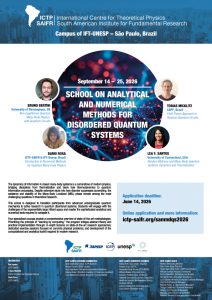
School on Analytical and Numerical Methods for Disordered Quantum Systems

September 14 – 25, 2026
Venue: ICTP-SAIFR/IFT-UNESP
Zoom ID: 852 2433 0607
Password: quantum
Home
The dynamics of information in closed many-body systems is a cornerstone of modern physics, bridging disciplines from thermalization and black hole thermodynamics to quantum information processing. Despite extensive study into how disorder suppresses scrambling, the existence and stability of the Many-Body Localized (MBL) phase remain among the most challenging questions in theoretical research.
This school is designed to transition participants from advanced undergraduate quantum mechanics to active research in quantum disordered systems. Students will engage with the challenges of the exponentially large Hilbert space and master the sophisticated analytical and numerical tools required to navigate it.
Four specialized courses provide a comprehensive overview of state-of-the-art methodologies. Prioritizing the principle of “learning by computing,” the program bridges abstract theory and practical implementation through:
- In-depth lectures on state-of-the-art research approaches
- Dedicated exercise sessions focused on concrete physical problems
- Development of the computational and analytical toolkit required in modern research.
Organizers:
- Rui Aquino (ICTP-SAIFR)
- Tobias Micklitz (Centro Brasileiro de Pesquisas Físicas)
- Dario Rosa (ICTP-SAIFR)
Announcement:
Application is now closed
Lecturers
Lecturers
- Bruno Bertini (University of Birmingham): Non-Equilibrium Quantum Many-Body Physics with Quantum Circuits
- Tobias Micklitz (CBPF): Field-Theory Approach to Quantum Chaos
- Dario Rosa (ICTP-SAIFR & IFT-Unesp) and Jorge Eduardo Nava Sejas (IFT-Unesp): Introduction to Numerical Methods for Quantum Many-body Physics
- Lea F. Santos (University of Connecticut): Many-body quantum systems
Registration
Program
Participants
Posters
- Arantes, Gabriel Moniz (IF-USP, Brazil): Enhancement of Non-Markovianity via Multi-Copy Coarse-Graining: Bounds and the Weak-to-Essential Transition
Quantum channels generally reduce the distinguishability of quantum states, thereby constraining information transmission and processing in open quantum systems. While it is known that distinguishability can be partially recovered through suitable post-processing protocols, a systematic characterization of the maximal achievable gain has remained elusive. Here, we establish a general framework to determine and optimize the recovery of distinguishability induced by a quantum channel. We introduce an algorithm that identifies the optimal implementation of a multi-copy coarse-graining protocol and applies efficiently to arbitrary channels. Within this framework, we derive a general upper bound on the attainable distinguishability gain and quantify the performance of the protocol in terms of its tightness relative to this bound. Our results show that weakly non-Markovian dynamics can be operationally promoted to the essentially non-Markovian regime via multi-copy coarse graining, as witnessed by the emergence of information backflow. A detailed analysis reveals a nontrivial trade-off between bound saturation and operational advantage, as well as a strong dependence on both the input ensemble and the number of copies. Taken together, these findings provide a unified and quantitative approach to assess, optimize, and interpret distinguishability recovery in open quantum systems, and establish multi-copy processing as a viable mechanism for activating non-Markovian behavior.
- Cespedes Gonzales, David Alexander (University of Houston, United States): Thermalization of string order in Haldane chain
In the Landau paradigm, phases of matter are characterized by local order parameters associated with symmetry breaking. However, certain phases known as topological phases, such as the Haldane phase, lie beyond this paradigm, and their order is instead captured by string order parameters, intrinsically nonlocal quantities. Separately, the Eigenstate Thermalization Hypothesis (ETH) provides an ansatz for the matrix elements of local operators in ergodic systems, explaining how isolated quantum systems reach thermal equilibrium. Since ETH is formulated for local operators, this leaves open the question of whether nonlocal quantities like string order parameters follow the ETH matrix structure. To address this, we study the ETH matrix element structure and relaxation dynamics of string order parameters in the spin-1 Haldane chain. We find that both the z- and x-direction string operators satisfy ETH in both their diagonal and off-diagonal matrix elements, provided that all symmetries are properly resolved. For the z-direction string operator this is automatic, since the relevant parity sector is fixed by total magnetization conservation. For the x-direction string operator, however, the global spin-flip symmetry in the x-direction constitutes an additional conserved charge that coexists with zero total magnetization, splitting the spectrum into two branches; ETH is restored only once this symmetry is implemented explicitly. Despite satisfying ETH, the thermalization dynamics of the string order are far from trivial and depend sensitively on the initial state: low-entanglement states such as the AKLT and Neel states thermalize slowly and develop non-trivial dynamics with a propagating light-cone structure consistent with Lieb-Robinson bounds, while high-entanglement random states thermalize rapidly with no such structure. To understand this nontrivial dynamics from the lens of ETH matrix structure we introduce a coarse-graining analysis of the dynamical matrix, whose decay rates reveal that different thermalization dynamics arise from a coherent alignment between the initial-state and operator structures in the energy eigenbasis, an effect invisible in the time-domain dynamics alone.
- De Medeiros, Davi Barbosa (Universidade de Pernambuco, Brazil): Quantum Transport in Fractal Networks
Quantum transport in nanostructured systems is strongly influenced by quantum coherence, interference effects, and statistical fluctuations, making topology an important factor in determining transport properties. In this work, we investigate electronic quantum transport in fractal networks using a graph-theoretical framework based on weighted adjacency matrices and Quantum Circuit Theory. Weak-localization corrections are incorporated through a Hessian-matrix formalism, allowing transport cumulants to be expressed directly in terms of network connectivity. We also extend the analysis to quantum thermal transport by considering phonon propagation in fractal geometries such as the Sierpinski triangle and carpet. Numerical implementations are performed in Mathematica, enabling the automatic generation of fractal graphs and the computation of transport quantities. The long-term goal is to develop a unified topological framework capable of describing both charge and heat transport in complex networks.
- Ghosh, Rahul (Ben Gurion University, Israel): Freezing a molten dissipative time-crystal with non-Markovianity
Spontaneous symmetry breaking is a unifying paradigm in physics, underlying diverse phenomena such as conventional crystallization, magnetism, and superconductivity. Recently, this concept has been extended to the time domain through continuous time crystals, open quantum systems that rely on environmental coupling to stabilize persistent oscillations and spontaneously break time-translation symmetry. However, the role of this environmental coupling involves a fundamental trade-off: while Markovian dissipation can stabilize time crystals under highly restrictive symmetry conditions, strong damping generically destroys quantum coherences, rapidly “melting” them. Here we show that a finite environmental memory, i.e. non-Markovian bath dynamics, prevents this destruction and re-freezes the time-crystal state even under overwhelmingly strong dissipation. We reveal that information backflow from the bath creates a memory-controlled spectral bottleneck, which selectively suppresses the system’s dominant decay channels while leaving its emergent oscillation frequency essentially intact. This frequency rigidity, absent in generic non-Markovian coherence preservation, is what connects our result to genuine time-crystalline order. We establish the effect in an exactly solvable model and confirm its robustness in two lower-symmetry models, with the stabilization threshold collapsing onto a single collective dissipation scale. Ultimately, this memory-induced stabilization manifests as a “transition-like spectral crossover”, reframing bath memory from a standard decoherence mechanism into a critical control parameter for realizing and sustaining robust non-equilibrium temporal order in solid-state, photonic, and hybrid quantum platforms.
- Larios Goetendia, Diego Alfredo (PONTIFICIA UNIVERSIDAD CATOLICA DEL PERU, Peru): Direct Measurement Protocol for the von Neumann Entropy of Two-Qubit X States
The von Neumann entropy is a fundamental quantity in quantum information theory, playing a central role in the characterization of quantum correlations and entanglement. Its experimental determination typically relies on quantum state tomography, a procedure whose complexity grows rapidly with the size of the system. Consequently, the development of direct measurement protocols for the von Neumann entropy has become an important challenge. Recent advances have demonstrated the possibility of estimating the von Neumann entropy of single-qubit systems without full state reconstruction. In this work, we extend this approach to the entire class of two-qubit X states, which are widely studied in quantum information theory. Harnessing the structure of these states, we propose a protocol that enables the direct determination of the von Neumann entropy from a reduced set of measurements. The method provides access to the spectrum of the density matrix, allowing the entropy to be determined without reconstructing the quantum state. Beyond its application to two-qubit X states, the proposed framework offers a scalable route toward accessing the spectra of larger quantum systems, opening new possibilities for the study of quantum correlations, entanglement, and information-theoretic properties in increasingly large Hilbert spaces.
- Manya Suni, Marco Antonio (Universidad Federal Fluminense (UFF), Brazil): Freezing scars
Quantum many-body scars represent a fascinating paradigm of ergodicity breaking, where a small set of atypical eigenstates resist thermalization under unitary evolution. While extensively studied in closed systems, understanding how these protected states behave in realistic, open quantum environments remains a key challenge. In this work, we investigate the phenomenon of freezing scars emerging in driven, open quantum systems subjected to periodic perturbations. Utilizing exact numerical simulations of stroboscopic time evolution ($t=nT$), we analyze the spectral features and the survival probability of these non-thermal states under the interlocking effects of periodic kicks and dissipation. Furthermore, we explore how the preservation of coherence provided by freezing scars can be leveraged to engineer robust non-equilibrium phases, such as discrete time crystals, and to optimize precision limits in quantum metrology and quantum sensing. Specifically, we evaluate the system’s sensitivity—defined as the derivative of the expectation value of an observable with respect to an external parameter—to determine the ultimate precision scaling achievable under these scarred dynamics. Our findings highlight freezing scars as a promising mechanism for protecting quantum information and enhancing metrological bounds against environmental decoherence.
- Mares, Jefter (IFSC/USP, Brazil): Driving the extended Hubbard model out-of-equilibrium
Relating entanglement and coherence structures in interacting many-body systems is essential for understanding their non-equilibrium dynamics. Systems composed of many interacting particles exhibit strong correlations and complex collective behavior, such as quantum phase transitions (QPTs). They provide an ideal setting to investigate how these properties evolve when a system is driven away from its ground state. In this work, we investigate how entanglement and energy fluctuations behave when driving fermionic systems out of equilibrium. By analyzing the relationship between the work distribution and the degree of entanglement, we aim to characterize the dynamics of accessing different quantum phases across these transitions. This perspective provides crucial insights into how quantum fluctuations and entanglement growth dictate the system’s evolution during non-equilibrium protocols. Specifically, we employ the extended Hubbard model, whose ground-state phase diagram is characterized by both traditional order parameters and quantum information measures, such as the von Neumann entropy and the rugosity of reduced states. We analyze the dynamic behavior of these quantifiers as the system is driven from its ground state using time-dependent quenches across QPTs – specifically exploring transitions involving charge-density wave, spin-density wave, and phase separation regions. By varying the quench rate, we can probe both near-adiabatic and highly non-equilibrium regimes, utilizing the moments of the work distribution to quantify the energy transitions that occur throughout the quench.
- Miliaresis, Georgios (University of Bonn, Germany): Andreev-Altshuler saddle points and the spectal form factor
We study spectral correlations in the non-linear sigma model framend work of Altland et al. [1] by computing analytically the spectral form factor (SFF). Starting from the model’s action we evaluate the contributions of Andreev–Altshuler saddle points. Using a controlled semiclassical expansion around these nontrivial saddles, we derive closed-form expressions for the SFF that capture both the ramp and plateau behavior at later times. Our results elucidate how Andreev–Altshuler configurations restore universal Random Matrix Theory correlations and provide explicit formulas for the crossover scales and amplitude of the ramp. These findings clarify the semiclassical origin of long-time spectral rigidity within the Altland et al. sigma-model and offer a transparent route to include nonperturbative saddle contributions in related disordered and chaotic systems. [1] Altland, A., Kim, K. W., & Micklitz, T., “Path integral approach to quantum thermalization,” arXiv:2509.06028 (submitted Sep 7, 2025); published in Phys. Rev. Research 8, 023076 (2026). (arxiv.org)
- Neves Bueno, Maria Alice (Universidade Federal do Rio Grande do Sul, Brazil): Theory of Space Group 194 in the Primitive Hexagonal Crystal System
In Condensed Matter Physics, Group Theory is a fundamental tool for describing the symmetries of solids and molecules. The central objective of this study consists of describing the complete translational and rotational symmetries of a crystal lattice, more specifically in developing the theory of Space Group 194 (P6_3/mmc, in Hermann-Mauguin notation) applied to the primitive hexagonal crystal system, although the analysis of point groups such as C6v and D6h is an essential intermediate step for understanding these hexagonal systems. Based on a prior understanding of molecular and point symmetries, this project aims to investigate the different operations and applications of this space group, which is ultimately fundamental for the characterization and analysis of the properties of various materials.
- Olave Escobar, Santiago (Universidad del Valle, Colombia): Floquet engineering for the multipolar orders of the spin-1 bilineal-biquadratic model
The high degree of control achieved in recent years by quantum simulation platforms such as superconducting circuits, trapped ions, neutral atoms and ultracold atomic gases (Georgescu, 2014) has enabled the exploration beyond the study of paradigmatic equilibrium many-body quantum systems. This progress has facilitated the investigation of genuine nonequilibrium phenomena, including dynamical quantum phase transitions (Heyl, 2013), many-body localization (Khemani, 2016), and discrete time crystals (Heyl, 2018). However, this new approach makes it necessary to investigate quantum systems under a variety of drives. Among the different driving protocols, periodic driving is particularly relevant, as it naturally leads to a Floquet description of the dynamics (Oka, 2019). Here we investigate how periodic driving affects multipolar magnetic orders in the spin-1 bilinear-biquadratic Heisenberg model driven by a time-periodic quadratic Zeeman field, using Floquet formalism to describe its dynamics. To this end, we study the time evolution of an initial state in the Ising phase and the Large-D phase of the BBH (Rodríguez, 2011). Through a parametrization of both the initial state and the periodic driving of the transverse magnetic field, we highlight the multipolar degrees of freedom of the system (Kusunose, 2008). Finally, we find that our analysis of the symmetries underlying the system correctly reveals hidden multipolar degrees of freedom, paving the way to induce a dynamic of combined total spin channels on the system driven by an external Zeeman field via Floquet theory. [1] Georgescu, I. M., Ashhab, S., & Nori, F. (2014). Quantum simulation. Reviews of Modern Physics, 86(1), 153–185. https://doi.org/10.1103/RevModPhys.86.153 [2] Heyl, M., Polkovnikov, A., & Kehrein, S. (2013). Dynamical quantum phase transitions in the transverse-field Ising model. Physical Review Letters, 110(13), 135704. https://doi.org/10.1103/PhysRevLett.110.135704 [3] Heyl, M. (2018). Dynamical quantum phase transitions: A review. Reports on Progress in Physics, 81(5), 054001. https://doi.org/10.1088/1361-6633/aaaf9a [4] Khemani, V., Lazarides, A., Moessner, R., & Sondhi, S. L. (2016). Phase structure of driven quantum systems. Physical Review Letters, 116(25), 250401. https://doi.org/10.1103/PhysRevLett.116.250401 [5] Oka, T., & Kitamura, S. (2019). Floquet engineering of quantum materials. Annual Review of Condensed Matter Physics, 10, 387-408. https://doi.org/10.1146/annurev-conmatphys-031218-013423 [6] Rodríguez, K., Argüelles, A., Kolezhuk, A. K., Santos, L., & Vekua, T. (2011). Field-induced phase transitions of repulsive spin-1 bosons in optical lattices. Physical Review Letters, 106(10), 105302. https://doi.org/10.1103/PhysRevLett.106.105302 [7] Kusunose, H. (2008). Description of multipole in f-electron systems. Journal of the Physical Society of Japan, 77(6), 064710. https://doi.org/10.1143/JPSJ.77.064710
- Oliveira, Wiliam (Pontifícia Universidade Católica do Rio de Janeiro, Brazil): Cavity-Enhanced Transport in Two-Dimensional Quantum Percolation
We investigate the effect of cavity light–matter coupling on the localization properties of a two-dimensional quantum percolation model. By analyzing the participation entropy in the full electron–photon Hilbert space, we characterize the localized and extended regimes as functions of the site-occupation probability and the light–matter coupling strength. Our finite-size scaling analysis shows that the cavity field systematically lowers the quantum percolation threshold, $p_q$, indicating that photon-assisted processes enhance the spatial spreading of eigenstates on the diluted lattice. These results demonstrate that cavity vacuum fluctuations provide a controllable mechanism to tune quantum transport in disordered two-dimensional systems.
- Rebelo Pereira, Mirela Beatriz (Universidade Federal do Rio de Janeiro, Brazil): Dynamic Control of Memory Retrieval in Open Quantum Hopfield Networks
Hopfield networks are a standard model of associative memory, where stored patterns correspond to attractors in a complex energy landscape. In the quantum regime, these networks can be described as disordered many-body systems whose dynamics are influenced by quantum fluctuations. The presence of a transverse field enables tunneling between metastable states, which may help the system avoid spurious minima and improve memory retrieval. However, understanding these dynamics remains challenging because of the exponential growth of the Hilbert space and the unavoidable interaction with the environment, which leads to decoherence. In this work, we investigate a control strategy based on time-dependent local fields for open quantum Hopfield networks. Rather than eliminating environmental effects altogether, the proposed approach seeks to control their influence, preserving quantum coherence long enough to benefit from tunneling while using dissipation to steer the system toward the desired memory state.
- Texca Garcia, Julio Cesar (Benemerita Universidad Autonoma de Puebla, Mexico): Novel approch to detect the onset of chaos in quantum many body systems.
The understanding of quantum chaos is quite important in part because nowadays it is accepted as a fundamental ingredient for the application of statistical mechanics and thermodynamics. In the broad field of non-equilibrium many-body quantum physics, the evolution of isolated systems after an instantaneous perturbation has become a prominent subject. Traditional methods for studying chaos in quantum systems are mainly based in energy level statistics and the structure of energy eigenstates. However, the involved tools are, in many cases, not enough sensitive to detect the onset of chaos when an integrability breaking term is included in the system. Specifically, traditional diagnostics of quantum chaos can fail to detect the onset of chaos when the strength of an integrability breaking term is weak. An alternative method for detecting chaos in quantum systems was proposed recently, the so-called adiabatic gauge potential (AGP). It was claimed and demonstrated that AGP is significantly more sensitive in detecting the onset of quantum chaos compared to traditional methods. In this work we study the AGP as a diagnostic of quantum many-body chaos. We employ a paradigmatic model of many-body quantum systems, the interacting Aubry-André model. We confirm that the AGP is more sensitive in detecting the onset of quantum chaos than transition than conventional diagnostics. In particular, we showed that the obtained value for the integrability-breaking term amplitude is orders of magnitude smaller than the predicted one by level statistics.
- Vasconcelos, Airton Cardoso (Universidade Federal de Alagoas (UFAL), Brazil): Interplay of global entanglement and spectral localization in disordered waveguide arrays with next-nearest-neighbor couplings
The dynamics of entanglement are investigated when a photon is injected into an array of disordered coupled waveguides, where disorder is introduced in both the nearest-neighbor and next-nearest-neighbor coupling strengths. To quantify the degree of entanglement in the waveguide system, the Meyer–Wallach entanglement measure is employed.
- Villanueva Filho, Orion De Macedo Xavier (Instituto de Física de São Carlos (IFSC), Brazil): Adiabatic corrections for DFT-inspired approximations for the quantum work extracted from a correlated system
Characterizing the energetic cost to drive a quantum system out-of-equilibrium is an appealing problem in the current stage of the development of quantum technologies. However, this is a formidable task, as realistic quantum systems are intrinsically many-body, and their dynamics involve a large number of degrees of freedom and complex entangled states. This challenge inspired recent approaches to construct approximations based on density functional theory, with promising results for work and entropy in driven Hubbard chains. At the core of these approaches is the idea that a many-body interacting system can be recast as a single-particle problem with an effective density functional description. While accurate to describe the average work in a wide range of parameters, these static approximations fail to recover work fluctuations and entropy production. Here, we extend these approximations by explicitly including time-dependent effects through the adiabatic local density approximation. We assess the accuracy of the approximated instantaneous state and discuss the impact of coherence.
Short talks
- De Assis Almeida, Patricia (Universidade de Sao Paulo, Brazil): TBA
TBA
- Dias, Rodrigo Alves (UFJF, Brazil): Qudit Implementation of the Rodeo Algorithm for Quantum Spectral Filtering
Qudits, the multi-level generalization of qubits, provide a natural extension of the binary paradigm in quantum computation and offer new opportunities to enhance algorithmic performance. Beyond their direct applicability to the simulation of multi-level quantum systems, higher-dimensional ancillae can improve sampling efficiency in quantum algorithms by enabling the simultaneous implementation of multiple control operations, thereby reducing circuit complexity. In this work, we pursue three main objectives. First, we present a formulation of the Rodeo algorithm employing a general d-level ancilla qudit. Second, we introduce the concept of the Rodeo kernel, defined as a two-frequency interferometer, which acts as a spectral filter in the energy domain. Finally, we propose a microcanonical protocol for the Rodeo algorithm. This protocol enables the estimation of entropic quantities through a single energy sweep and admits a natural interpretation as a Gaussian convolution of the density of states. To support the theoretical analysis, we perform numerical evaluations of the corresponding quantum circuit using ancilla qudits of dimensions three, four, and five. The simulations are performed for the one-dimensional Ising model, considering both spin-1/2 and spin-1 particles. The ancilla qutrit implementation exhibits an 18% reduction in fluctuations compared to the qubit implementation. Our results show that the qudits provide a framework for spectral analysis and thermodynamic characterization of multi-level quantum systems.
- Dos Santos Junior, Washington Francisco (Instituto de Física Teórica, São Paulo State university (IFT – Unesp), Brazil): Decoherent Quantum Transport in Disordered Graphene-Based Systems
Understanding the interplay between disorder and electron-electron interactions remains one of the central challenges in quantum many-body physics. In disordered systems, defects and impurities can induce localized states and drastically modify transport properties, while many-body interactions may qualitatively alter this picture, leading to unexpected transport regimes. Here, we investigate this interplay in low-dimensional carbon-based systems using a non-equilibrium Green’s function approach combined with a dynamical mean-field theory (DMFT) description of local correlations. Within this framework, the non-Hermitian character of many-body interactions naturally gives rise to coherent and incoherent contributions to quantum transport, providing a microscopic description of interaction-induced decoherence. Our results show that electron-electron interactions can significantly modify the transport properties of disordered systems and, in some cases, restore metallic behavior in regimes where disorder-induced localization would otherwise prevail. These findings provide new insights into the competition between disorder and many-body effects, highlighting the importance of open-system approaches for understanding experimentally relevant transport phenomena in quantum materials.
- Glodkowski, Aleksander (Wrocław University of Science and Technology, Poland): Anomalously slow diffusion in tilted chains
I will discuss transport in an interacting tilted (Stark) chain, a many-body system exhibiting anomalously slow dynamics. For strong tilts, transport becomes extremely slow, with the corresponding transport coefficient exponentially suppressed, leading to dynamics that appears almost frozen on experimentally and numerically accessible timescales. I will explain how this behavior originates from an emergent conservation of the dipole moment. In particular, I will demonstrate the emergence of dipole conservation and show how the resulting transport can be understood within the framework of fracton hydrodynamics.
- Pathak, Tanay (Kyoto University, Japan): Exact Entanglement Dynamics Beyond Nearest-Neighbor Dual-Unitary Floquet Systems
Exact results using dual-unitarity largely rely on nearest-neighbor structures, while finite-range interactions typically lead to complications. Going beyond the usual nearest-neighbor setting, we introduce an analytically tractable family of finite-range kicked Ising models that admit exact closed-form entanglement dynamics. The construction is based on a staggered structure in which dual- unitarity is present on sublattices that are then coupled to each other. The central observation is that these inter-sublattice couplings do not obstruct the dual-unitarity of the resulting model. For the minimal interaction range of r = 2, we derive exact expressions for all the n−R´enyi entanglement entropies at all times and show that the result is the sum of the two coupled sublattice contributions. Our framework extends naturally to larger finite interaction ranges and to systems with heterogeneous local Hilbert spaces, without additional assumptions. It thus provides a controlled setting for studying exact entanglement growth beyond strictly nearest-neighbor dual-unitary models.
- Saha, Abhik Kumar (Kyoto University, Japan): Information scrambling in all-to-all interacting models
Information scrambling is a hallmark of quantum chaos and thermalization in isolated quantum many-body systems. We investigate scrambling dynamics in the all-to-all interacting spin Sachdev–Ye–Kitaev (SYK)-q model using both pure- and mixed-state entanglement measures. We show that von-Neumann and Renyi entropies exhibit rapid growth followed by saturation near Haar random values, signaling efficient scrambling. The scrambling rate reveals a nontrivial dependence on the interaction order, system size, and Hamiltonian scaling. We further employ mixed-state entanglement as a powerful probe of information scrambling. We numerically find a universal relation between the Renyi-1/2 mutual information and entanglement negativity for minimal interaction order in the early growth regime. Furthermore, entanglement negativity displays a Page-curve-like behavior under unequal subsystem partitioning, characterized by the birth, spread, and eventual death of quantum correlations. Our results provide a generic description of information scrambling using entanglement dynamics in all-to-all interacting spin systems with multi-body interactions.
Videos and Files
-
10:00 - Lea Santos (University of Connecticut):
Many-body quantum systems - Class 1
-
11:30 - Lea Santos (University of Connecticut):
Many-body quantum systems - Class 2
-
10:00 - Tobias Micklitz (CBPF):
Field-Theory Approach to Quantum Chaos - Class 1
-
11:30 - Tobias Micklitz (CBPF):
Field-Theory Approach to Quantum Chaos - Class 2
-
14:00 - Tobias Micklitz (CBPF):
Field-Theory Approach to Quantum Chaos - Class 3
-
10:00 - Lea Santos (University of Connecticut):
Many-body quantum systems - Class 3
-
11:30 - Lea Santos (University of Connecticut):
Many-body quantum systems - Class 4
- 14:00 - Lea Santos (University of Connecticut): Dynamical manifestations of many-body quantum chaos and timescales for thermalization
-
10:00 - Tobias Micklitz (CBPF):
Field-Theory Approach to Quantum Chaos - Class 4
-
11:30 - Tobias Micklitz (CBPF):
Field-Theory Approach to Quantum Chaos - Class 5
-
10:00 - Lea Santos (University of Connecticut):
outlook
-
11:30 - Tobias Micklitz (CBPF):
outlook
- 10:00 - Dario Rosa (ICTP-SAIFR): Introduction to Numerical Methods for Quantum Many-body Physics - Class 1
- 11:30 - Dario Rosa (ICTP-SAIFR): Introduction to Numerical Methods for Quantum Many-body Physics - Class 2
-
10:00 - Bruno Bertini (University of Birmingham):
Non-Equilibrium Quantum Many-Body Physics with Quantum Circuits - Class 1
-
11:30 - Bruno Bertini (University of Birmingham):
Non-Equilibrium Quantum Many-Body Physics with Quantum Circuits - Class 2
-
10:00 - Dario Rosa (ICTP-SAIFR):
Introduction to Numerical Methods for Quantum Many-body Physics - Class 3
-
11:30 - Dario Rosa (ICTP-SAIFR):
Introduction to Numerical Methods for Quantum Many-body Physics - Class 4
- 14:00 - Bruno Bertini (University of Birmingham): No need for a bath: Dynamics and Relaxation in isolated quantum many-body systems
-
10:00 - Bruno Bertini (University of Birmingham):
Non-Equilibrium Quantum Many-Body Physics with Quantum Circuits - Class 3
-
11:30 - Bruno Bertini (University of Birmingham):
Non-Equilibrium Quantum Many-Body Physics with Quantum Circuits - Class 4
asdasdasd
Photos

Venue
Venue: The event will be held at IFT-UNESP, located at R. Jornalista Aloysio Biondi, 120 – Barra Funda, São Paulo. The easiest way to reach us is by subway or bus, See arrival instructions here.
Accommodation: Participants whose accommodation will be provided by the institute will stay at Hotel Intercity the Universe Paulista. Hotel recommendations are available here.
Attention! Some participants in ICTP-SAIFR activities have received email from fake travel agencies asking for credit card information. All communication with participants will be made by ICTP-SAIFR staff using an e-mail “@ictp-saifr.org”. We will not send any mailings about accommodation that require a credit card number or any sort of deposit. Also, if you are staying at Hotel Intercity the Universe Paulista, please confirm with the Uber/Taxi driver that the hotel is located at Rua Pamplona 83 in Bela Vista (and not in Jardim Etelvina).
Additional Information
Attention! Some participants in ICTP-SAIFR activities have received email from fake travel agencies asking for credit card information. All communication with participants will be made by ICTP-SAIFR staff using an e-mail “@ictp-saifr.org”. We will not send any mailings about accommodation that require a credit card number or any sort of deposit. Also, if you are staying at Hotel Intercity the Universe Paulista, please confirm with the Uber/Taxi driver that the hotel is located at Rua Pamplona 83 in Bela Vista (and not in Jardim Etelvina).
BOARDING PASS: All participants, whose travel has been provided or will be reimbursed by ICTP-SAIFR, should bring the boarding pass upon registration. The return boarding pass (PDF, if online check-in, scan or picture, if physical) should be sent to secretary@ictp-saifr.org by e-mail.
Visa information: Nationals from several countries in Latin America and Europe are exempt from tourist visa. Nationals from Australia, Canada and USA are required to apply for a tourist visa.
Accommodation: Participants, whose accommodation will be provided by the institute, will stay at Hotel Intercity the Universe Paulista. Hotel recommendations are available here.
Power outlets: The standard power outlet in Brazil is type N (two round pins + grounding pin). Some European devices are compatible with the Brazilian power outlets. US devices will require an adapter.
Poster presentation: Participants who are presenting a poster MUST BRING A PRINTED BANNER . The banner size should be at most 1 m (width) x 1,5 m (length). We do not accept A4 or A3 paper.
Badge: You will receive an identification badge upon registration, which must be used during the entire event. Without the badge, it may not be possible to enter the venue.
Security issues: Although São Paulo is a relatively safe city, be careful when using cellphones on the street, avoid isolated areas at night, and be aware when crossing the street that cars may not stop for pedestrians. Also, please do not leave valuable items like laptops unattended even for short breaks. At the IFT-UNESP, there are storage lockers available and keys can be obtained with our secretaries.