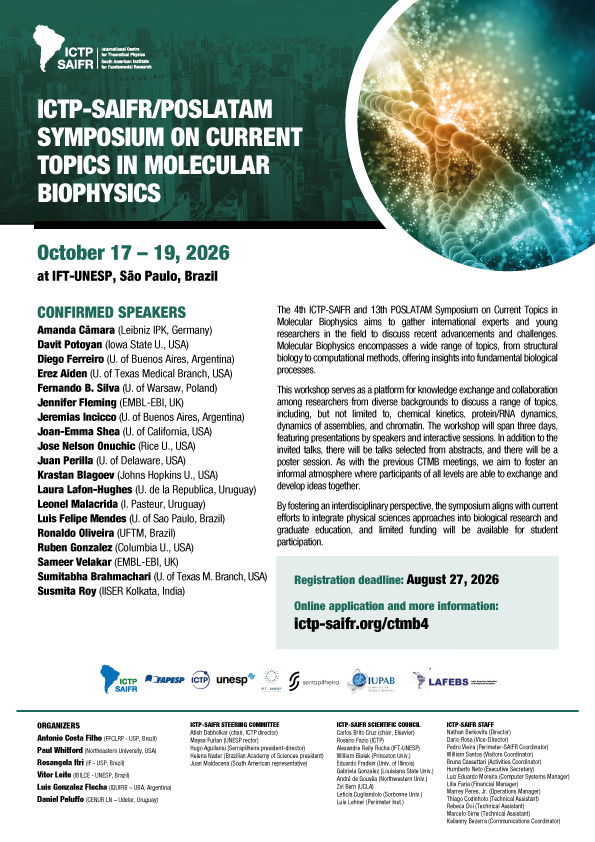
ICTP-SAIFR/POSLATAM Symposium on Current Topics in Molecular Biophysics (CTMB4)


October 17 – 19, 2026
São Paulo, Brazil
ICTP-SAIFR/IFT-UNESP
Home
The 4th ICTP-SAIFR and 13th POSLATAM Symposium on Current Topics in Molecular Biophysics aims to gather international experts and young researchers in the field to discuss recent advancements and challenges. Molecular Biophysics encompasses a wide range of topics, from structural biology to computational methods, offering insights into fundamental biological processes. This workshop serves as a platform for knowledge exchange and collaboration among researchers from diverse backgrounds to discuss a range of topics, including, but not limited to, chemical kinetics, protein/RNA dynamics, dynamics of assemblies, and chromatin. The workshop will span three days, featuring presentations by speakers and interactive sessions. In addition to the invited talks, there will be talks selected from abstracts, and there will be a poster session. As with the previous CTMB meetings, we aim to foster an informal atmosphere where participants of all levels are able to exchange and develop ideas together.
By fostering an interdisciplinary perspective, the symposium aligns with current efforts to integrate physical sciences approaches into biological research and graduate education, and limited funding will be available for student participation.
Organizers:
- Antonio Costa Filho (FFCLRP – USP, Brazil)
- Paul Whitford (Northeastern University, USA)
- Rosangela Itri (IF – USP, Brazil)
- Vitor Leite (IBILCE – UNESP, Brazil)
- Luis Gonzalez Flecha (IQUIFIB – UBA, Argentina)
- Daniel Peluffo (CENUR LN – Udelar, Uruguay)
Announcement:
Application is now closed
Speakers
- Erez L Aiden (University of Texas Medical Branch, USA)
- Ruben Gonzalez (Columbia University, USA)
- Sumitabha Brahmachari (University of Texas Medical Branch, USA)
- Jennifer Fleming (EMBL-EBI, UK)
- Ronaldo Oliveira (UFTM, Brazil)
- Davit Potoyan (Iowa State University, USA)
- Juan Perilla (University of Delaware, USA)
- Diego Ferreiro (University of Buenos Aires, Argentina))
- Jeremias Incicco (University of Buenos Aires, Argentina)
- Laura Lafon-Hughes (Universidad de la Republica, Uruguay)
- Leonel Malacrida (Institut Pasteur, Uruguay)
- Luis Felipe Santos Mendes (University of Sao Paulo, Brazil)
- Jose Nelson Onuchic (Rice University, USA)
- Garegin Papoian (University of Maryland, USA)
- Joan-Emma Shea (University of California, Santa Barbara, USA)
- Sameer Velakar (EMBL-EBI, UK)
- Susmita Roy (IISER Kolkata, India)
- Fernando B. Silva (University of Warsaw, Poland)
- Vinicius Contessoto (Rice University, USA)
Registration
Program
Participants
Posters
1st POSTER SESSION
Saturday, October 17
- 1. Acuña Tellez, Juan Sebastian (Universidad distrital Francisco Jose de Caldas, Colombia): Conformational Characterization in the NIS Symporter: Order Parameter for Alpha Helices and Lipids
The importance of studying the Na⁺/I⁻ symporter (NIS) lies in its fundamental role in human physiology, as it mediates the active transport of iodide ions into the thyroid gland. This process is the first step in the biosynthesis of thyroid hormones, which are of vital importance for the regulation of cellular metabolism at all stages of life, as well as for embryonic and nervous system development. Its ability to transport diverse substrates and isotopes has positioned it as a key tool in advanced medical imaging techniques, as well as in the treatment of thyroid cancer. Currently, kinetic and structural experimental studies are available, the latter primarily obtained through X-ray diffraction crystallography and cryogenic electron microscopy (cryo-EM). Over the last two decades, with the aid of these studies, the transport mechanism of through NIS has been proposed, which still possesses steps that are not completely− understood in a comprehensive manner from a biochemical, structural, and biothermodynamic perspective. For these reasons, molecular dynamics (MD) simulations are highly beneficial, as they have been shown to provide complementary information for this type of problem. To this end, MD trajectories have been generated in the NPT ensemble on the order of microseconds. The structural configurations of this simulation include a high-resolution NIS structure embedded in a membrane with highly physiological characteristics, along with concentrations of chloride, sodium, potassium, and iodide ions, as well as rhenium. This simulation also includes electrical potentials in order to model the entire system in a highly realistic environment. From this, it has been possible to verify some of the intermediate conformations initially proposed for the transport mechanism in NIS. Furthermore, the simulation suggests the presence of, apart from independent conformational changes, other types of movements identified as concerted conformational changes. For this reason, in this study we aim to verify (work in progress) this type of concerted molecular movements using a statistical mechanical order parameter that will eventually allow us to find these correlations. mediante un parámetro de orden mecánico estadístico que eventualmente nos va a permitir encontrar dichas correlaciones. [1] Ravera, S., Nicola, J. P., Salazar de Simone, G., Sigworth, F. J., Karakas, E., Amzel, L. M., Bianchet, M. A., & Carrasco, N. (2022). Structural insights into the mechanism of the sodium/iodide symporter (NIS). Nature, 612(7941), 795-801. https://doi.org/10.1038/s41586-022-05530-2 Palabras clave dinámica molecular, NIS, simportador de , cambio conformacional,−+ parámetro de orden. Abstract The importance of studying the Na⁺/I⁻ symporter (NIS) lies in its fundamental role in human physiology, as it mediates the active transport of iodide ions into the thyroid gland. This process is the first step in the biosynthesis of thyroid hormones, which are of vital importance for the regulation of cellular metabolism at all stages of life, as well as for embryonic and nervous system development. Its ability to transport diverse substrates and isotopes has positioned it as a key tool in advanced medical imaging techniques, as well as in the treatment of thyroid cancer. Currently, kinetic and structural experimental studies are available, the latter primarily obtained through X-ray diffraction crystallography and cryogenic electron microscopy (cryo-EM). Over the last two decades, with the aid of these studies, the transport mechanism of through NIS has been proposed, which still possesses steps that are not completely− understood in a comprehensive manner from a biochemical, structural, and biothermodynamic perspective. For these reasons, molecular dynamics (MD) simulations are highly beneficial, as they have been shown to provide complementary information for this type of problem. To this end, MD trajectories have been generated in the NPT ensemble on the order of microseconds. The structural configurations of this simulation include a high-resolution NIS structure embedded in a membrane with highly physiological characteristics, along with concentrations of chloride, sodium, potassium, and iodide ions, as well as rhenium. This simulation also includes electrical potentials in order to model the entire system in a highly realistic environment. From this, it has been possible to verify some of the intermediate conformations initially proposed for the transport mechanism in NIS. Furthermore, the simulation suggests the presence of, apart from independent conformational changes, other types of movements identified as concerted conformational changes. For this reason, in this study we aim to verify (work in progress) this type of concerted molecular movements using a statistical mechanical order parameter that will eventually allow us to find these correlations.
- 2. Adolfo, Larissa Maria Ferreira (Sao Paulo State University (UNESP), Brazil)
Proteins explore multidimensional energy surfaces composed of multiple metastable states and kinetic barriers that govern folding and conformational reorganization processes. Characterizing these energy landscapes from molecular dynamics simulations remains a major challenge due to the high dimensionality of the generated data. The Energy Landscape Visualization Method (ELViM) was developed to project high-dimensional conformational ensembles into lower-dimensional spaces using exclusively structural information, enabling the identification of metastable states and multiple transition pathways without requiring predefined reaction coordinates. However, as with other dimensionality reduction approaches, strictly two-dimensional projections may introduce geometric ambiguities and hinder the physical interpretation of the underlying energy landscape. Here, we present a new extension of ELViM, termed the Tomographic Dimension, designed to reconstruct energy landscapes with enhanced physical fidelity. This approach incorporates a physically meaningful reaction coordinate as an additional fixed dimension during the projection process. While this dimension explicitly represents the progression along the conformational process of interest, the remaining coordinates are iteratively optimized to preserve both the original structural relationships and the constraint imposed by the additional coordinate. The resulting three-dimensional representation organizes the conformational ensemble into distinct “tomographic slices,” allowing the distribution of conformational states to be visualized along a physically interpretable axis. The proposed methodology promotes a clearer separation of conformational funnels, improves the identification of metastable states, and reduces ambiguities inherent to conventional two-dimensional projections. Furthermore, it enables a more intuitive reconstruction of the energy landscape topology, bringing computational visualization closer to the classical folding-funnel framework. The method has been implemented as an open-source, platform-independent tool, broadening its applicability to the investigation of complex biomolecular processes, including protein folding, conformational transitions, and molecular association mechanisms. By integrating structural similarity with physically relevant reaction coordinates, this framework provides a powerful and general strategy for the visualization and interpretation of multidimensional biomolecular energy landscapes.
- 3. Anhesini, Dante Arroyo (Universidade Estadual Paulista “Júlio de Mesquita Filho”, Brazil): The Effects of Specific Residues Protonation in Adsorbed Lysozyme Orientation on a Negatively Charged Surface
Recent studies addressing hen-egg white lysozyme (HEWL) adsorption onto charged surfaces show that an orientation transition of the adsorbed protein is potentially associated with the deprotonation of specific tyrosine residues. This transition occurs at a lower pH in fixed-charge models compared to charge regulation (CR), due to surface-induced stabilization of the protonated states. Identifying these key ionizable residues is therefore essential for rational protein design and for optimizing surface-bound enzymes and biosensors. Here, we investigate the mechanistic role of these key tyrosine residues in the adsorption behavior of HEWL onto a negatively charged surface. Using coarse-grained constant-pH Monte Carlo simulations, we analyze an engineered HEWL variant in which the titratable residues TYR20 and TYR23 are replaced by non-chargeable amino acids. By systematically comparing fixed-charge and charge-regulation models, this work evaluates the hypothesis that suppressing this local negative charge patch affects the pH-induced inversion of oriented states. The comparison between CR and fixed-charge orientational profiles across a broad pH range provides direct insights into the molecular triggers governing the orientational shift. Overall, this study demonstrates how targeted mutations can be leveraged to design surface-active proteins with orientationally stable profiles under varying pH conditions.
- 4. Aquino Queirós, Marcos Vinícius (Instituto de Química/Unicamp, Brazil): Partitioning of alpha-synuclein into protein condensates
Protein-based biomolecular condensates are widely recognized to be important in several cellular processes. Among the proteins capable of forming condensates, the presynaptic intrinsically disordered protein alpha-synuclein has received considerable attention due to its phase separating properties and its association with Parkinson’s disease. Molecular chaperones have also been widely reported to prevent the amyloid aggregation of alpha-synuclein and to participate in biomolecular condensates. We generated condensates through the phase separation of several proteins, including molecular chaperones, in the presence of poly(ethylene glycol) (PEG), which is commonly used to mimic crowding effects. We then investigated the partitioning of alpha-synuclein into those condensates. Our results indicate that alpha-synuclein exhibits non-selective localization irrespective of the proteins tested. These findings may help elucidate the molecular mechanisms underlying protein partitioning within biomolecular condensates.
- 5. Belarmino De Souza Júnior, Ricardo (UNESP, Brazil): On the Role of Electrostatics in the Binding Mechanism of Glycosaminoglycans to SARS-CoV-2 N-NTD.
The nucleocapsid (N) protein of SARS-CoV-2 is essential for viral genome stabilization and replication, a process in which its N-terminal domain (N-NTD) plays a crucial role. Glycosaminoglycans (GAGs), such as heparins and chondroitins, have shown potential to destabilize the N-NTD and compete with viral RNA. In this work, we investigate the role of electrostatic (ES) forces in ligand-protein binding using coarse-grained Monte Carlo simulations based on a Cɑ Structure-Based Model (SBM) and Debye-Hückel theory. We calculated the ES binding energies and local probability distributions for heparins (4.5, 6.0, and 17.0 kDa) and chondroitins (40 and 60 kDa) modeled as negatively charged polyelectrolytes. Heparins exhibited stronger attraction to the N-NTD than chondroitins, due to their higher negative charge density. For chondroitins, longer chain lengths did not lead to proportional increases in binding energy because the Debye screening length (κ-1 ≈ 20 Å) is significantly shorter than the polymer chains. Probability distribution analysis revealed that both GAG ligands interact preferentially with Arg92 and His59, two residues located in important positively charged regions of the N-NTD, in agreement with chemical shift perturbation data. Overall, our results suggest that ES forces act as the guiding mechanism for initial protein-ligand binding, whereas the overall thermodynamic stability observed experimentally likely arises from solvation and entropic contributions not explicitly captured in this model. These insights elucidate key molecular details for the rational design of ES-targeted antiviral inhibitors.
- 6. Bleicher, Lucas (Universidade Federal de Minas Gerais, Brazil): The uric acid degradation pathway – an evolutionary biophysics investigation
Purine metabolism generate uric acid, which in most organisms is processed by its degradation to 5-hydroxy-isourate, then OHCU and finally S-allantoin. This pathway was lost in primate evolution, first by the pseudogenization of the uricase coding gene, followed by the loss of the upstream genes in the pathway. The second enzyme in this pathway, HIUase, suffered a duplication in early chordates giving rise to transthyretin, also a very interesting subject for evolutionary biophysics investigation as it presents multiple known functions and can also form amyloid fibers. Our group and Eric Gaucher’s studied the first two enzymes in the uric acid degradation pathway by ancestral sequence reconstruction, our collaborator Mariana Quezado is currently studying the third enzyme in the pathway, OHCU decarboxylase, and the evolution of the poorly understood protease function in transthyretins is also currently being investigated in our group. We will present a panel of how this interesting protein family can be studied using computational and experimental methods in molecular evolution and biophysics.
- 7. Bolli, Julia (UFSCar, Brazil): Chirality-dependent modulation of dimeric protein-protein interactions by nanoparticles: a molecular dynamics study
Protein-protein interactions are dynamically regulated by the molecular environment, and chiral nanomaterials may modulate these interactions through their stereochemistry and binding to specific protein surfaces. Here, we investigated how nanoparticle presence and chirality affect the interaction landscape of dimeric protein systems using all-atom molecular dynamics simulations. Five protein dimers were simulated for 1 μs using the CHARMM36 force field in GROMACS 2025.1 under three conditions: apo (protein only), and in the presence of two identical CuS-penicillamine (Pen) nanoparticles (NPs)[1] with either L-Pen or D-Pen chirality, resulting in 15 simulations. Temporal analyses using 100 ns windows evaluated protein-protein and protein-NP interaction energies, hydrogen bonding, residue-level contacts, RMSD, and radius of gyration, allowing the effects of NP presence and chirality to be assessed at both interaction and structural levels. The simulations revealed markedly protein- and chirality-dependent responses. For the Rac2–RhoGDI2 complex, NP binding was associated with pronounced structural stabilization: RMSD and radius of gyration decreased for both L- and D-NP, while the protein-protein interaction became more favorable and hydrogen bonding increased. Residue-level contacts remained concentrated in the same dimer interface regions, although contact fractions and residue rankings varied between conditions, indicating local rearrangements within a persistent interface. For Cathepsin X, NP binding increased RMSD while radius of gyration remained essentially unchanged, indicating conformational rearrangement without substantial changes in global compactness. In contrast, mitochondrial branched-chain amino acid aminotransferase (BCAT2) and the TACE–TIMP-3 complex displayed high structural stability with only minor changes in RMSD and radius of gyration. In BCAT2, the L-NP condition produced the most favorable chain-chain interaction among the investigated systems, whereas in TACE–TIMP-3 the D-NP condition was more favorable and was accompanied by increased hydrogen bonding. Residue-level contacts in the TACE–TIMP-3 complex were highly persistent, particularly in the TIMP-3 chain, where a conserved CYS–THR–CYS–SER interface region remained highly contacted after nanoparticle binding. For Fis1, both L- and D-NP reduced RMSD and radius of gyration while weakening the chain-chain interaction, indicating that structural stabilization can occur without strengthening the dimer interface. Overall, the results demonstrate that chiral CuS-Pen NPs modulate dimeric protein interactions in a strongly system-dependent manner. The combined energetic, hydrogen-bonding, residue-contact, RMSD, and radius of gyration profiles indicate that NP binding can promote interface stabilization, induce internal conformational rearrangements, or stabilize the protein without strengthening the dimer interface, depending on protein architecture and NP chirality. These findings highlight the joint role of protein architecture and nanoparticle chirality in determining the dynamic response of protein dimers to nanomaterial binding. [1] GAO, R.; XU, X.; KUMAR, P.; LIU, Y.; ZHANG, H.; GUO, X.; SUN, M.; COLOMBARI, F. M.; DE MOURA, A. F.; HAO, C.; MA, J.; EMRE, E. S. T.; CHA, M.; XU, L.; KUANG, H.; KOTOV, N. A.; XU, C. Tapered chiral nanoparticles as broad-spectrum thermally stable antivirals for SARS-CoV-2 variants. Proc. Natl. Acad. Sci. U. S. A., 121 (13), 2024.
- 8. Bueno De Camargo, Juliana (Instituto de Biociências, Letras e Ciências Exatas, Brazil): COMPUTATIONAL INVESTIGATION OF INTRINSICALLY DISORDERED PROTEIN–MEMBRANE INTERACTIONS
Antimicrobial peptides interact with biological membranes through a combination of electrostatic attraction, hydrophobic interactions, and conformational adaptation, but the molecular determinants governing their membrane activity remain incompletely understood. Here, we investigate the molecular basis of the differential membrane interaction of three MK peptide analogs, MK4589, MK5789, and MK4578911, combining experimental data with atomistic molecular dynamics simulations. Experimental studies have shown distinct membrane-disruptive activities among these peptides, with MK4589 exhibiting the highest leakage activity and a pronounced transition toward an α-helical conformation upon interaction with anionic membranes. To investigate the structural and energetic features underlying these differences, we performed all-atom molecular dynamics simulations for each peptide in both aqueous solution and a model lipid membrane. Three independent replicas were generated for each peptide in each environment, allowing the conformational behavior and peptide–membrane interactions to be sampled across multiple trajectories. The simulations were subsequently analyzed to characterize peptide conformational dynamics, membrane association, insertion, residue-specific interactions, hydrogen-bonding patterns, and the molecular organization of the peptide at the membrane interface. In addition, the simulation trajectories were subjected to Energy Landscape Visualization Method (ELViM) analysis to investigate the conformational landscapes and identify the major structural states sampled by each peptide. This computational approach provides a molecular-level framework for connecting peptide sequence and structural properties with membrane interaction and disruption. By combining atomistic simulations with conformational landscape analysis and experimental observations, this study aims to elucidate the structural and energetic determinants governing the distinct membrane behaviors of MK peptide analogs.
- 9. Caetano, Ricardo De Paiva (Ibilce – Instituto de Biociências, Letras e Ciências Exatas – Câmpus de São José do Rio Preto – Unesp, Brazil): De novo design of cyclic peptides guided by AI tools for the nucleoprotein/phosphoprotein binding site in the N-terminal domain of the nucleocapsid protein of human Metapneumovirus
Human Metapneumovirus (hMPV) is an etiological agent of global relevance associated with severe acute respiratory infections, such as bronchiolitis and pneumonia, particularly in children, the elderly, and immunocompromised individuals. Despite its significant health burden, there are currently no licensed vaccines or specific antiviral therapies for hMPV infections, highlighting a critical therapeutic gap. The replicative cycle of hMPV depends on the molecular interaction between the nucleoprotein (N) and the phosphoprotein (P), mediated by a six-residue C-terminal segment of the P protein (Ile289–Met294) that inserts into a hydrophobic and electrostatically complementary pocket in the N-terminal domain of the nucleoprotein (N-NTD). The pharmacological disruption of this protein-protein interface (PPI) represents a promising antiviral strategy. The present project proposes the de novo computational design of cyclic peptides with high affinity and specificity targeting the binding pocket in the N-NTD of hMPV, using an integrated artificial intelligence pipeline composed of RFdiffusion, ProteinMPNN, and AlphaFold2, followed by validation through molecular dynamics (500 ns, triplicate) and binding free energy calculations via MM-GBSA and Umbrella Sampling. It is expected to identify approximately five lead sequences with steric and chemical complementarity superior to the natural reference peptide, constituting candidate blockers of the hMPV N/P interaction for future synthesis and experimental validation.
- 10. Catanoce, Gustavo De Souza (UNESP, Brazil): INVESTIGATING THE CONFORMATIONAL CHANGES OF THE C-TERMINAL DOMAIN OF THE TRANSCRIPTION ANTITERMINATION PROTEIN RfaH
Metamorphic proteins are characterized by their ability to adopt more than one native conformation. A example is the Escherichia coli transcription antitermination protein RfaH, which regulates toxin gene expression by switching its C-terminal domain (CTD) between a two α-helix hairpin and a five β-strand barrel. However, the structural pathways describing this switch-folding remain poorly understood. In this study, we performed molecular dynamics simulations of the RfaH-CTD domain using the AWSEM force field to investigate its switch-folding mechanism. To map conformational changes across trajectories, we utilized the Energy Landscape Visualization Method (ELViM) developed by our group to project the protein phase space into 2D and 3D representations. Landscape analysis revealed distinct structural pathways across four simulated conditions. The α→β transition initiates through the nucleation of the three central β-strands of the barrel, whereas the β→α transition proceeds via an intermediate with helical structures. Unfolded→β simulations corroborate the αβ folding pathway while populating transient helical structures. Finally, unfolded-α simulations indicate that the longer α-helix forms first, followed by the assembly of the shorter helix. Overall, this study provides results detailing possible conformational changes presented by the CTD domain. This work was supported by Fundação de Amparo à Pesquisa do Estado de São Paulo (#2025/27919-1)
- 11. Chiappinelli, Matías Daniel (Universidad Nacional de Quilmes, Argentina): Impact of Mutations at Evolutionarily Conserved Sites on the Conformational Dynamics of Tandem-Repeat Proteins
Tandem-repeat proteins (TRPs) are composed of arrays of repeating structural units that assemble into extended, superhelical, or horseshoe-shaped architectures stabilized mainly by short-range interactions. Their distinctive sequence–structure–dynamics–function relationships have been extensively studied to understand the molecular principles that distinguish them from globular proteins. Here, we investigate how mutations affect the conformational mechanics of PR65, the HEAT-repeat scaffold of protein phosphatase 2A (PP2A), which acts as an elastic connector between its catalytic and regulatory subunits. Using computational approaches to characterize collective conformational changes, we found that the impact of mutations on the dynamics associated with PR65 binding to the catalytic subunit correlates with evolutionary conservation. Our results also reveal a common pattern among repeat units in the way mutations perturb collective dynamics, while highlighting differences associated with the specific functional role of individual units. Thus, although mutations in different repeats share a common influence on the global dynamics of the protein, their local contribution to function introduces additional variability in their effects. Interestingly, these relationships are not observed for the subsequent conformational changes occurring during binding of the PR65–catalytic subunit complex to the regulatory subunit. These findings highlight both shared and unit-specific features in how mutations modulate the conformational dynamics of tandem-repeat proteins. More broadly, they contribute to understanding the interplay between evolutionary conservation, conformational dynamics, and function in modular protein architectures.
- 12. Dos Santos, Barbara Salustiano (Unesp/IBILCE, Brazil): Solutions to the Schrödinger equation with an asymptotically linear potential
We determine the solutions to the Schrödinger equation for an asymptotically linear potential. Analytical solutions for the ground states for each quantum number l are obtained using the quantum supersymmetry formalism. This formalism supplies a trial wave function to be used in the variational method to calculate the excited states.
- 13. Eugênio, Lucas Rafael Oliveira Santos (IFSC-USP, Brazil): Structural and Biophysical Insights into the NtRH35–SCI1 Interaction
Coordinated plant development relies on the precise control of cell proliferation and differentiation within the floral meristem, mediated by transcriptional and post-transcriptional regulatory networks. The SCI1 protein (Stigma/Style Cell-Cycle Inhibitor 1) is a key regulator of cell proliferation in floral meristems and directly interacts with RH35, a DEAD-box RNA helicase homologous to human DDX41 and involved in RNA splicing. To elucidate the function of Nicotiana tabacum RH35 (NtRH35) in comparison to human DDX41 and to clarify the role of SCI1 in this pathway, this study integrates structural and functional approaches. Using ITC, fluorescence microscopy, and X-ray crystallography, we determined high-affinity binding constants, visualized protein condensate formation, and investigated the structural basis of the interaction, providing insights into the NtRH35–SCI1 complex.
- 14. Favaro Fuzari, Pedro Henrique (Ibilce – Instituto de Biociências, Letras e Ciências Exatas, Brazil): EXPLORING THE MECHANISM OF ACTION OF THE SYNTHETIC PEPTIDE E-MP1 ON BACTERIAL MEMBRANE MODELS THROUGH MOLECULAR DYNAMICS AND CONSTANT PH SIMULATIONS
Antibiotic resistance is a major public health problem worldwide, reducing the efficacy of conventional treatments. To address this issue, antimicrobial peptides (AMPs) emerge as a promising alternative. AMPs are small molecules of 5 to 50 amino acids that form part of the natural defense system against infections. Most AMPs have a positive charge, which facilitates their attraction to negatively charged bacterial membranes. Their structure also allows them to easily insert into the lipid bilayer. Polybia-MP1 (MP1), a peptide derived from the venom of the wasp Polybia paulista, stands out for its strong antibacterial activity. MP1 has no structure in aqueous solution, but upon binding to the membrane surface, it adopts an $\alpha$-helical conformation. This change enables the peptide to insert into the bacterial membrane, destabilizing its structure, forming pores, and leading to cell death. In addition, acidic conditions generated by bacterial membranes can alter the charge of specific amino acids, influencing peptide function. To investigate a possible increase in structural stability, aspartic acid residues were replaced with glutamic acid, giving rise to the synthetic variant E-MP1. In this work, we used conventional molecular dynamics and Constant pH Molecular Dynamics (CpHMD) simulations to evaluate the structural and electrostatic effects of this substitution. Through analyses such as peptide-to-membrane distance, secondary structure stability, salt bridge interactions, and protonation profiles, we evaluated the antimicrobial potential of the E-MP1 peptide.Antibiotic resistance is a major public health problem worldwide, reducing the efficacy of conventional treatments. To address this issue, antimicrobial peptides (AMPs) emerge as a promising alternative. AMPs are small molecules of 5 to 50 amino acids that form part of the natural defense system against infections. Most AMPs have a positive charge, which facilitates their attraction to negatively charged bacterial membranes. Their structure also allows them to easily insert into the lipid bilayer. Polybia-MP1 (MP1), a peptide derived from the venom of the wasp Polybia paulista, stands out for its strong antibacterial activity. MP1 has no structure in aqueous solution, but upon binding to the membrane surface, it adopts an $\alpha$-helical conformation. This change enables the peptide to insert into the bacterial membrane, destabilizing its structure, forming pores, and leading to cell death. In addition, acidic conditions generated by bacterial membranes can alter the charge of specific amino acids, influencing peptide function. To investigate an increase in structural stability, aspartic acid residues were replaced with glutamic acid, giving rise to the synthetic variant E-MP1. In this work, we used conventional molecular dynamics and Constant pH Molecular Dynamics (CpHMD) simulations to evaluate the structural and electrostatic effects of this substitution. Through analyses such as peptide-to-membrane distance, secondary structure stability, salt bridge interactions, and protonation profiles, we evaluated the antimicrobial potential of the E-MP1 peptide.
- 15. Ferrari Chiaranda, João Rodolfo (UNESP, Brazil): Synthesis and optical characterization of gold nanoparticles for biomarker applications
The continuous exposure to agrochemicals triggers severe oxidative stress in biological systems, highlighting glutathione (GSH) as a primary cellular redox biomarker. Developing Surface-Enhanced Raman Scattering (SERS) platforms is essential for tracing GSH at sublethal levels. However, the biophysical interactions at the metal-molecule interface dictate the sensor’s viability and signal amplification. This study investigates the interfacial behavior and colloidal dynamics of citrate-capped gold nanoparticles (AuNPs) when exposed to a standard Raman probe (Rhodamine 6G – R6G) and the biological target (GSH). The localized surface plasmon resonance (LSPR) shifts were systematically monitored via UV-Vis spectroscopy. UV-Vis data confirmed the successful synthesis of stable colloidal AuNPs, with the LSPR band centered at 524 nm. Assays with the model probe demonstrated exceptional plasmonic sensitivity; the electrostatic interaction between R6G and the nanoparticles induced controlled aggregation (evidenced by a secondary band at 650 nm), indicating the generation of possible electromagnetic hotspots. Conversely, direct interaction with GSH revealed a distinct phenomenon. While a profound hypsochromic shift in the deep UV region (from 206 nm to 198 nm) confirmed the tethering of GSH to the gold surface via Au-S bonding, colloid aggregation did not occur. The GSH monolayer effectively shielded the nanoparticles, locking the LSPR band at 522 nm and completely inhibiting aggregation. At 522 nm, the AuNPs–R6G system exhibited an approximately linear increase in extinction with increasing concentration, enabling R6G detection with an LOD of 1.11 µmol L⁻¹. In contrast, the extinction of the AuNPs–GSH system remained nearly constant, indicating no analytical response to GSH at this wavelength and greater colloidal stability resulting from Au–S interactions. These findings establish a crucial biophysical baseline, and underscore the need for rationally designed surface functionalization, potentially incorporating bifunctional linkers, to tune interfacial electrostatic interactions, promote controlled plasmonic coupling, and enable sensitive and selective SERS detection of GSH.
- 16. Ferraz Souza, José Eduardo (Department of Physics – IBILCE/UNESP, Brazil): Fluorescence Spectral Phasor Analysis of Polybia-MP1 Peptides in Lipid Vesicles
Laurdan generalized polarization (GP) is widely used to assess lipid packing and membrane order in model membranes. However, because conventional GP analysis relies on intensities at two selected wavelengths, it may overlook spectral changes not adequately captured by blue- and red-shifted emission contributions. Spectral phasor analysis, which maps the entire emission spectrum onto a model-free (G, S) plane, offers a complementary and potentially more sensitive readout of membrane order. Here, we applied spectral phasor analysis to Laurdan-labeled large unilamellar vesicles (LUVs) composed of E. coli polar lipid extract, in the absence and presence of the wasp-derived antimicrobial peptide Polybia-MP1 and four related analogues in which individual lysine residues were replaced by histidine. This design allowed us to investigate how the position of histidine influences peptide-induced membrane perturbations while maintaining the same net charge. Phasor coordinates were obtained across a temperature series (20, 37, 60 °C) and, independently, across a lipid-titration series. For each dataset, we fitted the phasor trajectory of the peptide-free LUV reference and decomposed every peptide-containing phasor point into two orthogonal components relative to this trajectory: a component along the line, equivalent to the classical lever rule and quantifying the ordered/disordered fraction, and a perpendicular component quantifying deviation from ideal two-state mixing. The peptide-free LUV trajectory was essentially linear across temperature (fit residuals ~10⁻⁴), consistent with simple two-state thermal behavior. Four of the five peptides remained close to this trajectory, indicating that they modulate the same ordered/disordered equilibrium already present in the peptide-free membrane. MP1, in contrast, showed a perpendicular deviation five- to fifty-fold larger than any other peptidetemperature combination, most pronounced at 60 °C, despite a comparatively modest change in classical GP alone — a distinction invisible to the two-point ratiometric metric. Titrationseries phasor data are currently being processed under the same lever-rule/deviation framework, and experiments are underway to define a third reference state, to test whether MP1’s deviation reflects a genuine three-component mixing regime describable by a tietriangle. In this work, we applied an explicit orthogonal deviation metric to Laurdan spectral phasors across lipid titrations, complementing recent ternary-phasor approaches developed for classifying intrinsic lipid mesophases.
- 17. Filho, Vicente Christiano (Instituto de Biociências, Letras e Ciências Exatas – Câmpus de São José do Rio Preto|UNESP, Brazil): Analysis of the Leptin Folding Energy Landscape: Implications Arising from the Pierced-Lasso Topology
This project investigates the folding of leptin, a biologically relevant protein due to its role in regulating appetite and energy metabolism. Leptin has a unique structure known as Pierce-Lasso Topology (PLT), characterized by a crucial threaded loop in its folding mechanism. Using structure-based models and the Energy Landscape Visualization Method (ELViM), this study aims to determine the impact of N-terminal segment variation on the distribution of slipknot and plug folding pathways. The primary goal is to identify an N-terminal length that balances these pathways and predict mutations that can be experimentally tested in collaboration with the University of Hawaii. The methodology involves computational simulations using coarse-grained models, thermodynamic analysis via WHAM, and structural visualization with tools such as VMD and UCSF Chimera. This research will contribute to a deeper understanding of fundamental principles in protein topology and the advancement of protein design with modified structural properties.
- 18. Giordano Viegas, Rafael (Instituto Federal de Educação, Ciência e Tecnologia de São Paulo (IFSP/Catanduva)., Brazil): Comparing Intrinsically Disordered Protein Ensembles with the Energy Landscape Visualization Method (ELViM)
Intrinsically disordered proteins (IDPs) populate complex energy landscapes characterized by broad and heterogeneous conformational distributions without a single dominant native basin. Integrative approaches combining computational modeling with experimental data have been used to determine conformational ensembles of IDPs, such as those deposited in the Protein Ensemble Database (PED). However, characterizing and comparing structural heterogeneity across these ensembles remains challenging. Here, we apply the Energy Landscape Visualization Method (ELViM) to investigate ensembles of the Nup153 NUS fragment and the N-terminal SH3 domain of Drk. This method provides a common low-dimensional representation of conformational ensembles, enabling direct comparison of their occupancy patterns and preferentially populated regions. The analysis reveals distinct conformational distributions even among ensembles sharing similar ensemble-averaged observables or derived from different initial conformer pools. Furthermore, this low-dimensional mapping supports the selection of representative structures and complementary structural analyses, enabling interactive exploration of IDP ensembles. ELViM thus complements integrative ensemble determination and supports the identification of conformational features that may underlie molecular function.
- 19. Guimarães, Haline Honório Bannitz (Federal University of São Paulo (UNIFESP), Brazil): FORMATION OF FIBRILS BY THE AMYLOID PEPTIDE Aβ (25–35) IN THE PRESENCE OF LIPOSOMES
Alzheimer’s disease is a leading cause of dementia, and its onset has been directly associated with the formation of amyloid plaques in brain tissue. It is currently accepted that the propensity of β-amyloid peptides to form fibrillar aggregates based on β-pleated structures is the main precursor to the disease. Here, we aim to study the interaction of the Aβ (25–35) peptide—the smallest β-amyloid fragment with a propensity for fibril formation—with membrane models (large unilamellar vesicles, LUVs) composed of phosphatidylcholine (POPC). First, we investigated the propensity of the Aβ (25–35) peptide to form fibrillar aggregates in the absence of liposomes using the thioflavin T (ThT) fluorescence assay over 48 hours. Concomitantly, 90° light scattering measurements were performed on the same samples to assess aggregate formation. After 48 hours, aggregate size and zeta potential were determined by Dynamic Light Scattering (DLS) and electrophoretic mobility measurements. Aggregate morphology was visualized by optical and fluorescence microscopy. The ThT kinetic assays revealed that Aβ(25–35) fibril formation is concentration-dependent (10 µM to 100 µM), with higher peptide concentrations leading to increased fluorescence intensity over 48 hours. The kinetic profile exhibited a classical sigmoidal curve: a lag phase during the first 5 hours, an exponential growth phase extending up to 24 hours and a plateau phase between 24 and 48 hours. DLS measurements revealed that aggregate size reached the micrometer scale, while zeta potential values were consistently negative. Optical microscopy showed heterogeneous aggregate morphology (typical fibrillar and amorphous structures). Then, the effect of the presence of POPC (0.5mM) liposomes on fibril formation of the Aβ (25–35) was investigated. Notably, it increased ThT fluorescence compared to peptide alone, indicating enhanced fibril formation, while the classical sigmoidal profile was preserved. Zeta potential and microscopy had no significant changes observed across samples. Finally, the interaction between Aβ (25–35) and POPC LUVs was studied with isothermal titration calorimetry (ITC), which directly measures the enthalpy of the interaction process and helps clarify the thermodynamic nature of the interaction. We conclude that POPC LUVs influence and modulate the aggregation pathway of the Aβ (25–35) peptide.
2nd POSTER SESSION
Sunday, October 18
- 1. Herrera Martinez, Laura Yeraldin (Universidad Distrital Francisco José de Caldas, Colombia): Conformational Characterization in the NIS Symporter: Order Parameter for Alpha Helices and Lipids
The importance of studying the Na⁺/I⁻ symporter (NIS) lies in its fundamental role in human physiology, as it mediates the active transport of iodide ions into the thyroid gland. This process is the first step in the biosynthesis of thyroid hormones, which are of vital importance for the regulation of cellular metabolism at all stages of life, as well as for embryonic and nervous system development. Its ability to transport diverse substrates and isotopes has positioned it as a key tool in advanced medical imaging techniques, as well as in the treatment of thyroid cancer. Currently, kinetic and structural experimental studies are available, the latter primarily obtained through X-ray diffraction crystallography and cryogenic electron microscopy (cryo-EM). Over the last two decades, with the aid of these studies, the transport mechanism of I- through NIS has been proposed, which still possesses steps that are not completely understood in a comprehensive manner from a biochemical, structural, and biothermodynamic perspective. For these reasons, molecular dynamics (MD) simulations are highly beneficial, as they have been shown to provide complementary information for this type of problem. To this end, MD trajectories have been generated in the NPT ensemble on the order of microseconds. The structural configurations of this simulation include a high-resolution NIS structure embedded in a membrane with highly physiological characteristics, along with concentrations of chloride, sodium, potassium, and iodide ions, as well as rhenium. This simulation also includes electrical potentials in order to model the entire system in a highly realistic environment. From this, it has been possible to verify some of the intermediate conformations initially proposed for the transport mechanism in NIS. Furthermore, the simulation suggests the presence of, apart from independent conformational changes, other types of movements identified as concerted conformational changes. For this reason, in this study we aim to verify (work in progress) this type of concerted molecular movements using a statistical mechanical order parameter that will eventually allow us to find these correlations.
- 2. Leal Rojas, Melanie Andrea (Universidad Distrital Francisco Jose de Caldas, Colombia): DESIGN OF AN IN VITRO IRRADIATION PROTOCOL WITH DOSIMETRIC CONTROL APPLIED TO THE STUDY OF PULMONARY SURFACTANT
Pulmonary surfactant (PS) is a lipoprotein complex essential for respiratory mechanics, composed of approximately 10% specific proteins (SP-A, B, C, and D) and 90% lipids, with dipalmitoylphosphatidylcholine (DPPC) as its primary component. Its fundamental physical function is to regulate the alveolar air-liquid interface, reducing surface tension and preventing pulmonary collapse. This work presents the design and validation of an experimental protocol to evaluate the disruption induced by ionizing radiation (IR) in this system under clinical radiotherapy conditions. The pulmonary surfactant was obtained through bronchoalveolar lavage of porcine lungs and subsequently prepared for use under controlled experimental conditions. From the physics of radiation interactions with matter, IR induces water radiolysis, generating reactive species (such as hydroxyl radicals ⋅OH, and aqueous electrons e⁻ₐq) that trigger lipid peroxidation processes. Previous preclinical studies show that different irradiation schemes induce comparable effects; however, they generally lack a detailed, quantitative, and reproducible dosimetric characterization. In this context, an experimental protocol is proposed that integrates physical control and methodological standardization. The experimental protocol is implemented using a clinical linear accelerator (Elekta) and includes a geometric simulation phase based on computed tomography, guaranteeing reproducible conditions with a defined source-surface distance (SSD). Three-dimensional dosimetric planning is performed in a treatment planning system (TPS), where the volume of interest is delineated and the desired doses are prescribed. Irradiation is executed using fields adjusted to the sample volume, with energies between 6 MV and 10 MV, prioritizing dose deposition homogeneity. Validation is performed through a rigorous dosimetric quality control, employing high-resolution detectors to verify the correspondence between the prescribed and delivered doses, as well as the homogeneity of the dose distribution. This protocol allows for the isolation of the direct effects of irradiation from biological variables, constituting a highly reproducible, standardized experimental tool of great value for analyzing interfacial dynamics in biophysical systems. Future projections focus on studying the alterations of the irradiated surfactant, ranging from its structural changes to its overall biophysical properties. This work was supported by Pontificia Universidad Javeriana. We thank the Medical Physics team at Hospital Universitario San Ignacio for providing the facilities and technical support.
- 3. Marcusse, Arthur Fernandes Stradiotto (Instituto de Biociências (IB)/Universidade de São Paulo (USP), Brazil): ANALYZING COMPLEX BIOLOGICAL OSCILLATIONS ACROSS DIVERSE CELL TYPES: PHENOTYPING WITH QUANTITATIVE COMPUTATIONAL METHODS
Diverse specialized plant cells exhibit oscillatory behaviors in ionic dynamics. Estimating their oscillatory parameters accurately (period, amplitude and phase) is fundamental to study their relationship to their putative functions in vivo. However, these biological oscillations are generally noisy, have fluctuating parameter values over time (i.e. are non-stationary) and may have multiple coexisting periods. To tackle these issues, the current work aimed to combine time-explicit estimates of the parameters of interest with adequate summaries at the populational level. This resulted in a pipeline named OscilloPhenotypeR whose goal is to refine the currently used methods in the field and increase the understanding of oscillatory phenomena in biological systems. The pipeline named OscilloPhenotypeR was developed using the R programming language and is divided in two modules: time series analysis and populational analysis. The first was implemented to perform an wavelet-based estimation of the significant oscillatory components present in one or in a pair of time series. The second module in turn assigns the significant oscillations to one or more distinct modes based on their periods, allowing comparison at the populational level. Differences in the oscillatory parameters and in their variation over time are thus estimated for 2 or more groups. The pipeline was developed iteratively, being validated with datasets of diverse cell types such as pollen tubes, guard cells, rhizoids and root hairs. Taking as a demonstrative dataset one of root hairs with 4 genotypes with growth and cytosolic calcium Ions concentration dynamics assessed by genetically-encoded Calcium sensor R-GECO1 under Light Sheet Fluorescence Microscopy acquired by collaborators. The oscillations were divided using k-means into High (HF) and Low Frequency (LF) modes, which could be compared among the genotypes. The results showed significantly altered oscillations in both modes on mutant of a cell wall protein, which was rescued when present with another mutation in a Golgi apparatus-localized Calcium Transporter (double mutant), being comparable to the oscillations detected in the wild-type genotype and the genotype with a mutation only in the transporter. In conclusion, the OscilloPhenotypeR unveiled differences in the oscillatory parameters, considerably improving their characterization and phenotyping. This quantitative tool aids in understanding the oscillatory phenomena and may be potentially applied to other systems. This aids for further modeling on the proprieties of the different molecular mechanisms involved in the generation and maintanance of such phenomena, which need to be further elucidated.
- 4. Medina, Bruna Gobbi (UNESP – São Paulo State University, Brazil): Investigation of the changes induced by the pesticide Imazapic in tilapia liver tissue biomarkers using Raman scattering
The extensive use of herbicides in agriculture raises concerns about aquatic ecosystem contamination and adverse effects on non-target organisms. Nile tilapia (Oreochromis niloticus) is a widely used model for assessing aquatic ecotoxicity. This study investigated molecular and morphological alterations in tilapia liver tissue following acute (24 h) and prolonged (96 h) exposure to the herbicide imazapic (IMZ), compared with an unexposed control group. Hepatic tissues were characterized by combining histological staining (Hematoxylin and Eosin, Picrosirius Red, and Toluidine Blue) with Raman spectroscopy and multivariate analysis. Histological analysis revealed time-dependent tissue damage, including cytoplasmic vacuolization, increased collagen deposition indicative of early fibrosis, and inflammatory responses associated with mast cell degranulation. Raman spectroscopy revealed changes in vibrational bands associated with lipids, proteins, glycogen, and nucleic acids, indicating disruptions in cellular biochemical composition and homeostasis. Principal Component Analysis (PCA) discriminated control and exposed groups according to exposure duration, revealing systematic molecular changes associated with chemical stress. The integration of Raman spectroscopy, multivariate analysis, and histology provides a complementary biophysical approach for investigating molecular and structural responses to environmental contaminants. These findings highlight the potential of Raman microspectroscopy combined with PCA as a sensitive and non-destructive approach for molecular profiling of toxicological responses in aquatic organisms. The authors acknowledge the funding agencies FAPESP (grant numbers 2025/01889-9, and 2024/11108-1), CNPq and CAPES for financial support.
- 5. Melian, Noelia Agostina (IQUIFIB ( UBA-CONICET), Argentina): Thermal adaptation of copper (I) transport PIB-ATPases: an in silico approach
Copper-transport P-type ATPases are integral membrane proteins responsible for maintaining cellular copper homeostasis. Despite being widely conserved among microorganisms adapted to diverse thermal environments, the structural features that allow them to function under different thermal conditions remain poorly understood. In this work, we performed a comparative in silico analysis of three homologous Cu(I)-ATPases from psychrophilic, mesophilic and thermophilic microorganisms. Three-dimensional structures corresponding to the E1 conformational state, obtained from experimental structures and computational models, were embedded in DMPC lipid bilayers and subjected to 500 ns all-atom molecular dynamics simulations at 298 K. After the RMSD values reached a stable regime, the resulting trajectories were used to compare structural organization, flexibility, surface electrostatic properties, and non-covalent interaction networks among the proteins. Despite their structural similarity, the proteins displayed differences in loop organization, regional flexibility, surface charge distribution, and stabilizing interactions. The thermophilic ATPase showed features consistent with increased structural rigidity, characterized by an increased number of ionic and interdomain interactions. In contrast, the cold-adapted ATPase showed higher flexibility in cytosolic regions, including the motif containing the catalytic aspartate that undergoes phosphorylation during the reaction cycle. Furthermore, it displayed a distinctive pattern of hydrophobic and aromatic interactions compared with its homologs, suggesting that these interactions may contribute to its adaptation to low-temperature environments. On the other hand, the mesophilic protein exhibited an intermediate structural and dynamic profile between those of the thermophilic and cold-adapted homologs. These results suggest that thermal adaptation in Cu(I)-transport ATPases involves the coordinated modulation of flexibility, electrostatic interactions, and local structural organization. Rather than affecting the proteins uniformly, the observed differences were concentrated in specific functional regions, whereas most of the transmembrane domains displayed similar dynamic behavior among the homologs. Together, these findings provide new insights into the structural basis of thermal adaptation in polytopic helical membrane proteins.
- 6. Menoni Molteni, Lucrecia Macarena (Universidad de la República, Uruguay): Targeted CRISPR/Cas9-mediated editing of vinculin to investigate PARylation during epithelial–mesenchymal transition
Epithelial–mesenchymal transition (EMT) is a fundamental biological process involved in embryonic development, tissue repair, and tumor progression, characterized by extensive remodeling of cell adhesion and cytoskeletal organization. Vinculin (VCL), a mechanosensitive protein that anchors the actin cytoskeleton to focal adhesions and adherens junctions, plays a central role in these processes. Our research is based on the hypothesis that two post-translational modifications of VCL differentially regulate EMT: tankyrase-mediated poly(ADP-ribosyl)ation (PARylation) contributes to the maintenance of the epithelial phenotype, whereas nitration promotes the acquisition of mesenchymal traits. As a first step toward testing this hypothesis, the aim of this study was to develop and evaluate a targeted gene-editing strategy to generate a cellular model selectively lacking VCL PARylation. A CRISPR/Cas9 knock-in approach based on homology-directed repair (HDR) was designed to introduce the G454V point mutation within the second tankyrase-binding motif (TBM II) of VCL, thereby preventing its PARylation. Guide RNAs and a single-stranded oligodeoxynucleotide (ssODN) donor template were designed and synthesized, and parallel genome-editing experiments were performed in MCF-7 and Vero cells under conditions with or without the HDR donor template. Edited cell populations were subsequently analyzed by next-generation sequencing (NGS) to assess editing outcomes and characterize repair events. NGS analysis identified the G454V mutation exclusively in one experimental condition containing the ssODN donor template, where it accounted for 0.41% of the sequencing reads (12/2,924), confirming the occurrence of HDR-mediated editing. However, this mutation co-occurred with a nearby deletion, consistent with competing non-homologous end joining (NHEJ) repair events. In addition, an unexpected G454E variant was detected. Because this substitution affects the same critical residue within TBM II while introducing an amino acid with markedly different physicochemical properties, it represents an interesting candidate for future studies addressing its potential impact on tankyrase binding and VCL PARylation. Overall, these findings demonstrate that the proposed strategy successfully introduced targeted modifications into the VCL locus, although HDR occurred at insufficient frequency to generate a suitable cell population for downstream functional analyses. The successful detection of the intended mutation provides proof of feasibility for the proposed gene-editing strategy while highlighting the major limitations of the current experimental system. These findings establish a foundation for further optimization of isogenic cell model generation through approaches aimed at increasing HDR efficiency, including cell-cycle synchronization and transient modulation of the NHEJ pathway. Ultimately, this model will enable investigation of the contribution of VCL PARylation to epithelial phenotype maintenance and, together with the parallel analysis of VCL nitration, will allow direct testing of the hypothesis that these two post-translational modifications differentially regulate cell adhesion, cytoskeletal organization, and epithelial–mesenchymal transition.
- 7. Monteiro, João Marcos Costa (Institute of Biosciences, Humanities and Exact Sciences, São Paulo State University (UNESP), Brazil): Exploring charge-transfer dynamics in biological systems with a reduced quantum-mechanical model
Charge-transfer processes play a central role in biological systems, including photosynthesis and DNA repair. Their characteristic timescales arise from the interplay between electronic interactions and the molecular environment and can be investigated through descriptions ranging from reduced theoretical models to detailed atomistic simulations. Here, we explore the electron transfer timescales obtained from a reduced quantum-mechanical description of charge-transfer dynamics in selected biological systems. The model represents donor and acceptor states through an asymmetric double-well potential and describes their interaction within a two-state quantum framework. The electronic coupling and eigenvalues are determined variationally, and the time-dependent transfer probability is used to estimate characteristic electron transfer times. A phenomenological relaxation term is included to account for the irreversible character of the processes considered. The approach is applied to charge-transfer steps in the photosynthetic reaction center of Rhodobacter sphaeroides and to the forward charge-transfer process involved in UV-induced DNA lesion repair. For the photosynthetic reaction center, characteristic times of approximately 3.5, 1.1, and 229 ps are obtained for the P→B, B→H, and H→Q steps, respectively. For DNA photolyase, a characteristic time of approximately 251 ps is obtained for the forward transfer toward the cyclobutane pyrimidine dimer lesion. These values are compatible with the experimentally reported timescales for the corresponding processes. The comparison between the systems also illustrates the limitations of the reduced description. In particular, the larger deviation associated with the H→Q step occurs in a region where structural flexibility and environmental fluctuations are expected to play a more significant role, although these effects are not explicitly included in the present model. Overall, the results show that a reduced quantum-mechanical treatment can provide characteristic timescales compatible with experiment for selected biological charge-transfer processes, while offering a simple physical description of the underlying electronic dynamics.
- 8. Moreto, Maria Eduarda (Unesp, Brazil): POTENCIAL DE MORSE VIA MECÂNICA QUÂNTICA SUPERSIMÉTRICA: AUTOVALORES DE ENERGIA E FUNÇÕES DE ONDA DE MOLÉCULAS DIATÔMICAS
As interações entre átomos e moléculas muitas vezes apresentam comportamentos que não são descritos adequadamente por modelos harmônicos simples (oscilador harmônico). No entanto, o potencial de Morse ganha destaque por se comportar como um modelo matemático de solução analítica para a equação de Schrödinger, sendo o mais adequado para descrever interações entre moléculas diatômicas. Essas moléculas, devido a sua estrutura simples, são sistemas ideais para o desenvolvimento de métodos matemáticos.
- 9. Ontiveros, Mallku Qhapaj (instituto de Química y Fisicoquímica Biológica IQUIFIB (UBA-CONICET), Argentina): Antimalarial activity of the flavonoid gossypin. First advances on its effect on calcium homeostasis through the plasma membrane Ca2+-ATPase (PMCA) in erythrocytes infected by Plasmodium falciparum
Malaria caused by the parasite Plasmodium remains a major global public health problem, particularly in tropical regions. The progressive emergence of drug-resistant Plasmodium falciparum strains underscores the need for antimalarial agents directed against host molecular targets, an expected approach to reduce the likelihood of parasite resistance. The intraerythrocytic growth of P. falciparum depends critically on Ca²⁺ supplied to the parasitophorous vacuole, a process in which the human plasma membrane Ca²⁺-ATPase (hPMCA4) is thought to play a central role (Joof et al., 2023), making this pump a promising host-directed target. Our laboratory previously identified natural flavonoids as inhibitors of isolated hPMCA4, with gossypin emerging as a selective candidate (Ontiveros et al., 2025). Here we evaluated the effect of gossypin on P. falciparum growth in human erythrocyte cultures in vitro, as a first step toward establishing a link between hPMCA4 inhibition and antimalarial activity. Parasite cultures were exposed to gossypin at 5, 25 and 50 µM and parasitemia was monitored over 48 h by quantification of propidium iodide fluorescence and infected red blood cell count in blood smears. Gossypin significantly inhibited parasite growth, with a 50% reduction observed at 5 µM. Based on microscopic examination of the blood smears, gossypin appeared to impair progression from the young trophozoite to more mature stages, although this possibility requires further investigation. Based on these results and to link the effects on parasite growth and PMCA4, we worked on developing a method to measure PMCA4 activity in human red blood cells for the study of inhibitors such as gossypin, by evaluating changes in cytoplasmic Ca2+ fluxes with the Fluo-4AM probe. These results indicate that gossypin restricts P. falciparum development at the trophozoite-to-schizont transition and support further investigation of hPMCA4 as a potential host-directed antimalarial target. The development and optimization of the fluorescence measurement-based method may be useful for evaluating the effect of gossypin on functional human red blood cells, both normal and pathological. With grants of ANPCYT, CONICET, and UBACYT
- 10. Resende-Lara, Pedro Túlio (Universidade Estadual de Campinas, Brazil): Investigating the dynamical changes of Nav1.1 channels in genetic epilepsies with pyAdMD: a hybrid enhanced sampling method to explore protein dynamics
Proteins exhibit a wide array of structural and dynamic properties essential for their biological roles. These behaviors occur across multiple timescales and are modulated by environmental factors, such as temperature, solvent composition, and the presence of binding partners or membranes. A comprehensive exploration of protein conformational space is crucial for elucidating functional mechanisms; however, this task is hindered by the high dimensionality of the energy landscape. To address this challenge, we recently developed Adaptive Molecular Dynamics with Excited Normal Modes (aMDeNM)1, which utilizes the kinetic excitation of normal modes (NM) during molecular dynamics simulations. The excitation of these modes was dynamically adjusted throughout the simulation, enabling extensive sampling of the energy landscape, surpassing the limitations of fixed linear displacements, and reducing structural stress and environmental resistance. In this study, we present a robust Python framework for configuring and executing aMDeNM simulations to investigate large-scale protein motions. This updated version, Adaptive Molecular Dynamics with Python (pyAdMD), generates uniformly distributed excitation vectors, ensuring that these vectors are equidistant in Cartesian space relevant to molecular dynamics. We validated the method using human calmodulin as proof of concept, and our findings indicate enhanced conformational sampling relative to standard molecular dynamics and other enhanced sampling techniques. Notably, pyAdMD can explore multidimensional collective variables, a capability that many established enhanced-sampling methods lack2. We further applied pyAdMD to study the dynamics of the wild-type Nav1.1 channel, a key protein mediating Na+ influx in GABAergic interneurons, and 28 missense variants linked to Dravet Syndrome, a severe developmental and epileptic encephalopathy. Our analysis revealed that the highest-collectivity NMs of wild-type Nav1.1 correspond to the proposed activation motion described by Deuis et al.3. These motions facilitate the dynamic coupling of the Nav1.1 voltage-sensing subdomains, a feature absent in most variants. The observed dynamic reorganization across different channel regions indicates that residue substitutions induce both localized and global structural changes in Nav1.1. These results underscore the necessity of exploring protein conformational spaces beyond local energy barriers. The pyAdMD code and usage instructions are accessible at https://github.com/pedro-tulio/pyAdMD. References: 1. Resende-Lara, et al. Journal of Chemical Theory and Computation 2026. Adaptive Normal Mode Sampling (aMDeNM) Enhances Exploration of Protein Conformational Space and Reveals the Functional Role of Frequency Coupling. 10.1021/acs.jctc.6c00398 2. Laio, A.; Gervasio, F. L. Reports on Progress in Physics 2008. Metadynamics: A Method to Simulate Rare Events and Reconstruct the Free Energy in Biophysics, Chemistry and Material Science. 10.1088/0034-4885/71/12/126601. 3. Deuis, J. R. et al. Neuropharmacology 2017. The pharmacology of voltage-gated sodium channel activators. 10.1016/j.neuropharm.2017.04.014
- 11. Rodriguez, Carolina Mercedes (Instituto de Investigaciones Biológicas y Tecnológicas, Argentina): Influence of the Membrane Environment on Acetylcholinesterase Activity and Its Modulation by Monoterpenes
Acetylcholinesterase (AChE) is a membrane-associated enzyme whose activity depends, at least in part, on its surrounding environment. Here, we investigated the relationship between membrane properties and AChE activity, as well as how the membrane environment influences the enzyme’s response to natural compounds such as monoterpenes. Using bovine erythrocyte membranes as a model, we combined kinetic assays, rheological measurements, and Brewster Angle Microscopy (BAM) to characterize membrane properties and their relationship with enzyme activity. We further evaluated the effects of selected monoterpenes on membrane-associated AChE. Our results indicate that the membrane environment plays an important role in determining AChE activity and its modulation by monoterpenes, highlighting the relevance of membrane properties in the regulation of membrane-associated enzymes.
- 12. Sanches, Murilo Nogueira (UNESP, Brazil): Decoding Intrinsically Disordered and Aggregating Proteins using ELViM as a Unified Framework for Complex Energy Landscapes
Characterizing the conformational landscapes of intrinsically disordered proteins (IDPs) and their heterogeneous aggregation pathways remains a major challenge in structural biology due to the limitations of traditional, biased reaction coordinates. To address this, we present the application of the Energy Landscape Visualization Method (ELViM), a distance-based similarity metric and force projection embedding framework, as a versatile, unbiased approach to mapping high-dimensional structural relationships into intuitive low-dimensional landscapes. We demonstrate ELViM’s broad utility across three distinct biomedical systems of increasing structural complexity, beginning with the regulation of the Sodium/Hydrogen Exchanger 1 (NHE1). By mapping the conformational landscape of its disordered C-terminal tail, ELViM allows the visualization of the effects of phosphorylation at S785, stabilizing transient helix 4, showcasing the method’s exquisite sensitivity to subtle, chemically driven local structural transitions. Expanding the method’s capabilities to multi-chain assemblies, we developed an enhanced ELViM framework to simultaneously map monomeric and oligomeric spaces of the amyloidogenic Tau protein. This implementation effectively decoupled intra-chain folding from inter-chain assembly, revealing how the disease-associated P301L mutation shifts conformational preferences toward compact, pre-organized ensembles. Finally, we applied ELViM to coarse-grained simulations of amyloid-beta (Aβ40 and Aβ42) aggregation from monomers to tetramers. ELViM successfully mapped their early-stage oligomerization energy landscapes and resolved distinct, variant-specific pathways, confirming that a critical prefibrillar intermediate is required for Aβ40 fiber formation but is entirely absent in Aβ42. Together, these diverse applications highlight ELViM as a robust, non-biased, and highly scalable methodology capable of unlocking critical thermodynamic and kinetic insights across a wide spectrum of complex protein systems.
- 13. Sánchez, Ana Gabriela (CENUR Litoral Norte, Universidad de la República, Uruguay): Guanine nitration by peroxynitrite and the chemical environment: the effects of pH and CO2
Variations in the pH of the cellular microenvironment modulate the equilibrium between peroxynitrite (ONOO⁻) and ONOOH. In the presence of CO2, peroxynitrite generates the nitrosoperoxycarbonate anion (ONOOCO2⁻), whose subsequent decomposition yields the reactive radicals CO3•⁻ and NO2•. These species play a significant role in promoting nuclear nitro-oxidative stress and in the generation of nitro-oxidized aromatic rings in biomolecules. Guanine–peroxynitrite reaction kinetics were studied as a function of pH (5.60–8.00), temperature (10–40 °C), and bicarbonate concentration (1–20 mM, pH 7.40, 25 °C) using a rapid-mixing apparatus with a dead time of 2-3 ms. Biphasic time courses (0.01–5 s) of 8-nitroguanine (8-NitroGua) formation were recorded in 100 mM phosphate buffer, 100 mM NaCl, and 0.1 mM DTPA at λmax = 396 nm, and empirical exponential equations were fitted to the data. At 25 °C, the sum of the amplitudes of bi-exponential fits showed a sustained increase in the concentration of 8-NitroGua (10–18 μM) across the pH range, consistent with spectrophotometric measurements under identical conditions (0.2–60 s). In the presence of bicarbonate, the production of 8-NitroGua increased with bicarbonate concentration up to 6 mM, then slightly but continuously decreased all the way up to 20 mM. Under these conditions, the bi-exponentially increasing behavior showed a fast component, with rate constant (kf) linearly increasing with bicarbonate, and a slow component, whose rate constant (ks) remained unchanged. In conclusion, at low pH, a single nitration mechanism predominates, and above the pKa for the ONOO-/ONOOH equilibrium, a second component appears, consistent with the two pathways described for peroxynitrite decay (isomerization to HNO3 and decay by homolysis to radicals OH• and NO2•). Nitration time courses in the presence of bicarbonate are consistent with the nitrating capacity of ONOOCO2⁻ previously described. Interestingly, in the presence of ~6 mM HCO3⁻, the yield of 8-NitroGua doubled (~15 to 30 μM). At the nuclear level (pH 7.80) and in the presence of CO2, the formation of 8-NitroGua may be promoted by a direct nitration mechanism via ONOO- and by a reduced component of the radical mechanism, since ONOOCO2- levels are diminished.
- 14. Schimidt, Lucca Sanches (Instituto de Geociências e Ciências Exatas (IGCE), Universidade Estadual Paulista (UNESP), Brazil): Detection in low Concentrations of the Herbicide Simazine Through Nanostructured Sensors for Surface Enhanced Raman Spectroscopy
The State of São Paulo is responsible for more than half of sugar cane production in Brazil, which is second only to India. Additionally, the bad handling of pesticides in agriculture, such as excessive use or misdisposal, can contaminate the soil, water bodies, communities nearby and intoxicate the farmers and consumers of those crops. The objective of this project is the detection of Simazine (SMZ) pesticide in concentrations lower than those permitted by the regulatory environmental agencies (10-8 mol/L) through nanostructured sensors grown by Layer-by-Layer (LbL) techniques using polyethylenimine (PEI) and gold nanoparticles (AuNPs). The nanoparticles were synthesized utilizing two different reducing agents: trisodium citrate (AuNPs-Cit) or sodium borohydride (AuNPs-BH4), resulting in nanoparticles with different photonic, electrical, and chemical properties. AuNPs characterization and Simazine adsorption on the gold nanoparticles’ surface were analyzed by absorption spectra in the Ultraviolet-Visible (UV-Vis) range. Film growth kinetics were monitored and studied by UV-Vis on a quartz substrate. The interactions between SMZ, AuNPs, and PEI in the LbL film were studied using micro-Raman spectroscopy and mapping, in the presence and absence of the pesticide. LbL films grown on interdigitated electrodes were used to analyze both the electrical properties of the analytes and the limits of SMZ detection in electrical systems by electrical impedance analysis. UV–Vis spectra confirmed there was no SMZ adsorption, with the film exhibiting linear growth until a plateau was reached, while also revealing distinct interaction behaviors between the two AuNP systems (LbL films of AuNPs-BH4 and AuNPs-Cit) and the polymer matrix. These observations were further corroborated by Raman spectroscopy and Raman mapping analyses, confirming that citrate-capped AuNPs tend to aggregate while borohydride-capped AuNPs are isolated. Moreover, impedance measurements demonstrated the high sensitivity of the developed platform, enabling detection of SMZ at concentrations such as 10⁻10 mol/L, 100 times lower than the regulatory limits established for environmental monitoring.
- 15. Singh, Parveen (Jammu university ,Jammu and Kashmir,India, India): Artificial Intelligence for Molecular Biophysics: Opportunities for Data-Driven Discovery
Advances in artificial intelligence and machine learning are opening new possibilities for molecular biophysics by enabling the analysis of complex biological data and accelerating scientific discovery. This talk will discuss how data mining, machine learning, and predictive analytics can complement experimental and computational approaches in studying biomolecular systems. Drawing upon my experience in AI, healthcare data mining, and interdisciplinary research, I will highlight the potential of data-driven methods for biomolecular data analysis, pattern discovery, and predictive modelling. The presentation will also discuss current challenges, including data quality, model interpretability, and the importance of close collaboration between computer scientists and molecular biophysicists. The objective is to encourage interdisciplinary research that combines computational intelligence with molecular biophysics to address complex biological problems.
- 16. Talero, Santiago (Universidad Distrital Francisco José de Caldas, Colombia): PRELIMINARY COMPUTATIONAL STUDY OF THE PULMONARY SURFACTANT: A MOLECULAR DYNAMICS SIMULATION OF THE MINI-B PEPTIDE AND A DPPC MONOLAYERS
Pulmonary surfactant is a lipid–protein complex that reduces alveolar surface tension to near-zero values at end-expiration. Its most abundant phospholipid is DPPC, yet the hydrophobic protein SP-B is functionally indispensable and its congenital absence is lethal. No experimental structure of the mature 79-residue protein exists: every published simulation of “full-length SP-B” in fact simulates a homology model built on the saposin fold. This project avoids that uncertainty by starting from Mini-B, a 34-residue construct that preserves the N- and C-terminal amphipathic helices and their disulfide connectivity, and for which an NMR structure is available. DPPC monolayers will be built at the air/water interface in the standard slab geometry: two opposing monolayers flanking a water layer, with the gas phase represented as a vacuum region along the box normal containing N2 molecules at 273 K. Systems are assembled in CHARMM-GUI and described by the CHARMM36m (protein) and CHARMM36 (lipid) force fields with TIP3 water. All simulations are run in GROMACS: an NVT stage equilibrates the bilayer precursor, after which the monolayer slab is generated and propagated in NPT at 273 K. The study is deliberately restricted to a quasi-equilibrium regime. Instead of a continuous compression, seven steps will be taken into account with fixed areas (45–90 Ų, finer between 55 and 65 Ų) are sampled independently. Each state is a well-defined NVT ensemble, so the surface tension obtained in GROMACS from the pressure tensor is a genuine ensemble average with statistical uncertainty from block averaging and independent replicas. Surface pressure is referenced to the surface tension of pure water computed with the same model and cutoffs. The isotherm is reconstructed point by point, and the compressibility modulus K_A = −A(∂π/∂A) is estimated. Finally this work will characterize at molecular level the behaviour of the Pulmonary surfactant in presence of SP-B.
- 17. Tendrih Sodré, Pedro (Institute of Physics / University of Sao Paulo, Brazil): Early Conformational Checkpoints in Amylin Misfolding: A Comparative analysis across amylin variants
The early conformational conversion of monomeric amylin is a critical determinant of cytotoxicity and islet amyloid deposition in Type-2 Diabetes. To establish how sequence variation alters misfolding pathways, we simulated four variants (human wild-type, S20G, feline, and rat amylin) using replica-exchange molecular dynamics in implicit solvent and the Energy Landscape Visualization Method (ELViM). Minimum free energy pathways projected from the most populated region toward a protofibrillar reference (PDB: 7YKW) show that helical reorganization and chain extension constitute the primary free energy barrier for all sequences. While feline and human amylin exhibit similar unfolding transition barriers, S20G and rat amylin display pronounced mechanistic divergence with an extended coil containing secondary structure elements. Uniquely, the final state along the S20G pathway adopts an intramolecular beta-sheet closely matching the protofibrillar fold. In contrast, rat amylin preserves a persistent N-terminal alpha-helix that blocks conversion to extended, aggregation-competent conformations. Resolving these sequence-specific landscape architectures reveals the structural intermediates that promote or prevent self-assembly, indicating the conformational templates for therapeutic intervention.
- 18. Valadares, João Pedro Pimenta (Universidade de São Paulo, Brazil): STRUCTURAL CHARACTERIZATION OF VIRGIN AND TREATED CAUCASIAN HAIR USING OPTICAL MICROSCOPY
Hair style, appearance, color, and shape are essential aspects of human identity and aesthetics, often altered through cosmetic treatments like coloring, bleaching, and straightening. Analyzing the structural and morphological changes caused by these treatments requires advanced methods [1-4]. While electron microscopy techniques, such as SEM and TEM, offer high- resolution imaging at the nanoscale, the need of measurements on ultra/high vacuum conditions limits their practicality for routine analysis. Optical microscopy (OM) is as a more accessible and versatile alternative, enabling real-time, in-situ observation of hair samples under ambient conditions without extensive preparation. OM can resolve structural details at the micron or submicron level and supports dynamic investigations, such as monitoring changes under varying temperatures, environmental conditions, and the effects of fluorescence or light polarization. This study presents optimizations on OM protocols for sample preparation, mounting and measurement, focusing on capturing time-lapse videos of hair fibers undergoing changes across a wide temperature range. In addition, we developed a software capable of automatically extracting the mean fiber diameter evolution from the recorded video data, revealing the precise thermal expansion. Certified human hair samples, including virgin, bleached, and straightened hair, were analyzed to investigate structural alterations induced by chemical treatments. In-situ observations of hair heated up to 300°C provided detailed insights into structural changes under heating, highlighting OM’s utility in both cosmetic and forensic applications
- 19. Yashima, Pedro Yuji (Ibilce – Instituto de Biociências, Letras e Ciências Exatas – Câmpus de São José do Rio Preto – Unesp, Brazil): Effects of Charge Regulation on the Adsorption of Biomolecules onto Ionizable Surfaces
Some studies demonstrate the relationship between charge regulation and peptide adsorption on charged lipid membranes. Based on this, a theoretical mathematical modeling was applied, in which pH-sensitive peptides interact with a pH-sensitive charged flat surface in the presence of salt. In this context, the average electrostatic potential influences the probability of protonation of amino acids in the peptides as well as the ionization state of the surface, making both the peptide charge and the surface charge dependent on the local chemical environment. The model is based on an extension of the Poisson-Boltzmann equation and the Bikerman model, incorporating the effects of collective charge regulation, the dimensions of the species in solution, and the packing of the species on the charged surface. The system is described by means of a variational approach, where the minimization of a Helmholtz free energy functional results in a Modified Poisson-Boltzmann equation. The resulting boundary value problem was solved numerically using the finite difference method together with appropriate boundary conditions. This approach allowed the determination of the peptide concentration profile and the average charge as a function of the distance from the charged surface, enabling the estimation of the zeta potential for direct comparison with experimental results.
Videos and Files
-
09:30 - Ruben Gonzalez (Columbia University):
The mechanism of mRNA activation
-
11:00 - Ronaldo Oliveira (UFTM):
Exploring genome organization with Minimal Polymer Models
-
11:45 - Emanuel Kava (University of São Paulo):
Stress-regulated phase separation of human GRASP55
-
12:00 - Antonio Carlos Oliveira (Institute of Biomedical Sciences - University of São Paulo):
Learning from HI-C reveals nuclear dynamical reorganization in budding yeast across the cell cycle
-
14:00 - Sumitabha Brahmachari (University of Texas Medical Branch):
Physics of chromosome architecture and function
-
14:30 - Diane C. A. Lima (USP):
LIPID COMPOSITION MATTERS: POPE ENRICHMENT MODULATES CURVATURE AND STRESS REDISTRIBUTION IN GRAM-NEGATIVE OUTER MEMBRANE MODELS
-
14:45 - Jose Nelson Onuchic (Rice University):
Energy Landscape, Order and Disorder, and Protein Sequence Coevolution: From Proteins to Chromosome Structure
-
16:30 - Davit Potoyan (Iowa State University):
Wired to Function: Dynamic Networks in Biomolecular Condensates & Allosteric Machines
-
17:15 - Diego Ferreiro (University of Buenos Aires):
Probing the Dark Energy
in the Functional Protein Universe
-
09:00 - Juan Perilla (University of Delaware):
Elasticity of the HIV-1 core facilitiates nuclear entry and infection
-
09:45 - Susmita Roy (IISER Kolkata):
Counter-ion Condensation Phenomenon
-
11:00 - Luis Felipe Santos Mendes (University of Sao Paulo):
Beyond phase separation: how molecular regulation reshapes biomolecular condensates
-
11:30 - Laura Lafon-Hugues (Universidad de la Republica):
Poly-ADP-ribosylation in physiological and pathological contects: liquid-liquid phase separations (LLPS) as a unifying paradigm for diverse functions
-
14:30 - Vinicius Contessoto (Rice University):
Modeling Structural Ensembles of genomes
-
15:00 - Garegin Papoian (University of Maryland):
From Energy Landscapes to Ultralarge Chemical Spaces: Physics-Guided AI for Molecular Recognition
-
16:30 - Sameer Velakar (EMBL-EBI):
TBA
-
17:15 - Federico Caamaño (Facultad de Ciencias Exactas y Naturales, Universidad de Buenos Aires, Argentina):
Protein Dark Energy identifies loss of function mutations far away from the active sites
-
17:30 - Jennifer Fleming (EMBL-EBI):
AlphaFold Database as a community platform
-
09:00 - Paul Whitford (Northeastern University):
TBA
-
09:45 - Kenneth Massaharu Da Fonseca Miasaki (Universidade Estadual Paulista):
TBA
-
11:00 - Erez L Aiden (University of Texas Medical Branch):
TBA
asdasdasd
Additional Information
Attention! Some participants in ICTP-SAIFR activities have received email from fake travel agencies asking for credit card information. All communication with participants will be made by ICTP-SAIFR staff using an e-mail “@ictp-saifr.org”. We will not send any mailings about accommodation that require a credit card number or any sort of deposit. Also, if you are staying at Hotel Intercity the Universe Paulista, please confirm with the Uber/Taxi driver that the hotel is located at Rua Pamplona 83 in Bela Vista (and not in Jardim Etelvina).
BOARDING PASS: All participants, whose travel has been provided or will be reimbursed by ICTP-SAIFR, should bring the boarding pass upon registration. The return boarding pass (PDF, if online check-in, scan or picture, if physical) should be sent to secretary@ictp-saifr.org by e-mail.
Visa information: Nationals from several countries in Latin America and Europe are exempt from tourist visa. Nationals from Australia, Canada and USA are required to apply for a tourist visa.
Accommodation: Participants, whose accommodation will be provided by the institute, will stay at Hotel Intercity the Universe Paulista. Hotel recommendations are available here.
Power outlets: The standard power outlet in Brazil is type N (two round pins + grounding pin). Some European devices are compatible with the Brazilian power outlets. US devices will require an adapter.
Poster presentation: Participants who are presenting a poster MUST BRING A PRINTED BANNER . The banner size should be at most 1 m (width) x 1,5 m (length). We do not accept A4 or A3 paper.
Badge: You will receive an identification badge upon registration, which must be used during the entire event. Without the badge, it may not be possible to enter the venue.
Security issues: Although São Paulo is a relatively safe city, be careful when using cellphones on the street, avoid isolated areas at night, and be aware when crossing the street that cars may not stop for pedestrians. Also, please do not leave valuable items like laptops unattended even for short breaks. At the IFT-UNESP, there are storage lockers available and keys can be obtained with our secretaries.