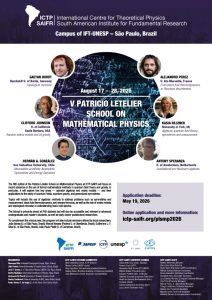
V Patricio Letelier School on Mathematical Physics


August 17 – 28, 2026
IFT-UNESP, São Paulo, Brazil
Home
The fifth edition of the Patricio Letelier School on Mathematical Physics at ICTP-SAIFR will focus on recent advances in the use of formal mathematical methods in quantum field theory and gravity. In particular, it will explore two key areas — operator algebras and matrix models — and their applications to the study of quantum fields, quantum gravity, and generalized symmetries.
Topics will include the use of algebraic methods to address problems such as symmetries and measurement, black hole thermodynamics, and entropy formulas, as well as the role of matrix models and topological recursion in understanding black hole spectra.
The School is primarily aimed at PhD students but will also be accessible and relevant to advanced undergraduate and master’s students, as well as early-career postdoctoral researchers.
Organizers:
- Giuseppe Dito (Université Bourgogne Europe, Dijon, France)
- Júlio Fabris (Federal University of Espirito Santo, Vitoria, Brazil)
- José Francisco Gomes (Institute of Theoretical Physics – UNESP, São Paulo, Brazil)
- Dmitry Melnikov (International Institute of Physics, Natal, Brazil)
- Aleksandr N. Pinzul (University of Brasilia, Brasilia, Brazil)
- Dmitry Vasilevich (Federal University of ABC, Santo Andre, Brazil)
- Paulo Afonso Faria da Veiga (University of São Paulo, São Carlos, Brazil)
Announcement:
Application is now closed
Participants list here
Click here for satisfaction survey
Lecturers
Minicourses
- Gaetan Borot (Humboldt University of Berlin, Germany) – Topological recursion (Exercises here)
- Clifford Johnson (University of California Santa Barbara, USA) – Random matrix models and 2d gravity (Exercises here)
- Hernán A. González (San Sebastian University, Chile) – Observables at infinity: asymptotic symmetries and energy operators (Exercises here)
- Alejandro Perez (University Aix-Marseille, France) – From black hole thermodynamics to Planckian discreteness (Exercises here)
- Kasia Rejzner (University of York, UK) – Algebraic quantum field theory: symmetries and measurement
- Antony Speranza (University of Amsterdam, Netherlands) – Gravitational von Neumann algebras (Exercises here)
Seminars
- Victor Hugo Marques Ramos (University of São Paulo, São Paulo, Brazil) – Invisible extended Unruh-DeWitt detector
- Marcel Novaes (Federal University of Uberlândia, Uberlândia, Brazil) – Use of random matrices in quantum transport
- Guilherme Lima Ferreira da Silva (University of São Paulo, São Carlos. Brazil) – Partition function expansions and extreme statistics of eigenvalues of random matrices
- João Pitelli (University of Campinas, Campinas, Brazil) – A Tale of Punctured Minkowski Spacetime
Registration
Program
Posters
First week
- Ay Casa Grande, Henrique (UFABC, Brazil): causal perturbation theory and scattering amplitudes
Motivated by the limited interaction between the mathematical physics community and theoretical physicists—particularly in high-energy theory—we present a computation that is typically among the first examples in quantum field theory courses but, to our knowledge, has not been explicitly carried out in the literature: the scattering amplitudes of the $\lambda\phi^4$ model in four-dimensional space-time, derived within the framework of causal perturbation theory. Our goal is to introduce this mathematically rigorous formalism in the most accessible way possible. To that end, we emphasize the general aspects of the theory while deliberately avoiding unnecessary mathematical sophistication. Finally, we briefly discuss how the divergent integrals encountered in quantum field theory can be reinterpreted as problems concerning the domain of distributions.
- Basso, Marcos Leopoldo Wayhs (Universidade Estadual de Campinas, Brazil): Work and heat statistics for quantum fields and their fluctuation relations
The formulation of thermodynamic quantities in quantum field theory (QFT) faces conceptual challenges, particularly due to the absence of standard notions such as projective measurements and Gibbs states. While recent progress has led to consistent definitions of work distributions for quantum fields using Ramsey interferometry and localized probes, a complete thermodynamic description also requires a notion of heat. In this work, we build upon interferometric approaches to quantum work and explore the extension of these ideas toward defining heat in QFT. We consider a scalar quantum field locally coupled to Unruh–DeWitt detectors and analyze how energy exchanges can be operationally characterized through localized interactions. As a starting point, we review recent results on work distributions in curved spacetime and their consistency with fluctuation relations in Kubo–Martin–Schwinger (KMS) states. Motivated by these developments, we outline a program to define a heat distribution for quantum fields in curved spacetime within a Ramsey-type framework. Such a construction would enable the study of fluctuation relations involving heat and provide a route toward a full thermodynamic description. We comment on implications for fundamental results such as the Landauer principle in relativistic settings. [1] A. Ortega, E. McKay, A. M. Alhambra, and E. Martín-Martínez, Work distributions on quantum fields, Phys. Rev. Lett., 122 240604 (2019). [2] R. L. S. Costa, M. L. W. Basso, J. Maziero, L. C. Céleri, Work distribution of quantum fields in static curved spacetimes, Phys. Rev. D 113, 025010 (2026).
- Becerra, Manuel (Universidad de Los Andes, Colombia): Emergent Gauge Symmetries on the Fuzzy Sphere
In 2020, A.P. Balachandran et. al. proved that a finite-dimensional C*-algebra, via the decomposition of the GNS space into irreducibles, enables us to define entropy-increasing quantum operations parameterized by the action of an emergent gauge group. This construction depends only on the non-uniqueness of the decomposition. Similarly, one can quantize a compact homogeneous space (given the interpretation of classical configuration space) of the form Q=G/H, where G is a compact Lie group, by constructing its so-called covariance algebra and considering a von Neumann algebra generated by a covariant representation of this algebra. Then, one can proceed analogously to the finite-dimensional case and identify another emergent gauge group, of which the classical gauge group is a subgroup. The non-commutative geometry counterpart of the sphere is the fuzzy sphere, which is, in essence, a matrix approximation for the algebra of continuous functions on the sphere. At a fixed value of spin, one can construct the covariance algebra associated with the fuzzy sphere algebra by the induced action of SU(2). Thus, an emergent gauge group can be constructed at every value of spin. We give explicit constructions for these gauge groups, compare them to the classical gauge group U(1) and the emergent gauge group for the sphere S^2=SU(2)/U(1), and discuss their possible interpretations. (This is a joint project with student Juan Andres Ospina Sabogal, who is also applying to the school.)
- Do Valle, Giovanna Fernandes (Universidade Federal de Minas Gerais, Brazil): Unruh-DeWitt detectors in a delocalized massive shell
In this work, we explore a detector’s response to vacuum fluctuations inside a hollow spherical shell in spatial superposition. To properly describe this system, we employ the formalism of Quantum Reference Frames (QRF), which allows us to transition to a perspective where the detector inherits the quantum delocalization. By performing this change of frame, we can analyze the interaction within a classical gravitational background while maintaining the quantum nature of the source. Finally, we investigate what information the detector’s response provides about the shell’s quantum state, identifying which features of the superposition are effectively captured by the detector.
- Habermann, Gustavo Schranck (Instituto de Física de São Carlos – USP, Brazil): Probing the limits of the semiclassical Einstein equation
In the context of semiclassical gravity, the semiclassical Einstein equation is often invoked when backreaction of quantum matter/fields on the spacetime is at stake. It is expected to hold when quantum fluctuations are small. Yet, it is routinely used to justify the central role of the expectation value of the stress-energy tensor of quantum fields, whose fluctuations formally diverge. Here we propose a new way to probe the limits of this approximation by exploiting peculiar nonlinearities of gravity. As a proof of principle, we construct a controlled, analytically tractable setting where the incoherent mixture of weak-gravity states drives the system into a strong-gravity regime. By selecting a branch-degenerate observable, one can compare predictions of quantum and semiclassical gravity, potentially delimiting the validity of the latter.
- Jimenez Peñafiel, Marvin Francisco (Universidad de Investigacion y Tecnologia Experimental Yachay, Ecuador): Bayesian Analysis of the Starobinsky Inflationary Model: A Mathematical Physics Perspective
This presentation is based on my undergraduate thesis work on the Starobinsky inflationary model, studied through Bayesian analysis with Cobaya. The project focuses on exploring the parameter space of the model and analyzing its predictions in relation to cosmological observables associated with inflation and the early universe. Since inflation is closely related to gravity and the mathematical structure of cosmological models, this work is also connected to the broader themes of mathematical physics. Through this presentation, I would like to share my current progress, receive feedback, and discuss how inflationary models connect physical predictions with deeper theoretical and mathematical frameworks in modern physics.
- Nair, Akhil U (Birla Institute of Technology and Science, Pilani – Hyderabad campus, India): Encoding Geometric Signatures in Unruh Radiation
Standard Hawking/Unruh radiation exhibits a thermal spectrum that obscures the underlying geometric details of spacetime. However, in the context of black hole evolution, where the horizon is dynamic rather than static, one expects deviations from strict thermality that may encode geometric information. In this work, we use Rindler spacetime as a near-horizon toy model to investigate how specific geometric configurations imprint on Unruh radiation. Our results imply that there are horizon-defined geometric configurations that give rise to Unruh/Hawking radiation, so that it is not featureless but carries the “fingerprints” of geometric modifications near the horizon. We will discuss the implications of these selective excitations for information retrieval in collapsing geometries and conclude by presenting preliminary results that extend this framework to more general classes of evolving horizons.
- Ospina, Juan Andrés (Universidad de los Andes, Colombia): Emergent Gauge Symmetries on the Fuzzy Sphere
In 2020, A.P. Balachandran et. al. proved that a finite-dimensional C*-algebra, via the decomposition of the GNS space into irreducible representations, naturally induces entropy-increasing quantum operations parameterized by the action of an emergent gauge group. This construction depends only on the non-uniqueness of the decomposition. Similarly, one can quantize a compact homogeneous space (given the interpretation of classical configuration space) of the form Q=G/H, where G is a compact Lie group, by constructing its so-called covariance algebra and considering a von Neumann algebra generated by a covariant representation of this algebra. Then, one can proceed analogously to the finite-dimensional case and identify another emergent gauge group, of which the classical gauge group is a subgroup. The non-commutative geometry counterpart of the sphere is the fuzzy sphere, which is, in essence, a matrix approximation for the algebra of continuous functions on the sphere. At a fixed value of spin, one can construct the covariance algebra associated with the fuzzy sphere algebra by the induced action of SU(2). Thus, an emergent gauge group can be constructed at every value of spin. We give explicit constructions for these gauge groups, compare them to the classical gauge group U(1) and the emergent gauge group for the sphere S^2=SU(2)/U(1), and discuss their possible interpretations. This project is joint work with student Manuel Becerra, who is also applying to the school.
- Ottoni, Rafael Gonçalves Almeida (Instituto de Física Teórica (IFT) – Unesp, Brazil): Symplectic quantization of topologically massive electrodynamics
Gauge theories in three spacetime dimensions have plenty of connections with high temperature behavior of four-dimensional models and three-dimensional condensed matter physics, for instance, the quantum Hall effect and superconductivity. In this work we analyze the presymplectic structure of the phase manifold corresponding to the (2+1)-dimensional electromagnetic field with a Chern-Simons term using the Faddeev-Jackiw approach and perform the path-integral quantization. Having in hand the generating functional of the theory, we also analyze its quantum behavior using non-perturbative methods and demonstrate the mechanism by which the free gauge field gets an excitation corresponding to a massive particle state.
Second week
- Casella, Pedro (IFT-Unesp, Brazil): A correspondence of SUSY and geometrical structures
We wish to show how we can use the language of supersymmetry to arrive at results from Complex Analysis and Differential Geometry, such as Hyperkahler geometry description, de Rham and Doulbeaut Complex and also how we may apply this to deform Lorentzian and Riemannian metrics in propagating spaces.
- Da Silva, Caio Angelo (Instituto de Física de São Carlos (IFSC) – Universidade de São Paulo (USP), Brazil): On the gauge-invariant magnetic charge of the BPST instanton solution
In this work, we will address some results involving the dynamical charges of Yang-Mills theories that follow from its integral formulation. Making use of the Belavin-Polyakov-Schwartz-Tyupkin 1-instanton solution of an SU(2) Yang-Mills theory in Euclidean spacetime, we shall consider the non-Abelian Gauss law, which follows from our integral equations, and calculate some quantities associated with the 1-instanton internal charge configuration. As will be discussed, one very important property of this integral formulation is that it allows the extraction of gauge invariant quantities, such as magnetic fluxes and magnetic charge densities, both of which we shall present in this work for the case of the 1-instanton. While the requirement of gauge invariance is satisfied, another important condition must be fulfilled for our results to be considered physical: they also need to be invariant with respect to the reparameterization of the surfaces employed in the calculations. As we shall see, apart from some special critical points, where this condition is indeed satisfied for the 1-instanton solution, the quantities mentioned above are not, in general, reparametrization-invariant. In fact, while the information on the critical points may be considered observable, we find that these quantities are defined on a mathematical structure called loop space, as we shall discuss in more detail.
- Grechko, Agata (Universidade de São Paulo, Brazil): Celestial Compton amplitudes and Celestial KMOC formalism
Two main directions of my research now is, firstly, studying the IR properties of soft limit of massive Compton scattering amplitudes after integral transformation and how the spurious poles affects the soft expansion of it, and secondly, how to formulate well-established in amplitude physics KMOC formalism for massive states in order to obtain some classical limits for the celestial observables. This is what I would like to present on a poster session.
- Junca, Mateus Da Silva (Universidade Federal do Espírito Santo, Brazil): A matrix model for the sine-Liouville gravity
We develop a one-term deformation of the six-vertex model on a dynamical lattice, called the seven-vertex model on a random lattice. The construction of the system is based on a complex matrix model whose perturbative expansion generates random graphs with oriented loops and vacancies. At the large N limit, the only graphs that contribute to the partition function are those with the topology of a sphere. This model can be understood as a q-deformation of the O(2) model. Unlike the latter, the weight of the loops in the seven-vertex model is no longer global; it depends on curvature defects and on the shape of the loops. The solution is obtained via the spectral curve constructed from the saddle-point approximation in the large N limit. Based on the two couplings (the cosmological constant and the temperature) we identify three distinct phases and their scaling behaviors: the pure gravity, dense, and dilute phases. In the dense and dilute phases, the model describes two-dimensional gravity with compactified bosons, as in the six-vertex model. The scaling limit near the tricritical point is described by Sine-Liouville gravity. We also conclude that the renormalization group flow connecting the dilute and dense phases is similar to the massless flow of the sine-Gordon model with an imaginary mass coupling.
- Malavazzi, Henrique (Sao Carlos Institute of Physics, Brazil): The Hidden Symmetries of Classical Yang-Mills theories
We show that classical, non-supersymmetric Yang-Mills theories coupled to spin-1/2 and spin-0 elementary matter fields, in (3 + 1)-dimensional Minkowski space-time, possess exact structures that resemble integrability, with an infinite number of conserved charges in involution. Such structures live in the space of non-abelian electric and magnetic charges, and are based on flat connections in generalized loop spaces, presenting an R-matrix, and Sklyanin relation. We present two novel symmetries of Yang-Mills theories. The first one corresponds to global transformations generated by the infinity of those conserved charges under the Poisson brackets. The gauge and matter fields, as well as Wilson lines and fluxes, have interesting transformation laws under such a global symmetry. The second one corresponds to symmetries of the integral Yang-Mills equations, which lead to the conserved charges. They generate an infinite-dimensional group, where the elements are holonomies of connections on the loop space of functions from the circle S1 to the space-time. Our approach certainly applies to the Standard Model of the Fundamental Interactions. The conserved charges are gauge invariant, and so, in the case of QCD, they are color singlets and perhaps are not confined. Therefore, the hadrons may carry such charges. Our results open up the way for the construction of non-perturbative methods for Yang-Mills theories.
- Pinto, Luigy (Universidade federal do Rio Grande do norte, Brazil): Nonconformal Wilson loops on ABJM
Supersymmetric quantum field theories provide a framework for exploring extended operators and their nonperturbative dualities. A prominent example is the three-dimensional ABJM theory, an N=6 superconformal field theory constructed from two copies of a Chern-Simons-matter action. In this theory, Wilson loop operators are defined via the holonomy of a superconnection. In this work, we investigate a specific class of nonconformal 1/6 BPS Wilson loops that preserve a fraction of the theory’s 24 supercharges. We analyze the two-point correlation functions of these operators.
- Rodrigues, Marcela De Albuquerque (Departamento de Física – FEG/UNESP, Brazil): Wigner and Bargmann Theorems in Pseudo-Hermitian Quantum Mechanics
In the standard formulation of Quantum Mechanics, Wigner’s Theorem establishes that transformations preserving transition probabilities are implemented by unitary or antiunitary operators on Hilbert spaces with a positive-definite inner product. Bargmann’s Theorem, in turn, characterizes the structure of continuous projective representations of Lie groups associated with symmetries. Pseudo-Hermitian Quantum Mechanics, developed by Ali Mostafazadeh, extends the usual formalism by introducing a metric operator that generalizes the inner product. This framework naturally leads to Hilbert spaces endowed with indefinite metrics, in which the notion of symmetry and the validity of classical theorems must be reexamined. In this work, we investigate the generalization of Wigner’s and Bargmann’s theorems to spaces with indefinite inner product. Preliminary results show that, in particular, extending Bargmann’s Theorem requires additional assumptions on the metric operator in order for continuity to be well defined.
- Salmen, Sasa (IFUSP, Brazil): Peripheral Algebras and Asymptotic Dynamics of Quantum Channels on Type II von Neumann Algebras
The asymptotic dynamics of finite-dimensional quantum channels is strongly constrained by the structure of their peripheral eigenoperators, leading to the emergence of noiseless subsystems, cyclic dynamics, and decomposition theorems for the peripheral algebra. In the infinite-dimensional setting, however, many of these structural results are no longer automatic, particularly for quantum channels acting on type II von Neumann algebras. In this work, we investigate possible extensions of the finite-dimensional structure theory of peripheral algebras to semifinite von Neumann algebras. Motivated by the decomposition theory of von Neumann algebras and by results of Wolf and García on the structure of cycles of quantum channels, we study how the peripheral algebra may decompose through its center into measurable families of factors. Special attention is given to the interplay between the action of a quantum channel on the center of the peripheral algebra and the resulting dynamics on the associated fibers. We discuss conditions under which the peripheral space acquires a von Neumann algebra structure, analyze the role of automorphism and detailed balance assumptions, and explore the distinction between deterministic fiber permutation and more general mixing behavior induced by completely positive maps. Examples involving type II_1 and type II_infty algebras are considered as guiding models for the theory. This project aims to provide a framework for understanding asymptotic quantum dynamics in infinite dimensions through the structure of peripheral algebras and their central decomposition.
- Silva, Laís Lamar Rodrigues (UNESP, Brazil): Aspects of Noether Gauge Embedding in higher-spin theories
String Theory predicts an infinite spectrum of massive higher-spin (HS) particles. In the tensionless limit, these masses vanish, leading to a description of unconstrained massless HS particles where neither the fields nor the gauge parameters satisfy any constraints. In contrast, Field Theory descriptions typically impose constraints on both fields and symmetry parameters. In this work, we implement the Noether Gauge Embedding (NGE) to promote non-symmetric theories to gauge invariant ones and to extend the gauge structure of existing symmetric models. We investigate the extension of theories invariant under transverse diffeomorphisms (TDiff) to full diffeomorphism invariance (Diff) by relaxing gauge constraints. By using the NGE procedure for arbitrary integer spin, we arrive at the doublet action, found by A. Sagnotti and D. Francia, recovering the unconstrained structure found in the tensionless limit of String Theory. We have also analyzed a “New Fronsdal” theory invariant under traceless and double-divergenceless diffeomorphisms. Using the NGE, we extend the gauge symmetry, lifting the vanishing double-divergence constraint on the gauge parameter, and we arrive at the Fronsdal model, which is invariant only under traceless diffeomorphisms. This analysis was explicitly constructed for the spin-3 and spin-4 cases, and the spin-5 sector is currently under investigation. Both the resulting doublet and Fronsdal actions align with existing literature and point to a consistent route for constructing unconstrained HS theories within the NGE structure.
- Sobrinho, Valmir Peixoto De Souza (International Institute of Physics, Brazil): States of 2D Yang-Mills and Large-Volume Entanglement
We study entanglement in two-dimensional Yang-Mills theory, viewed as a quasi-topological model of emergent space. The most familiar class of states in this theory are states defined by Euclidean path integrals over Riemann surfaces. Bipartite states of this class have thermofield double structure, with entanglement consistently reducing with total area and the number of topological defects, turning separable in the infinite-area limit. In contrast, Wilson lines and loops generate rich nonmonotonic behavior of the entanglement entropy. Most notably, we find that for a certain discrete set of configurations, entanglement remains finite at infinite area. The reduced density matrices, in such configurations, take the form of finite-dimensional projectors onto non-trivial vacuum sectors.
Short talks
First week
- Fiorentino, Angelo Mario Raffaele (The University of Melbourne, Australia): Modular Theory of Standard Subspaces and Bosonic bi-partite systems
We consider standard subspaces K of a doubled Hilbert space h⊕Ch, where C is the canonical conjugation on h and Ch is the canonical conjugate Hilbert space. To each such K we assign a von Neumann algebra W*-CCR(K) acting on the doubled bosonic Fock space. Given K and its symplectic complement K’, the algebras W*-CCR(K) and W*-CCR(K’) are in standard form, generating a bosonic standard bipartite system in the sense of https://doi.org/10.1103/PhysRevLett.133.261602. The modular theory of these von Neumann algebras emerges directly from the modular theory of standard subspaces via second quantization: the modular conjugation J and modular operator Δ of W*-CCR(K) are given by Γ(j_K) and Γ(δ_K), where j_K and δ_K are the one-particle modular objects associated with K and Γ is the second quantization functor. We explicitly compute these modular objects for a distinguished class of standard subspaces: graph subspaces K = { ξ ⊕ C(xξ )}, where x is a closed operator on h with dense range and trivial kernel. The spectral properties of x are then linked to the type of the von Neumann algebra W*-CCR(K): when the essential spectrum of δ_K coincides with its full spectrum, the type is completely determined by the multiplicative group generated by Sp(x*x). If time permits, we will specialize those results to the Araki-Woods representation, emerging from the GNS representation of a bosonic quasi-free state, and draw a link to embezzlement of entanglement in bosonic many-body systems.
- Knopki, Henrique Antonio Rodrigues (Universidade Federal do Paraná, Brazil): The effective field theory of the gravitational functional measure
The gravitational path integral measure has been the subject of an increasing interest lately, and no conclusive answer yet exists for its correct form. In this paper, we adopt effective field theory techniques to shed light on this issue. We build the configuration-space metric as an energy expansion, including all possible terms that satisfy the underlying symmetries, and use it to define a Riemannian measure. We study the running of the free parameters that show up in this expansion at leading order, which corresponds to the DeWitt metric with parameter $\lambda$. We show that a flat configuration space is excluded on unitarity grounds. The renormalization group contains one UV fixed point at $\lambda=-1$, thus allowing for the UV completion of the measure sector. This fixed point corresponds to the value obtained by identifying DeWitt’s metric from the kinetic term of general relativity, a standard procedure in the literature that otherwise lacks physical motivation. Our results provide such a justification from first principles.
- Lopez, Juan Felipe (Universidad de los Andes, Colombia, Colombia): Effects of non-commutativity of linear cosmological perturbations. A DFR approach
In 1995 Doplicher, Fredenhagen and Roberts (DFR) proposed a model of non-commutative (quantum) spacetime and a model of QFT for a scalar field has been established, and posteriorly extended in way compatible with the framework of Perturbative Algebraic QFT. In this talk, the DFR algebra of free fields is extended to a cosmological background for fields describing linear cosmological perturbations. The fundamental field is fixed as the Mukhanov-Sazaki variable, and the modifications of the power spectrum is studied for an adiabatic expansion of the vacuum state.
- Martinek, Leandro (Instituto Balseiro, Argentina): Optimal symmetry operators
We present a constructive method to maximize the expectation value of operators that implement a symmetry on a subsystem, making use of modular tools. More generally, we study the positive cones associated with a von Neumann algebra, as defined by Araki. Given a reference vector, an algebra, and a state on the algebra, the purification of the state in the cone $\alpha = 0$, associated with the reference vector and the algebra, yields the unique vector whose overlap with the reference vector is maximal among all possible purifications. This establishes that the supremum in Uhlmann’s theorem is uniquely attained by this vector, thereby providing the fidelity between the given state and the state obtained by restricting the reference vector to the algebra. Moreover, this purification can be explicitly constructed using modular tools. In addition, given an automorphism of the algebra, we show how to construct isometries implementing the automorphism using the positive cones. We prove that the isometry constructed from the cone $\alpha = 0$ is the one with maximal expectation value among all possible isometries implementing the automorphism. We illustrate these ideas with two simple examples: one involving a system of two spins, and the other in the theory of the massless scalar field in 3+1 dimensions.
- Sifat, Md Abdullah Al Hasib (Lomonosov Moscow State University, Russia): Conformal blocks of Wess-Zumino-Witten model from its free-field representation
A powerful approach to the celebrated Wess-Zumino-Witten (WZW) model is provided by its free-field realization. However, explicit calculations of conformal blocks are not described in the literature in full detail. We begin this study with the simplest cases of the $\hat{sl}(2)_k$ and $\hat{sl}(3)_k$ WZW models, with special emphasis on their global $sl(2)$ and $sl(3)$ symmetries of the resulting correlators, which are not explicit in this formalism. Also non-trivial is the verification of the Knizhnik-Zamolodchikov equations in the $\hat{sl}(3)_k$ case, where the answers take the form of double integrals over screening charge positions and do not look like ordinary hypergeometric functions.
Second week
- Chakraborty, Debarghya (ICTP-SAIFR, Brazil): Krylov Complexity From Loschmidt Echo
Krylov Complexity has emerged as a widely-used probe of dynamical delocalization of a quantum state or operator. In certain contexts, it can also be connected to quantum chaos. A more traditional measure of chaos, with a clear semiclassical interpretation, is the Loschmidt echo, which quantifies the return amplitude obtained by evolving a state forward in time, and then backward for the same duration under a slightly perturbed Hamiltonian. I will describe a robust connection between Krylov complexity and a specific Loschmidt echo. This connection provides a complementary interpretation for the meaning of Krylov complexity. Moreover, Krylov complexity gets a clear geometric interpretation in terms of a quantum geometric tensor, labelled by time and the deformation parameter in the Loschmidt echo. These connections bring us closer to estimating Krylov complexity, and the Krylov variance directly from the autocorrelation function without the need of computing Lanczos coefficients.
- Ferreira, Matheus Curado (Brazilian Center of Physical Research, Brazil): Cosmological Bootstrap with Nonlinear Dispersion Relations
Cosmological correlators are usually bootstrapped under the assumption that particles propagating during inflation follow relativistic dispersion relations. This assumption underlies much of the standard cosmological collider picture, where heavy fields leave characteristic oscillatory signals in the squeezed limit of primordial non-Gaussianities. However, several well-motivated early-universe scenarios — including ghost-condensate phases, tilted spectator sectors and higher-derivative effective theories — naturally lead to nonlinear dispersion relations and non-relativistic corrections. My research investigates how the cosmological bootstrap program can be extended to this broader class of systems. The central question is how symmetry, analyticity, factorization and boundary consistency constrain inflationary correlators when the internal exchanged modes are governed by nonlinear dispersion. In such cases, the usual relativistic template for massive exchange may be modified through new phase structures, altered suppression factors and deformed squeezed-limit behavior. By studying these effects in explicit models with Whittaker-like mode functions and higher-derivative dispersion relations, I aim to identify the analytic signatures that distinguish non-relativistic cosmological collider physics from the standard relativistic case. This may provide a new route to classify primordial correlators beyond conventional assumptions and to connect bootstrap methods with a wider landscape of inflationary effective field theories.
- Ghelem, Yusuf (University of Melbourne, Australia): Adiabatic vacua from Kahler structures and beyond
Adiabatic vacua play a central role in quantum fields in cosmological spacetimes, where they serve as distinguished initial conditions and as reference states for the renormalisation of observables. In this talk we introduce new methods based on linear complex structures which provide a powerful tool for determining adiabatic vacua. The new methods generalize both the standard WKB appoach and the Lewis-Riesenfeld invariants, and allow us to study the problem of many coupled bosonic and fermionic degrees of freedom with general quadratic time-dependent Hamiltonian. We show that the adiabatic number operator and the adiabatic vacuum of finite order can be expressed in terms of the adiabatic complex structure of the same order.
We compare our results to standard techniques which apply only to a single degree of freedom, and comment on its applicability to problems in quantum fields in cosmological spacetimes, many-body systems, where the Hamiltonian is time dependent with slowly-changing parameters.
- Kumar, Neeraj (Walailak University, India): Renyi Law’s in Modified Gravity Theories
Einstein’s equations are notoriously difficult to solve beyond highly symmetric cases. Hawking’s area law provides an important constraint on gravitational dynamics without requiring knowledge of the full dynamical solution. This raises a natural question: Can more such constraints be found? In a recent article¹ focused on the dynamics of systems with long-range interactions and few degrees of freedom, it was shown that a family of constraints—formulated using Rényi divergences—govern a system’s approach to equilibrium. The second law of thermodynamics emerges as a special case within this broader framework. This idea has been explored in the context of AdS/CFT, where it was found that these generalized constraints can forbid certain transitions that are otherwise permitted by the second law alone². In the gravitational sector, such constraints offer valuable insights into black hole mergers³, especially given the inaccessibility of their full dynamical evolution. These constraints are also expected to have implications for the boundary CFT systems as dual to the merger process in the bulk. In our work4, we studied such a merger scenario involving five-dimensional AdS black holes in Gauss–Bonnet gravity. We analyzed the impact of the Gauss–Bonnet parameter on the final mass as a function of the Rényi parameter. Along with new insights for a black hole merger, this shall have applications from gauge/gravity duality perspective to study real quantum systems.
- Rivera, Brian Fernando (Pontificia Universidad Católica de Valparaiso/Universidad Técnica Federico Santa María, Chile): Superconformal Indices, Holography and Black Hole Entropy
The entropy of supersymmetric black holes in asymptotically AdS5 spacetimes admits a microscopic description in terms of N=4 Super Yang–Mills theory through the AdS/CFT correspondence. In this talk, we discuss how the superconformal index, defined as a supersymmetric trace over the Hilbert space of the theory, counts protected BPS states and probes this microscopic sector. After imposing gauge invariance, the index can be written as an integral over the gauge group (U(N)), leading naturally to a matrix-model formulation. In the large-(N) regime and in a Cardy-like limit, the saddle-point analysis of this integral yields an entropy function which, after a Legendre transform with respect to the chemical potentials, reproduces the Bekenstein–Hawking entropy of supersymmetric rotating and charged black holes in AdS5. Finally, we briefly discuss how finite-(N) corrections and giant graviton contributions refine this description, providing a more detailed connection between the protected spectrum of the gauge theory and the microscopic structure of the corresponding gravitational solutions.
- Santos Felipe, Bruno (CMCC – UFABC, Brazil): Quantum superposition of boundary conditions
In this work, we explore the quantum superposition of boundary conditions in the context of the Poincaré patch of the two-dimensional anti–de Sitter space. Focusing on Robin (mixed) boundary conditions, we investigate the response function of the Unruh-DeWitt (UDW) detector interacting with two or more scalar fields, each respecting a different boundary condition. The role of this quantum superposition is twofold: (i) it may represent different fields propagating on the same spacetime and interacting with a UDW detector or (ii) it may describe a UDW detector on a superposition of spacetimes, each one with an inequivalent propagating field.
Videos and Files
-
09:00 - Dmitry Melnikov, Dmitry Vasilevich, Giuseppe Dito, Júlio Fabris, Aleksandr N. Pinzul, Paulo A. Faria da Veiga (International Inst. of Physics, UFRN, UFABC, Université Bourgogne Europe, Federal University of Espirito Santo, University of Brasilia, University of São Paulo):
Opening
-
11:00 - Gaetan Borot (Humboldt University of Berlin):
Topological recursion - 1
-
14:30 - João Pitelli (University of Campinas):
A Tale of Punctured Minkowski Spacetime
-
09:00 - Kasia Rejzner (University of York):
Algebraic quantum field theory: symmetries and measurement - 1
-
11:00 - Gaetan Borot (Humboldt University of Berlin):
Topological recursion - 2
-
14:30 - Kasia Rejzner (University of York):
Algebraic quantum field theory: symmetries and measurement - 2
-
09:00 - Kasia Rejzner (University of York):
Algebraic quantum field theory: symmetries and measurement - 3
-
11:00 - Antony Speranza (University of Amsterdam):
Gravitational von Neumann algebras - 1
- 14:00 - Gaetan Borot (Humboldt University of Berlin): Large random matrices and Young diagrams
-
09:00 - Kasia Rejzner (University of York):
Algebraic quantum field theory: symmetries and measurement - 4
-
11:00 - Antony Speranza (University of Amsterdam):
Gravitational von Neumann algebras - 2
-
14:30 - Gaetan Borot (Humboldt University of Berlin):
Topological recursion - 3
-
09:00 - Gaetan Borot (Humboldt University of Berlin):
Topological recursion - 4
-
11:00 - Victor Hugo Marques Ramos (University of São Paulo):
Invisible extended Unruh-DeWitt detector
-
14:30 - Antony Speranza (University of Amsterdam):
Gravitational von Neumann algebras - 3
-
09:00 - Antony Speranza (University of Amsterdam):
Gravitational von Neumann algebras - 4
-
11:00 - Angelo Mario Raffaele Fiorentino, Henrique Antonio Rodrigues Knopki, Neeraj Kumar, Juan Felipe Lopez, Leandro Martinek (The University of Melbourne, Universidade Federal do Paraná, Walailak University, Universidad de los Andes, Instituto Balseiro):
Short talk session 1
-
09:00 - Clifford Johnson (University of California Santa Barbara):
Random matrix models and 2d gravity - Class1
-
11:00 - Marcel Novaes (Federal University of Uberlândia):
Use of random matrices in quantum transport
-
14:30 - Clifford Johnson (University of California Santa Barbara):
Random matrix models and 2d gravity - Class 2
-
09:00 - Clifford Johnson (University of California Santa Barbara):
Random matrix models and 2d gravity - Class 3
-
11:00 - Hernan Gonzalez (San Sebastian University):
Observables at infinity: asymptotic symmetries and energy operators - Class 1
-
14:30 - Alejandro Perez (University Aix-Marseille):
From black hole thermodynamics to Planckian discreteness - Class 1
-
15:30 - Matheus Curado Ferreira, Bruno Santos Felipe, Debarghya Chakraborty, Marcelo Rezende Barbosa, Brian Fernando Rivera, Md Abdullah Al Hasib Sifat (Brazilian Center of Physical Research, CMCC - UFABC, ICTP-SAIFR, IFT/ICTP-SAIFR, Pontificia Universidad Católica de Valparaiso/Universidad Técnica Federico Santa María, Lomonosov Moscow State University):
Short talk session 2
-
09:00 - Clifford Johnson (University of California Santa Barbara):
Random matrix models and 2d gravity - Class 4
-
11:00 - Hernan Gonzalez (San Sebastian University):
Observables at infinity: asymptotic symmetries and energy pperators - Class 2
-
14:00 - Alejandro Perez (University Aix-Marseille):
Emergence of cosmic structure from Planckian discreteness
-
09:00 - Alejandro Perez (University Aix-Marseille):
From black hole thermodynamics to Planckian discreteness - Class 2
-
11:00 - Hernan Gonzalez (San Sebastian University):
Observables at infinity: asymptotic symmetries and energy operators - Class 3
-
14:30 - Guilherme Lima Ferreira da Silva (University of São Paulo):
Partition function expansions and extreme statistics of eigenvalues of random matrices
-
16:00 - Alejandro Perez (University Aix-Marseille):
From black hole thermodynamics to Planckian discreteness - Class 3
-
09:00 - Alejandro Perez (University Aix-Marseille):
From black hole thermodynamics to Planckian discreteness - Class 4
-
11:00 - Hernan Gonzalez (San Sebastian University):
Observables at infinity: asymptotic symmetries and energy operators - Class 4
asdasdasd
Photos

Venue
Venue: The event will be held at IFT-UNESP, located at R. Jornalista Aloysio Biondi, 120 – Barra Funda, São Paulo. The easiest way to reach us is by subway or bus, See arrival instructions here.
Accommodation: Participants whose accommodation will be provided by the institute will stay at Hotel Intercity the Universe Paulista. Hotel recommendations are available here.
Attention! Some participants in ICTP-SAIFR activities have received email from fake travel agencies asking for credit card information. All communication with participants will be made by ICTP-SAIFR staff using an e-mail “@ictp-saifr.org”. We will not send any mailings about accommodation that require a credit card number or any sort of deposit. Also, if you are staying at Hotel Intercity the Universe Paulista, please confirm with the Uber/Taxi driver that the hotel is located at Rua Pamplona 83 in Bela Vista (and not in Jardim Etelvina).
Additional Information
Attention! Some participants in ICTP-SAIFR activities have received email from fake travel agencies asking for credit card information. All communication with participants will be made by ICTP-SAIFR staff using an e-mail “@ictp-saifr.org”. We will not send any mailings about accommodation that require a credit card number or any sort of deposit. Also, if you are staying at Hotel Intercity the Universe Paulista, please confirm with the Uber/Taxi driver that the hotel is located at Rua Pamplona 83 in Bela Vista (and not in Jardim Etelvina).
BOARDING PASS: All participants, whose travel has been provided or will be reimbursed by ICTP-SAIFR, should bring the boarding pass upon registration. The return boarding pass (PDF, if online check-in, scan or picture, if physical) should be sent to secretary@ictp-saifr.org by e-mail.
Visa information: Nationals from several countries in Latin America and Europe are exempt from tourist visa. Nationals from Australia, Canada and USA are required to apply for a tourist visa.
Accommodation: Participants, whose accommodation will be provided by the institute, will stay at Hotel Intercity the Universe Paulista. Hotel recommendations are available here.
Power outlets: The standard power outlet in Brazil is type N (two round pins + grounding pin). Some European devices are compatible with the Brazilian power outlets. US devices will require an adapter.
Poster presentation: Participants who are presenting a poster MUST BRING A PRINTED BANNER . The banner size should be at most 1 m (width) x 1,5 m (length). We do not accept A4 or A3 paper.
Badge: You will receive an identification badge upon registration, which must be used during the entire event. Without the badge, it may not be possible to enter the venue.
Security issues: Although São Paulo is a relatively safe city, be careful when using cellphones on the street, avoid isolated areas at night, and be aware when crossing the street that cars may not stop for pedestrians. Also, please do not leave valuable items like laptops unattended even for short breaks. At the IFT-UNESP, there are storage lockers available and keys can be obtained with our secretaries.