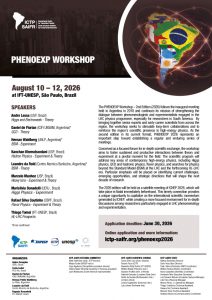
PHENOEXP Workshop

August 10 – 12, 2026
São Paulo, Brazil
ICTP-SAIFR/IFT-UNESP
Zoom ID: 886 9014 2093
Password: phenoexp
Home
The PHENOEXP Workshop – 2nd Edition (2026) follows the inaugural meeting held in Argentina in 2018 and continues its mission of strengthening the dialogue between phenomenologists and experimentalists engaged in the LHC physics programme, especially for researchers in South America. By bringing together senior experts and early-career scientists from across the region, the workshop seeks to stimulate long-term collaborations and to reinforce the region’s scientific presence in high-energy physics. As the second edition in its current format, PHENOEXP 2026 represents an important step toward establishing a regular and enduring series of meetings.
Conceived as a focused forum for in-depth scientific exchange, the workshop aims to foster sustained and productive interactions between theory and experiment at a pivotal moment for the field. The scientific program will address key areas of contemporary high-energy physics, including Higgs physics, QCD and hadronic physics, flavor physics, and searches for physics beyond the Standard Model (BSM) at the LHC and the forthcoming HL-LHC era. Particular emphasis will be placed on identifying current challenges, emerging opportunities, and strategic directions that will shape the next decade of research.
The 2026 edition will be held as a satellite meeting of ICHEP 2026, which will take place in Natal immediately beforehand. This timely connection provides a unique opportunity to capitalize on the international scientific momentum generated by ICHEP, while creating a more focused environment for in-depth discussions among researchers particularly engaged in LHC phenomenology and experimentation.
Students are welcome to present their research by submitting an abstract for poster presentation.
Organizers:
- Andre Sznajder (UERJ, Brazil)
- Carla Gobel (PUC Rio, Brazil)
- Daniel de Florian (ICAS UNASAM, Argentina)
- Hernan Pablo Wahlberg (La Plata, Argentina)
- Leandro da Rold (Centro Atomico de Bariloche, Argentina)
- Rogerio Rosenfeld (IFT UNESP, Brazil)
Announcement:
Application is now closed
Participants list here
Click here for satisfaction survey
Speakers
Speakers:
- Daniel de Florian (ICIFI UNSAM, Argentina)
- Hernan Wahlberg (UNLP, Argentina) – BSM Experiment
- Kanchan Khemchandani (Unifesp, Brazil)
- Leandro da Rold (Centro Atomico Bariloche, Argentina)
- Marisilvia Donadelli (UERJ , Brazil)
- Marcelo Munhoz (USP, Brazil)
- Andre Lessa (IFUSP, Brazil)
- Rafael Silva Coutinho (CBPF, Brazil)
- Thiago Tomei (NCC-Unesp, Brazil)
Registration
Program
Posters
- Borges Sena, Camila (Instituo de Matemática, Estatística e Física (IMEF) – FURG, Brazil): Phi-4 Model: A fractional approach
In this work, we propose a time-fractional generalization of the scalar φ⁴ model, constructed using the conformable fractional derivative. The formulation preserves the classical limit (α → 1) while modifying the dynamics for α < 1. Numerical analysis shows that decreasing α intensifies oscillations, produces non-periodic solutions, and leads to the breakdown of energy conservation, consistent with Noether’s theorem. These results highlight the fractional derivative as a promising approach for describing nonlinear systems with modified temporal dynamics.
- Franção, Vinícius Silva (Universidade de São Paulo, Brazil): Breakdown of Bjorken and Gubser Flows Induced by Electromagnetic Fields
Bjorken and Gubser flows provide analytical solutions commonly used as benchmarks for relativistic hydrodynamic codes. However, electromagnetic fields coupled to the hydrodynamic evolution can break the symmetries of these flows. Using numerical simulations, we study the deviations produced by this coupling in Bjorken- and Gubser-like initial conditions. The results show significant deformations relative to the evolution without fields, including the formation of shock-like compressive structures.
- Issa Sabha De Oliveira, Ryan (Instituto de Física da Universidade de São Paulo, Brazil): Studying exotic hadrons of three-body nature
Recent experimental results from collaborations such as LHCb have revealed the existence of baryons and mesons with quantum numbers that cannot be described within the conventional quark model as three-quark or quark–antiquark states. These hadrons, commonly referred to as exotic states, have motivated extensive theoretical investigation regarding their internal structure and formation mechanisms. In several cases, these states are found close to two-hadron thresholds, with quantum numbers compatible with s-wave interactions, suggesting a molecular interpretation in which two hadrons with low relative momentum interact through meson exchange and form a loosely bound state. However, some exotic candidates exhibit quantum numbers incompatible with two-hadron s-wave interactions and/or are located near three-hadron thresholds, indicating that more complex dynamical mechanisms may be involved. In recent years, studies of three-hadron interactions within effective field theory frameworks have successfully described states such as ϕ(2170), N(1710), and K(1460), reproducing experimental observations, while also predicting the existence of exotic hadrons, including hidden-charm kaons and nucleons with masses around 4300 MeV. In this project, we investigate the use of effective Lagrangians for the dynamical generation of hadronic states in two-body systems and employ the resulting two-body scattering amplitudes (t-matrices) to study three-meson systems with hidden strangeness. As an application, we explore the possibility of dynamically generating the state η₁(1855) through the interaction of two pseudoscalar mesons and one vector meson. This study aims to contribute to the understanding of exotic hadron spectroscopy and the role of few-body interactions in the strong sector.
- Lima Fideles De Souza, Rian (Pontifícia Universidade Católica do Rio de Janeiro, Brazil): Amplitude Analysis of $D^+\to \pi^-\pi^+K^+$ Using LHCb Run 2 Data
The study of $D^+$ meson decays provides an excellent laboratory for testing the Standard Model of particle physics. In this work, we present a renewed investigation into a specific doubly Cabibbo-suppressed decay channel of the $D^+$ meson, marking the first major analysis of this channel since the 2004 publication by the FOCUS Collaboration. Furthermore, this research is being conducted in parallel with the analysis of the $D_s^+ \to \pi^- \pi^+ K^+$ decay, mirroring the joint analytical approach established in the 2004 study. By updating the measurements of these combined $D^+$ and $D_s^+$ decay channels, this study aims to provide refined data and further probe the predictive limits of hadronic weak decays within the Standard Model.
- Moraes, Nara (IFUSP, Brazil): The Effect of Correlated Experimental Uncertainties on Bayesian Inference of Quark-Gluon Plasma Properties
Bayesian inference has become the state-of-the-art framework for fitting theoretical models to experimental data from heavy-ion collisions at LHC and RHIC accelerator facilities, enabling both parameter estimation and uncertainty quantification in the extraction of quark-gluon plasma (QGP) parameters. The QGP is a deconfined state of strongly interacting matter under extreme conditions, expected to have existed in the first moments of the Universe and known to be produced in heavy-ion collisions at accelerator facilities in the first years of the 21st century. In this model-to-data comparison approach, the likelihood combines the data with the associated uncertainties from both the measurements and the theoretical model. In the case of observables such as rapidity distributions, where the measured signal can receive contributions from the central and forward detector regions, bin-to-bin correlations may carry significant information. Since experimental correlations are often not provided by detector collaborations, current approaches neglect them. As a first step, we test the impact of modeled correlation structures on the inferred QGP parameter posteriors. As a second step, we aim to explore how these correlations can be informed by the uncertainty information provided by the collaborations themselves. Ultimately, we investigate whether incorporating these correlations in the likelihood has a significant impact on the inferred QGP parameter posteriors.
- Palma, Lucas Nahuel Horacio (ICIFI UNSAM, Argentina): The polarized photon distribution function
The parton distribution functions (PDFs) are a fundamental component of hard scattering processes. At leading order, they represent the probability of finding a parton with a momentum fraction x in a hadron target. With the increase in the accuracy of experimental measurements over the last few decades, it has become necessary to enhance the precision of theoretical calculations. To achieve this goal, precise fits of PDFs are indispensable. In this presentation, I will discuss the LuxQED method for computing the polarized photon PDF. This method allows us to express the photon PDF in terms of the structure functions g1 and g2.
- Perin, Luiza Fernanda (Universidade de São Paulo, Brazil): Inference of the Quantum Chromodynamics Equation of State
High-energy heavy-ion collisions produce a medium composed of strongly coupled particles that exhibits hydrodynamic behavior called the Quark Gluon Plasma (QGP). Because the QGP cannot be observed directly, its properties must be inferred through computational simulations. A key input to these simulations is the equation of state (EoS), which describes how matter transitions between different phases and directly influences the dynamics of the collision. In this work, we present a non-parametric procedure based on Gaussian processes to obtain the EoS and incorporate it into hydrodynamic simulations, establishing the framework for future Bayesian inference of its parameters.
- Rocha, Carlos Antonio Da (Instituto Federal de São Paulo – Campus São Paulo, Brazil): Heavy Tetraquark Spectroscopy via Chiral Two-Pion Exchange Potentials
This project proposes developing a theoretical framework for the spectroscopy of fully and doubly heavy tetraquarks (containing c and b quarks) based on effective potentials derived from two-pion exchange in the chiral formalism. The approach leverages the author’s expertise in nucleon-nucleon (NN) two-pion exchange potentials, as established in seminal works [Rocha & Robilotta, PRC 49, 1818 (1994); Robilotta & Rocha, Nucl. Phys. A615, 391 (1997); Higa, Robilotta & Rocha, PRC 69, 034009 (2004)], extending the methodology to the heavy-quark sector via Heavy Quark Spin Symmetry (HQSS) and Heavy Hadron Chiral Perturbation Theory (HHχPT). The relevance of the theme is underscored by the recent discovery of fully charmed tetraquark candidates by the LHCb, ATLAS, and CMS collaborations [LHCb, ATLAS, CMS Collaborations (2024-2025); Agaev et al., arXiv:2412.16068 (2025); Eur. Phys. J. C 85, 1303 (2025)], which have opened a new window into non-perturbative QCD. The project aims to predict mass spectra, decay widths, and decay channels for tetraquarks with compositions bbbc, cccb, and bbcc, providing theoretical guidance for interpreting current and future LHC data. The methodology combines: (i) extension of the chiral two-pion exchange NN potentials to the heavy-quark sector using HQSS, (ii) solution of the four-body Schrödinger equation via the correlated Gaussian method [Wu & Zhu, PRD 111, 034044 (2025)], and (iii) calculation of decay widths using QCD sum rules. The project envisions the formation of a research group involving undergraduate and graduate students, as well as collaborations with researchers within the INCT-FNA network and possibly international institutions. The expected outcomes include several publications and the consolidation of a new theoretical research line in hadronic spectroscopy at IFSP-SPO.
- Rojahn Da Silva, Iago (Instituto de Física da USP, Brazil): Phenomenological Analysis of Elastic Scattering Using the McIntyre Model and Regge Poles
Elastic scattering is one of the fundamental processes in nuclear physics. Although it represents one of the simplest nuclear reactions, its angular distributions contain detailed information about nuclear interactions and diffraction phenomena. Phenomenological descriptions based on the Strong Absorption Model (SAM) and the Optical Model (OM) provide useful parameterizations of the scattering matrix. Among these approaches, the McIntyre formalism provides a reasonable description of the diffraction pattern at forward angles, while its combination with the Regge pole approach allows the description to be extended to backward angles, where additional oscillatory structures are observed. In this work, the McIntyre formalism was implemented to calculate the S-matrix and investigate its performance over the angular range, with particular emphasis on its limitations at backward angles. The Regge pole formalism was subsequently incorporated to improve the description of the scattering in this region. A computational framework was developed in C++ to implement the phenomenological models and calculate elastic-scattering angular distributions. The Coulomb contribution was calculated analytically, while the nuclear contribution was obtained from the phenomenological S-matrix. The model parameters were determined by fitting the calculated angular distributions to experimental data, using seven adjustable parameters in the combined analysis. The results were compared with those reported by Badran and Badahdah (2009) and Badran et al. (2015), showing good agreement and supporting the implementation of the models. The developed computational framework provides a basis for further applications of phenomenological scattering models to elastic-scattering studies of stable and exotic nuclei. [CNPq 2023-526].
- Siqueira, Jorge Júlio (Centro Brasileiro de Pesquisas Físicas, Brazil): Studies of the Selection for Charmless Three-Body B+- Decays
This work presents the ongoing optimization of the event selection for charmless three-body B meson decays in LHCb Run 3. Building on the Run 2 analysis, the selection is being improved by exploiting the larger dataset and enhanced detector performance. A multivariate analysis (MVA) is used to improve signal-background separation, while dedicated charm vetoes are applied to obtain a cleaner sample for future CP violation studies.
Videos and Files
- 09:00 - Leandro da Rold (Centro Atomico Bariloche, Argentina): Higgs & Electroweak Theory
- 09:50 - Marisilvia Donatelli (UERJ , Brazil): Higgs Experiment
- 11:00 - Daniel de Florian (ICIFI UNSAM, Argentina): QCD
- 09:00 - André Lessa (IFUSP): BSM Theory
- 09:50 - Hernan Wahlberg (UNLP, Argentina): BSM Experiment
- 11:00 - Rafael Silva Coutinho (CBPF, Brazil): Flavour Physics (Theory & Experiment)
- 09:00 - Marcelo Munhoz (IFUSP): Heavy Ions (Theory & Experiment)
- 10:00 - Kanchan Khemchandani (Unifesp, Brazil): Hadron Physics
- 11:10 - Thiago Tomei (IFT - UNESP): HL-LHC Prospects
asdasdasd
Photos

Venue
Venue: The event will be held at IFT-UNESP, located at R. Jornalista Aloysio Biondi, 120 – Barra Funda, São Paulo. The easiest way to reach us is by subway or bus, See arrival instructions here.
Accommodation: Participants whose accommodation will be provided by the institute will stay at Hotel Intercity the Universe Paulista. Hotel recommendations are available here.
Attention! Some participants in ICTP-SAIFR activities have received email from fake travel agencies asking for credit card information. All communication with participants will be made by ICTP-SAIFR staff using an e-mail “@ictp-saifr.org”. We will not send any mailings about accommodation that require a credit card number or any sort of deposit. Also, if you are staying at Hotel Intercity the Universe Paulista, please confirm with the Uber/Taxi driver that the hotel is located at Rua Pamplona 83 in Bela Vista (and not in Jardim Etelvina).
Additional Information
Attention! Some participants in ICTP-SAIFR activities have received email from fake travel agencies asking for credit card information. All communication with participants will be made by ICTP-SAIFR staff using an e-mail “@ictp-saifr.org”. We will not send any mailings about accommodation that require a credit card number or any sort of deposit. Also, if you are staying at Hotel Intercity the Universe Paulista, please confirm with the Uber/Taxi driver that the hotel is located at Rua Pamplona 83 in Bela Vista (and not in Jardim Etelvina).
BOARDING PASS: All participants, whose travel has been provided or will be reimbursed by ICTP-SAIFR, should bring the boarding pass upon registration. The return boarding pass (PDF, if online check-in, scan or picture, if physical) should be sent to secretary@ictp-saifr.org by e-mail.
Visa information: Nationals from several countries in Latin America and Europe are exempt from tourist visa. Nationals from Australia, Canada and USA are required to apply for a tourist visa.
Accommodation: Participants, whose accommodation will be provided by the institute, will stay at Hotel Intercity the Universe Paulista. Hotel recommendations are available here.
Power outlets: The standard power outlet in Brazil is type N (two round pins + grounding pin). Some European devices are compatible with the Brazilian power outlets. US devices will require an adapter.
Poster presentation: Participants who are presenting a poster MUST BRING A PRINTED BANNER . The banner size should be at most 1 m (width) x 1,5 m (length). We do not accept A4 or A3 paper.
Badge: You will receive an identification badge upon registration, which must be used during the entire event. Without the badge, it may not be possible to enter the venue.
Security issues: Although São Paulo is a relatively safe city, be careful when using cellphones on the street, avoid isolated areas at night, and be aware when crossing the street that cars may not stop for pedestrians. Also, please do not leave valuable items like laptops unattended even for short breaks. At the IFT-UNESP, there are storage lockers available and keys can be obtained with our secretaries.