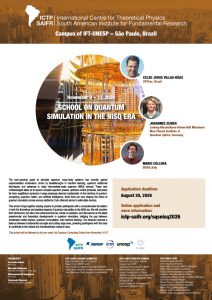
School on Quantum Simulation in the NISQ era

November 9 – 13, 2026
Venue: ICTP-SAIFR/IFT-UNESP
Home
This school brings together leading experts to provide participants with a comprehensive foundation in both the theoretical and practical aspects of quantum simulation in the NISQ era. We will combine both introductory and a few advanced lectures, hands-on sessions, and discussions on the latest experimental and theoretical developments in quantum simulation, bridging the gap between condensed matter physics, quantum computation, and machine learning. The structure ensures a balance between fundamental concepts and cutting-edge ones, providing participants with the tools to contribute to this vibrant and interdisciplinary research area.
This school will be followed by the two-week 3rd Quantum Computing School from November 16-27.
Organizers:
- Fernando Iemini (UFF, Brazil)
- Marcello Dalmonte (University of Bologna / ICTP-Trieste, Italy)
- Mohammad Ali Rajabpour (UFF, Brazil)
- Reyhaneh Khasseh (University of Augsburg, Germany)
Announcement:
Application is now closed
Lecturers
Lecturers
- Celso Jorge Villas-Bôas (UFSCar , Brasil) – Adiabatic Quantum Computing and Applications to Industrial Problems
- Johannes Zeiher (Ludwig-Maximilians-Universität München / Max Planck Institute of Quantum Optics, Germany) – Understanding, controlling, and creating quantum matter atom by atom
- Mario Collura (SISSA, Italy) – Tensor Networks for Quantum Computing
Registration
Program
Participants
Posters
- Agorio, Leopoldo (Universidad de la República, Uruguay): Quantum Optimization Approaches for Binary Motion Planning Problems
Many engineering problems involve binary decision variables that naturally lead to Mixed-Integer Linear Programs (MILPs). Such formulations frequently arise in robotics, including multi-robot motion planning, task allocation, and scheduling, but quickly become computationally challenging as the problem size increases. This poster presents an approach to reformulate a class of MILPs arising in multi-agent motion planning into forms compatible with current quantum optimization algorithms. Starting from a Benders decomposition, the original problem is transformed into a bilinear formulation that can be expressed as a Quadratic Unconstrained Binary Optimization (QUBO) problem. This enables the use of quantum optimization techniques such as the Quantum Approximate Optimization Algorithm (QAOA) and Quantum Annealing (QA). The proposed framework is illustrated through safe multi-robot trajectory planning problems. We also discuss how the same methodology can be extended to other combinatorial optimization problems relevant to robotics, such as the Traveling Salesman Problem (TSP). The goal is to demonstrate how practical optimization problems in robotics and control can be reformulated to exploit emerging quantum computing paradigms while highlighting both their current potential and limitations.
- Amaral, Cesar Augusto Do (Universidade Federal de Santa Catarina, Brazil): Hardware-Trained Pauli-Correlation Encoding Optimization with Noise-Directed Adaptive Remapping
We propose a framework that combines Noise-Directed Adaptive Remapping (NDAR) with a Pauli-Correlation Encoding (PCE) variational optimizer for execution on an IBM quantum processor. PCE represents a large binary optimization problem through a reduced set of Pauli correlators measured from a shallow variational circuit. After each optimization stage, NDAR uses the best decoded solution to remap the corresponding Ising problem while preserving its spectrum and circuit architecture. The objective is to investigate whether hardware-induced biases can be incorporated into the optimization procedure by progressively aligning the effective attractor of the noisy device with promising solutions. The emphasis is not on establishing a general performance advantage, but on demonstrating that NDAR can be consistently integrated with PCE and executed within the constraints of current IBM NISQ hardware. The study combines theoretical analysis, noisy simulations, and, where available, experiments on a real IBM quantum processor. It provides a practical framework for studying how device-specific noise and attractor structure influence correlator-based variational optimization.
- Andrade, Bárbara (LaBRI – Université de Bordeaux, Spain): Dynamic Induction of Lattice Gauge Theories on a Quantum Computer
Gauge invariance is central to modern physics and underpins quantum simulations of lattice gauge theories (LGTs). Existing quantum simulation approaches employ Gauss’s law either to energetically suppress gauge-violating processes in analog platforms or to detect and discard gauge-violating outcomes in digital devices. Here we introduce a third paradigm, in which Gauss’s law is used to dynamically generate the gauge theory itself from a substantially simpler Hamiltonian. Starting from a readily programmable three-body XXX model, we employ experimentally efficient single-qubit U(1) gauge symmetry-generator terms that induce the dynamics of a U(1) LGT. We implement this approach using 101 qubits on a 156-qubit IBM quantum processor and observe real-time dynamics in quantitative agreement with the target LGT while reducing the entangling-gate depth per Trotter step by a factor of five compared with a direct implementation. Our results establish gauge protection as a resource for Hamiltonian engineering rather than merely symmetry preservation, opening a scalable resource-efficient route towards digital quantum simulations of increasingly complex gauge theories in higher spatial dimensions.
- Andreoni, Riccardo (ICTP, Italy): Many-body ergodicity breaking from wavefunction snapshots
Modern experiments can carry out projective measurements of the many-body states dubbed wavefunction snapshots. The urgent theoretical question is whether properties of projective measurement outcomes themselves, such as their distributions, can reveal new organizing principles, phases, or effective descriptions without relying on predefined observables. In the context of ergodicity-breaking phase transitions, these questions have not yet been explored. Here, we study two characteristics of non-equilibrium wavefunctions in the vicinity of the ergodicity-breaking critical point: the binary intrinsic dimension (BID) of the wavefunction snapshots, and the wavefunction networks constructed using characteristic Hamming distance in the many-body Hilbert space. We show that they clearly detect the critical behavior, which is manifested in extensive but submaximal BID and scale-free networks. While our analysis is based on theoretical arguments and numerical simulations, it can be applied to characterize quantum dynamics in ongoing experiments.
- Bertuzzi, Leticia (UFSC, Brazil): Time rescaling for second-order feedback-based quantum optimizatio
This work investigates strategies to improve the performance of the Feedback-based Algorithm for Quantum Optimization (FALQON) in solving the MaxCut problem, with a focus on accelerating convergence and achieving high approximation ratios with reduced circuit depth. The proposed approach combines two complementary techniques: a formulation based on a second-order expansion of the algorithm dynamics and a time-rescaling strategy. This combination leads to the TR-HY-FALQON variant, whose performance is compared with other FALQON formulations and with the Quantum Approximate Optimization Algorithm (QAOA). The analysis is carried out on different classes of graphs, including 3-regular graphs, which are commonly used as benchmarks in the literature, and Erdős–Rényi graphs, allowing the behavior of the algorithm to be investigated in less symmetric structures that remain relatively unexplored in the context of FALQON. The results show that the combined approach achieves superior performance among the analyzed variants, reaching high approximation ratios, low dispersion across different instances, and, for specific graph configurations, a significant reduction in the number of layers required to reach solutions close to the theoretical reference. This reduction in circuit depth helps bring the algorithm closer to the practical constraints of quantum devices in the NISQ era. In addition to combining time rescaling with higher-order formulations, this study also opens the possibility of investigating new feedback laws associated with the time-rescaling procedure. At present, the rescaling functions are predefined analytically, and a natural extension of this work is to explore feedback mechanisms capable of dynamically determining or adapting this behavior during the evolution of the algorithm. This perspective broadens the possibilities for controlling FALQON dynamics and may contribute to the development of even more efficient formulations. Overall, these results constitute an in-depth study of FALQON and are currently being developed along two complementary research directions, with the potential to result in two scientific articles and, consequently, two distinct contributions for poster presentation.
- Carvalho Da Silva, Lorena Dietrich (Instituto de Física da Universidade de São Paulo, Brazil): Non-classical State Transfer in Microwave-Optical Transducers
Several groups are developing microwave-to-optical quantum transducers using acoustic degrees of freedom to interface microwave qubits with telecom-band optical networks. Despite their potential, implementing these systems remains challenging, since their small dimensions lead to significant heating, generating thermal noise that limits transduction rates and compromises quantum protocol requirements. In this work, we simulate the fidelity behavior of quantum states transfer within an optomechanical cavity under dissipative conditions, modeling the optical-mechanical energy exchange via a beamsplitter Hamiltonian. Specifically, we analyze how thermal noise, cavity decay, and mechanical damping affect the system’s dynamics in the weak-coupling and effective strong-coupling regimes. Our results show that while ideal dynamics exhibit coherent Rabi oscillations, dissipation leads to damped behavior, where state transfer fidelities converge to a stationary plateau. The main goal of understanding this loss of state fidelity due to dissipation in optomechanical systems is essential for optimizing transducers that aim for high-fidelity information transfer with minimal information loss.
- Da Silva Junior, Silvio Jonas (Université Marie & Louis Pasteur, France): Small-world structure of Quantum Computer hardware
We study quantum-computer hardware from a complex-network perspective, representing quantum register states and residual qubit interactions as an effective weighted network. Using the Åberg criterion, we identify a percolation transition associated with the onset of quantum chaos and dynamical thermalization. Our network approach reproduces results from exact diagonalization while allowing us to access systems of up to 30 qubits.
- Debebe, Girma Debru (Ethiopian Electric Utility, Ethiopia): Bridging Mechanical Engineering and Quantum Computing: Applications of Quantum Simulation in Complex Systems
Mechanical engineering has traditionally relied on advanced mathematical modeling, numerical simulation, and optimization techniques to analyze and design complex systems. However, as engineering challenges become increasingly sophisticated, conventional computational methods face limitations in efficiently solving large-scale and highly complex problems. The emergence of quantum computing, particularly quantum simulation in the NISQ (Noisy Intermediate-Scale Quantum) era, provides new opportunities to explore alternative approaches for addressing these computational challenges. This work explores the potential integration of quantum computing principles with mechanical engineering applications, focusing on the role of quantum simulation in understanding and optimizing complex systems. Potential applications include advanced materials development, energy system modeling, structural optimization, fluid dynamics, and multi-variable engineering simulations. Quantum algorithms and hybrid quantum-classical approaches may provide new pathways for improving computational efficiency and discovering solutions to problems that are difficult to address using conventional methods. As a mechanical engineer involved in infrastructure and utility-related systems, I am interested in understanding how quantum simulation can complement existing engineering practices and contribute to future technological advancement. Participation in this school will provide the theoretical foundation and practical exposure needed to evaluate the relevance of quantum technologies for engineering applications. The knowledge gained will support interdisciplinary innovation by connecting engineering expertise with emerging computational technologies and will contribute to building awareness and capacity in quantum computing applications within the engineering and energy sectors.
- Dias, João (Instituto Militar de Engenharia, Brazil): Quantum-IDS: Intrusion Detection for Cloud Quantum Computing Under Distributional Uncertainty and Adversarial Quantum Workload Telemetry
This work proposes a Quantum-IDS, a machine learning system designed to detect invisible threats in cloud-based quantum platforms. By utilizing quantum-context-aware features, the SVM model achieved an $F_1$ score of $0.8794$, demonstrating high effectiveness against intense attacks. However, performance declines in the face of stealthy attacks and distribution shifts. A hybrid combination (Random Forest and Isolation Forest) raised the recall to $0.8600$. Shannon entropy proved crucial for detection, validating the approach. Finally, tests demonstrate that gradient-based adversarial attacks (FGSM) are significantly more detrimental to security than heuristic attacks of the same magnitude.
- Dos Reis, Gustavo Marques (Universidade Federal do ABC, Brazil): Supervised Quantum Machine Learning
Supervised Learning is a fundamental area for tasks such as classification and linear regression. With the recent advances in Large Language Models (LLMs), artificial intelligence has become pervasive, raising the question of how Quantum Mechanics can contribute to this field. Since 2019, quantum parameterized circuits have been explored in analogy to neural networks, where parameters are tuned to minimize a cost function. Motivated by this approach, this research focuses on Quantum Machine Learning (QML) algorithms. Based on a review of several papers, one algorithm was selected to be implemented and tested with synthetic data, yielding promising results.
- Drinko, Alexandre (Einstein Hospital Israelita, Brazil): Quantum optimization with magic
Quantum algorithms represent an important research direction in quantum computing. The work “Measurement-Guided State Refinement for Shallow Feedback-Based Quantum Optimization Algorithm” [arXiv:2602.20407] presents a post-selection method to improve the performance of the FALQON optimization algorithm. However, the post-selection criterion is fixed and chosen ad hoc. Therefore, we propose using a measure of quantum magic to guide the post-selection process, with the aim of improving the performance of the FALQON-MGI algorithm.
- Duriez, Alan Cavalcanti (Universidade Federal Fluminense, Brazil): Predicting band gaps of periodic materials with subspace quantum diagonalization
A key objective of computational solid state physics is to predict electronic properties of periodic materials. However, electronic structure simulations based on density functional theory fail to predict experimental results if correlations are not properly accounted for. Here, we report a sample-based quantum diagonalization workflow for simulating electronic states of periodic materials, and for predicting their band gaps. To that end, we devise a general lattice Hamiltonian representation in which material-specific, electronic interaction parameters are obtained self-consistently. Two exemplar, wide-gap materials – hafnium dioxide and zirconium dioxide – are expressed as quantum circuits that leverage the lattice representation with a materials-specific parametrization. We sample the quantum circuits on a state-of-the-art, superconducting quantum processor and diagonalize the lattice Hamiltonian in the reduced configuration subspaces with standard techniques. Our method outperforms select quantum-chemical benchmarks as well as approaches based on density functional theory, the standard reference in materials simulation of solids. Importantly, the quantum-computed band gap predictions for the two dielectrics agree with independent lab experiments. In essence, quantum-classical hybrid simulation workflows on pre-fault tolerant quantum computers produce useful, experimentally verifiable property predictions in applied materials science.
- Emile-Dilan, Nguimfack (University of Nigeria,Nsukka, Nigeria): SYNTHESIS, CHARACTERIZATION, AND ELECTROCHEMICAL PERFORMANCE OF Mg-Co MOFs FOR SUPERCAPACITOR APPLICATIONS
The advantages of supercapacitors, like high power density, quick charge-discharge rates, and safety, are very alluring, but their practical applications are hindered by the low energy density and inadequate cycling stability. Metal-organic frameworks (MOFs) have surfaced as ideal energy storage alternatives owing to their ultra-high surface area, adaptable pore size, and large number of redox-active sites. This investigation proposes the facile microwave synthesis of bimetallic MgXCo1-X-MOFs as an alternative energy-storing device for the purpose of improving the supercapacitors’ performance. XRD, FTIR, SEM, EDX, and UV-vis spectroscopies have been carried out for characterization purposes to examine structural and morphological characteristics of synthesized materials. Electrochemical analysis has been conducted on the basis of CV, GCD, and EIS measurements. Among the synthesized materials, the sample Mg0.4Co0.6-MOF demonstrated the highest charge-storage capacity of about 300 F/g at a current density of 0.5 A g-1. The electrode possesses superb cyclability of 99.09% and a Coulombic efficiency of 99.81% up to 5000 cycles. The device formed by using an asymmetric supercapacitor assembled from Mg0.4Co0.6-MOF (positive electrode) and AC (negative electrode) exhibited excellent power of 720 W kg−1 and energy density of 31.9 Wh kg−1, which proves that it is a promising candidate for supercapacitor devices.
- Gomes, Raphael Fortes Infante (UNIVERSIDADE FEDERAL DA INTEGRAÇÃO LATINO-AMERICANA (UNILA), Brazil): Analysis of time series anomalies using unsupervised quantum machine learning: applications and perspectives
Anomaly detection in time series is a fundamental task in a wide range of scientific and industrial applications, including energy systems, finance, manufacturing, telecommunications, and the Internet of Things (IOT). However, the increasing volume, dimensionality, and complexity of temporal data pose significant challenges for conventional analytical and machine learning approaches. In this sense, we explore the potential of unsupervised quantum machine learning (QML) as an emerging framework for identifying anomalous patterns in time series without relying on labeled datasets. First, we introduce the fundamental concepts underlying time series anomalies and discuss how to encode temporal information into quantum states. Subsequently, we address the current limitations of this technique (including scalability and noise resilience) to explore the computational benefits of quantum approaches compared to established classical methods. The main goal is to provide a critical overview of the current state of art, highlighint the opportunities and challenges toward practical scientific and industrial applications. Finally, we discuss the perspectives for future research, emphasizing hybrid architectures, quantum-enhanced representations and the development of robust benchmarking strategies, as well as the open question of quantum advantage in current algorithms.
- Guevara Hernández, Johann Mauricio (Francisco José de Caldas District University, Colombia): Simulation of three flavor neutrino oscillations on a quantum processor
Neutrino oscillations, manifested as flavor transitions during propagation, arise from the mismatch between the flavor and mass eigenstates. In this work, we apply quantum computing techniques to model neutrino oscillations and investigate their dynamics under three physical scenarios: vacuum propagation, the inclusion of a CP-violating phase, and propagation through a constant matter potential. Three distinct quantum circuits are implemented and tested both on a two-qubit quantum processor and in simulated environments. The results reproduce the expected oscillation behavior across the three scenarios, demonstrating the ability of few-qubit quantum systems to capture increasingly complex features of neutrino oscillations and highlighting their potential for quantum simulation of physical phenomena.
- Herrera Rodriguez, Luis Eduardo (University of Delaware, United States): Two-dimensional coherent spectrum of molecular aggregates with a quantum computing approach
Two-dimensional coherent spectroscopy is a powerful technique for probing the ultrafast dynamics of molecular systems, providing detailed insight into electronic couplings, environmental effects, and energy transfer. However, simulating nonlinear spectroscopic signals remains computationally demanding for large molecular aggregates due to the exponential scaling of the underlying quantum dynamics. In this work, we present a quantum computing approach for simulating two-dimensional coherent spectra of molecular aggregates. The system dynamics are described within the Lindblad master equation framework. To enable implementation on quantum hardware, the open-system evolution is mapped onto unitary dynamics through a dilation method. As a proof of concept, the methodology is demonstrated for a molecular dimer, illustrating the construction of the quantum algorithm and its application to nonlinear spectroscopic simulations.
- Issa, George (University of California, Davis, United States): Physics-Constrained Variational Autoencoder for Analytic Continuation of Quantum Monte Carlo Data
Extracting real-frequency spectral functions A(ω) from imaginary-time quantum Monte Carlo data is an ill-posed inverse problem that stands between DQMC and experiment. We present a variational autoencoder whose decoder emits complex poles and residues forming a simple pole expansion, making causality, the spectral sum rule, and the 1/ω² tail exact by construction. Our model trains against a χ² reconstruction loss whitened by the measured Monte Carlo bin covariance. Benchmarks against maximum-entropy and stochastic continuations on Hubbard and Holstein DQMC data are presented.
- Jafari, Mohammad (Universidade Federal Fluminense, Brazil): Defining quantum chaos indicatiors through operator spaces
This poster presents a numerical study of operator dynamics in finite spin chains, investigating an indicator for chaos
- Leandro, Julia Perretto (IFSC-USP, Brazil): Quantum State Textures in Nonequilibrium Many-Body Systems
The dynamics of nonequilibrium many-body quantum states provides an interesting setting for studying entanglement, coherence, and thermalization. Since full quantum state tomography becomes impractical for large systems, alternative approaches are needed to characterize these properties. In this project, we investigate quantum state texture as a tool to probe correlations and athermality in spin systems following a sudden quench. Using exact diagonalization, we will study the evolution of global and local textures and compare them with measures of entanglement, coherence, entropy production, and athermality. Our goal is to see whether quantum state texture can give an informative characterization of nonequilibrium many-body dynamics.
- Leonel, João Pedro Rodrigues (Universidade Federal de Alagoas, Brazil): Bosonic Quantum Battery with Saturable Nonlinearity
Quantum batteries exploit quantum mechanical properties to store and deliver energy efficiently. In this work, we investigate a bosonic quantum battery based on an optical cavity containing a nonlinear dielectric medium with saturable nonlinearity, a model that features a bounded energy spectrum and provides a more realistic description than Kerr-type nonlinear models. The system is charged by a coherent laser field, and its dynamics are described by an effective Hamiltonian incorporating saturable nonlinearity, while dissipa tive effects are included through the Lindblad master equation. From the time evolution of the density operator, we evaluate the stored energy and the er gotropy, which quantifies the maximum extractable work from the battery. Our results show that saturable nonlinearity significantly modifies the energy spectrum by increasing the density of energy levels as the saturation parameter grows. For negative detuning between the cavity and laser frequencies, the nonlinear battery exhibits enhanced stored energy, ergotropy, maximum energy, and maximum power compared with the harmonic oscillator. In contrast, for positive detuning, its performance becomes inferior to that of the harmonic case. We also identify an optimal range of the saturation parameter that maximizes battery performance, whereas the limits of vanishing and very large saturation recover the linear regime. These findings demonstrate that saturable nonlinearity can serve as a valu able resource for improving energy storage and work extraction in bosonic quan tum batteries, even in the presence of dissipation. For the numerical results, we used QuTiP (Quantum Toolbox in Python) package.
- Libois, José (UFSC, Brazil): Data Embedding in Variational Quantum Eigensolver applied to Quantum Chemistry.
Simulating quantum systems, specifically within quantum chemistry, remains one of the most highly anticipated applications for NISQ-era quantum hardware. Despite this potential, variational quantum algorithms frequently encounter optimization challenges, including barren plateaus and convergence to local minima. To mitigate these issues, we introduce a modified Variational Quantum Eigensolver (VQE) architecture that integrates low-computational-cost classical data. By explicitly embedding a non-linear mapping of the Hartree-Fock energy into the ansatz parameterization, we construct a highly guided, physics-inspired circuit. Numerical evaluations indicate a substantial reduction in the iteration count necessary to achieve ground-state convergence, highlighting the efficiency and scalability of our framework compared to standard VQE implementations.
- Macena Cabral, Edgard (Instituto de Física de São Carlos, Brazil): Mpemba-assisted quantum state preparation
This project explores the Mpemba effect as a way to accelerate the dissipative preparation of quantum states in digital quantum simulators. Focusing on many-body Hamiltonians in regimes where their ground-states are entangled, we will investigate models with engineered relaxation dynamics and identify favourable initial states for which Mpemba acceleration can be exploited. Our ultimate goal is to analyse how these strategies can reduce preparation times in noisy quantum platforms.
- Mares, Jefter (IFSC/USP, Brazil): Work statistics and correlation dynamics for finite-time quenches in extended Hubbard chains
The interplay between energy exchanges and quantum correlations offers valuable insights into non-equilibrium processes, particularly as these correlations can function as fuel to power thermal machines. Strongly interacting systems provide a direct physical setting to investigate how correlations and entanglement behave when fermionic systems are driven out of equilibrium. In the one-dimensional extended Hubbard model, we study finite-time quenches from a metallic to ordered phases, analyzing how driving speed dictates the statistics of work evaluated via the two-point measurement scheme. Computing the first three central work moments reveals that fast drives generate large work fluctuations, captured by the second moment. In this fast-driving regime, the target state fidelity remains low due to excitations into multiple higher energy states. In the intermediate-time regime, a distinct drop and subsequent recovery emerge in the third moment, the skewness. This coincides with a sharp decrease in nearest-neighbor mutual information, logarithmic entanglement negativity, and global state texture — a metric quantifying the geometric complexity of a state. Finally, for long evolution times, high target state fidelity is restored, and the second and third work moments follow a power-law decay as the driving effects of this fast regime fade. Accounting for these temporal regimes is therefore essential to mitigate unwanted work fluctuations when extracting quantum resources from non-equilibrium systems.
- Marques, Maurício (Instituto de Física Armando Dias Tavares – UERJ, Brazil): Using Qibo as a tool in learning Quantum Computing: A workshop proposal for undergraduate students.
Quantum Computing is an emerging field with significant potential to transform computation, simulation, and information processing. Despite its rapid international development, educational initiatives aimed at introducing undergraduate students to Quantum Computing remain relatively limited in Brazil, particularly those using accessible, open-source computational tools. This work proposes a workshop for undergraduate students centered on Qibo, an open-source Python framework for quantum computing and quantum simulation. The proposal seeks to provide an accessible introduction to fundamental concepts of Quantum Computing through practical activities, combining theoretical foundations with hands-on implementation of quantum circuits and algorithms. By using an open-source framework, the workshop aims to reduce barriers related to access to proprietary platforms and encourage students to experiment with quantum technologies in a reproducible computational environment. The educational approach is designed to connect concepts from quantum mechanics, linear algebra, and computer science with practical quantum programming, providing students with an initial pathway into the field. The project also responds to the growing need for qualified human resources in Quantum Computing in Brazil, contributing to the development of educational initiatives that can broaden participation in this emerging research and technological area. The expected outcome is a structured workshop proposal that can be implemented and evaluated with undergraduate students, providing a basis for future initiatives in Quantum Computing education in the Brazilian academic context.
- Mathew, Sheryl (The Institute of Mathematical Sciences, Chennai, India): Super-Extensive Charging Power in the Absence of Global Operations
Quantum batteries provide a platform to investigate whether many-body quantum effects can enhance charging performance beyond classical limits. While superextensive charging power has been demonstrated in several models, it is commonly believed that such enhancement requires global operations or interaction orders scaling with system size. In this work, we show that this viewpoint is incomplete. We identify the g-extensivity of the Hamiltonian — the maximal cumulative interaction strength acting on a single site — as the fundamental quantity governing the scaling of charging power in direct-charging protocols. Using bounds derived from the AKLH lemma, we prove that if either the battery or charger Hamiltonian remains bounded in g, then superextensive charging power is impossible irrespective of the interaction order or participation number. In particular, commuting or non-interacting Hamiltonians with bounded g impose strict constraints on the operator norm of the charging commutator. Conversely, we demonstrate that superextensive charging power can emerge even for fixed low-locality Hamiltonians when, for instance, the interaction energy is distributed nonuniformly across sites such that g grows with system size. To illustrate this mechanism, we introduce a modified central-spin (MCS) architecture in which both the battery and charger Hamiltonians remain energy-extensive while possessing large g-extensivity. Numerical simulations reveal superextensive scaling of the commutator norm and charging power, approaching quadratic scaling for suitable initial states. Our results establish that global operations are not the essential resource for quantum advantage in direct charging. Instead, the relevant structural ingredient is the distribution of interaction energy encoded by g-extensivity. These findings provide a unified framework for understanding charging-power bounds and identifying experimentally feasible architectures capable of surpassing classical charging limits.
- Miranda Spengler, Luís Guilherme (Instituto de Física, Universidade Federal de Mato Grosso do Sul, Brazil): The Ramsey Block: A Robust Quantum Communication Protocol Guaranteed by Combinatorics
Quantum communication networks face a fundamental tradeoff between infrastructure robustness and resource efficiency. Protocols such as BB84 and Superdense Coding illustrate different priorities, but network architecture introduces another challenge: ensuring that functional communication paths exist despite the distribution of resources. We introduce the Ramsey Block, a quantum communication protocol based on Ramsey’s Theorem and the result R(3,3)=6. By considering a fully connected six-node network, we show that combinatorial structure can guarantee the existence of a functional communication channel. We analyze the resulting resource requirements and show how the protocol trades communication efficiency for guaranteed connectivity. In a distributed configuration, the architecture also exhibits security properties analogous to BB84 against eavesdropping. The Ramsey Block provides a simple model for studying the robustness-efficiency tradeoff in quantum network engineering and illustrates how combinatorial methods can contribute to the design of quantum communication architectures.
- Monteiro De Almeida Neto, Manoel Jairo (UNILA, Brazil): Variational Quantum Simulation of Coherent Exciton Transport in Photosynthetic Complexes
Photosynthetic light-harvesting systems provide a natural platform for investigating quantum phenomena in biological environments. In particular, experiments on the Fenna–Matthews–Olson (FMO) complex have revealed exciton delocalization and long-lived coherence during excitation transfer between bacteriochlorophyll molecules. In this work, we propose a quantum simulation framework for studying coherent excitation transport in a simplified FMO model using the Variational Quantum Eigensolver (VQE). The system is described by a Frenkel-exciton Hamiltonian, in which local excitation energies and inter-site couplings characterize the seven bacteriochlorophyll-α pigments of an FMO unit. The Hamiltonian is mapped onto qubits and solved variationally, with the results benchmarked against classical exact diagonalization. Beyond ground-state energy estimation, the study investigates how variations in excitonic coupling and energetic disorder affect the system’s energy structure and excitation delocalization. The proposed approach aims to provide a computationally accessible framework for exploring the interplay between quantum coherence, interference, and energy transport in biological systems, connecting quantum computing methodologies with open questions in quantum biology.
- Moraes, Nara (IFUSP, Brazil): Quantum Learning of Covariance Matrices for Bayesian Inference
Correlations among experimental uncertainties can have a significant impact on statistical inference, particularly when observables are analyzed through multivariate likelihoods. In Bayesian parameter estimation, these correlations are encoded in covariance matrices and directly affect the geometry of the likelihood and, consequently, the resulting posterior distributions. However, estimating covariance structures from finite and high-dimensional datasets remains a challenging statistical problem. In this work, we investigate quantum machine learning approaches for learning classical covariance matrices and their application to Bayesian inference. Parameterized quantum circuits are employed as covariance estimators, with the goal of reconstructing correlation structures from synthetic datasets. The study is initially performed using quantum circuit simulation and datasets with controlled correlation patterns, providing a benchmark in which the true covariance matrix is known. The reconstructed covariance matrices are subsequently incorporated into multivariate likelihood functions to investigate how errors in covariance estimation propagate to Bayesian posterior distributions. Quantum estimates are then compared with classical covariance estimators in terms of estimation accuracy and their impact on the posterior distributions of inferred model parameters.
- Navarro Ambriz, Ronaldo (Universidad Nacional Autonoma de Mexico, Mexico): Simulating Abelian Anyonic Statistics in the Bose-Hubbard Model: A Comparative Study using DMRG and VQE
The simulation of anyonic statistics in quantum many-body systems presents an opportunity to explore complex quantum phases in a bosonic lattice. This work investigates the behavior of Abelian anyons by implementing a conditional hopping by the number of ocuppation within a Bose-Hubbard model [1]. To establish robust classical benchmarks, the system is scaled and analyzed first utilizing exact diagonalization and then Density Matrix Renormalization Group (DMRG) algorithm. These classical numerical methods are employed to characterize distinct quantum phases and observables for a system with unit filling. Furthermore, I present a comparative analysis of these benchmarks against results obtained using a hybrid quantum-classical algorithm, the Variational Quantum Eigensolver (VQE). [1] T. Keilmann, S. Lanzmich, I. McCulloch, and M. Roncaglia. Statistically induced phase transitions and anyons in 1D optical lattices. Nat. Commun., 2:361, 2011.
- Nkwambia Masiana, Jospin (University of Kinshasa, Democratic Republic of the Congo): Exploring Quantum Simulation Techniques for the NISQ Era: Opportunities and Challenges
This poster presents an overview of quantum simulation methodologies tailored for the Noisy Intermediate-Scale Quantum (NISQ) era. It highlights current approaches to harnessing NISQ devices for simulating complex quantum systems, discusses key challenges such as noise and error mitigation, and explores potential applications in computing and material science. The work aims to contribute to the understanding and advancement of practical quantum simulations.
- Pinto, Gustavo Soares (Universidade Federal da integração latino americana, Brazil): Mapping Green Hydrogen Infrastructure Planning onto NISQ Devices: A QAOA Study of Electrolyser Siting
Deciding where to install alkaline electrolysers is a discrete optimisation problem coupling capital cost, grid connection margin, curtailed renewable generation and hydrogen freight distance. We formulate it as a capacitated p-median problem and encode it as a QUBO, with binary variables for site opening and consumer assignment, and quadratic penalties enforcing single assignment and a fixed plant count. Instances are built from Brazilian data: curtailment records from the national operator (2023–2026), substation connection margins, and demand from a survey of hydrogen consumers, aggregated by k-means into a 16-qubit instance whose exact optimum is obtained by exhaustive search. We solve it with QAOA (p = 1–5) under both ideal and hardware-calibrated noise models, comparing plain expectation-value optimisation against CVaR cost functions and warm starts from a greedy classical solution, and benchmarking against MILP and simulated annealing at equal evaluation budgets. We report approximation ratio, feasibility rate as a function of penalty weight, and transpiled circuit depth on heavy-hex connectivity. Our aim is not quantum advantage, but a quantitative account of how much of a realistic energy-infrastructure problem fits current hardware, and which structural feature — penalty scaling or qubit connectivity — binds first.
- Pozo Galvis, Daniel Genary (Rheinland-Pfälzische Technische Universität Kaiserslautern-Landau, Ecuador): Tilted Dirac Cones as Photonic Gauge Fields: A 1D Route to Non-Abelian Simulation
One-dimensional photonic multilayers offer a simple and highly tunable platform for emulating effective condensed-matter Hamiltonians through geometric control. Here, Si/SiO₂ photonic crystals are investigated as a route for engineering tilted Dirac cones, motivated by the connection between spatially varying cone tilts, emergent spacetime geometries, and synthetic non-Abelian gauge fields. Using the transfer matrix method, we first characterize the emergence of Dirac crossings in conventional binary multilayers and show that variations of the relative layer thicknesses primarily shift the Dirac point in momentum space. Extending the unit cell to four layers introduces additional geometric degrees of freedom: by redistributing the thicknesses of layers made of the same material while preserving the lattice period and total optical contribution, the local dispersion can be modified while the Dirac node remains approximately fixed. An effective two-band Hamiltonian derived around the crossing provides a direct relation between the multilayer geometry, group velocities, and the resulting tilt parameter, and allows us to identify configurations in which this control remains robust against fabrication variations. These results establish a route toward spatially varying tilted Dirac cones in experimentally accessible one-dimensional photonic structures, providing a platform for photonic quantum simulation of effective Hamiltonians and a first step toward the realization of geometry-induced non-Abelian gauge fields.
- Puri, Stavya (Barcelona Supercomputing Centre, Spain): Gaussian Augmented Matrix Product States
Understanding the relationship between quantum resources and classical simulability is central to identifying the origins of quantum advantage. We introduce a class of resourceful many-body states, termed as Gaussian Augmented Matrix Product States (GAMPS), constructed by applying generic fermionic Gaussian unitaries to random matrix product states. This construction retains the efficient classical simulability of its constituent structures while combining the entangling power of fermionic Gaussian unitaries with the Fermionic non-Gaussianity and non-stabilizerness of random matrix product states. We develop a tensor-network framework based on matrix-product representations and replica methodologies to analytically and numerically characterize the resource content of the ensemble. In particular, we investigate fermionic anti-flatness, entanglement, anti-concentration features, and approximate unitary-design properties.Our results show that GAMPS exhibit Haar like anti-concentration at smaller bond dimensions than conventional random matrix product states, with the deviation from the Haar value displaying a faster power-law decay. The trace distance of the ensemble from their Haar counterparts also exhibits an asymptotic power-law scalings, establishing that GAMPS approximate unitary two-design. Furthermore, the fermionic Gaussian layer generates near-maximal volume-law entanglement even at modest bond dimensions. These results demonstrate how substantial quantum resources and Haar like statistical properties can emerge within a framework that remains efficiently classically simulable, providing a tractable setting to explore the relationship between quantum resources, many-body complexity, and classical simulability.
- Ramirez Trino, Eddy Ariel (Universidade Federal Fluminense, Brazil): Universal Quantum Matter Through the Lens of Nonstabilizerness
Nonstabilizerness is usually introduced in quantum information as a resource associated with states and operations beyond the stabilizer formalism. Here, we explore a complementary perspective: whether nonstabilizerness can serve as a probe of universal structure in quantum many-body systems. Using stabilizer Rényi entropies, which characterize the organization of quantum states in Pauli space, we establish exact correspondences with Shannon–Rényi entropies in related free-fermionic systems, including an exact mapping between the transverse-field Ising and doubled XX chains. These mappings make nonstabilizerness analytically tractable and reveal universal behavior across critical, massive, boundary, and finite-temperature regimes, with scaling controlled by correlation lengths, crossover functions, and conformal data. Our results show that nonstabilizerness is not only a resource relevant to quantum advantage, but also a sensitive information-theoretic observable of universal quantum matter.
- Reis, Theo Ariston Melo (Universidade de Brasília, Brazil): Dissipative Quantum Tunneling Through a Potential Barrier in the Caldirola–Kanai Formalism
Quantum tunneling is a fundamental phenomenon in quantum mechanics, playing a central role in a wide range of physical processes and technological applications. In this work, we numerically investigate the influence of dissipation on the tunneling of a Gaussian wave packet through a potential barrier. Dissipation is modeled using the Caldirola–Kanai formalism, while the time evolution of the wave function is computed with the Crank–Nicolson method. We analyze the transmission, reflection, and absorption probabilities as functions of the incident wave vector, the dissipation parameter, and the barrier width. The results show that dissipation significantly modifies the quantum scattering process by reducing the transmission probability, altering the reflection coefficient, and introducing a finite probability of particle localization within the barrier region. These findings indicate that dissipative effects not only quantitatively affect quantum tunneling but also give rise to new dynamical features associated with particle trapping in regions of nonzero potential. This study contributes to the understanding of dissipative quantum dynamics and may provide insights into the description of open quantum systems and quantum transport phenomena.
- Sahli, Nawel (University of Monastir – Faculty of Sciences, Tunisia): Design of Quantum Communication Networks through a Holographic-Inspired Approach
Quantum communication networks are a key technology for future secure information systems. In this research, we explore the design of quantum network architectures using a holographic-inspired approach. The objective is to investigate how topology and connectivity principles can improve the robustness of quantum communication under realistic noise conditions. Using quantum simulation techniques, we evaluate the performance of different network architectures in terms of entanglement distribution and fidelity. This work aims to contribute to the development of efficient quantum network designs suitable for future quantum communication infrastructures.
- Sanino Da Silva, Marina Heloysa (UNESP, Brazil): BCS-BEC crossover in trapped one-dimensional Fermi-Hubbard chains: entanglement and correlation signatures from DMRG and effective-pairing theory
Confined ultracold atoms in optical lattices provide a versatile platform for simulating lattice models of strongly correlated quantum systems, where pairing phenomena and superfluid phases can be explored under controlled conditions. While the crossover between the Bardeen-Cooper-Schrieffer (BCS) phase and the Bose-Einstein condensation (BEC) is well understood in homogeneous systems, spatial confinement breaks translational symmetry and reshapes correlation patterns, making the BCS-BEC identification in trapped geometries challenging and allowing unconventional phases to emerge with no direct analog in homogeneous systems. Here we present a characterization of the BCS-BEC crossover in harmonically confined one-dimensional Fermi-Hubbard chains. Our analysis combines Density Matrix Renormalization Group (DMRG) simulations and entanglement-based diagnostics with effective models describing the formation of tightly bound fermion pairs. This combined approach enables a detailed understanding of how the interplay between interactions and confinement reshapes the crossover, leading to insulating regions coexisting with persistent superfluid correlations. Within this framework, we further introduce conditioned correlation functions whose power-law decay allows a clear distinction between BCS-like and BEC-like regimes. The consistency between the effective descriptions and the numerical DMRG results yields a unified picture of the crossover in harmonically confined geometries.
- Singh, Parveen (Jammu university ,Jammu and Kashmir,India, India): Artificial Intelligence Meets Quantum Simulation: Opportunities for Hybrid AI–Quantum Approaches in Scientific Modelling during the NISQ Era
Quantum computing is opening new possibilities for solving scientific problems that are difficult to address using classical computing alone. At the same time, artificial intelligence has become an essential tool for extracting patterns from complex data and supporting scientific decision-making. This poster explores the opportunities for combining these two rapidly developing fields through hybrid AI–quantum approaches in the NISQ era. My research background is in artificial intelligence, machine learning and data mining, with applications in healthcare and interdisciplinary scientific problems. More recently, I have developed an interest in applying AI to nuclear science and other computationally intensive domains. This has motivated me to explore how quantum simulation can complement classical AI techniques, particularly in modelling complex physical systems where conventional approaches face computational limitations. The poster presents a conceptual framework illustrating how data-driven methods and quantum simulation may work together in future scientific applications. It highlights possible research directions, including feature representation, optimization, simulation-assisted learning and scientific modelling. Rather than presenting completed results, the poster identifies open challenges and potential opportunities for collaboration between computer scientists and physicists. The objective is to initiate discussion with researchers working in quantum simulation, learn from their expertise, and refine future interdisciplinary research directions. I hope this interaction will help build collaborations that combine AI, data science and quantum technologies to address complex scientific problems in the NISQ era.
- Sood, Dhruv (Tata Institute of Fundemental Research, Mumbai, India, India): The Harrow–Hassidim–Lloyd Algorithm for Sparse Linear Systems
The Harrow–Hassidim–Lloyd (HHL) algorithm is one of the earliest quantum algorithms to demonstrate an exponential asymptotic advantage for solving sparse systems of linear equations. In practice, however, its performance is limited by the cost of Hamiltonian simulation, finite phase-estimation precision, and the condition number of the underlying matrix. In this work, we investigate practical Hamiltonian simulation strategies for implementing the HHL algorithm on near-term quantum simulators through a systematic comparison of Suzuki–Trotter product formulas and block encoding. Their performance is first evaluated on representative matrix classes with varying sparsity and subsequently on sparse linear systems arising from the finite-difference discretization of representative partial differential equations. We find that the two approaches exhibit complementary regimes of applicability: Suzuki–Trotter decomposition provides a qubit-efficient implementation for highly structured sparse matrices, whereas block encoding achieves improved solution fidelity for moderately dense systems at the expense of additional ancillary qubits. Across all benchmark problems, matrix structure, Hamiltonian simulation accuracy, and condition number emerge as the principal factors governing practical HHL performance. These results provide practical guidance for selecting Hamiltonian simulation strategies in quantum linear-system solvers and help clarify the challenges that must be addressed to realize their advantages on future quantum hardware.
- Telles De Miranda, Joaquim (Centro Brasileiro de Pesquisas Físicas, Brazil): Tensor product random matrix theory
The evolution of complex correlated quantum systems such as random circuit networks is governed by the dynamical buildup of both entanglement and entropy. We here introduce a real-time field theory approach — essentially a fusion of the $G \Sigma$-functional of the SYK-model and the field theory of disordered systems — enigneered to microscopically describe the full range of such crossover dynamics: from initial product states to a maximum entropy ergodic state. To showcase this approach in the simplest nontrivial setting, we consider a tensor product of coupled random matrices, and compare to exact diagonalization.
- Tsypilnikov, Andrei (Instituto de Fisica, Universidade Federal Fluminense, Brazil): AC sensing with Floquet Time Crystals
Floquet time crystals (FTCs), including prethermal ones, are a promising platform for sensing AC fields thanks to their intrinsic many-body protection. Here, we present an exact analytical treatment of the quantum Fisher information (QFI) dynamics of general FTC sensors in closed systems. Tuning the direction and frequency of the AC field induces resonant transitions between macroscopic paired cat states, enabling robust Heisenberg scaling of precision that persists for times exponentially long in system size. The QFI exhibits a step-like structure over time due to eventual dephasing along the cat subspaces. We analyze this behavior for various initial states, including ground states, low-correlated states, and high-correlated states, in both the linear and nonlinear response regimes and across the FTC phase transition. In this transition, the QFI captures the associated critical exponents. Our results are illustrated using a specific FTC realized by the long-range interacting Lipkin–Meshkov–Glick (LMG) model. Complementing these ultimate bounds, we address the practical realization of optimal measurements that saturate the QFI. Using the method of moments, we demonstrate that the symmetric logarithmic derivative (SLD) saturates the bound but is generally nonlocal and difficult to measure. For the FTC AC sensor, however, the SLD can be accurately approximated by simple observables, such as collective spin magnetization or a parity operator depending on the initial state. These theoretical predictions are corroborated by simulations employing parameters motivated by experiments in nuclear magnetic resonance. Together, these results demonstrate the fundamental metrological power of Floquet time crystals and provide a practical approach to near-optimal AC sensing.
- Uria Valencia, Mariano (Universidad de Concepción, Chile): Continuous-Variable Quantum State Tomography Enabled by Quantum Mirrors
In quantum technologies, continuous-variable systems offer advantages over their discrete counterparts. However, continuous-variable tomography suffers from exponentially growing sample complexity. We propose protocols using quantum mirrors to transfer the complete information of incident photonic states onto a control atomic system. This enables full photonic state characterization through measurements on the control atom alone, realized via kernel functions, direct wavefunction reconstruction, and pointwise Wigner function measurements. Our approach overcomes the limitations of conventional photon counting, statistical inference, and inverse transformation, providing a robust framework for benchmarking and verifying non-Gaussian states in continuous-variable quantum optics.
- Villanueva Filho, Orion De Macedo Xavier (Instituto de Física de São Carlos (IFSC), Brazil): DFT approaches to quantum thermodynamics: the ionic Hubbard model quenched
Characterizing the energetic cost of driving a quantum system out of equilibrium is an appealing problem at the current stage of development of quantum technologies. Nonetheless, this remains a formidable task, as realistic quantum systems are intrinsically many-body, and their dynamics involve a large number of degrees of freedom and complex entangled states. This challenge has motivated recent approaches based on density functional theory, which have yielded promising results for work and entropy in driven Hubbard chains. At the core of these approaches is the idea that an interacting many-body system can be recast as an effective single-particle problem described by a density functional. Here, we extend this framework by explicitly including time-dependent effects through the adiabatic local density approximation and apply it to the driven one-dimensional ionic Hubbard model. In particular, we employ a new exchange-correlation functional based on the mapping between the local chemical potential and the local site occupation to address the convergence problems caused by the discontinuity near half filling, while also proposing a new method for computing the extracted work through an energy density functional relation. We assess the accuracy of the approximate instantaneous states across different interaction strengths, evolution times, and temperatures. Our results show a considerable improvement in the estimation of the extracted work, particularly in strongly interacting regimes, arising both from the more accurate initial state provided by the new functional and from the proposed energy estimation method.
- Yousefabadi, Fatemeh (UFF, Brazil): Collective Dissipation as a Platform for Quantum Memory
Continuous time crystals emerge in driven-dissipative spin ensembles when collective magnetization spontaneously breaks time-translation symmetry. In this work, we investigate the potential of these non-equilibrium phases of matter for technological applications, with a particular focus on their use as quantum memories. Leveraging their many-body interactions and inherent robustness against noise, we examine how the intrinsic dynamics of such systems can enable reliable information storage. Our analysis combines finite-size Lindblad simulations with a complementary mean-field treatment to characterize the system’s behavior across different scales and assess its viability for practical quantum memory architectures.
- Zide, Masihlume Zide (University of South Africa, South Africa): Simulation of Quantum Systems Using Qiskit
Quantum simulation is one of the most promising applications of near-term quantum computers, offering new approaches to studying quantum systems that are difficult to model using classical methods. This poster presents an overview of quantum system simulation using Qiskit, an open-source quantum computing framework developed for designing, executing, and analyzing quantum circuits. The work explores the implementation of simple quantum simulations on Noisy Intermediate-Scale Quantum (NISQ) devices and quantum simulators, demonstrating how quantum circuits can be used to represent and evolve quantum states. Fundamental concepts such as state preparation, Hamiltonian evolution, quantum gates, and measurement are introduced through practical examples implemented in Qiskit. The effects of noise and hardware limitations are also discussed, together with basic strategies for improving simulation accuracy on current quantum devices. This work highlights the capabilities and challenges of quantum simulation in the NISQ era while providing a practical introduction to quantum programming with Qiskit. The project aims to build foundational skills in quantum algorithm development and to illustrate the potential of quantum simulation for future applications in physics, chemistry, and materials science.
Venue
Venue: The event will be held at IFT-UNESP, located at R. Jornalista Aloysio Biondi, 120 – Barra Funda, São Paulo. The easiest way to reach us is by subway or bus, See arrival instructions here.
Accommodation: Participants whose accommodation will be provided by the institute will stay at Hotel Intercity the Universe Paulista. Hotel recommendations are available here.
Attention! Some participants in ICTP-SAIFR activities have received email from fake travel agencies asking for credit card information. All communication with participants will be made by ICTP-SAIFR staff using an e-mail “@ictp-saifr.org”. We will not send any mailings about accommodation that require a credit card number or any sort of deposit. Also, if you are staying at Hotel Intercity the Universe Paulista, please confirm with the Uber/Taxi driver that the hotel is located at Rua Pamplona 83 in Bela Vista (and not in Jardim Etelvina).
Additional Information
Attention! Some participants in ICTP-SAIFR activities have received email from fake travel agencies asking for credit card information. All communication with participants will be made by ICTP-SAIFR staff using an e-mail “@ictp-saifr.org”. We will not send any mailings about accommodation that require a credit card number or any sort of deposit. Also, if you are staying at Hotel Intercity the Universe Paulista, please confirm with the Uber/Taxi driver that the hotel is located at Rua Pamplona 83 in Bela Vista (and not in Jardim Etelvina).
BOARDING PASS: All participants, whose travel has been provided or will be reimbursed by ICTP-SAIFR, should bring the boarding pass upon registration. The return boarding pass (PDF, if online check-in, scan or picture, if physical) should be sent to secretary@ictp-saifr.org by e-mail.
Visa information: Nationals from several countries in Latin America and Europe are exempt from tourist visa. Nationals from Australia, Canada and USA are required to apply for a tourist visa.
Accommodation: Participants, whose accommodation will be provided by the institute, will stay at Hotel Intercity the Universe Paulista. Hotel recommendations are available here.
Power outlets: The standard power outlet in Brazil is type N (two round pins + grounding pin). Some European devices are compatible with the Brazilian power outlets. US devices will require an adapter.
Poster presentation: Participants who are presenting a poster MUST BRING A PRINTED BANNER . The banner size should be at most 1 m (width) x 1,5 m (length). We do not accept A4 or A3 paper.
Badge: You will receive an identification badge upon registration, which must be used during the entire event. Without the badge, it may not be possible to enter the venue.
Security issues: Although São Paulo is a relatively safe city, be careful when using cellphones on the street, avoid isolated areas at night, and be aware when crossing the street that cars may not stop for pedestrians. Also, please do not leave valuable items like laptops unattended even for short breaks. At the IFT-UNESP, there are storage lockers available and keys can be obtained with our secretaries.