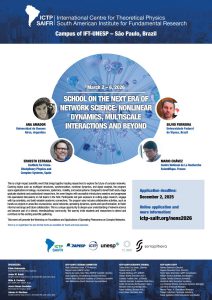
School on The Next Era of Network Science: Nonlinear Dynamics, Multiscale Interactions and Beyond

March 2 – 6, 2026
IFT-UNESP, São Paulo, Brazil
Home
The Next Era of Network Science: Nonlinear Dynamics, Multiscale Interactions and Beyond is a high-impact scientific event that brings together leading researchers to explore the future of complex networks. Covering topics such as multilayer structures, synchronization, nonlinear dynamics, and signal analysis, the program spans applications in biology, neuroscience, epidemics, mobility, and social systems. Designed to benefit both early-stage graduate students and postdoctoral researchers, the event begins with accessible introductory sessions and progresses into specialized discussions on hot topics in the field. Participants will gain exposure to cutting-edge research, engage with top scientists, and build valuable academic connections. The program also includes collaborative activities, such as hands-on projects in areas like neuroscience, social networks, spreading dynamics, sports and synchronization, to foster informal exchange and future collaboration. This is a unique opportunity to deepen your understanding of network science and become part of a vibrant, interdisciplinary community. We warmly invite students and researchers to attend and contribute to this exciting scientific gathering.
This event will precede the Workshop on Foundations and Applications of Spreading Phenomena on Complex Networks.
Organizers:
- Pablo Balenzuela (Departamento de Física, Universidad de Buenos Aires, Argentina)
- Javier M. Buldú (Complex Systems Group & G.I.S.C., Universidad Rey Juan Carlos, Spain)
- Hilda A. Cerdeira (ICTP-SAIFR, and Instituto de Física Teórica, Brazil)
- Jesús Gómez-Gardeñes (Departamento de Física de la Materia Condensada, Universidad de Zaragoza, Spain)
Announcement:
Application is now closed
List of participants here
Lecturers
Lecturers
- Ana Amador (Universidad de Buenos Aires, Argentina) – Complex Systems in the modern era: Nonlinear Dynamics, Excitability, and Biological Function, and Modeling neurons and brains: Dynamical systems and experimental neural data
- Silvio Ferreira (Universidade Federal de Viçosa, Brazil) – Spreading and networks
- Ernesto Estrada (Institute for Cross-Disciplinary Physics and Complex Systems, Spain)
- Mario Chávez (Centre national de la recherche scientifique, France) – Neuroscience and networks I: From brain data to networks, and Neuroscience and networks II: Brain networks in healthy subjects and diseases (Reading material and Data)
- Javier M. Buldú (Universidad Rey Juan Carlos, Spain) – Complex Networks and Sports
- Jesús Gómez-Gardeñes (Universidad de Zaragoza, Spain) – Network Epidemiology, and Social Dynamics and Networks
- Johann H. Martínez (Universidad Rey Juan Carlos, Spain) – Complex Systems, and Network Structure
- Pablo Balenzuela (Universidad de Buenos Aires, Argentina) – Network-Based Analysis of Social Media Data (Reading material and Dataset proposal)
Abstracts here
Registration
Program
The schedule might be changed.
Posters
- Antivar Gonzalez, Angie (Universidad Nacional de Colombia, Colombia): Strategic Recovery of Complex Networks Under Accumulated Damage
This work presents a strategy for the recovery of complex networks affected by accumulated damage, understood as the progressive deterioration of their internal connections. We propose an algorithm that prioritizes repairs on structurally relevant links by combining topological information with a quantitative assessment of accumulated damage, guiding limited resources toward interventions with the highest global impact. The method incorporates a non-Markovian recovery dynamic in which repair decisions depend not only on the current state of the system but also on the history of past interventions. This memory-based mechanism enables a coherent and cumulative restoration process, strengthening the system’s resilience as recovery progresses. The strategy was implemented on a real urban metro network, where we simulated damage and assessed multiple recovery scenarios. Results show that the proposed joint index, combining structural relevance and accumulated damage, restores the system more quickly and effectively than strategies based on either of these dimensions alone. In some cases, the system not only regains its original level of functionality but exceeds it, displaying antifragile behavior in which performance improves after targeted recovery. This approach offers a flexible and generalizable alternative for guiding recovery in damaged complex networks. By focusing on combined repair criteria, it opens a less explored direction with potential applications across infrastructure systems, biological networks, and other domains where strategic restoration and resilience are central challenges.
- Arthuso, Victor (Universidade Federal de Viçosa, Brazil): Impacts of human mobility over epidemic models for vector borne diseases
Vector-borne diseases, such as arboviruses, present a major challenge to global public health, and their study is extremely relevant in Brazil. In this work, we use the SIR-SI compartmental model (Susceptible-Infected-Recovered + Susceptible-Infected) to simulate the transmission dynamics of these diseases, focusing on the effect of human mobility in this model, that is, the flow of people between different locations. The idea is to investigate how human mobility affects the transmission of a vector-borne disease. Synthetic metapopulations are built for a study of these influences, adopting a simplified two-patch model and studying the transmission dynamics based on climatic factors and the vector population present in the patch, as well as the proportion of people moving from one location to another. Subsequently, a star graph structure is inserted into the model to study synthetic metapopulations distributed across a central region and its peripheral areas.
- Brill, Germano Hartmann (Universidade Federal do Rio Grande do Sul (UFRGS), Brazil): Epidemic Extinction in a Continuous SIRS Model with Vaccination
Epidemics have shaped human history, often with devastating consequences, motivating the development of mathematical models to understand and control their dynamics. Among the many aspects of epidemic behavior, the conditions that lead to epidemic extinction stand out as a central—if not the fundamental—question in epidemic modeling. In this work, we study epidemic ex- tinction in a continuous SIRS (Susceptible–Infected–Recovered–Susceptible) model governed by a system of ordinary differential equations (ODEs). The model includes vaccination as a time-dependent process and considers the reinfection of recovered individ- uals through loss of immunity. We analyze how different parameter regimes—particularly infection, recovery, and immunity loss rates—affect the persistence or extinction of the epidemic. Special attention is given to the limitations of continuous population models, in which the infected fraction can fall below the equivalent of a single individual, leading to nonphysical outcomes such as unrealistically long persistence or artificial secondary peaks. By comparing the continuous SIRS dynamics with expected real- world thresholds for extinction, we highlight the importance of incorporating stochasticity or discrete effects to accurately describe epidemic fade-out.
- Carrrera Samuels, David Ethan (Universidade Federal de Viçosa, Brazil): Dynamical Effects of the Vicsek Model with Volume Exclusion
Collective motion is the coordinate movement of groups of individuals in the same system. This phenomenon is able to be in diverse areas of study, as for example, in biological systems, ecology or even in artificial systems, as a group of robots. In this work, we investigate collective movements of self propelled particles with short-range interactions with one another, guiding their next steps. We use a modified version of the Vicsek model to study their contact dynamics. The standard Vicsek model (SVN) considers point-like particles. The modification is the addition of volume exclusion for the particles which is, nowdays, not broadly studied, meaning that now if two particles get too close to each other, they will collide, and have a probability of interacting with the Viesek rule or modifies the direction of the particles proportionally to the alignment between them. The detour will be maximum when their velocities are pointing in opposite directions, and minimum when their directions are parallel. Although this model is based on the Vicsek model, it shows some similarities with the Run-and-Tumble (RnT) model in the sense of volume exclusion and change of direction after a collision. The RnT model has the emergence of the Motility-Induced Phase Separation phenomenon that is characterized by the coexistence of high and low density regions where some particles stay stuck for some time while others move freely. Our preliminary results show that for the SVN, the number of contacts distribution has a Gaussian distribution for both ordered and disordered phases, while the contact time distribution shows a stretched-tailed distribution for very low noise ordered phase. In addition, we study how the volume exclusion affects the order parameter. We observed that as the probability of following the collision rule is increased, the Vicsek’s model order parameter lowers even for low noise phase. The same happens when we increase both the size and the particle density of the system. As these results change the main aspect of the flocking phase of the SVN, we will approach the next steps with the search for a possible appearance of phase separation in the Vicsek model with volume exclusion. For that we will look for statistics such as collision time interval distribution, cluster size, and other measurements that we still need to think about. We intend to study other dynamical descriptions of our model.
- Cassiano De Oliveira, Israel (Universidade Federal de São Carlos, Brazil): NETWORK STRUCTURAL PATTERNS REVEALED BY NONLINEAR DYNAMICS IN ENVIRONMENTAL DNA TIME SERIES
Ecological interactions play a central role in shaping communities and respond to environmental variation across multiple scales. Yet, microbial communities in aquatic ecosystems are often investigated in a compartmentalized way (e.g., only zooplankton, only phytoplankton), which obscures emergent network-level patterns. In addition, most studies emphasize spatial variation, overlooking time as a key axis of change. This gap is particularly relevant in tropical systems, where sampling is scarce and seasonal signals are less pronounced than in temperate regions, making temporal dynamics harder to detect. In this study, we reconstructed monthly ecological networks from a five-year time series collected in a tropical reservoir. We applied Empirical Dynamic Modelling to metabarcoding abundance data to infer time-varying microbial associations using a nonlinear, state-dependent approach – an advance over traditional static and linear methods such as SparCC, FlashWeave and monotonic correlations (e.g. Spearman, Pearson). This workflow produced a sequence of 60 networks, enabling us to examine how both community composition and network structure change over time, potentially linked to wet-dry cycles and interannual climate anomalies such as El Niño and La Niña. By integrating temporal resolution with a dynamic modeling framework, our study offers new insights into how microbial interaction networks reorganize in tropical freshwater ecosystems.
- Contreras Celada, Susana Alejandra (Pontificia Universidad Católica de Valparaíso, Chile): Proximity-induced Pitchfork-bifurcation of an in-phase synchronized state in coupled nano-oscillators
This poster studies a pair of nanomagnetic oscillators driven by a time-periodic anisotropy field and coupled by their dipolar fields. Via numerical simulations and analytical analysis of the Landau–Lifshitz equation, we show that the system exhibits in-phase-synchronized cycles alongside desynchronized periodic orbits. A transition occurs when the desynchronized states synchronize into a periodic motion that later loses symmetry through a transverse, supercritical pitchfork bifurcation, producing a stable anti-phase oscillation. Surprisingly, the instability of the in-phase synchronization occurs when the magnetic oscillators approach each other.”
- Di Ciocco, Favio Augusto (Universidad de Buenos Aires, Argentina): Cascades of collaborative rumors
Social media platforms bombard users with vast amounts of information, often exceeding individual cognitive processing capacities. In contexts where forming an informed opinion is costly, individuals tend to rely on social reinforcement, validating information only if it is confirmed by their local environment. In this work, we study the propagation of unverified information (rumors) in complex networks, focusing on a scenario with two rumors regarding a single topic: one positive and one negative. We introduce a mechanism where these rumors are correlated, such that the adoption of one facilitates the adoption of the other, that is, they collaborate in the adoption of the other. However, since the rumors represent opposing views, agents who accept both encounter a state of cognitive dissonance. This conflict is eventually resolved by discarding both beliefs and adopting a stricter criterion (higher threshold) for accepting future information.
- Dos Santos, Mariana Macedo (Universidade de São Paulo, Brazil): Understanding How Complex Contagion Shapes Information Spread
Understanding how repeated contacts shape information spread is essential for modeling social influence beyond classical rumor dynamics. In this work, we bring a threshold-based rumor model and explore how its behavior depends on structural properties of the network. Our analysis includes investigating the role of heterogeneous connectivity patterns, such as when the initial seed is placed on high-degree hubs versus low-degree leaf nodes, as well as evaluating the dynamics across multiple network topologies. We also aim to explore how higher-order interactions, introduced through simplicial or multi-node structures, may affect the spreading process under reinforcement.
- Gabaldon, Christopher (Departamento de Física, Facultad de Ciencias Exactas y Naturales , Universidad de Buenos Aires (UBA), Argentina): Heuristic inference of a complex system’s dynamical state
In the theory of critical phenomena, it is well known that the point of highest variability (and maximum susceptibility) identifies the system’s critical point. At the same time, graph theory recognizes that the percolation point can be detected through the divergence of a network’s diameter. In this work, we bring these ideas together with the aim of identifying the dynamical state of a system. We propose that the percolation point of the correlation matrix reflects this state. We evaluate this hypothesis in two synthetic systems with distinct dynamics: the Ising model, and a simple cellular automaton that captures the behavior of a set of excitable neurons. The results were reproduced using human fMRI data. In all cases, the critical point estimated through functional networks correlates linearly with the one inferred from other indicators, such as temporal autocorrelation measures. These findings are relevant for identifying the dynamical state of the brain in different subjects, both in healthy conditions (sleep, coma, etc.) and in disease (Alzheimer’s, Parkinson’s, etc.).
- Giovanini, Guilherme (Universidade de São Paulo, Brazil): A control theoretical approach to gene regulation raises quantitative constraints for dynamic homeostasis in stochastic gene expression
Cell phenotype dynamic homeostasis contrasts with the inherent randomness of intracellular reactions. Although feedback control of master regulatory genes (MRG) is a key strategy for maintaining gene network expression ranges limited, understanding the quantitative constraints and corresponding mechanisms enabling such a dynamic stability under noise remains elusive. Here we model MRG expression as a stochastic process and downstream genes as sensors which response conditionally induce MRG activity. We show that at homeostatic regime: i. the trajectories of the MRG expression levels can be adjusted towards specific ranges using both the exact solutions of the stochastic model and the exact stochastic simulation algorithm (SSA); ii. there exists a sampling rate which optimizes the feedback control of the MRG activity, and non-optimal controls resulting in alternative homeostatic dynamics; iii. the feedback control of MRG activity leads to updates which intensities and time intervals are non-linearly related; iv. the ON state probability of an MRG promoter has dynamics confined within a narrow domain. Our results help to understand the quantitative constraints underpinning dynamic homeostasis despite randomness, the mechanisms underlying alternative, non-optimal, homeostatic regimes, and may be useful for theoretically prototyping therapies aiming at gene networks modulation.
- Gonsalves, Paulo Henrique (State University of Ponta Grossa (UEPG), Brazil): Analysis of Spatial Patterns using Ordinal Networks
An important area of complex systems is the analysis of emerging patterns (whether in one, two, or more dimensions) resulting from the interaction between various agents or factors together. One of the tools for analyzing this type of pattern are techniques based on entropy and its derivatives, which allow us to analyze not only the evidence of regularity and randomness (permutation entropy) but also the existence (or not) of a priority among the possible configurations in a particular system. Based on these techniques, more specifically permutation entropy, we can “map” the patterns studied as ordinal networks and thus understand not only the possible neighborhood configurations in a system, but also the types of configurations to which the structures transition spatially. This work aims to show an alternative to the way in which certain two-dimensional patterns are analyzed and classified.
- Granado, Mauro (Instituto de Física La Plata, National University of La Plata (Buenos Aires, Argentina) – National Council of Scientific Research and Technical (CONICET), Argentina): Canine preictal topology: ordinal complexity and neural mapping for seizure forecasting
Reliable seizure forecasting requires detecting subtle, network-level transitions that precede ictal onset, often invisible to standard univariate markers. Here we study long-term intracranial EEG (iEEG) recordings from five dogs with naturally occurring epilepsy (16 electrodes, 400 Hz), comparing interictal segments with preictal windows spanning the hour before seizures (65–5 min, 5-min horizon). We first quantify dynamics using the Bandt–Pompe ordinal framework in the entropy–complexity plane (normalized Shannon permutation entropy H and MPR statistical complexity C), across multiple embedding parameters. While this approach captures robust subject-specific signatures, it shows strong overlap between interictal and preictal distributions, limiting state discrimination. To uncover latent mesoscale reorganization, we propose a topology-first pipeline that converts each high-dimensional iEEG segment (per channel) into a structured 2D representation using Self-Organizing Maps (SOMs; 50×50 hexagonal grids). We then apply a bidimensional extension of the Bandt–Pompe method to SOM weight lattices, using the resulting H×C values to optimize SOM hyperparameters and maximize informational content. Finally, we project SOM representations with UMAP and detect state-dependent “islands” via HDBSCAN, validating separation using cluster purity metrics. We find that complexity-optimized SOM configurations (σ = 4.0, η = 2.0) yield topologically rich UMAP embeddings with clear, individualized preictal markers, achieving high cluster purity (~86%) and substantially finer state decomposition than low-complexity regimes. These results support the existence of personalized preictal topological signatures and provide an interpretable, computationally tractable framework for patient-specific seizure forecasting and potential closed-loop implantable applications.
- Jiofack, Armand Delors (USP, Brazil): characterisation of chimera state in swarmalator system.
Due to the lack of organization of node indices by fixed neighbors in space, the characterization of chimera states in disordered systems as swarmalators is not possible using classical tools such as strength of incoherence and discontinuity measures. Here we propose a new approach that uses recurrence analysis without requiring a reorganization of the system. Swarmalators are dynamic systems combining phase interaction and spatial dynamics, which can give rise to complex collective states. Introducing a delay in the coupling enriches these dynamics and promotes the emergence of hybrid states, where some units in the network synchronise while others remain desynchronised, a characteristic feature of chimeras. To identify and quantify these states, we are using a framework based on recurrence analysis, including tools such as recurrence matrices (RP, JRP). This framework makes it possible to detect dynamic transitions, identify the boiling state as a chimera state, and propose a parameter quantifying the proportion of truly independent nodes in a network.
- Leite, Rafael Nathan Cardoso E Cruz (Universidade Federal de Pernambuco, Brazil): Properties of Complex Networks in the Chesapeake Bay Food Web: Robustness Analysis via Energy Cutoff
The Chesapeake Bay, one of the largest estuaries in the United States, is an ecological system of great complexity and relevance. The food web is composed of thirty-six trophic components, all of which are functionally connected. The interactions among these components are analyzed using complex networks methods. The cutoff paradigm is applied to a weighted ecological network with a cutoff value of θ. The results reveal patterns characteristic of connectivity dynamics in complex networks evidencing both the initial robustness of the system and its tendency to fragmentation at higher values of the cutoff. These patterns are consistent with several theoretical approaches to network theory in ecology and provide empirical support for central hypotheses about resilience and stability in ecosystems. From an applied perspective, the findings underscore the importance of conservation strategies that protect keystone species, such as carnivorous fish, which act as crucial connectors between the two main subnetworks. Although they are positioned at the top of the food web and are often assumed to be less critical to network stability, these species play a pivotal role in regulating populations of lower-level organisms, thereby maintaining the overall integrity of the ecosystem. This interdisciplinary approach, which combines biology, physics, and mathematics, is essential to address the challenges posed by the biodiversity crisis in the Anthropocene.
- Llamoza Rafael, Johan Alexander (Universidade Estadual de Campinas, Brazil): Transactional Financial Networks for Credit Behaviour Prediction in a Peruvian Bank
Traditional credit risk models usually assess each customer in isolation, using demographic, financial and behavioural variables. This work evaluates whether a customer’s position in the bank’s transactional network provides additional predictive power. Using anonymised person-to-person transfers from a Peruvian bank, we build daily directed, weighted graphs where nodes are customers and edges are aggregated monetary transfers. From these graphs we compute network metrics such as PageRank, Katz centrality, closeness and degree-based measures, which are then aggregated in 9- and 6-month windows and combined with traditional features in a LightGBM model for binary credit-risk classification. Graph-based variables account for a relevant portion of the total feature importance and lead to consistent improvements in out-of-time performance compared with the baseline model. These results indicate that the transactional network structure captures non-redundant information about credit risk, providing complementary signals that enhance credit-scoring models.
- Lober De Souza Piva, Luiza (Universidade de São Paulo (USP), Brazil): Discovering equations from data: symbolic regression in dynamical systems
The process of discovering equations from data lies at the heart of physics and in many other areas of research, including mathematical ecology and epidemiology. Recently, machine learning methods known as symbolic regression emerged as a way to automate this task. This study presents an overview of the current literature on symbolic regression, while also comparing the efficiency of five state-of-the-art methods in recovering the governing equations from nine processes, including chaotic dynamics and epidemic models. Benchmark results demonstrate the PySR method as the most suitable for inferring equations, with some estimates being indistinguishable from the original analytical forms. These results highlight the potential of symbolic regression as a robust tool for inferring and modeling real-world phenomena.
- Lorenzoni, Paulo Henrique (Universidade Federal de Viçosa (UFV), Brazil): Reproduction number on structured graphs
Contagious diseases are characterized by their transmission from an infected individual to a susceptible one through physical contact, which can be represented by a network composed of nodes (individuals) and links (interactions) connecting them. In this context, theoretical epidemiology introduces the basic reproductive number $R_0$, a parameter that predicts the average number of infections generated by a single infected individual in a fully susceptible population. This parameter is used to define the epidemic threshold of the system, if $R_0 \ge 1$, meaning that an infected individual transmits the disease to one or more susceptible individuals, the disease can spread through the population, marking a transition from the absorbing (inactive) phase to the active phase. In the case of well-mixed homogeneous populations, where individuals interact with equal chance, the basic reproductive number $R_0$ serves its purpose effectively. However, for structured populations, the criterion $R_0 = 1$ fails to accurately distinguish between absorbing and active phases. Given the necessity to generalize the concept of $R_0$, we investigate the average number of infections in the $n$-th generation, denoted by $R_n$. Thus, the per capita infection ratio between successive generations, $R_n / R_{n-1} = 1$, is used as an alternative way to estimate the epidemic threshold. To this end, we perform spreading analyses on regular lattices from 1D to 5D, random regular networks (RRN), as well as annealed and quenched networks with power-law degree distribution $P(k) \sim k^{-\gamma}$, for the Susceptible-Infected-Susceptible (SIS), Contact Process (CP), and Susceptible-Infected-Removed (SIR) models, at the epidemic thresholds predicted by stochastic simulations and mean-field theories. For regular lattices, we observe convergence behavior $R_n / R_{n-1} \to 1$ at the critical point with a universal scaling. In heterogeneous networks, finite-size effects in the ratio $R_n / R_{n-1}$ are strong such that the convergence to the unit ratio occurs for very large systems. This criterion for the epidemic threshold has been shown to be valid for systems exhibiting a non-vanishing threshold in the thermodynamic limit.
- Lula Costa, Ana Paula (Fundação Oswaldo Cruz, Brazil): From the Dilution Effect to Dilution Landscapes: Effects of Natural Vegetation Cover and Fragmentation on Host-parasite Eco-evolutionary Dynamics
The conversion and fragmentation of natural landscapes are key drivers of biodiversity loss and the erosion of ecosystem services, including disease regulation. Although habitat degradation is linked to higher zoonotic disease risk, the mechanisms by which landscape structure shapes host-parasite eco-evolutionary dynamics remain poorly understood. Here, we combine a spatially explicit metacommunity and coevolutionary model with empirical host-parasite interactions data to examine how landscape cover and configuration shape ecological and coevolutionary outcomes. We find that (1) landscapes with a higher amount of natural cover and lower fragmentation level dilute the distribution of parasites throughout the host community and lead to more homogenous coevolutionary trajectories; (2) highly degraded, fragmented landscapes constrains host-parasite dispersal, promoting smaller, more heterogeneous interaction networks with divergent coevolutionary dynamics, which rise the risk of new parasite variants emerging; and (3) loss of habitat reduces host diversity, impacting parasite host range. These results extend the dilution effect hypothesis by incorporating the structure of the interaction networks and the coevolutionary dynamics. Our findings suggest an increased risk of zoonotic transmission and strength of parasite-host interactions in a degraded landscape. Hence, conservation actions should focus on maintaining functional connectivity to mitigate the effects of landscape conversion on host-parasite dynamics and to promote the disease-regulation service of natural ecosystems.
- Marques De Almeida, Mayla Aparecida (UNESP, Brazil): Boundary crises and decay of orbits to the fixed points in nonlinear mappings
A class of two-dimensional nonlinear mappings, expressed in terms of action and angle variables, is investigated. These mappings depend on a control parameter modulating the degree of nonlinearity, a dissipation parameter, and a dynamical exponent. By adjusting these parameters and appropriately naming the action-angle variables, it is possible to recover various well-known mappings from the literature. The primary goal of this work is to examine the orbital convergence toward fixed points through a detailed phenomenological study of scaling behaviors near bifurcations. This analysis allowed us to identify critical exponents that characterize universality classes associated with such transitions. Additionally, we employed Lyapunov exponents to explore chaotic regimes and conducted an in-depth study of boundary crises, focusing on the interaction and crossing of stable and unstable manifolds.
- Marques, Maurício (Instituto de Física Armando Dias Tavares – UERJ, Brazil): I am, unfortunately, unable to present a poster.
I am, unfortunately, unable to present a poster.
- Milla, Pierina (Pontifical University Catholic of Peru (PUCP), Peru): Shear-induced instabilities for autocatalytic reaction fronts involving different diffusivities
Reaction fronts involving a substrate and an autocatalytic reactant can become unstable if they have different diffusivities. This diffusion-driven instability takes place if the ratio between the diffusion coefficients is greater than a critical threshold. In the case of cubic autocatalysis, the critical diffusivity ratio between the substrate and the autocatalyst is equal to δ = 2.3. In this presentation, we study the stability of flat propagating fronts in a shear flow. The shear-flow model consists of two layers moving relative to one another with constant velocity. The reaction front travels in the same direction as the velocity. We carry out a linear stability analysis by introducing small perturbations of fixed wavelength in the transverse direction. This allows us to compute the corresponding growth rate for each perturbation. We find that shear flow enhances the front instability when the original diffusivity ratio δ exceeds the value of three. These results compare well with a single-layer model using the effective diffusivities due to Taylor dispersion.
- Oliveira, Maria Vithória Peres Dias (São Carlos Institute of Physics(IFSC)/University of São Paulo(USP), Brazil): Influence of topological characteristics on the dynamics of neuronal networks
Neuronal networks’ dynamics depend on the connectivity structure, depicted in a connection matrix, as well as the dynamic representation of their activity. This matrix must follow Dale’s Law, distinguishing excitatory and inhibitory neurons and be sparse. Despite the extensive literature on dynamics in neuronal networks, the diversity of models used, with variations in terms of matrix density, respect for Dale’s Law, and the dynamic model of the neurons, makes it difficult to systematically compare the results. Topological characteristics like connection heterogeneity, modularity and degree assortativity are often ignored. This study aims to analyze topological effects on network dynamics using a consistent nonlinear model for comparability, based on numerical simulations to avoid analytical simplifications.
- Oliveira, Raabe Melo (Universidade Federal do Ceará, Brazil): Anderson Localization with Long-Range Correlations
Disordered systems with long-range correlations provide a rich framework for exploring the interplay between topology and localization phenomena. In this work, we investigate the Anderson transition on a network characterized by long-range connections, where the probability of linking distant sites decays as a power law. By tuning the strength of disorder, we observe a transition from extended to localized states, revealing how long-range interactions influence the onset and nature of localization. Our results highlight the crucial role of network topology in shaping the critical behavior of the Anderson transition, bridging insights from complex network theory and disordered quantum systems.
- Pérez De Oliveira, Maria Amanda (Universidade Federal de Pernambuco, Brazil): Optimal Dynamic Range of a Heterogeneous Neural Network Lattice Model
Since the pioneering studies of Beggs and Plenz, which identified neuronal avalanches with scale-invariant properties, the hypothesis that the brain operates near a critical point has gained strength. This proximity offers advantages such as optimal information transmission and increased sensitivity to stimuli. Research suggests that excitable neural networks maximize their dynamic range at this critical point, where the transition between subcritical and supercritical states occurs. This work investigates the response curves and dynamic range in neural networks modeled as cellular automata, comparing homogeneous square lattices to half-and-half square lattices. In the homogeneous network, all neurons can be excited, whereas in the half-and-half network the lattice is divided into stimulated neurons and neurons whose activity is measured. Python simulations were used to analyze the response curves and compute the dynamic range as a function of the local branching rate. A signature of criticality was observed in the response curves of both networks, characterized by the critical exponent 1/ℎ with a slope of 0.285, indicating the critical transition point. The half-and-half square lattice showed a significant optimization of the dynamic range, reaching 47.05 dB, surpassing the value observed in the homogeneous network by more than an order of magnitude. Additionally, the maximum mean activity in the half-and-half network varied with the local branching rate, unlike in the homogeneous network. These results indicate that the structural heterogeneity in the half-and-half network positively impacts dynamic response capabilities, suggesting greater efficiency in stimulus encoding. The significant divergence in dynamic range between the two networks, combined with the signature of criticality, highlights the relevance of heterogeneity in complex systems, opening new possibilities for exploring the influence of topology in neural networks and other dynamical systems.
- Perez, Ignacio Augusto (Instituto de Investigaciones Físicas de Mar del Plata (UNMdP – CONICET), Argentina): Recovery of contour nodes in interdependent directed networks
Extensive research has focused on studying the robustness of interdependent non-directed networks and the design of mitigation strategies aimed at reducing disruptions caused by cascading failures. However, real systems such as power and communication networks are directed, which underscores the necessity of broadening the analysis by including directed networks. In this work, we develop an analytical framework to study a recovery strategy in two interdependent directed networks in which a fraction q of nodes in each network have single dependencies with nodes in the other network. Following the random failure of nodes that leaves a fraction p intact, we repair a fraction of nodes that are neighbors of the giant strongly connected component of each network with probability or recovery success rate γ. Our analysis reveals an abrupt transition between total system collapse and complete recovery as p is increased. As a consequence, we identify three distinct phases in the (p, γ) parameter space: collapse despite intervention, recovery enabled by the strategy, and resilience without intervention. Moreover, we demonstrate our strategy on a system built from empirical data and find that it can save resources compared to a random recovery strategy. Our findings underscore the potential of targeted recovery strategies to enhance the robustness of real interdependent directed networks against cascading failures.
- Riffel, Théo Bruno Frey (USP São Carlos, Brazil): Multi-Stage Classification of Parkinson’s Disease Using Functional Brain Networks and Machine Learning
The clinical diagnosis of Parkinson’s Disease (PD) is notoriously unreliable, with accuracy in early-stage, untreated cases as low as 26%. This diagnostic gap highlights an urgent need for quantitative, interpretable biomarkers. This thesis develops and validates a multi-stage (Control, Prodromal, PD) classification framework by integrating resting-state fMRI (rs-fMRI) connectomics with machine learning. We systematically compared two feature-engineering approaches: (i) network-based graph metrics, and (ii) high-dimensional region-to-region func tional connectivity (FC). Our results demonstrate a clear distinction: the graph-metrics approach performed poorly (best test F1-macro = 0.478). In contrast, the direct FC approach proved far superior, with a Logistic Regression classifier using the functionally-derived Shen 268 atlas achieving a test F1-macro score of 0.665 (a 39% relative improvement). Beyond classification, we identified interpretable neurobiological markers. Both statistical group analysis and SHAP (SHapley Additive exPlanations) analysis converged, revealing that the model’s predictions were driven by widespread decreases in PD brains connectivity. These disruptions were centered on the Subcortical-Cerebellar (SC) network, identifying both a loss of internal connectivity within the SC network and a disconnection between the SC network and other cortical systems, such as the Motor network. This research validates the superiority of raw FC data over abstracted metrics, provides quantitative support for PD as a “disconnection syndrome,” and establishes a robust, explainable framework to aid in the diagnosis of Parkinson’s disease.
- Robalino Ramírez, Britney Carolina (Yachay, Ecuador): Information flow and the emergence of collective behavior in dynamical networks.
n this project we investigate the relationship between the emergence of collective behavior and the information flow between different scales of dynamical systems possessing global interactions. We consider global coupling functions whose source can be external (driven systems) or internal (autonomous systems). By employing general models of coupled chaotic maps for such systems, we shall study collective behaviors such as synchronization, chimera states, dynamical clustering and generalized synchronization. We shall use time series analysis quantities such as the normalized mutual information and the information transfer between global and local variables to characterize the correlations and causal relations between different levels of the system. We shall explore the possibility of inferring the collective behavior of a system from the knowledge of a local time series.
- Rodriguez Ornelas, Josue Mauricio (Universidad de Guadalajara, Centro Universitario de los Lagos., Mexico): Observability-Based Inference of Node Centrality in Networks of Nonlinear Oscillators
This research explores a novel methodology for extracting topological information from complex dynamical networks through the use of linear state observers. Specifically, it investigates how the estimation error generated by Luenberger-type observers—unidirectionally coupled to nonlinear oscillators—can reveal structural characteristics of the network, such as node centrality. The observers are implemented in a bilayer configuration, where each dynamical unit (e.g., Rössler oscillator) is paired with a dedicated observer receiving partial measurement signals. As a case study, the methodology is applied to star networks of increasing size, where one central node is connected to multiple peripheral nodes. Simulation results demonstrate a clear relationship between the estimation error and the node’s topological position: observers coupled to central nodes consistently exhibit larger errors than those linked to peripheral units, especially during partial synchronization regimes. This behavior reflects the greater complexity in estimating the state of highly connected nodes due to the accumulation of heterogeneous signals.
- Russo, Bruno (Instituto de Cálculo, Argentina): Spreading Vaccine Information on Twitter And the Role of Influencers
Understanding how information and misinformation spread on social media is essential for characterizing public responses to health interventions. In this study, we analyze the propagation of vaccine-related narratives on Twitter (X) during the COVID-19 vaccination rollout in Argentina. Using datasets of Spanish-language tweets collected between December 2020 and April 2021, we construct cumulative adoption curves for key case studies (#SputnikV, #AstraZeneca, #VacunatorioVIP) and evaluate several epidemiological diffusion models (SIR, SEI, SIZ, SEIZ). Our results show that the SEIZ family consistently provides the best fit across all scenarios, successfully capturing the slow-growth, acceleration, and saturation phases of trend adoption. We complement this macroscopic modeling with a retweet-network analysis (~54k nodes, ~130k edges), revealing that the emergence of structurally central “bridge” users—measured via betweenness centrality—coincides with the inflection point of the empirical curves, indicating their key role in accelerating trend diffusion. These findings highlight the importance of both compartmental dynamics and network structure for understanding large-scale information spread and pave the way for future work on counterfactual interventions, synthetic network generation, and robustness analyses
- Salgado Corrado, Ariel Olaf (Instituto de Cálculo, UBA-CONICET, Argentina): Characterizing Socioeconomic Mixing in Urban Parks: A Complex Network Approach to co-accessibility in Argentina
Urban parks are vital for social integration, yet their role in bridging socioeconomic groups is understudied, particularly in Latin American cities. We contribute to filling the gap by modeling the metropolitan areas of Buenos Aires, Rosario, and Córdoba as complex networks of people and places. To capture the flows from residences to parks, we utilize three accessibility models: two established extreme cases from the literature and a third, newly proposed model that allows for a self-consistent demand estimation. Each model generates a distinct scaling law between park attractiveness and expected demand, thereby offering different perspectives on access equity for each socioeconomic group. The results consistently indicate that higher socioeconomic status correlates with better park access in Buenos Aires, while the reverse is true in Córdoba. Furthermore, although the parks in Buenos Aires facilitate the most diverse interactions, they remain significantly below their theoretical maximum for social mixing. By applying community detection at multiple resolutions to the networks, we see a transition from large communities tied by the main parks to small communities tied by local parks. This transition is accompanied with a decrease in diversity as communities become more local. Overall, we find that urban parks in Buenos Aires can be seen as social mixers, with increased diversity compared to the surrounding of the neighborhoods. Cordoba and Rosario, on the other hand, just reproduce the overall level of mixing found at the city level.
- Seth, Soumyajit (Narsee Monjee Institute of Management Studies Hyderabad, India): Complex dynamics of a heterogeneous network of Hindmarsh-Rose neurons
This contribution is devoted to the study of the collective behavior of two HR neurons followed by a network of HR neurons. The collective behavior of the two coupled neurons was obtained from the connection between the traditional 3D HR and a memristive 2D HR neuron via a gap junction. The dynamical properties of this first topology revealed that it is dissipative, therefore can support complex phenomena. From numerical simulations, it is found that the coupled neurons display a variety of behaviors just by varying the control parameter. Amongst these behaviors found, we have periodic bursting or spiking, quasi-periodic bursting or spiking, and chaotic bursting or spiking. Non-synchronized motion is observed when the electrical coupling strength is weak. However, synchronized cluster states are observed when the coupling strength is increased. Also, a variety of cross-ring networks made of a combination of N = 100 different HR neurons in the network are also investigated. It is discovered that the spatiotemporal patterns are affected by the network topology. The cluster states are represented in the non-homogeneous network’s ring and star structures. The ring and ring-star structures contain single and double-well chimera states. Finally, in the PSIM simulation environment, a comparable electronic circuit for the two coupled heterogeneous neurons is designed and investigated. The results obtained from the designed analog circuit and the mathematical model of the two coupled neurons match perfectly.
- Sulbaran Pineda, Hendrik Jose (Universidad Católica del Maule, Instituto Venezolano de Investigaciones Cientifícas (IVIC),, Chile): The habitat switch: How degradation vs. restoration shapes hantavirus infection in Oligoryzomys longicaudatus
Habitat disturbance modulates rodent-borne pathogen transmission by altering contact rates and demographic regulation. We developed an eco-epidemiological model for Andes hantavirus (ANDV) transmission in the sigmodontine reservoir Oligoryzomys longicaudatus that explicitly couples habitat dynamics with infection dynamics. The model links a logistic habitat equation, incorporating restoration and degradation processes, to a density-dependent SIR system where transmission scales with instantaneous habitat-mediated carrying capacity. We derived the basic reproduction number and computed the time-dependent effective reproduction number. By varying restoration and degradation processes, we evaluated four epidemiological metrics across the entire time horizon: cumulative incidence rate, per-capita cumulative incidence rate, average instantaneous incidence rate, and prevalence relative to carrying capacity. Additionally, we assessed threshold risk indicators related to the effective reproduction number in a final temporal window. Sensitivity analysis of restoration and degradation changes on epidemiological metrics revealed a robust concentration mechanism, where habitat loss decreases carrying capacity, elevates effective density, and amplifies transmission. Conversely, restoration contracts the supercritical region and reduces infection across all metrics. Trade-offs also arise because restoration can increase total host abundance while simultaneously reducing per-capita transmission pressure. Our results provide threshold and infection maps linking habitat management to epidemiological outcomes, suggesting that sustained restoration at moderate intensity, combined with measures limiting reservoir crowding, offers the greatest reduction in ANDV risk.
- Tabet Cruz, Gabriella Lima (Universidad Complutense de Madrid, Spain): Contrasting eco-evolutionary patterns of host immunity and bacterial virulence in zoonotic networks
Infection arises from biological compatibility between hosts and pathogens, shaped by the interplay of host immune defences and pathogen virulence traits that ultimately determine who infects whom. The understanding of such complex interactions requires a multispecies approach. Here, we integrate phylogenetic, immunogenetic, and virulence data across wild mammal and zoonotic bacteria species to uncover how molecular and functional traits shape host-pathogen associations. By combining immune profiles of innate and adaptive pathways with bacterial virulence mechanisms—including toxins, secretion systems, and motility—we reveal two contrasting eco-evolutionary patterns. Bacterial traits form modular and phylogenetically conserved networks, suggesting that infectivity strategies are evolutionarily constrained and aligned with host sharing. In contrast, mammalian immune traits show extensive overlap and low modularity, indicating flexible and convergent responses to infection. Innate traits retain weak phylogenetic signals, whereas adaptive traits evolve independently of host ancestry. A machine learning method highlights key determinants on both sides, such as immunoglobulin and Rel/NF-κB pathways in hosts, and exotoxins, secretion systems, and adhesion factors in bacteria. Together, these results suggest that bacterial virulence evolves under strong functional constraints, while host immunity diversifies through adaptive flexibility. This asymmetry helps explain how evolutionary and ecological processes jointly structure zoonotic transmission.
- Tonon, Bryannie Carla De Lima (Universidade Federal de Viçosa (UFV), Brazil): Spatial Random Networks for Modeling Human Mobility and Epidemic Dynamics
Interactions between elements of social, biological, and technological systems can be represented by complex networks. In spatially embedded networks, vertices can represent locations, while edges can capture flows or movements between them, making these models particularly relevant for understanding and controlling epidemic spreading. In this work, we generate random geometric networks (RGNs) where each node has a different radius of influence and is placed uniformly on a bidimensional area. We analyze different types of connection probabilities and characterize the structural properties of the networks. A case of particular interest is the modeling of mobility patterns, where vertices represent locations with associated populations, and edges account for flows of individuals between them, generating metapopulations. We further apply these weighted networks in an epidemic compartmental model, and verify that the epidemic threshold depends on both spatial and mobility patterns. As a perspective, the synthetic mobility networks can be compared with real data and serve as a baseline for exploring the influence of mobility in more complex scenarios, such as epidemic spreading processes in interconnected populations.
- Toro, Daniel (Universidad de Chile, Chile): The role of centrality in the distribution of chimera states on Duffing oscillator networks
The interplay between network structure and nonlinear dynamics shapes the behavior of many complex systems. Among these, chimera states are intriguing phenomena where coherent and incoherent regimes coexist in systems of coupled identical oscillators [1]. Here, we analyze the emergence and distribution of chaotic chimera states in different network topologies (Erdős–Rényi, Watts–Strogatz, and Barabási–Albert) composed of linearly coupled Duffing oscillators [2], aiming to unveil how structural characteristics, such as centrality and connectivity, influence the formation of chaotic domains. The study is conducted by generating a localized chaotic state within a synchronized background (chaotic pinch) and tracking its evolution toward a stable chimera configuration. The Lyapunov spectrum is used to quantify each node’s contribution to chaotic dynamics (c.f. Fig. 1a), enabling the establishment of proper relations with network characteristics. We find that the chaotic pinch localization does not determine the extent of the chaotic region but rather depends strongly on the network structure and its characteristics. A statistical characterization of the chaotic domains reveals a smooth transition in size from synchronized to chaotic regimes depending on the mean degree and coupling strength $\kappa$ (c.f. Fig. 1b).. Moreover, the localization of the chaotic domains is directly related to how structurally relevant the node is within the network, according to the measurement of different centralities (c.f. Fig. 1c). These results highlight the central role of network centrality in the emergence of localized chaotic states, opening the possibility of predicting incoherent behavior in real-world networks [3]. References [1] D. M. Abrams & S. H. Strogatz Phys. Rev. Lett. 93, 174102 (2004) [2] M. G. Clerc, S. Coulibaly, M. A. Ferré, & R. G. Rojas Chaos 28, 083126 (2018). [3] E. Schöll, Eur. Phys. J. Spec. Top. 225, 891 (2016).
Videos and Files
- 09:00 - Johann H. Martínez (Universidad Rey Juan Carlos): Complex Systems
-
11:30 - Johann H. Martínez (Universidad Rey Juan Carlos):
Network Structure
- 09:00 - Ana Amador (Universidad de Buenos Aires): Nonlinear dynamics, excitability & biological function
- 11:30 - Ana Amador (Universidad de Buenos Aires): Dynamical systems & experimental neural data
-
12:30 - Mario Chavez (Centre national de la recherche scientifique):
Neuroscience & networks I
-
15:00 - Mario Chavez (Centre national de la recherche scientifique):
Neuroscience & networks II
-
09:00 - Silvio Ferreira (Universidade Federal de Viçosa):
Spreading & Networks
-
11:30 - Jesús Gómez-Gardeñes (Universidad de Zaragoza):
Network epidemiology
- 14:00 - Mario Chavez (Centre national de la recherche scientifique): Low-dimensional representations of multilayer networks
-
09:00 - Jesús Gómez-Gardeñes (Universidad de Zaragoza):
Social dynamics & Networks
-
11:30 - Pablo Balenzuela (University of Buenos Aires, Argentina):
Social media analysis
-
09:00 - Javier M. Buldú (Universidad Rey Juan Carlos):
Complex networks & Sports
asdasdasd
Venue
Venue: The event will be held at IFT-UNESP, located at R. Jornalista Aloysio Biondi, 120 – Barra Funda, São Paulo. The easiest way to reach us is by subway or bus, See arrival instructions here.
Accommodation: Participants whose accommodation will be provided by the institute will stay at Hotel Intercity the Universe Paulista. Hotel recommendations are available here.
Attention! Some participants in ICTP-SAIFR activities have received email from fake travel agencies asking for credit card information. All communication with participants will be made by ICTP-SAIFR staff using an e-mail “@ictp-saifr.org”. We will not send any mailings about accommodation that require a credit card number or any sort of deposit. Also, if you are staying at Hotel Intercity the Universe Paulista, please confirm with the Uber/Taxi driver that the hotel is located at Rua Pamplona 83 in Bela Vista (and not in Jardim Etelvina).
Additional Information
BOARDING PASS: All participants, whose travel has been provided or will be reimbursed by ICTP-SAIFR, should bring the boarding pass upon registration. The return boarding pass (PDF, if online check-in, scan or picture, if physical) should be sent to secretary@ictp-saifr.org by e-mail.
Visa information: Nationals from several countries in Latin America and Europe are exempt from tourist visa. Nationals from Australia, Canada and USA are required to apply for a tourist visa. Check for some helpful information here.
Poster presentation: Participants who are presenting a poster MUST BRING A PRINTED BANNER . The banner size should be at most 1 m (width) x 1,5 m (length). We do not accept A4 or A3 paper.
Power outlets: The standard power outlet in Brazil is type N (two round pins + grounding pin). Some European devices are compatible with the Brazilian power outlets. US devices will require an adapter.
Security issues: Although São Paulo is a relatively safe city, be careful when using cellphones on the street, avoid isolated areas at night, and be aware when crossing the street that cars may not stop for pedestrians. Also, please do not leave valuable items like laptops unattended even for short breaks. At the IFT-UNESP, there are storage lockers available and keys can be obtained with our secretaries.