QCD meets Gravity School

December 8 – 12, 2025
ICTP-SAIFR, São Paulo, Brazil
Venue: ICTP-SAIFR/IFT-UNESP
Zoom ID: 876 5368 6580
Password: gravity
Home
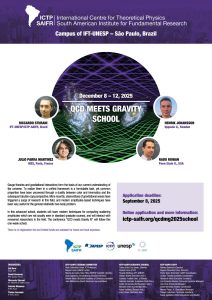
Gauge theories and gravitational interactions form the basis of our current understanding of the universe. To realize them in a unified framework is a formidable task, yet common properties have been uncovered through a duality between color and kinematics and the subsequent double-copy perspective. More recently, observations of gravitational waves have triggered a surge of research in this field, and modern amplitudes-based techniques have been very useful for the general relativistic two-body problem.
In this advanced school, students will learn modern techniques for computing scattering amplitudes which are not usually seen in standard graduate courses, and will interact with renowned researchers in the field. The conference “QCD meets Gravity” will follow this one-week school. You can find information on the previous QCD meets Gravity events here: QCD Meets Gravity X (Taiwan 2024), IX (CERN 2023),VIII (Zurich 2022), VII (UCLA 2021), VI (Northwestern 2020), V (UCLA 2019), IV (2018), III (UCLA 2017), II (UCLA 2016), I (Edinburgh 2016)
Organizers:
- Zvi Bern (UCLA, USA)
- David Kosower (IPhT, Saclay, France)
- Riccardo Sturani (IFT-UNESP/ICTP-SAIFR, Brazil)
- Gabriel Menezes (IFUSP, Brazil)
- Thales Azevedo (IF-UFRJ, Brazil)
There is no registration fee and limited funds are available for travel and local expenses.
Announcement:
Application is now closed.
Application deadline: September 8, 2025
Click here for satisfaction survey
List of Participants: here
Lecturers
Lecturers
- Henrik Johansson (Uppsala U., Sweden) – Basics of Color-Kinematics Duality and Double Copy
- Alfredo Guevara (Princeton, Inst. Advanced Study, USA) – Classical gravitational scattering
- David Kosower (IPhT, Saclay, France) – Introduction to Scattering Amplitudes
- Riccardo Sturani (IFT-UNESP/ICTP-SAIFR, Brazil) – The basis of Gravitational Waves: abstract and reading material
Registration
Participants
Program
The schedule might be changed.
Posters
- Abouzeid, Salma Ali (Faculty of Science – Alexandria University, Egypt): SU(3) Gauge Fields on Snyder Quantum Geometry: Towards a Finite and Unitary Quantum-Gravity Framework
We explore a simple scenario in which quantum gravity interacts only with a pure SU(3) Yang–Mills sector. Ultraviolet divergences are softened by adopting Snyder’s Lorentz-invariant minimal length ℓs ≃ 2 × 10^−5 m, while the vacuum is modelled as a mosaic of roughly 10^123 confinement–scale “SU(3) atoms.” Taken together, these ingredients lower the naive Planck-scale zero-point energy to the observed cosmological constant and allow a mixed Snyder–Planck lattice that satisfies reflection positivity. Within a leading Einstein–Hilbert + Yang–Mills truncation, the functional renormalisation group then exhibits a non-Gaussian fixed point with three relevant directions, in line with the asymptotic-safety programme. At low energies, the same setup suggests a 0++ glueball of mass 1.3–1.7 GeV, which could act as a self-interacting SIMP dark-matter candidate, and it reproduces the Bekenstein–Hawking entropy together with the universal −1/6 ln A correction without introducing an ad hoc brick-wall cut-off. Predicted deviations from the speed of light in gravitational-wave signals and from standard zero-point motion in opto-mechanical resonators are far below current experimental reach. Although the framework is still idealised and relies on several simplifying assumptions, it offers a finite, Lorentz-covariant setting that appears compatible with existing observations and may provide a useful test bed for further studies of quantum gravity coupled to non-Abelian gauge fields.
- Bittencourt, Thales (UFF, Brazil): Generating Jackiw-Teitelboim Euclidean gravity from static three-dimensional Maxwell-Chern-Simons electromagnetism
We consider pure three-dimensional Maxwell-Chern-Simons electrodynamics in the static limit. We show that this theory can be mapped onto a two-dimensional gravitational model in the first-order formalism of Riemannian manifolds with Euclidean signature, coupled to a real scalar field naturally interpreted as a dilaton. In this framework, the Newtonian and cosmological constants in two dimensions are fully determined by the electric charge. The solution to this gravitational model is found to be trivial: a constant dilaton field on a flat manifold. However, we introduce two distinct shifts of the spin connection that transform the model into Jackiw-Teitelboim gravity. Specifically, we identify two additional solutions: a hyperbolic manifold with also a constant dilaton configuration; and a spherical manifold where, again, the dilaton assumes a constant, nonzero field configuration. In both non-flat cases, by employing the Gauss-Bonnet theorem in the specific cases of compact manifolds, we establish that the manifold’s radius is fixed by the cosmological constant (and, therefore, by the electric charge).
- Briceño, Matias Sebastian (Universidad San Sebastián, Chile): Scalar subleading soft theorems from an infinite tower of charges
We investigate the emergence of infinite-dimensional symmetries in the absence of gauge invariance by analyzing massless scalar theories. We construct an infinite tower of charges that arise from the subleading equations of motion at null infinity and are built from specific combinations of asymptotic field coefficients. By carefully analyzing the dynamics at spatial infinity, we show that this tower of surface integrals commutes with the S-matrix of the interacting model. As an application, we demonstrate that these symmetries lead to an infinite set of subleading soft relations, valid at tree-level in a cubic interaction with massive scalar fields.
- Carvalho, Willian Oliveira (ICEN UFPa, Brazil): Lorentz violating quadratic gravity
This work explores the renormalization of the Bumblebee model within the framework of quadratic gravity, a theoretical setting that permits the violation of Lorentz symmetry. Such violation arises from a vector field whose potential is engineeredto induce a nonzero vacuum expectation value (VEV), thereby leading to the emergence of a preferred direction in spacetime and consequently, to the spontaneousbreaking of Lorentz symmetry. The action governing the model describes the coupling between the bumblebee field and gravitational sector, incorporating quadratic curvature terms as well as interaction terms that account for the coupling betweenthe bumblebee field and the gravitational field via specific coupling coefficients. The analysis is centered on the computation of radiative corrections, namely self-energy corrections and one-loop two-point functions, for both the bumblebee field and the gravitation propagator, with particular attention to the effects of Lorentz-violating vertex insertions.
- Cunha, Ivana (Universidade Federal do Pará, Brazil): Ultra-Planckian Quark and Gluon Scattering in Agravity
We analyze tree-level quark and gluon scattering via graviton exchange in Agravity, a renormalizable and UV-complete theory of quadratic quantum gravity. In the ultra-Planckian regime ( ≫ 2 s≫m 2 ), we compute squared amplitudes and cross sections for the processes → gg→gg, → ˉ gg→q q ˉ, → gq→gq, and → qq→qq. All amplitudes scale as 1 / 1/s, consistent with UV completeness. We also address unitarity in the presence of higher-derivative ghost states and show that infrared divergences in forward scattering are regulated by finite quark masses. These results support the consistency of Agravity as a framework for describing gravitational interactions among matter fields at trans-Planckian energies.
- De Aguiar Alves, Níckolas (Universidade Federal do ABC, Brazil): Asymptotic Symmetries on Conformal Killing Horizons
Symmetries are ubiquitous in modern physics. They not only allow for a more simplified description of physical systems but also, from a more fundamental perspective, can be seen as determining a theory itself. In the present paper, we propose a new definition of asymptotic symmetries that unifies and generalizes the usual notions of symmetry considered in asymptotically flat spacetimes and expanding universes with cosmological horizons. This is done by considering BMS-like symmetries for “asymptotic (conformal) Killing horizons”, or A(C)KHs, here defined as null hypersurfaces that are tangent to a vector field satisfying the (conformal) Killing equation in a limiting sense. The construction is theory-agnostic and extremely general, for it makes no use of the Einstein equations and can be applied to a wide range of scenarios with different dimensions or hypersurface cross sections. While we reproduce the results by Dappiaggi, Moretti, and Pinamonti in the case of asymptotic Killing horizons, the conformal generalization does not yield only the BMS group, but a larger group. The enlargement is due to the presence of “superdilations”. We speculate on many implications and possible continuations of this work, including the exploration of gravitational memory effects beyond general relativity, understanding antipodal matching conditions at spatial infinity in terms of bifurcate horizons, and the absence of superrotations in de Sitter spacetime and Killing horizons. Based on arXiv: 2504.12514 [gr-qc].
- Ferreira, Matheus Curado (Brazilian Center of Physical Research, Brazil): Cosmological Ghost Collider
The Cosmological Bootstrap can establish a solid relation between a quantum field theory and curved spacetimes. For a deSitter (dS) spacetime this framework has already proven promising for calculating correlation functions and quantum corrections associated to particle scattering in the early universe .The entire program has the conformal group as its starting point, for the primordial universe it fits perfectly, if we conceive the primordial universe as being a approximately deSitter universe. This is possible since the isometries of the de Sitter space-time are given by the conformal group $SO_{d+1,1}$. One important result of this method is that it shows how particle production during inflation can affect the signals we observe today. Particles created by the expanding spacetime leave signatures in the distribution of matter, such as specific momentum-dependent features and angular patterns. These signatures carry information about the physical processes that happened during inflation and can be used to study very high-energy physics. Future observations could make it possible to detect these signals more precisely. This would allow us to test ideas about particles that existed during inflation and learn more about how the early universe worked.~In our proposal, we study a situation where the usual symmetry is broken. We look at a version of the cosmological collider with a massive ghost particle that breaks Lorentz symmetry. This particle is produced by gravity in a spacetime that is close to de Sitter, but not exactly. If such a particle exists, it could leave a signal that helps us understand the geometry of the early universe and test physics beyond the Standard Model.
- Figueira, Vicente Viater (USP, Brazil): 2+1 Dimensional Gravity as a Gauge Theory
This work investigates General Relativity (GR) in 2+1 dimensions as a toy model for formulating gravity in the style of a gauge theory. Using the vielbein and spin connection formalism—considering these as independent—the Einstein-Hilbert action is rewritten in terms of differential forms, such that the gauge redundancy associated with diffeomorphisms can be interpreted as local Poincaré transformations. It is shown that, in 2+1 dimensions, classical GR is equivalent to a Chern-Simons theory for the group ISO(2,1) and, with a cosmological constant, for SO(3,1) or SO(2,2). This equivalence provides a clear path toward quantization, making use of the topological structure and renormalizable character of Chern-Simons theory, with nontrivial dynamics arising at the boundary conditions. The study also discusses implications for D = 3+1 and the limitations of this approach.
- Guedes, Fillipe Marques (Universidade do Estado do Rio de Janeiro, Brazil): Local composite operator formalism in gauge theories with Gribov horizon restriction
Understanding the infrared (IR) dynamics of Quantum Chromodynamics (QCD) remains a major open problem in theoretical physics, directly related to phenomena such as confinement and the dynamical generation of mass. This work focuses on the study and application of advanced methods in non-Abelian gauge theories in the non-perturbative regime, particularly within the Refined Gribov-Zwanziger (RGZ) framework. The central formalism is quantum field theory, applied both to fundamental QCD and to infrared-modified gauge theories. Among the non-perturbative tools used, the RGZ approach restricts the functional integration over gauge fields to the Gribov region, eliminating residual infinitesimal gauge copies and enabling a semi-analytical analysis of infrared QCD. Various correlation functions computed using the RGZ action at tree level and one-loop order have shown compatible results with available lattice data in Landau gauge and also for propagators in Linear covariant gauges. This compatibility is based, however, by the fitting of infrared generated masses from lattice data and a fully self-consistent prediction for the RGZ action, even though possible through the calculation of dimension-two condensates and the solution of the gap equation, is still lacking. In this context, the Local Composite Operator (LCO) formalism plays a crucial role, providing a renormalizable method to construct effective potentials for local operators made up of nonlinear functions of the fundamental fields. Through the introduction of auxiliary fields and gap equations, this formalism allows for the non-perturbative evaluation of dimension-two condensates, which are essential for understanding mass generation in the RGZ approach and reaching ab initio predictions in this theory. The aim of this work is to explore further the calculation of this effective potential.
- Haiashi, Lucas (University of São Paulo, Brazil): NLO angular impulse
We here derive an expression for the angular impulse in the so called KMOC formalism up to the NLO, extending previous work. Applying the newly derived to compute scattering amplitudes for two rotating black holes
- Hernández, Jacobo (Benemérita Universidad Autónoma de Puebla, Mexico): I don’t have a title yet
I will check my recent work and see what I could use for the poster. As mentioned, I’m currently doing like an internship at IPhT, so I have not had the time to see what I could add to a poster.
- Lueiza Colipí, Andrés Felipe (Universidad de la Frontera, Chile): Quantum Cosmology in K-Essence Theory: The Tachyon Case
We study the quantum cosmological behavior of a non-minimally coupled k-essence field to gravity. The Hamiltonian of the system is constructed using the Dirac–Bergmann algorithm, and the resulting constraints are classified into first- and second-class. By employing Dirac brackets, we derive the canonical commutation relations consistent with the constrained dynamics. We show that the quantum dynamics, governed by the Wheeler–DeWitt equation, reduces to a massless Klein–Gordon equation. Finally, we analyze the effective Einstein equations of the theory and examine the behavior of the effective fluid as a dark energy component of the universe, we investigate possible phantom crossing line induced by quantum effects.
- Martínez, Álvaro Rafael (Institute of Theoretical Physics, Faculty of Mathematics and Physics, Charles University, Czechia): Classical Single Copy and Conformal Transformations
The double copy has unveiled surprising correspondences between gauge and gravity theories, ranging from scattering amplitudes to classical solutions. At the classical level, identifying a systematic procedure to construct single copies beyond the Kerr–Schild double copy remains an open challenge. As a step in this direction, we examine the classical scattering of charges and masses in spherically symmetric Yang–Mills and gravitational fields in the probe limit, with particular focus on the Janis–Newman–Winicour spacetime. Our findings indicate that conformal transformations may provide a pathway to defining single copies that reduce to the Yang-Mills Coulomb field, at least for stationary and spherically symmetric geometries. This example suggests the existence of a more general procedure to obtain single copies corresponding to Yang–Mills theories, and may provide hints towards clarifying the connection between the classical and amplitude-based double copy.
- Montoli, Sebastián (Facultad de Ciencias, Uruguay): Two-dimensional gravity theories and holography with finite cutoff
Recently, the relationship between gravity theories defined on a finite patch of spacetime and conformal field theories deformed by the TTbar flow has been explored. In particular, it has been conjectured that gravity on a finite patch of an asymptotically Ads3 spacetime has as its holographic dual a conformal field theory deformed by TTbar. The main argument supporting this is that the deformation of the Ward identity of the conformal theory formally coincides with the Wheeler–DeWitt equation for gravity in Ads3. The problem has also been addressed in one lower dimension: starting from JT gravity in the second-order formalism, a canonical quantization approach is employed to obtain and solve the Wheeler–DeWitt equation. Our interest lies in gravity in 1+1 dimensions. However, unlike the approaches mentioned above, we formulate the problem in the first-order formalism. Working within this formalism, we find that by imposing Dirichlet boundary conditions on the canonical variables, the path integral defining the solution of the Wheeler–DeWitt equation reduces to an ordinary integral. This result can be interpreted as the analogue of a TTbar type deformation of a conformal field theory that satisfies a Ward identity.
- Parlanti, Martin Gabriel (Instituto de Física La Plata, Argentina): Four-dilatino scattering amplitude from superstrings theories and proton-proton elastic scattering.
We study high-energy scattering at fixed angle in the planar limit of non-Abelian gauge field theories from type IIB superstring theory scattering amplitudes. First, we consider four-glueball scattering described in terms of the four-dilaton string theory scattering amplitude. We explicitly calculate some angular integrals of four scalar spherical harmonics on the five sphere leading to selection rules for several scattering processes. Then, we consider the high-energy limit of the four-dilatino scattering amplitude in type IIB superstring theory, which allows to describe four spin-1/2 fermions scattering in the dual gauge field theory. In both cases, the partonic structure of the scattering cross sections is obtained. The Regge behavior is also obtained. In addition, we study certain related aspects by considering the effective action constructed from IIB supergravity.
- Reichenberg Ashby, Michael (Queen Mary University of London, United Kingdom): The exact classical double copy: New insights from the first-order formulation of gravity
In many cases, non-abelian gauge theories possess a structure which admits a duality between colour and kinematics. This duality allows for a double copy construction in which observables in the gauge theory can be manipulated to yield gravity observables. Recently, the double copy has been adapted to show direct correspondences between certain special exact solutions to the classical equations of motion for gravity and gauge theory. However, it remains unclear how and under what circumstances this procedure can be extended to form general exact double copies. In 2+1 dimensions, Einstein’s gravity is non-dynamical and only contains topological degrees of freedom, allowing it to be rewritten as a first-order Chern-Simons theory with a gauged spacetime symmetry. By examining the relationships between gravity and gauge solutions and their associated observables in this regime we can understand more about the geometrical structure underlying the exact double copy and provide new insight into its mechanism in more non-trivial cases. It is known that the double copy of gauge theory Wilson loops is the gravitational Wilson loop, a phase factor proportional to the proper distance around a closed curve. We demonstrate the classical equivalence between this phase factor and the Wilson loop operator associated to the gravitational Chern-Simons connection, providing motivation for investigating how the classical double copy manifests in the first-order formalism of gravity.
- Rogoski Golembionski, Vanessa Grazieli (Universidade Estadual Paulista Júlio de Mesquita Filho (UNESP), Brazil): Quantum Gravity from the Asymptotically Safe Approach
A theory is said to be asymptotically safe if two conditions are satisfied: There exists a fixed point g* such that, as the energy scale tends to infinity, the couplings of the theory flow towards this fixed point; the critical surface associated with g* has finite dimension. In this work, we aim to provide an introduction to the quantization of the gravitational interaction, guided by the asymptotic safety approach and its conditions. This is relevant since, macroscopically, gravity is well described by General Relativity, however, we encounter problems such as spacetime singularities. Thus, a quantum theory of gravity could potentially solve this issue. When we apply the usual Quantum Field Theory formalism to the quantization of gravity, we are faced with a perturbatively non-renormalizable theory, and therefore with a lack of predictivity in the ultraviolet regime. In order to overcome this problem, the asymptotic safety approach emerges as a promising alternative, especially by proposing the existence of a non-trivial fixed point in the renormalization group flow, where the so-called beta functions vanish and, if there exists a finite number of directions associated with such a point, the theory remains predictive. References EICHHORN, Astrid. Asymptotically safe gravity. arXiv preprint arXiv:2003.00044, 2020. EICHHORN, Astrid. The microscopic structure of quantum space-time and matter from a renormalization group perspective. Nature Physics, v. 19, n. 11, p. 1527–1529, 2023. PERCACCI, Roberto et al. Asymptotic safety. Approaches to quantum gravity, p. 111–128, 2009. WEINBERG, Steven. Ultraviolet divergences in quantum theories of gravitation. In: General Relativity. 1979. p. 790–831.
- Soares Jr., David Miguel (Unesp – Guaratinguetá, Brazil): Nonlinear Gravitoelectromagnetism as an Alternative Approach to Dark Matter and Dark Energy Phenomena
Our work investigates nonlinear gravitomagnetic equations as an alternative explanation for dark matter and dark energy phenomena. The objective is to develop a theoretical framework where nonlinear corrections act as an effective source in Einstein’s equations, potentially accounting for galactic rotation curves usually attributed to dark matter, as well as repulsive effects usually attributed to dark energy.
- Vieira, Douglas Willian (São Paulo State University, Brazil): The quark-gluon vertex in the Refined Gribov-Zwanger Scenario
In its fundamental formulation, quarks and gluons are described by Quantum Chromodynamics (QCD), a quantum field theory built upon the Yang–Mills paradigm. To understand and quantitatively describe the complex low-energy (infrared) regime of this theory, a primary approach involves the calculation of its fundamental correlation functions, with the divergences present in the corresponding diagrams being identified. In this context, the Refined Gribov–Zwanziger (RGZ) scenario has emerged as a promising formalism, as it allows investigation precisely in the region where non-perturbative effects, such as confinement, become dominant. The purpose of this work is to investigate the quark–gluon vertex in the non-perturbative sector of Yang–Mills theories in the presence of a Gribov horizon, with the aim of understanding the role of minimal coupling in the non-perturbative description within the RGZ framework. The investigation begins with the analytical computation of one-loop vertex corrections, aiming to identify the underlying structures of these contributions as well as the divergences present in the corresponding diagrams. The results will be compared with lattice QCD simulations to assess whether the RGZ framework reliably captures the non-perturbative effects of the quark–gluon vertex
- Zamperlini Dos Santos, Joao Victor (Federal University of Santa Catarina, Brazil): The Impact of Primordial Black Holes on Nuclear Interactions through Spacetime Curvature Corrections to the Yukawa Potential
We explore how spacetime curvature modifies quantum interactions, with an emphasis on Yukawa-type potentials. Using a local Riemann normal coordinate expansion, we derive curvature corrections to propagators and compute the resulting modifications to the interaction potential via Born’s approximation. The corrections, controlled by geometric quantities of the spacetime, lead to the breaking of radial symmetry and shifts in scattering properties. We show that, while small in most environments, these effects may be enhanced near primordial black holes, due to their extreme curvature at small scales, which may provide a natural setting to probe such semiclassical effects, potentially linking QFT in curved spacetime with phenomenology of dark matter candidates, at scales well above the Planck scale.
Videos and Files
2025-12-08
- 09:00 - Riccardo Sturani (IFT-UNESP/ICTP-SAIFR, Brazil): The basis of Gravitational Waves - Class 1
-
11:00 - David Kosower (IPhT, Saclay, France):
Introduction to Scattering Amplitudes - Class 1
-
14:30 - Henrik Johansson (Uppsala U., Sweden):
Basics of Color-Kinematics Duality and Double Copy - Class 1
-
09:00 - Riccardo Sturani (IFT-UNESP/ICTP-SAIFR, Brazil):
The basis of Gravitational Waves - Class 2
-
11:00 - David Kosower (IPhT, Saclay, France):
Introduction to Scattering Amplitudes - Class 2
-
14:30 - Henrik Johansson (Uppsala U., Sweden):
Basics of Color-Kinematics Duality and Double Copy - Class 2
- 09:00 - Alfredo Guevara (Princeton, Inst. Advanced Study, USA): Classical gravitational scattering - Class 1
-
11:00 - Henrik Johansson (U. of Uppsala, Sweden):
Basics of Color-Kinematics Duality and Double Copy - Class 3
- 14:00 - Henrik Johansson (U. of Uppsala, Sweden): From Graviton Scattering to Black-Hole Amplitudes in General Relativity
-
15:45 - David Kosower (IPhT, Saclay, France):
Introduction to Scattering Amplitudes - Class 3
-
09:00 - Alfredo Guevara (Princeton, Inst. Advanced Study, USA):
Classical gravitational scattering - Class 2
-
11:00 - David Kosower (IPhT, Saclay, France):
Introduction to Scattering Amplitudes - Class 4
-
14:30 - Henrik Johansson (Uppsala U., Sweden):
Basics of Color-Kinematics Duality and Double Copy - Class 4
-
09:00 - Alfredo Guevara (Princeton, Inst. Advanced Study, USA):
Classical gravitational scattering - Class 3
-
11:00 - David Kosower (IPhT, Saclay, France):
Introduction to Scattering Amplitudes - Class 5
-
14:30 - Henrik Johansson (Uppsala U., Sweden):
Basics of Color-Kinematics Duality and Double Copy - Class 5
asdasdasd
Photos

Additional Information
Attention! Some participants in ICTP-SAIFR activities have received email from fake travel agencies asking for credit card information. All communication with participants will be made by ICTP-SAIFR staff using an e-mail “@ictp-saifr.org”. We will not send any mailings about accommodation that require a credit card number or any sort of deposit. Also, if you are staying at Hotel Intercity the Universe Paulista, please confirm with the Uber/Taxi driver that the hotel is located at Rua Pamplona 83 in Bela Vista (and not in Jardim Etelvina).
BOARDING PASS: All participants, whose travel has been provided or will be reimbursed by ICTP-SAIFR, should bring the boarding pass upon registration. The return boarding pass (PDF, if online check-in, scan or picture, if physical) should be sent to secretary@ictp-saifr.org by e-mail.
Visa information: Nationals from several countries in Latin America and Europe are exempt from tourist visa. Nationals from Australia, Canada and USA will be required to obtain a tourist e-visa for visits after April 10, 2025. Please check here which nationals need a tourist visa to enter Brazil.
Accommodation: Participants whose accommodations are provided by ICTP-SAIFR will stay at Hotel Intercity the Universe Paulista. Other hotel recommendations are available here.
Poster presentation: Participants who are presenting a poster MUST BRING A PRINTED BANNER . The banner size should be at most 1 m (width) x 1,5 m (length). We do not accept A4 or A3 paper.