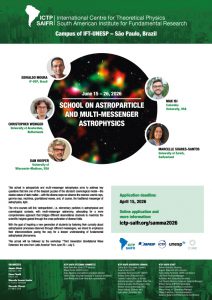
School on Astroparticle and Multi-messenger Astrophysics

June 15 – 26, 2026
Venue: ICTP-SAIFR/IFT-UNESP
Home
This school in astroparticle and multi-messenger astrophysics aims to address key questions that link one of the deepest puzzles of the standard cosmological model—the elusive nature of dark matter—with the diverse ways we observe the cosmos: cosmic rays, gamma rays, neutrinos, gravitational waves, and, of course, the traditional messenger of astrophysics, light.
The mini-courses will link ‘astroparticles’, i.e. elementary particles in astrophysical and cosmological contexts, with multi-messenger astronomy, advocating for a more comprehensive approach that bridges different observational channels to maximize the scientific insights gained through the cross-pollination of diverse fields.
With the goal of inspiring a new generation of students by fostering their curiosity about astrophysical processes observed through different messengers, we intend to emphasize their interconnections paving the way for a deeper understanding of fundamental astrophysical phenomena.
This school will be followed by the workshop “Third Generation Gravitational Wave Detectors: the view from Latin America” from June 29 – July 3.
Organizers:
- Angela Olinto (Columbia U., USA)
- Elena Pinetti (Flatiron, USA)
- Marcelle Soares-Santos (U. of Zurich, Switzerland)
- Riccardo Sturani (IFT-UNESP, Brazil)
Announcement:
Application is now closed
Participants list here
Lecturers
Lecturers
- Dan Hooper (University of Wisconsin–Madison, USA) – Dark Matter Candidates, Searches, Evidence, and Constraints
- Max Isi (Flatiron Institute, USA) – Gravitational Wave Astronomy (Suggested materials)
- Knut Moraa (U. of Zurich, Switzerland) – Direct detection of dark matter (Reading material, Slides: Tuesday, Wednesday, Thursday, and Friday; and Hands-on exercises)
- Edivaldo Moura (IF-USP, Brazil) – Astrophysical cosmic rays (Slides and Prolem set)
- Marcelle Soares-Santos (U. of Zurich, Switzerland) – EM-Optical transient searches
- Christopher Weniger (University of Amsterdam, Netherlands) – Machine Learning for Astroparticle Physics
Registration
Program
Posters
- Antonini, Ana (UFRGS, Brazil): The evolution and formation of ultramassive white dwarf stars
Although the highest possible mass for a white dwarf star (WD) is a well-established limit, known as the Chandrasekhar Mass (Mch = 1.4 M☉), the progenitor mass for such a white dwarf is much more contentious, as differences in the treatment of convection alone can create a variation in progenitor mass of ~2M☉. Furthermore, modeling a sequence through the end of the Super Asymptotic Giant Branch (SAGB) is extremely computationally expensive and requires overcoming several instabilities. Consequently, very few works have been dedicated to modeling the full evolution of ultramassive WDs. And yet, establishing an accurate initial-final mass relation and more fully understanding the characteristics of ultramassive white dwarfs remains imperative if we aim to better constrain the chemical evolution of the Galaxy, the rates for core-collapse supernovae events, and the very nature of type Ia supernovae. In this work, we use the stellar evolution code MESA, in version r24.08.1, to compute the evolution and final fate of stars with initial masses 6-9M☉ and metallicity Z=0.02, from the pre-ZAMS until low luminosities (L < 10^-4 L) in the white dwarf cooling curve. As a result, we find massive and ultramassive WDs with masses ranging from 0.927-1.313M, and either CO (Mwd 1.015M) or ONe (Mwd 1.088M) cores. The 7.5M sequence was the lowest mass explored to undergo carbon burning. At the lower end of our grid (Mwd 1.088M), our models are H-rich, while for masses larger than this, our models are more representative of H-deficient WDs. We discuss and detail each step of the progenitor’s evolution, providing core masses and ages at different stages, carbon ignition and thermal pulse characteristics, as well as crystallization temperatures and cooling ages. This is the first grid of UMWD that accounts for the evolution both during the TP-SAGB stage and post-AGB.
- Arruda, Pedro (Universidade Federal de São Carlos Campus Sorocaba, Brazil): Low-Mass Neutron Stars and Effective Phase Transitions from a Hybrid Van der Waals-Polytropic Equation of State
We investigate phase-transition-like behavior in neutron stars using a simplified piecewise equation of state that combines a modified van der Waals-type core with a polytropic crust. This approach remains analytically tractable while still incorporating nonlinear density dependence. We impose thermodynamic stability and causality conditions and identify the critical densities at which the curvature of the pressure versus energy density relation changes. In the non-relativistic limit, generalized Lane-Emden equations describe a smooth transition layer between the core and the crust. We then integrate the Tolman-Oppenheimer-Volkoff equations for different parameter regimes that represent thermal and interaction effects in the stellar core. The resulting mass-radius sequences produce neutron star masses in the range from 0.99 to 2.05 solar masses, while the chemical potential displays characteristic signatures of phase-transition-like behavior at densities well above the matching point. Our results show that analytic equation-of-state models can reproduce key features commonly associated with phase transitions and provide a controlled framework for investigating low-mass neutron star configurations.
- Bastos, Raissa Bispo (UFABC, Brazil): Distorção de lentes magnéticas na propagação de raios cósmicos no meio galáctico
A compreensão dos processos físicos que ocorrem durante a propagação de raios cósmicos (RCs) nos meios interestelar e intergaláctico é um dos maiores problemas, não totalmente resolvido na atualidade pelos astrofísicos. Os RCs são partículas carregadas altamente energéticas que são defletidas pelos campos magnéticos presentes nestes meios, tornando muito difícil sua correlação com as fontes astrofísicas. Desta maneira, faz-se necessário um estudo detalhado acerca do transporte de RCs em ambientes galácticos e das propriedades físicas dos campos magnéticos presentes. Neste projeto de iniciação científica, desevolveu-se um programa em python que realiza simulações da propagação de partículas carregadas em campos magnéticos, produzindo os efeitos das chamadas “lentes magnéticas” e aplicando-as ao estudo das deflexões sofridas pelos RCs. Atualmente, este projeto ainda está em desenvolvimento, e os estudos para todos os campos classicos foram concluídos, com resultados satisfatóriamente compatíveis a expectativa teórica. Na fase final, a programação da simulação de campos galáctios mais complexos será finalizada e os resultados serão comparados com os da literatura.
- Capellini, Gabriel Cassoli (Instituto de Astronomia, Geofísica e Ciências Atmosféricas, Brazil): Multiwavelength analysis of a protoplanetary nebula: particle acceleration from radio to gamma-rays
A multiwavelength study suggested an association between a Fermi-LAT source and a protoplanetary nebula exhibiting a jet-outflow morphology and non-thermal emission in radio and X-rays. This emission may arise from the production of relativistic particles via diffusive shock acceleration, driven by the interaction between the jet and the ejected envelope of the progenitor asymptotic giant branch star. Motivated by this, we performed a multiwavelength analysis of this gamma-ray candidate, developed a radiative model and fitted with the observed spectrum. Through this approach, we constrain the physical parameters of the source and investigate the possible hadronic origin of the gamma-ray emission. Our model considers a jet-based scenario to provide the necessary conditions to reproduce the non-thermal behavior observed in radio and X-rays, as well as the potential gamma-ray counterpart. We conclude that this source represents an excellent opportunity to study the role of jets in planetary nebulae and their ability to drive particle acceleration and high-energy emission in this class of objects.
- Carvalho Corrêa, João Pedro (Universidade Federal de Minas Gerais – UFMG, Brazil): Mixed Freeze-In and Freeze-Out Histories and Dark-Sector Decays in a \texorpdfstring{$\mathbb{Z}_4$}{Z4} Two-Scalar Model
We present a systematic non-equilibrium analysis of a renormalisable $\mathbb{Z}_4$ Higgs-portal dark sector comprising a complex scalar $S_A$ and a real scalar $S_B$. In this framework, conversion, semi-annihilation, and (when kinematically allowed) $S_B\to S_A S_A$ decays shape the coupled relic-density evolution. Imposing theoretical consistency, Higgs invisible-decay limits, and the latest LZ spin-independent bound with the standard relic-fraction rescaling, we show that the severe exclusions typical of thermal two-WIMP analyses are largely an artefact of requiring \emph{both} components to thermalise with the SM bath. Mixed WIMP–FIMP (and fully feeble FIMP–FIMP) histories reopen regions excluded in thermal two-WIMP interpretations, since the total relic density can be shared while the direct-detection signal is carried only by the thermal fraction. For the unstable hierarchy $M_{S_B}>2M_{S_A}$, we identify decay-dominated regimes—SuperWIMP, injection-assisted freeze-out, and sequential freeze-in (“SuperFIMP”)—where late dark-sector injection sets the final $S_A$ abundance. These results establish the $\mathbb{Z}_4$ Higgs-portal model as a controlled benchmark for multi-component dark matter beyond the two-thermal-relic assumption.
- Castro Nieva, Paula Andrea (Universidad del Valle, Colombia): Validation of two Earth-mass planets orbiting GJ1002
The GJ-1002 star system, a nearby red dwarf, hosts two Earth-mass planets (b and c) located in its habitable zone. This study aims to validate the existence of these planets through a comprehensive reanalysis of radial velocity (RV) and full width at half maximum (FWHM) data obtained with the ESPRESSO and CARMENES spectrographs. To this end, frequency-domain techniques were applied, including Welch’s power spectrum, the Siegel test, pseudowindows, and Monte Carlo simulations. Statistical tests such as the Bayesian Information Criterion (BIC) and the likelihood ratio test were also used to assess the orbital nature of the detected signals. The results show that the RV method robustly identifies planetary signals, while the FWHM analysis helps to distinguish between stellar activity and planet-induced variations. Taken together, these tools confirm the presence of GJ-1002 b and c, planets that, due to their proximity and potentially habitable conditions, are emerging as ideal candidates for future atmospheric studies.
- Ceciliano, Isaías (Universidad de Costa Rica, Costa Rica): Muon Tagging and γ/Hadron Separation in SWGO with Multi-PMT Detectors and Deep Learning
The Southern Wide-field Gamma-ray Observatory (SWGO) will require efficient muon-tagging and gamma/hadron separation to enhance its sensitivity to very-high-energy gamma rays. In this work, we study analysis strategies for multi-PMT detectors aimed at improving background rejection through simulated detector signals and data-driven methods. Our current approach focuses on extracting and evaluating features from simulated traces, including charge-based observables and transformations related to cumulative and inverse cumulative distributions, as input to machine-learning models for event classification.
- Da Silva, Derlei Jurandir (Universidade Tecnológica Federal do Paraná, Brazil): Stereoscopic Reconstruction of Air Showers via Multi-task Deep Learning for CTAO Large-Sized Telescopes
The Cherenkov Telescope Array Observatory (CTAO) represents the next generation of ground-based gamma-ray observatories, designed to improve sensitivity by an order of magnitude over current instruments. A major scientific challenge for CTAO lies in the low-energy range covered by the Large-Sized Telescopes (LSTs), where the scarcity of Cherenkov photons and hadronic background contamination limit traditional reconstruction methods based on Hillas parametrization. This work proposes and validates a deep convolutional siamese neural network designed for full stereoscopic event reconstruction in LSTs. Using Monte Carlo simulations (CORSIKA + sim_telarray), we demonstrate that stereoscopic fusion combined with attention mechanisms enables achieving an energy resolution under 20% and an angular resolution under 0.15° in full stereoscopic mode. By enhancing performance at the lowest energies, the proposed model optimizes the CTAO’s capability to identify electromagnetic counterparts of transient phenomena, such as gravitational wave events and neutrino emissions, which is fundamental for the advancement of multi-messenger astrophysics. These results consolidate the network as a promising tool for maximizing the scientific potential of the next generation of Cherenkov telescopes.
- De Almeida, Guilherme Santana (IFSC-USP, Brazil): Very High Energy Emission from the Galactic Center
The Very High Energy gamma-ray emission from the Galactic Center is associated with a variety of sources, ranging from supernova remnants (SNRs), pulsar wind nebulae (PWNe), diffuse components, and a possible PeVatron associated with the supermassive black hole, Sagittarius A*. Due to the complex and crowded environment, modern detection and analysis techniques must be employed to better understand the origins of this emission. The first Large-Sized Telescope (LST-1), at the Northern site of the Cherenkov Telescope Array Observatory (CTAO), provides enhanced TeV sensitivity and a wider field of view (~4.5°) compared to other ground-based Imaging Atmospheric Cherenkov Telescopes (IACTs). In this study, we present a preliminary analysis of the region using observations performed with LST-1, with particular attention to the morphological and spectral properties of the detected emission, as well as the challenges posed by background estimation.
- Dedin Neto, Pedro (Institute of Physics – University of Sao Paulo (IF – USP), Brazil): Time-of-Flight Constraints on Neutrino Millicharge from Supernova Neutrinos in Galactic Magnetic Fields
Although neutrinos are electrically neutral in the Standard Model, many theoretical scenarios allow them to carry a small electric charge. In that case, a millicharged neutrino propagating through magnetic fields undergoes a small Lorentz-force deflection, inducing an additional geometric time delay when compared to a straight-line propagation. In the ultra-relativistic regime relevant for supernova neutrinos, this delay scales as $q_\nu^2E_\nu^{-2}$, i.e., with the same leading energy dependence as the standard time-of-flight delay from neutrino mass. Motivated by this correspondence, we formulate a framework to reinterpret supernova time-of-flight limits on neutrino mass as constraints on neutrino millicharge. We express both effects in terms of a common $E_\nu^{-2}$ dispersion coefficient and compute the millicharge-induced contribution using a line-of-sight-dependent Galactic magnetic-field kernel, extending the original SN1987A uniform-field estimate. Applying this translation to existing SN1987A limits and to projected sensitivities for future Galactic core-collapse supernova observations, we obtain bounds ranging from the $\sim 10^{-17}$ level for SN1987A to the low-$10^{-19}$ regime for next-generation Galactic-bursts, with optimistic combinations of detector sensitivity and Galactic sightline approaching $\sim 10^{-20}$. We compare these results with other bounds in the literature and discuss how a nonzero neutrino mass affects the interpretation. Supernova neutrino timing, therefore, provides a complementary long-baseline propagation probe of neutrino millicharge.
- Dos Santos Neto, Paulo Barros (Centro Brasileiro de Pesquisas Físicas, Brazil): Blazars variability in terms of the characteristic energy of the electrons
We investigate the temporal and spectral variability of a sample of ten blazars using observations from the Fermi-LAT space telescope. Our study aims to uncover the physical origin of this variability by testing its consistency within a single-zone synchrotron self-Compton (SSC) framework. In particular, we examine the hypothesis that the observed variability can be predominantly explained by changes in a single parameter, the peak energy of the electron distribution, assuming a log-parabolic form for the electron energy spectrum. Our results provide insights into the dominant physical mechanisms driving variability in blazar emission.
- Estrada, Lima (Instituto Balseiro, Universidad Nacional de Cuyo, Argentina): Atmospheric Muon Measurements on Redpitaya STEMlab Platform
This work presents a multi-channel acquisition system implemented on the Redpitaya STEMlab platform, designed for experiments that require precise temporal correlation between analog signals. The application enables synchronous sampling up to four input channels with a configurable trigger source, allowing the detection and analysis of temporal coincidences of events. The results confirm reliable time alignment across all channels and demonstrate the suitability of the system for nuclear electronics, coincidence measurements, and general fast-pulse detection. The proposed implementation combines flexibility, open-source tools, and low-cost hardware, offering an accessible alternative to commercial multi-channel digitizers.
- Fontana, Rodrigo Dal Bosco (UFRGS, Brazil): Chaplygin black holes without rotation
We investigate the fundamental properties of recently proposed Chaplygin geometries, examining the limits on their charge, density, and mass, and deriving constraints on the formation of event horizons, singularities, and other key features.
- Gouvêa, Marcela (Brazilian Center for Physics Research (CBPF), Brazil): Active Galactic Nuclei population studies with the Southern Wide-field Gamma-ray Observatory (SWGO)
This project aims to anticipate and support future SWGO observations by developing a simulated pre-catalog of potentially detectable blazars. Using the 4FGL-DR4 gamma-ray catalog and the 4LAC-DR3 AGN catalog, both based on Fermi-LAT data, as references, we identify sources within SWGO’s field of view. These sources have their fluxes extrapolated into the TeV range with the spectral model reported in the catalog. The extrapolated fluxes are combined with SWGO’s instrument response functions (IRF) to predict the expected observational signal. Subsequently, the spectral models are modulated using gamma-ray light curves to account for temporal variability, and the corresponding time-dependent event counts are computed. The methodology includes the use of tools such as the \texttt{GammaPy} package and the in-development SWGO Python package \texttt{pyswgo}, to simulate both steady and time-variable observational signals. Although SWGO lacks the temporal resolution to resolve rapid variability, its continuous sky-monitoring capability enables the detection of long-term emission from faint sources and provides real-time alerts for transient events observable with facilities like CTAO. The resulting data set will serve as a strategic resource to prioritize targets, guide observational planning, and explore joint analysis with CTAO, contributing to the characterization of high-energy blazars and their variability.
- Hartmann, Gabriel Curi Hallal (Universidade Federal do Rio Grande do Sul (UFRGS), Brazil): One-loop power spectrum corrections in interacting dark energy cosmologies
Interacting Dark Energy (IDE) models offer a promising avenue to explore possible exchanges of energy and momentum between dark matter and dark energy, providing a dynamical extension of the standard $\Lambda$CDM paradigm. Such interactions modify the growth of cosmic structures, imprinting distinctive signatures on the matter power spectrum that can be tested through large-scale structure (LSS) observations. In this work, we compute the one-loop corrections to the matter power spectrum in IDE models. We then reinterpret these results within the standard framework of the Effective Field Theory of Large-Scale Structure (EFTofLSS), which provides a consistent description of mildly non-linear scales and allows for reliable comparisons with observational data. We investigate two commonly studied forms of the coupling function, $Q$, namely $Q = \xi \mathcal{H} \rho_{\rm m}$ and $Q = \xi \mathcal{H} \rho_{\rm DE}$, and introduce a novel interaction term, $Q = \Gamma \, \rho_{\rm m} \, \rho_{\rm DE} \, \theta_{\rm m}$, characterized by the non-linear coupling constant $\Gamma$, which links the interaction strength to the velocity divergence of dark matter. This coupling function is proposed to isolate the effects solely of the IDE model on mildly non-linear scales. Using Full-Shape (FS) measurements of the galaxy power spectrum from BOSS DR12, we constrain the interaction rate $\Gamma$, the cosmological parameters, and the bias parameters. We find $\Gamma = 0.0039 \pm 0.0082$, which is highly consistent with the $\Lambda$CDM model. This work opens the possibility of testing IDE models at mildly non-linear scales, potentially providing new insights for this class of models beyond the standard $\Lambda$CDM framework.
- Pasquevich, Lucas Manuel (Instituto Argentino de Radioastronomía, Argentina): Neutrinos from super-Eddington Seyfert galaxies
Multimessenger observations suggest that Seyfert galaxies are promising sources of high-energy neutrinos, although their dense inner environments can strongly suppress very-high-energy gamma-ray emission. During episodes of intense accretion, these systems may enter a super-Eddington state in which the accretion flow becomes geometrically and optically thick within a critical radius, while strong magnetic fields develop in the innermost regions and powerful radiation-driven winds are launched from the disk. We propose that the cores of super-Eddington Seyfert galaxies provide favorable conditions for the acceleration of relativistic particles via magnetic reconnection in a magnetically confined region near the supermassive black hole. These hadrons can interact with the intense photon field of the disk, producing high-energy neutrinos at potentially detectable levels for current observatories such as IceCube. At the same time, the surrounding outflows efficiently absorb the associated gamma-ray emission from the inner regions. Super-Eddington Seyfert galaxies thus emerge as plausible hidden neutrino sources, combining efficient neutrino production with strongly attenuated gamma-ray emission.
- Perez Brito, Noely Rosa Maria (Universidade Federal de Pelotas, Brazil): Propagação de raios cósmicos ultra energéticos
;
- Pradhan, Dipankar (IOP Bhubaneswar, India): Complex scalar dark matter with effective Higgs portals beyond radiation domination
The increasingly stringent limits on the Higgs-portal coupling from direct-detection experiments with dark matter (DM) place the minimal renormalizable complex scalar DM scenario with thermal freeze-out in the standard radiation-dominated era under strong tension. This tension can be alleviated by introducing a dimension-5 Higgs-portal operator and/or by modifying the standard cosmological history. We study the production of complex scalar DM within an effective field theory framework during both reheating and the radiation-dominated epoch. While both scenarios admit regions of parameter space consistent with current constraints, freeze-out during reheating opens additional viable regions that are otherwise excluded by DM overabundance in the radiation-dominated case. The renormalizable Higgs-portal coupling is constrained by relic density as well as direct- and indirect-detection bounds, whereas the dimension-5 coupling is constrained by relic density and indirect-detection limits from DM semi-annihilation. We also analyze the production cross sections of complex scalar DM at hadron and lepton colliders.
- Reisch, Gabriela (UFABC, Brazil): Explorando Sistemas Binários de Estrelas de Nêutrons: Uma Jornada pela Relatividade Geral
Este projeto teve como objetivo analisar sistemas binários de estrelas de nêutrons na Relatividade Geral, abordando sua formação, o formalismo tensorial e as equações de Einstein que descrevem a geração e propagação de radiação gravitacional gerada por esses sistemas.
- Rocha, Ana Clara (Observatório Nacional, Brazil): Search for Dark Matter in Light of the CTAO and SWGO Experiments
The existence of dark matter (DM) is well established through multiple gravitational evidences across different scales. One of the main approaches to investigate its nature is indirect detection, which seeks high-energy gamma-ray signals originating from DM annihilation. In this study, we explore the sensitivity of the Cherenkov Telescope Array Observatory (CTAO) and the Southern Wide-field Gamma-ray Observatory (SWGO) to the indirect detection of DM. We simulate the expected gamma-ray signals from DM annihilation in key astrophysical targets, such as the Galactic Center and galaxies clusters. Our analysis incorporates realistic background estimates, including diffuse Galactic emission and cosmic-ray contamination, to assess the detectability of DM signatures. We derive sensitivity limits on DM mass and annihilation cross-section for different theoretical models. We expect our results to highlight the potential of CTAO and SWGO to probe the properties of DM with unprecedented precision.
- Rodríguez Aburto, Amanda Florencia (Universidad Técnica Federico Santa María, Chile): Sommerfeld Enhancement for Vector Dark Matter in the Fundamental Representation of SU(2)L
In this work, we study an extension of the Standard Model which includes a new massive vector field in the fundamental representation of SU(2)L. The neutral component of the new vector field is a natural dark matter candidate. We compute the annihilation cross section with Sommerfeld enhancement and the photon flux arising from dark matter annihilation events. We found that the model exhibits resonances for masses in the range of 2-10 TeV. This resonance is influenced by the choice of portal Higgs coupling parameter. We show that these prediction can be partially tested by CTA in the near future.
- Silva Pizzi, Lautaro (Universidad de Buenos Aires – Instituto de Tecnologías en Detección y Astropartículas, Argentina): Maps and Azimuthal Asymmetries of the Muon Density of Extensive Air Showers with the Underground Muon Detector of the Pierre Auger Observatory
Extensive air showers (EAS) initiated by ultra-high-energy cosmic rays exhibit azimuthal asymmetries in their particle density distribution, primarily due to attenuation and geometric projection effects in inclined showers. While these asymmetries have been extensively characterized for the electromagnetic component using Surface Detectors, this work presents a systematic study of azimuthal modulations in the pure muon component using data from the AMIGA Underground Muon Detector (UMD) of the Pierre Auger Observatory. We analyze the muon density maps in the shower plane, characterizing the “early-late” asymmetry as a function of the primary energy (E > 10^17 eV), zenith angle, and distance to the core. By comparing these maps with CORSIKA simulations (considering proton and iron primaries and hadronic interaction models such as QGSJet and SIBYLL), we evaluate the sensitivity of azimuthal asymmetries as a new observable for mass composition studies.
- Silva, Murillo Gregorio Grefener Da (São Carlos Institute of Physics /University of São Paulo, Brazil): FITTING THE GALACTIC CENTER GAMMA-RAY EMISSION WITH DARK MATTER
Dark Matter (DM) is thought to dominate the Universe’s matter content. We investigate the gamma-ray source HESS J1745-290, coincident with the supermassive black hole (SMBH) Sagittarius A* at the Galactic Center, where the presence of the SMBH may cause adiabatic DM contraction, giving origin to a density spike. Extending previous results, which showed DM alone cannot explain the signal, we find that adding a diffuse gamma-ray background and other non-thermal components significantly improves the fit, indicating that the total emission can be consistently described by these processes combined with a DM contribution.
- Souza, João Vitor Porciuncula (Universidade Federal do Rio Grande do Sul, Brazil): A Study of Dark Energy in a Modified Gravity Theory f(R, T)
This undergraduate thesis project focuses on modeling dark energy within the f(R, T) formalism of General Relativity [1]. The main objective is to generalize the Einstein–Hilbert action by introducing an arbitrary function that depends not only on the Ricci scalar R, but also on the trace T of the energy–momentum tensor. From this modified action, we derive the corresponding field equations, the modified Friedmann equations, and an effective equation of state for dark energy. We consider a minimal coupling scenario given by f(R, T) = f(R) + f(T), where f(R) is chosen as the Hu–Sawicki model [2] and f(T) is taken to be a linear function containing a free parameter. Finally, we analyze the cosmological evolution predicted by this framework, with particular emphasis on the dynamical behavior of the dark energy equation of state, which is no longer constant as in the ΛCDM model.
- Teixeira, Pedro Resende Saraiva Teixeira (Universidade Federal de Minas Gerais, Brazil): Hunting Dark Matter in the Dark: Parameter Space Optimization using MCMC
Although astrophysical observations strongly support the existence of Dark Matter, the Standard Model lacks a valid candidate, motivating the exploration of a Multicomponent Dark Sector interacting via new discrete symmetries. Evaluating the multidimensional parameter space for these models—such as extracting the relic density (\Omega h^2) and scattering cross-sections—presents a severe computational bottleneck. Brute-force scanning methods fail completely, wasting over 99\% of CPU resources on thermodynamically unviable regions. To overcome this, we implemented a Markov Chain Monte Carlo (MCMC) ensemble sampler based on Bayesian statistics. By utilizing a log-prior as an absolute kinematic filter, the algorithm immediately rejects unstable parameter regions, shielding the computational engine from heavy, unnecessary thermodynamic calculations. The MCMC walkers intelligently navigate the parameter space by evaluating a total logarithmic probability that incorporates both cosmological constraints and direct detection penalties. This inter-language architecture provides absolute numerical stability and massive efficiency gains. A previously intractable computational problem that would require months of processing was successfully mapped in its entirety in a matter of hours. Ultimately, this optimized MCMC approach accurately revealed the intricate thermal suppression required by processes like semi-annihilation within these dark sector models.
- Valiati, Marcus (Brazilian Center for Physics Research (CBPF), Brazil): Multi-wavelength modeling of Blazars with Artificial Inteligence tools
Active Galactic Nuclei (AGNs) host a supermassive black hole at the center of a galaxy, surrounded by a torus of gas and dust, as well as a relativistic jet. According to the AGN unification model, these objects are classified based on the observer’s viewing angle of the jet, encompassing radio galaxies, quasars, and blazars. Blazars are characterized by jets that are closely aligned with the observer’s line of sight. Their emission spans the entire electromagnetic spectrum, from radio to very high energy γ-rays. The spectral energy distribution (SED) of blazars typically displays a double-humped structure. The first peak, from infrared to X-rays, is attributed to synchrotron radiation from a population of electrons within the jet’s magnetic field. The second peak, located in the γ-ray band, is explained by leptonic or hadronic models. The leptonic scenario, synchrotron photons are upscattered via the inverse Compton process (SSC), while hadronic models involve synchrotron emission from protons or photo-meson interactions. To model the full SED, several numerical tools like JetSet, agnpy, ATHEνA, and SOPRANO are used but they often demand substantial computational resources. Simulation-Based Inference (SBI) emerges as a promising alternative, offering a likelihood-free Bayesian framework to infer physical parameters by training neural networks on simulated data. In this project, we generated a synthetic set of SSC parameters using ronswanson sampling method, which served as input to the numerical code SOPRANO to simulate SSC emission. The output SEDs were then used to train the SBI model. We applied a neural spline flow (NSF) density estimator to infer SSC parameters directly from the SED. Our method was tested on both clean and noise-perturbed datasets, to better approximate real observational conditions. The goal is to recover the SSC parameters that best reproduce observed SEDs, offering a fast and efficient alternative for parameter estimation in multiwavelength modeling of blazars.
Videos and Files
- 09:00 - Edivaldo Moura (IF-USP): Astrophysical cosmic rays - Class 1
-
11:00 - Christopher Weniger (University of Amsterdam):
Machine Learning for Astroparticle Physics - Class 1
-
14:00 - Christopher Weniger (University of Amsterdam):
Machine Learning for Astroparticle Physics - Class 2
- 09:00 - Edivaldo Moura (IF-USP): Astrophysical cosmic rays - Class 2
-
11:00 - Knut Moraa (U. Zurich):
Direct detection of dark matter - Class 1
-
14:00 - Knut Moraa (U. Zurich):
Direct detection of dark matter - Class 2
- 09:00 - Edivaldo Moura (IF-USP): Astrophysical cosmic rays - Class 3
- 11:00 - Knut Moraa (U. Zurich): Direct detection of dark matter - Class 3
- 14:00 - Christopher Weniger (University of Amsterdam): Learning from Simulations: AI-Driven Inference for Gravitational Waves and Cosmology
-
15:30 - Christopher Weniger (University of Amsterdam):
Machine Learning for Astroparticle Physics -- 3
-
09:00 - Edivaldo Moura (IF-USP):
Astrophysical cosmic rays - Class 4
-
11:00 - Christopher Weniger (University of Amsterdam):
Machine Learning for Astroparticle Physics -- 4
-
14:00 - Knut Moraa (U. Zurich):
Direct detection of dark matter - Class 4
-
09:00 - Edivaldo Moura (IF-USP):
Astrophysical cosmic rays - Class 5
-
11:00 - Christopher Weniger (University of Amsterdam):
Machine Learning for Astroparticle Physics -- 5
-
14:00 - Knut Moraa (U. Zurich):
Direct detection of dark matter - Class 5
-
09:00 - Dan Hooper (University of Wisconsin–Madison):
Dark Matter Candidates, Searches, Evidence, and Constraints - Class 1
-
11:00 - Max Isi (Columbia University):
Gravitational Wave Astronomy - Class 1
- 14:00 - Marcelle Soares Dos Santos (U. of Zurich): Gravitational Wave Astronomy - Class 1
-
09:00 - Dan Hooper (University of Wisconsin–Madison):
Dark Matter Candidates, Searches, Evidence, and Constraints - Class 2
-
11:00 - Max Isi (Columbia University):
Gravitational Wave Astronomy - Class 2
-
14:00 - Marcelle Soares Dos Santos (U. of Zurich):
Gravitational Wave Astronomy - Class 2
-
09:00 - Dan Hooper (University of Wisconsin–Madison):
Dark Matter Candidates, Searches, Evidence, and Constraints - Class 3
-
11:00 - Max Isi (Columbia University):
Gravitational Wave Astronomy - Class 3
-
14:00 - Marcelle Soares Dos Santos (U. of Zurich):
Building for Discovery: instrumentation for multi-messenger astrophysics
-
15:30 - Marcelle Soares Dos Santos (U. of Zurich):
Gravitational Wave Astronomy - Class 3
-
09:00 - Dan Hooper (University of Wisconsin–Madison):
Dark Matter Candidates, Searches, Evidence, and Constraints - Class 4
-
11:00 - Max Isi (Columbia University):
Gravitational Wave Astronomy - Class 4
-
14:00 - Marcelle Soares Dos Santos (U. of Zurich):
Gravitational Wave Astronomy - Class 4
-
09:00 - Dan Hooper (University of Wisconsin–Madison):
Dark Matter Candidates, Searches, Evidence, and Constraints - Class 5
-
11:00 - Max Isi (Columbia University):
Gravitational Wave Astronomy - Class 5
-
14:00 - Marcelle Soares Dos Santos (U. of Zurich):
Gravitational Wave Astronomy - Class 5
asdasdasd
Photos

Venue
Venue: The event will be held at IFT-UNESP, located at R. Jornalista Aloysio Biondi, 120 – Barra Funda, São Paulo. The easiest way to reach us is by subway or bus, See arrival instructions here.
Accommodation: Participants whose accommodation will be provided by the institute will stay at Hotel Intercity the Universe Paulista. Hotel recommendations are available here.
Attention! Some participants in ICTP-SAIFR activities have received email from fake travel agencies asking for credit card information. All communication with participants will be made by ICTP-SAIFR staff using an e-mail “@ictp-saifr.org”. We will not send any mailings about accommodation that require a credit card number or any sort of deposit. Also, if you are staying at Hotel Intercity the Universe Paulista, please confirm with the Uber/Taxi driver that the hotel is located at Rua Pamplona 83 in Bela Vista (and not in Jardim Etelvina).
Additional Information
Attention! Some participants in ICTP-SAIFR activities have received email from fake travel agencies asking for credit card information. All communication with participants will be made by ICTP-SAIFR staff using an e-mail “@ictp-saifr.org”. We will not send any mailings about accommodation that require a credit card number or any sort of deposit. Also, if you are staying at Hotel Intercity the Universe Paulista, please confirm with the Uber/Taxi driver that the hotel is located at Rua Pamplona 83 in Bela Vista (and not in Jardim Etelvina).
BOARDING PASS: All participants, whose travel has been provided or will be reimbursed by ICTP-SAIFR, should bring the boarding pass upon registration. The return boarding pass (PDF, if online check-in, scan or picture, if physical) should be sent to secretary@ictp-saifr.org by e-mail.
Visa information: Nationals from several countries in Latin America and Europe are exempt from tourist visa. Nationals from Australia, Canada and USA are required to apply for a tourist visa.
Accommodation: Participants, whose accommodation will be provided by the institute, will stay at Hotel Intercity the Universe Paulista. Hotel recommendations are available here.
Power outlets: The standard power outlet in Brazil is type N (two round pins + grounding pin). Some European devices are compatible with the Brazilian power outlets. US devices will require an adapter.
Poster presentation: Participants who are presenting a poster MUST BRING A PRINTED BANNER . The banner size should be at most 1 m (width) x 1,5 m (length). We do not accept A4 or A3 paper.
Badge: You will receive an identification badge upon registration, which must be used during the entire event. Without the badge, it may not be possible to enter the venue.
Security issues: Although São Paulo is a relatively safe city, be careful when using cellphones on the street, avoid isolated areas at night, and be aware when crossing the street that cars may not stop for pedestrians. Also, please do not leave valuable items like laptops unattended even for short breaks. At the IFT-UNESP, there are storage lockers available and keys can be obtained with our secretaries.