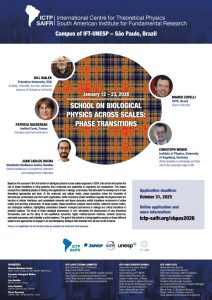
School on biological physics across scales: phase transitions

January 12 – 23, 2026
IFT-UNESP, São Paulo, Brazil
Home
Based on the success of the first school on biological physics across scales organized in 2024, this school will explore the role of phase transitions in living systems, from molecules and organelles to organisms and ecosystems. This classic concept from statistical physics is finding new applications in biology, at all scales, that stimulate the development of new theoretical approaches and tools. At the molecular and cellular levels, phase separation drives the formation of biomolecular condensates and chromatin organization, while membrane phase transitions regulate the physical state and function of cellular interfaces, and cytoskeletal networks and tissue dynamics exhibit transitions reminiscent of active matter and jamming phenomena. At larger scales, phase transitions underpin neural activity, collective animal motion, and ecological resilience, highlighting connections between emergent phenomena in biology and critical transitions in physical systems. The study of these biological phenomena, in turn, stimulates the development of new theoretical frameworks, such as the study of non-equilibrium dynamics, highly multicomponent mixtures, network dynamics, stochastic processes, and criticality in active systems. The goal of this school is to bring together experts on these different systems and approaches to engage in an interdisciplinary dialogue with students from all over South America.
Previous editions:
School on Biological Physics across Scales: Pattern Formation
Organizers:
- Ricardo Martinez-Garcia (CASUS / HZDR, Germany and ICTP-SAIFR/IFT-UNESP, Brazil)
- Fernanda Selingardi Matias (Universidade Federal de Alagoas, Brazil)
- Lara Koehler (MPI-PKS Dresden, Germany)
- Luisa Ramirez (Johannes Guttenberg Univ., Germany)
- Pierre Ronceray (Turing Centre for Living Systems, CNRS / Aix-Marseille University, France)
Announcement:
Application is now closed
Click here for satisfaction survey
Lecturers
Lecturers
- Patricia Bassereau (Institut Curie, France): Domains and biomembranes – Outline and Reading material
- Bill Bialek (Princeton University, USA): Scaling, criticality, and the statistical physics of biological networks – Reading material and References
- Mauro Copelli (Universidade Federal de Pernambuco, Brazil): Brain criticality
- Juan Carlos Rocha (Stockholm Resilience Centre, Sweden): Critical transitions in ecosystems: detection and management challenges – Lectures and Reading material
- Christoph Weber (Institute of Physics, University of Augsburg, Germany): Active droplets in cell biology and their role in the molecular origin of life – Outline and Reading material
Registration
Participants
Presentations
Short Talks
- Antonio, Julia (Universidade de São Paulo, Brazil): Use of 18S rRNA for characterization of eukaryotic biodiversity of Laje de Santos.
Marine biodiversity assessments are essential for understanding ecosystem structure and for supporting conservation strategies, especially in dynamic coastal environments. In this project, we investigate the eukaryotic community composition of the Laje de Santos Marine State Park, a protected area in southeastern Brazil which also is a hotspot of marine biodiversity. Using environmental DNA (eDNA) and 18S rRNA gene metabarcoding, we aim to characterize the taxonomic diversity present in the region and to evaluate how environmental and oceanographic conditions shape the spatial distribution of these communities. The study integrates molecular analyses with ecological and physical parameters, allowing us to explore patterns of community structure in relation to habitat variability and hydrodynamic processes. By combining biodiversity profiling with environmental data interpretation, this research contributes to a broader understanding of how biological and physical processes interact in marine ecosystems. The results are expected to support monitoring efforts and provide a baseline for future ecological and conservation studies in the Laje de Santos region.
- Arana Villarroel, Ricardo Josué (Universidad Nacional de Córdoba, Argentina): Dynamic and Structural Properties of TTFL Models of the Molecular Circadian Clock
Biological clocks are present in all organisms and operate at different levels of complexity. At the molecular level, they are based on transcriptional-translational feedback loops (TTFLs), evolutionarily conserved gene networks that regulate circadian rhythms (24 hours) in gene expression, metabolism, and cellular physiology. In this work, we analyze a generalized Goodwin model, formulated using coupled first-order differential equations that describe the temporal evolution of the concentrations of the species that make up the TTFLs. We study the necessary conditions for the emergence of oscillations and derive analytical expressions for the period and phase delays. We apply these results to the Griffith and Kim-Forger models, demonstrating that both can generate similar dynamics under certain specific relationships between their parameters. This allows the construction of equivalent phase diagrams that characterize the type of oscillation or its absence. Finally, in the context of synthetic biology, this characterization opens new possibilities for the design of genetic circuits applied to the bioremediation of contaminated water and soils, especially those affected by industrial activities.
- Buchweitz Garcez, Amália (Universidade Federal do Rio Grande do Sul, Brazil): Comparison Between Statistical Analyses and Machine Learning Methods for Extreme Event Detection in Climate Data
According to the latest report from the United Nations’ Intergovernmental Panel on Climate Change (IPCC), human-induced climate change is contributing to a rise in the frequency and intensity of extreme weather events. In this study, we analyze historical trends in extreme temperature (heat and cold waves) and precipitation in Brazil, motivated by the growing impact of climate change. We used open access data from the Brazilian National Institute of Meteorology (INMET) from 634 conventional meteorological stations during a period of 60 years, from 1960 to 2020. From the database, we were able to extract the daily minimum (TN) and maximum (TX) temperatures and the daily precipitation. Our analysis indicates a consistent rise in TX90p (extreme maximum temperature) events, while the opposite trend is observed for TN10p (extreme minimum temperature) events. Furthermore, there is a more relevant increase in TX90p events in the North, Northeast and Southeast regions and a decrease in TN10p events in the same regions. Regarding precipitation, a significant rise in extreme rainfall events is observed in the South, while drought events have decreased. Conversely, Dry Days events show an increasing trend in the Northeast and Southeast regions. These results seem to be in accordance with the present literature. Currently, we are using machine learning techniques to further investigate climate and precipitation anomalies in the data. Our goal for the following months is to compare the results from the statistical analysis to the anomalies detected by the ML methods.
- Chhabra, Tanya (Syracuse University, United States): Impact of tunable interactions on emergent behavior in a random field Ising model with feedback
Traditional condensed matter and statistical physics approaches coarse-grain over small-scale interactions to predict emergent behavior, but in biological systems small-scale interactions can be altered by emergent macroscopic properties via feedback. As a foundational model for biological systems that can adjust small-scale tunable degrees of freedom based on emergent properties, we investigate an Ising model with a tunable random field at every site. These site-specific ‘fields’ experience a negative feedback driven by the emergent magnetization. A mean-field version of this model with zero disorder in the initial conditions was recently proposed to study neural activity, leading to oscillations and scale free avalanches that match observations from brain recordings1. As we are interested in mechanical biological networks in 2 or 3 dimensions and where the disorder is prevalent, we perform numerical simulations of a 2D Random field Ising Model at zero temperature with this feedback and observe a critical point separating the paramagnetic and the ferromagnetic regimes. In the latter regime, system spanning avalanches drive oscillations with timescales that are modified by the disorder. Since there is a diverging length scale, we also study feedback where magnetization is only averaged over a local finite, length scale. 1 Lombardi, F., Pepić, S., Shriki, O. et al. Nat Comput Sci 3, 254–263 (2023)
- Menezes Dos Santos, Rafael (ICTP-SAIFR / IFT Unesp, Brazil): Animal movement and behavior drives population dynamics away from simple well-mixed models.
Despite the advances in studies describing how and why animals move, the consequences of this movement for entire populations, communities, and ecosystems have been less explored. In this presentation, I will address how an individual-level, stochastic process-based description of movement can be integrated into models of population and community dynamics. We show that the widespread existence of range residency — the animals do not explore the entire available habitat uniformly — changes interactions and patterns of population abundance. The complex interplay between population-level spatial patterns and organism-level space usage can nevertheless be captured by a simple coefficient indicating how animals share space. We show that this index is sufficient to predict important population patterns such as the carrying capacity. main reference: https://doi.org/10.1101/2025.02.09.637279
- Nasirimarekani, Vahid (Max Planck institute for dynamics and self-organization, Germany): Filamentous self-organization across scales in gliding filaments
Filamentous structures are prevalent in biology, from the cytoskeleton in eukaryotic cells to cyanobacteria that form kilometer-long mats. We questioned the relationship between gliding filaments across scales, namely microtubules and the slime-secreting cyanobacteria species, Lyngbya Lagerheimii. We show that both filaments form very similar, if not identical, assemblies. From this, we propose that a common physical process governs the self-organization of chiral gliding filaments across scales.
- Nogueira De Sá, Pedro Goes (Institute of Biosciences of USP, Brazil): The entropy of water transport in excretory systems: from nephrons to Malpighian tubules
During the transition from freshwater to terrestrial habitats, animals’ excretory functions adapted significantly to cope with osmotic difficulties, with water conservation as the primary challenge. The strategy developed by mammals consists of isosmotic reabsorption of up to 90% of filtered water, a process driven by Starling forces and active ion transport. Our model shows that entropy generation in the mammalian nephron is dominated by active ion transport, which exerts a pressure more than 500 times greater than Starling forces. Considering the importance of active transport in the mammalian kidney, we compared its thermodynamics to those of another excretory system in which active transport is paramount to excretion: the Malpighian tubules of insects. The entropy generation rates of active transport in both excretory systems were found to fall within similar ranges, despite the vastly different ecological contexts of each clade. Thus, fundamental biophysical constraints of active transport are a dominant factor shaping excretion energetics, outweighing the distinct evolutionary pressures on mammals and insects.
- Rajoria, Jitin (The Institute of Mathematical Sciences, Chennai, Tamil Nadu, India): Target search on a DNA
We study biological processes in which DNA-binding proteins locate specific target sites on a DNA sequence. This phenomenon is critical in several biological functions, including gene regulation, transcription, replication, recombination, and gene editing technologies etc. This binding occurs through facilitated diffusion, a combination of 3D diffusion (excursions) in the cytoplasm and 1D diffusion (sliding) along the DNA. Using a stochastic model framework, we analyze the search process without assuming any specific dynamics for sliding or excursions. We obtain a general expression for the average total search time for the protein to find its target and further investigate the fluctuations in the 1D sliding time. Our analysis reveals that the system imposes a lower bound on these fluctuations through an inequality which suggests that a broad distribution of sliding times is necessary for an efficient search. We also study the diffusion-based mechanism for 1D sliding and benchmark our results against previous studies. The inequality highlights the crucial role of DNA length in enabling efficient target search.
- Ruano Sanchez, Saul (Universidad Nacional Autónoma de México (UNAM), Mexico): Lipid Vesicle Self-Assembly in a Coarse-Grained DPD Model
We employed a coarse-grained model within the Dissipative Particle Dynamics (DPD) framework to study the self-assembly of lipid suspensions. Each lipid is represented by hydrophilic and hydrophobic beads, allowing us to capture the key mechanisms underlying self-assembly. We explored different concentrations to identify the threshold for vesicle formation and then fixed the concentration to examine how system size influences morphology and diffusion, characterized by the radius of gyration and mean-square displacement, respectively. Our results provide insights into the mesoscale dynamics of lipid organization and contribute to the design of artificial cells and drug-delivery vesicles through mesoscopic modeling.
Posters
- Borges, Luiza Duarte (Universidade Federal de Santa Catarina, Brazil): First order phase transition in dry active matter simulations
Active matter systems show the emergence of collective self-ordered behavior between particles. Simulations of this kind can be used in order to describe biologically motivated problems, such as trajectories of flocking birds, biological tissue, schools of fish or bacterial colonies. A code was created based on a simple model for dry active matter simulations – the Vicsek model. The role of noise intensity and density was investigated and the discontinuous phase transition successfully shown.
- Cambrainha, Gustavo Gama (Universidade Federal de Pernambuco, Brazil): Hierarchical organization of critical brain dynamics
The hierarchical organization of the brain is a fundamental structural principle, while brain crit- icality is a leading hypothesis for its collective dynamics. Yet, how the brain’s structure shapes these critical dynamics is still an open question. Here, we address this question by applying the phenomenological renormalization group to large-scale neuronal recordings from the mouse visual cortex and hippocampus. We find that signatures of criticality are not uniform across the cortex, but instead decrease systematically along the known anatomical hierarchy in both brain systems, and are strongly modulated by behavior in the visual system.
- Caquito Júnior, José Maria (UFMG, Brazil): Fast Tomographic Imaging of Cells Enabled by Defocusing Microscopy
Defocusing Microscopy (DM) is a label-free, quantitative phase-imaging technique capable of generating three-dimensional tomograms of cells and characterizing their membrane elastic properties. By requiring just a conventional widefield microscope and using it’s defocusing to aquire data, DM provides a low-cost, widely accessible, and non-invasive method for probing transparent samples. While its applications span from biological systems (e.g., macrophages, red blood cells) to inorganic structures (e.g., optical waveguides), the technique’s adoption has been severely limited by its high computational cost. Specifically, the time required for 3D reconstruction was prohibitively long, taking several hours per image. To overcome this limitation, we have reformulated the model of image formation. Our new approach uses the first-order Born approximation to model light scattering in the sample, and Fourier optics to describe light propagation in the system. We showed that the relationship between object shape and image contrast is given by a Poisson equation, which can be efficiently solved using Fast Fourier Transform algorithms. This new model achieves a dramatic reduction in processing time, enabling 3D reconstruction in approximately 20 milliseconds. This increase in computational efficiency opens the possibility for real-time tomographic imaging.
- Carpio Andrada, Agustin (Universidad de Buenos Aires, Argentina): Decomposition of Respiratory Motor Patterns in Birdsong as Excitable Transients
The production of birdsong involves complex respiratory motor gestures shaped by intricate neural and muscular coordination. We propose that these gestures can be decomposed into simpler dynamical elements generated by a minimal excitable system. Using air sac pressure recordings from singing canaries (Serinus canaria), we model each syllable as a linear superposition of transients arising from perturbations of a two-dimensional Wilson–Cowan-type excitable system. By fitting these transients to observed pressure patterns using a differential evolution algorithm, we obtain accurate reconstructions of the motor gestures underlying song. We then apply unsupervised dimensionality reduction and clustering to the extracted transients, identifying a compact set of gesture types—motor primitives—shared across individuals with distinct vocal learning histories. Our results suggest that complex motor sequences in birdsong may be constructed from a limited, reusable repertoire of dynamical modules, offering insights into the structure of learned behavior and the neural encoding of motor control. This framework introduces a principled, dynamical decomposition of vocal behavior with potential applications in the study of motor learning and neuroethology.
- Da Fonseca Miasaki, Kenneth Massaharu (Universidade Estadual Paulista, Brazil): Effect of lysine to histidine substitution on the interfacial properties of the peptide Polybia-MP1
Introduction: Antimicrobial peptides are of growing interest due to their dual activity against pathogens and cancer cells. Polybia-MP1 (MP1), isolated from Polybia paulista venom, exhibits potent antimicrobial effects and inhibits cancer cell proliferation. To enhance tumor selectivity, the analog HMP1 HMP1 was designed by replacing all lysine residues with histidines, introducing pH sensitivity to exploit the acidic tumor microenvironment. Materials and Methods: HMP1 was characterized for its surfactant properties and interfacial behavior with biomimetic lipid monolayers using Langmuir trough experiments and fluorescence microscopy. The effects of pH (5.5–7.5), ionic strength, and membrane composition on lipid organization and phase stability were evaluated. Results and Discussion: HMP1 induced pronounced morphological rearrangements in DPPC lipid domains, forming microdomains without altering the total condensed phase area. These effects were strongly pH- and ionic strength-dependent, with distinct responses under low and physiological salinities. The peptide preferentially interacted with ordered or cholesterol-enriched membranes, showing minimal insertion into fluid POPC monolayers. MP1 showed negligible effects under identical conditions, highlighting the functional impact of the lysine-to-histidine substitution. HMP1 selectively modulated membrane morphology and domain organization in a charge- and environment-dependent manner. Conclusion: HMP1 reorganizes lateral lipid structure and forms microdomains in a pH- and ionic strength-dependent manner, preferentially targeting ordered and cholesterol-rich membranes. The lack of similar effects for MP1 underscores the importance of lysine-to-histidine substitution in conferring membrane selectivity and pH responsiveness. These properties support HMP1 as a promising candidate for targeted, pH-responsive peptide therapeutics and drug delivery platforms.
- De Graaf Sousa, Niels (University of Copenhagen, Denmark): Self-propulsive active nematics
Active matter systems often display mixed symmetry behaviors that go beyond traditional polar or nematic descriptions. In this study, we introduce a minimal model that incorporates self-propulsion into the active nematic framework, revealing how this addition shifts the onset of instability and transforms the system’s dynamical landscape. Numerical simulations support these findings, showing the emergence of giant density fluctuations in topological defects, long-range vorticity order, and non-universal energy cascades. These ordered states appear within the active turbulence regime, well before the transition to flocking. Interestingly, the degree of self-organization depends non-monotonically on self-propulsion, with optimal behavior marked by a peak in correlation length. Our results offer new insights into self-propelled active nematic systems such as migrating cell layers and swarming bacteria, and open up possibilities for designing synthetic materials with tunable collective dynamics.
- De Moraes, Luan Martins Torres (Federal University of Pernambuco, Brazil): Turbulence signatures in mouse spontaneous spiking activity dynamics
The brain is a complex system of billions of interconnected neurons whose collective activity gives rise to cognition and behavior. Physicists have approached its study using tools from statistical mechanics, network theory, and dynamical systems to uncover universal principles and critical phenomena in neural dynamics. Experimental studies in living mice, through advanced recordings of neuronal spike activity, now provide detailed data to test and refine these theoretical models. Recently, the hypothesis that the brain exhibits turbulent behavior has emerged as a possible explanation for its remarkable ability to adapt to multiple time scales and to propagate information efficiently across them. However, strong evidence for such turbulence remains scarce in the literature. In this work, we use the superstatistics—a general framework to study non-equilibrium systems based on local equilibrium hypothesis—to investigate the neuronal spike activity of living mice and infer the number of relevant time scales. Our results reveal that the mouse visual cortex displays signatures of turbulence when analyzing the summed neuronal spike activity. This process can be modeled as a Poisson process with an intermittently fluctuating log-normal average rate, characterized by multiple time scales, suggesting that information cascades among these scales in a manner analogous to the energy cascade in turbulent fluids. These findings provide new insight into how the brain manages to operate efficiently across multiple characteristic time scales, maintaining robust and flexible information propagation among them.
- De Paula, Edson Vinícius (Federal University of Pernambuco, Brazil): Revealing stimulus-dependent dynamics through statistical complexity
Advances in large-scale neural recordings have expanded our ability to describe the activity of distributed brain circuits. However, understanding how neural population dynamics differ across regions and behavioral contexts remains challenging. Here, we surveyed neuronal population dynamics across multiple mouse brain areas (visual cortex, hippocampus, thalamus, and midbrain) using spike data from local ensembles. Two complementary measures were used to characterize these dynamics: the coefficient of variation (CV), a classical indicator of spike-time variability, and statistical complexity, an information-theoretic quantifier of organizational structure. To probe stimulus-dependent activity, we segmented and concatenated recordings from behavioral experiments into distinct time series corresponding to natural image presentations, blank screens, and spontaneous activity. While the CV failed to discriminate between these conditions, statistical complexity revealed clear, stimulus-specific motifs in population activity. These results indicate that information-theoretic measures can uncover structured, stimulus-dependent patterns in neural population dynamics that remain hidden to traditional variability metrics, underscoring their potential for advancing our understanding of large-scale brain organization.
- De Souza, Lucas (Federal University of Rio Grande do Norte, Brazil): How quorum sensing shapes clustering in active matter
Active matter refers to nonequilibrium systems composed of a large assembly of self-propelled entities, such as bacteria, tissue cells, animal flocks, and colloids. A common trait among them is collective behavior, arising from interactions between individuals. One communication strategy between microorganisms is chemically sensing others’ presence, a mechanism known as quorum sensing [1]. This mechanism induces a response in which the organisms regulate their movement to achieve ecologically favorable spatial distributions. However, motion can be limited by excluded-volume interactions. When self-propulsion directions fluctuate slowly, the combination of persistent motion and excluded volume can lead to particle clustering [2]. Quorum-sensing regulation may then alter this scenario, generating diverse spatiotemporal patterns [3]. We show that active particles with steric repulsion and quorum-sensing motility reduction display reentrant clustering. As control parameters are varied, clustering disappears and then reappears. One of the phase behaviors that emerges from this interplay is a previously unexplored class of active gels induced by quorum sensing. Remarkably, quorum sensing leads to kinetically-arrested transient states with long memory of the system’s initial condition. These results can link phenomena observed in both synthetic and biological systems and show how the combination of excluded volume and quorum sensing can yield a variety of self-organization phenomena. [1] M. B. Miller et al. Annu. Rev. Microbiol. 55, 165-199 (2001). [2] A. I. Curatolo, et al. Nat. Phys. 16, 1152 (2020). [3] J. Palacci, et al. Science 339, 936–940 (2013). [4] T. Lefranc et al. Phys. Rev. X 15 (2025).
- Ferreira, Lucas De Lazari (Instituto de Geociências e Ciências Exatas. Unesp, Rio Claro, Brazil): Resilience: From local to global stability in nonlinear dynamical systems
Resilience is generally understood as the ability of a system to absorb disturbances while maintaining its functional state. Variants of this concept are applied across a wide range of fields, from ecology and engineering to economics and psychology. However, the relationship between resilience and the formal definitions of stability in dynamical systems theory remains to be further elucidated. Here, we investigate the local and global stability properties of simple stochastic nonlinear systems with the goal of unravelling quantitative measures of resilience applicable to both stable and metastable states.
- Fonseca, Anne Kétri Pasquinelli (Instituto de Geociências e Ciências Exatas – IGCE Universidade Estadual Paulista “Júio de Mesquita Filho” – UNESP – Campus de RIo Claro, Brazil): Properties of phase transitions from limited to unlimited diffusion in stochastic billiards
The aim of this work is investigate and characterize a phase transition from limited to unlimited diffusion observed in a dissipative and time-dependent oval billiard due to the variation of control parameters. We focus on a transition that occurs as we introduce a dissipation in each of the collisions. Near the phase transition, the dynamics is scaling invariant, characterizing a continuous phase transition. The central phenomenology uses a set of scaling hypotheses, the solution of the probability distribution and a generalized homogeneous function. From them we obtain a relation between the critical exponents leading to a scaling law, which can be proved using numerical simulations or analytic descriptions
- Franco Franco, Jesus Omar (Instituto de Física – UNAM, México, Mexico): Phase transition in a hypegraphs ensambles
The statistical mechanics approach to network theory has its roots in the classical Erdös–Rényi random graph model, which established a probabilistic foundation for studying the emergence of large-scale connectivity and phase transitions in complex systems. This framework was later generalized by Park and Newman, who introduced maximum-entropy ensembles constrained by topological observables such as degree sequences, thus bridging the gap between random graph theory and statistical physics. More recently, Cimini and collaborators have extended these ideas to weighted and higher-order networks, showing how ensemble methods can systematically describe the equilibrium properties and fluctuations of real-world complex systems. Building upon this tradition, we explore phase transitions in hypergraph ensembles, where interactions naturally extend beyond pairs of nodes. Hypernetworks have proven particularly powerful for modeling biological systems — including genetic, protein, and microbial interaction networks — in which multiway relationships are essential. In this context, various similarity metrics can be used to probe the structural organization of the system. By tuning a control parameter that governs the density of hyperedges, we can induce transitions between distinct topological regimes, effectively reconstructing and perturbing real hypernetworks to identify potential new hyperlinks. This methodology opens new perspectives for applying statistical mechanics to biological data, offering insights into how collective behavior and higher-order connectivity emerge in complex living systems.
- Gómez Contreras, Yerly Zaudí (Universidad Distrital Francisco José de Caldas, Colombia): The role of the Casimir effect as a physical model for the organization of lipid membranes.
Biological membranes exhibit complex mechanical properties, such as low compressibility and high lateral fluidity, which are essential for their structural stability and biological function. These characteristics are influenced by molecular interactions that can be analyzed using physical models. In this work, we explore the feasibility of describing membrane stability through the Casimir effect. By modeling the membrane as a dielectric multilayer system (classical capacitor), the theoretical framework allows us to evaluate how Casimir-Lifshitz interactions might contribute to the organization and stability of lipid bilayers. This approach seeks to provide a physical-mathematical perspective to understand how quantum electrodynamic effects might influence biological structures at the nanometer scale.
- Julian Salgado, Pedro Jesus (UNIVERSIDAD AUTONOMA METROPOLITANA, Mexico): Abrupt transitions in the optimization of diffusion with distributed resetting
Brownian motion with stochastic resetting to a fixed position is frequently used to study random search processes. Under this scheme, it is well-established that stochastic resetting is a mechanism to minimize the mean first passage time. However, the effects on the mean first passage time due to distributed resetting to random positions are less explored. In this work, we study the first-passage properties of a one-dimensional Brownian particle with stochastic resetting to random positions. The resetting positions are drawn from a probability density function with compact support that does not include the target location. Under this set-up, we find that the optimal resetting rate, which minimizes the mean first-passage time, exhibits discontinuous, “first-order” transitions. This behavior is governed by the emergence of two competing local minima in the mean first passage time. We observe this behavior only if the related parameters with the probability density function of the resetting positions are greater than certain critical values. Otherwise, the optimal resetting rate behaves smoothly, as if there were only one resetting point. To further study the above transitions, we analyze the particle’s last resetting position before absorption. Using this approach, we characterize two distinct search strategies: One strategy favoring fast resetting to less likely positions but nearer to the target, while the other favoring slower resetting with more probable but distant resetting positions. Both strategies become equally optimal at the transition point of discontinuity.
- Marin, Alfredo Antonio Reis (USP, Brazil): Two locus model of balanicng and epistatic selection: a case study with the HLA genes
The human immune system relies on a group of genes known as HLA, found in the major histocompatibility complex (MHC) region of the genome. These genes show an extraordinary level of genetic diversity and are often inherited together more frequently than expected by chance. In this project, we explore how two evolutionary processes — balancing selection, which maintains diversity, and epistasis, where genes interact with each other — might work together to produce these patterns. By developing a simple two-locus model, we aim to better understand the evolutionary forces shaping variation in the HLA region.
- Menuci Muccillo, Vinicius (IFT- UNESP, Brazil): Random Walks and Lévy Flights in the Priosoner’s Dilemma
Evolutionary games provide a framework to study the emergence and maintenance of cooperation among individuals. Specifically, the Prisoner’s Dilemma illustrates how cooperation can arise among selfish individuals. This study analyzes mobility in the spatial Prisoner’s Dilemma, exploring two distinct movement dynamics, random walks and Lévy flights, and their roles in promoting or hindering cooperation. It is well known that random walks favor cooperative behavior under certain conditions (e.g., low mobility) compared to the static case, whereas Lévy flights remain relatively unexplored. In the implementation of the game dynamics, agents’ strategies evolve based on local interactions and the replication of the most successful strategies. Mobility, however, is kept as simple as possible, being random and independent of previous steps, strategies, or neighborhood. Furthermore, by introducing a population viscosity parameter that defines the probability of invading unoccupied spaces, we can alter the relationship between the two characteristic timescales: game interactions and movement. For random walks, we investigated the robustness of results from previous studies regarding synchronous and asynchronous updates, finding that the qualitative behavior seems consistent. Unlike random walks, where the excluded volume of neighbors restricts movement, Lévy flights allow agents to bypass some occupied sites. This enables cooperative clusters to be exploited not only at the surface but also directly in their core. Similarly, cooperators can abandon clusters from both the surface and the core, which, in principle, undermines cooperation. Lévy flights were studied for specific parameters where cooperation, despite the added challenges of greater movement freedom, could still benefit and prevail when compared to the static case. By imposing additional conditions that, in principle, destabilize the mechanism sustaining cooperation in spatial games (cluster formation), our work contributes to understanding the minimal requirements for cooperative behavior to remain stable in a population.
- Mossi, Luiza Treichel (UFRGS, Brazil): Tracking and Analysis of confined ciliated microswimmers
This work details the development of a computational methodology for the analysis of Paramecium motility, with the objective of using them as bioindicators for water toxicity. From microscopy videos, an AI-based tracking system is employed to extract the individual trajectories of the organisms. Subsequently, various statistical metrics are applied to characterize and quantify their swimming patterns under different experimental conditions, such as in control and contaminated media. The project also explores the creation of computational simulations to model the observed behavior, aiming to deepen the understanding of the dynamics of these microorganisms. The goal is to bridge the gap between individual, micro-scale movements and the macro-scale patterns that emerge from their interactions, providing quantitative data for models of biological active matter.
- Naskar, Dipam (National Institute of Science Education and Research, NISER, India): Dissecting the pathophysiology of full-length human Tau as an IDP and the spread function of neuro-degeneracy through protein-membrane interaction
Tau, a microtubule-associated protein under normal physiological conditions, is a natively unfolded soluble protein with a very limited tendency for aggregation in the solution state. However, Tau aggregates are the characteristic feature of several neurodegenerative conditions like Alzheimer’s Disease and Pick Disease. The pathological aggregations are possibly driven by the interaction of Tau proteins with biological membranes. Our work focuses on understanding the membrane-Tau interactions leading to these aggregate-driven Tauopathies. Experimentally, we use in vitro reconstitution-based techniques, confocal imaging and micromanipulation to assess the binding kinetics of Tau and quantify subsequent membrane deformation by employing micropipette aspiration with rigidity modulus of the membrane (Kb) as the dependency factor. We observe that the aggregate state of Tau, artificially induced in the solution state by Heparin, has a higher binding affinity towards the membrane as compared to oligomeric and monomeric states. To unravel the molecular driving forces behind this observation, we use Martini 3.0-based coarse-grained molecular dynamics simulation with Tau proteins in its solution state and while it interact with the membrane. We use the available solution state SAXS data for Tau to reparameterize the Martini force-field that faithfully captures the available experimental observables. We apply the improved force-field parameters to study the protein-protein and protein-membrane interactions. The summation of our experimental and computational findings indicates membrane deformation mediated through Tau aggregation and the subsequent propagation of neurodegeneration mediated through Tau-membrane interaction.
- Oliveira, Igor (Instituto de Física da Universidade de São Paulo, Brazil): THE INFLUENCE OF CHOLESTEROL AND ORDERED PHOSPHATIDYLSERINE ON THE LIPID PACKING FOR MODELS OF THE CYTOPLASMIC LEAFLET OF THE PLASMA MEMBRANE
The eukaryotic plasma membrane (PM) is a complex structure, with its functionality intricately associated with its asymmetry. The difference in lipid composition between the inner and outer leaflets of the lipid bilayer highlights this asymmetry. Interestingly, the cytoplasmic leaflet has a significant fraction of unsaturated lipids, conferring on the leaflet a high fluid character. Additionally, a key component of the PM is cholesterol, which affects lipid packing and could promote the organization of coexistence of liquid phases, depending on the lipid composition. To evaluate the impact of cholesterol on lipid packing, we used large unilamellar vesicles (LUVs) composed of lipid structures to mimic the cytoplasmic leaflet of the plasma membrane. We used a lipid packing sensor probe, Laurdan, to evaluate the lipid packing/ order of different lipid compositions. We examine the role of phosphatidylserine (PS), phosphatidylcholine (PE), and cholesterol in ordering or disordering the membrane. Here, we perform experiments using mono and di-unsaturated lipids. We analyzed the Generalized Polarization (GP) of the Laurdan to quantify membrane packing/order, and to compare the results. In addition, a deconvolution analysis of the Laurdan emission peaks (centered at 2.82 eV and 2.53 eV) corroborates the observed GP values. We also investigate how divalent ions affect lipid packing, hemifusion, and fusion. We monitor vesicle aggregation and fusion using optical and fluorescence microscopy, as well as dynamic light scattering. We observe hemifusion and fusion events in Giant Unilamellar Vesicles (GUVs). From these results, we demonstrate how cholesterol fractions and divalent ions influence membrane packing. Finally, we investigate the sources of lipid ordering in models of the cytoplasmic leaflet, and we overestimate the ordering effect using saturated PS lipids. In these experiments, we evaluate whether ordered lipids in the cytoplasmic leaflet could induce phase separation. Our results elucidate the main interactions in the PM inner leaflet and may provide important insights in the study of asymmetric membranes. This work was supported by Fundação de Amparo à Pesquisa do Estado de São Paulo (FAPESP #2024/02663-1 and # 2022/04046-4).
- Peña, Jason (Universidad Autónoma Metropolitana and Universitat de Barcelona, Mexico): Nucleation insights into viral capsid self-assembly: key roles of line tension, bending energy, and kinetics
The capsid of many spherical viruses forms via a self-assembly process, yet the physical mechanisms by which the Capsid Building Blocks (CBBs) yield complex and highly symmetrical structures remain unclear. In this work, we present a Viral Capsid Self-Assembly (VCSA) model based on classical nucleation theory that incorporates bending energy, and we explore its non-equilibrium kinetics, as well as the influence of a scaffold on the formation of viral capsids. We analyze the role of bending energy in VCSA when this energetic contribution dominates over the compression stress. The model predicts that including bending energy accelerates the capsid formation rate, leads to premature closure, and determines the final size based on the ratio of bending modulus to line tension. Our findings suggest that CBBs may have preferred interaction angles different from those observed in native viruses in order to compensate for the premature closure effect. Subsequently, we use mesoscopic non-equilibrium thermodynamics to derive an equation governing VCSA kinetics. Since the resulting equation is a Fokker-Planck equation, this framework interprets capsid formation as a diffusive process in the phase space of reaction coordinates, where the kinetics determine the size distribution of closed capsids.
- Rodrigues, Matheus (Instituto de Biofísica Carlos Chagas Filho, Brazil): Role of Calpain A on the modulation of Dorsal nuclear gradient in the early development of D.melanogaster
The establishment of the dorsal-ventral (DV) axis in Drosophila melanogaster is governed by a spatially-dependent concentration gradient of the NF−κB homolog, Dorsal. The magnitude of this morphogen gradient is modulated by the protease Calpain A, which interacts with the IκB homolog, Cactus, promoting its cleavage into a truncated protein, CactusE10. To investigate the dynamics of this system, we formulated a mathematical model based on a system of coupled partial differential equations (PDE’s) representing the biochemical reaction network. Bayesian Statistics was employed to explore the model’s parameter space. We show that a simple network, wherein Calpain A controls Cactus levels is sufficient to recapitulate the primary phenotypes observed in Calpain A knockdown (CalpainA KD) embryos. The model quantitatively reproduces the experimentally observed attenuation of the nuclear Dorsal gradient amplitude. Furthermore, the model accurately reproduces other key phenotypes, including the increase in total Cactus levels on CalpainA KD embryo when compared to control and the uniform spatial distribution of total Cactus in embryos. These findings validate the model’s utility in describing the pathway and advance our quantitative understanding of Dorsal gradient modulation. Our simulations indicate that the effects of the truncated CactusE10 protein are not initially required to reproduce the CalpainA KD phenotype, proposing to adress its role in the modulation of the gradient for future experimental investigation.
- Silva Vasquez, Andres (Universidad Nacional de Colombia, Colombia): Modularity, Nestedness, and Resilience in an Urban Ecological Interaction Network
I analyzed the biotic interaction network of Bogotá using centrality and architectural metrics to compare the roles of native and non-native species and to evaluate the network’s resilience to node removal. Nestedness (NODF), modularity (greedy Newman algorithm), density, clustering, and robustness were computed across mutualistic and parasitic inter-kingdom subnetworks. Native and non-native species showed no significant differences in standard centrality distributions, although the highest-ranked nodes were mostly non-native. Under targeted removal of species with the largest out-degree, the network exhibited rapid loss of density, an increase in modularity, and an abrupt collapse of robustness near 50% node removal, contrasting with random removal. These results indicate that non-native species tend to engage more frequently in non-mutualistic interactions, in contrast to natives, which may influence the overall organization of the network.
- Solano Cabrera, César Osvaldo (División de Ciencias e Ingenierías, Universidad de Guanajuato, Mexico): Geometric and finite size effects on colloidal systems
Colloidal matter is present in our daily lives—for example, in biological fluids, food, and technological products such as paints. These kinds of materials are well known for exhibiting a wide range of fascinating phenomena, such as Brownian motion and self-assembly. In the context of biological systems, there are situations where colloidal particles are constrained or embedded to move within curved and finite spaces. Due to the influence of the host medium, novel phenomena emerge in these systems, including anomalous diffusion and the frustration of phase transitions. In this work, we present a simulation-based and analytical approach aimed at elucidating the role of geometry and finite size on the behavior and properties of colloidal suspensions.
- Sousa, Gustavo Alexandre De (UEPG, Brazil): Wave Patterns in a Hippocampal Network
High-order cognitive functions, particularly spatial processing and long-term memory mediated by the hippocampus, are intrinsically linked to complex oscillatory patterns, such as traveling waves. Mathematical modeling provides a robust framework for replicating and exploring these neural dynamics. In this work, we investigate the oscillatory phenomena arising from a simulated hippocampal network. The network is comprised of adaptive exponential integrate-and-fire (AdEx) neurons interconnected via chemical excitatory synapses. Our findings reveal that specific combinations of coupling strength and connection radius dictate the resulting wave geometries. Moreover, a method for the detection of spiral waves is presented. We demonstrate that the appearance of multiple spiral waves induces global desynchronization within the network.
- Stefani Amancio Santiago, Thalyta (Unicamp, Brazil): Designing coacervate-forming polypeptides from repetitive motifs of disordered proteins
Intrinsically disordered proteins (IDPs) play a central role in liquid-liquid phase separation (LLPS), forming biomolecular condensates that organize intracellular components. This phenomenon is often linked to low-complexity regions containing repetitive motifs with limited amino acid diversity. Here, we present a bioinformatics-based strategy to identify minimal consensus repeats capable of driving LLPS in synthetic polypeptides. Using the DisProt database, sequences were grouped into four chemical classes according to their chemistry, then analyzed with a one-hot encoding alignment to detect patterns across different repeat lengths. The most representative motifs were translated into amino acid sequences, expressed recombinantly in E. coli, and evaluated against the native IDP. Turbidimetry and partitioning assays confirmed that the designed proteins undergo coacervation with selective carbohydrate binding, reproducing the phase behavior of their parent domains. These results demonstrate that short consensus repeats can recapitulate the essential features of IDP-driven coacervation, offering a versatile platform for constructing programmable condensates and bioinspired soft materials.
- Suarez, Daniela Lioren (División Física Estadística Interdisciplinaria-Centro Atómico Bariloche, Argentina): Modeling Patagonian Ecosystems: Physics, Ecology, and Grasshopper Dynamics
Patagonia, in southern Argentina, presents unique and complex environmental and socio-productive conditions. In the steppe, wetlands —known regionally as mallines— are key ecosystems due to their ecological functions and their importance for livestock production. Among the organisms inhabiting these environments, herbivorous insects can, under certain circumstances, experience population outbreaks that reduce the availability of food resources for other animals and cause significant economic losses. As a first step toward understanding these dynamics, a previous interdisciplinary study focused on two predominant species of native grasshoppers, commonly known as tucuras: Dichroplus elongatus, generally considered a pest, and D. vittigerum. Both species inhabit Patagonian mallines and feed primarily on grasses and herbaceous plants. Through field and laboratory experiments, vegetation cover, feeding preferences, and consumption rates were quantified. Based on these data, a spatially explicit, individual-based stochastic model was developed, showing that the potential impact of outbreaks depends critically on both insect density and available plant biomass, thus allowing the establishment of pest thresholds under various realistic scenarios [1]. Building on this previous work, we proposed a more complex model for a different Patagonian wetland located in the province of Neuquén, where the species involved and the ecological dynamics differ. In this case, we considered a single grasshopper species (Dichroplus maculipennis) and three plant resources. We analyzed the migratory behavior of insects in search of food, as well as competition with livestock and predation by birds, thereby incorporating new ecological interactions. This ongoing work aims to better understand the complex interactions among insects, plants, and animals in these ecosystems, and to move toward a more realistic description of outbreak dynamics. [1] Serrano, L. S., Pietrantuono, A. L., Laguna, M. F., Weigandt, M., Amadio, M. E., & Fernández-Arhex, V. (2025). Assessing the potential impact of grasshopper outbreaks on Patagonian wetlands through mathematical modeling. Scientific Reports, 15(1), 682.
- Tavares Mineiro, Hudson Vinicios (Universidade Federal de Lavras, Brazil): Scaling Laws and Applications in Urban Phenomena
Recently, there has been a systematic effort to understand how urban phenomena occur, indicating that pursuing an urban theory that provides a quantitative and organized approach to city management is a fundamental priority. Some propositions observed so far suggest that urban systems exhibit universal scaling behavior concerning individual needs, socioeconomic, and infrastructure variables. The development of this urban theory should be conducted mathematically, provided that the theory proves feasible. In this sense, this work aimed to identify some universalities by testing them against certain urban metrics that exhibit specific patterns across various cities in different countries worldwide. The results obtained support patterns in some of the selected metrics for analysis. In conclusion, the discussion revolved around the results obtained concerning the different premises and variables adopted here and the prospects for this area of study.
Program
Videos and Files
-
09:00 - Christoph Weber (Institute of Physics, University of Augsburg, Germany):
Active droplets in cell biology and their role in the molecular origin of life - Class 1
- 11:00 - Patricia Bassereau (Institut Curie, France): Domains and biomembranes - Class 1
-
14:00 - Juan Carlos Rocha (Stockholm Resilience Centre, Sweden):
Critical transitions in ecosystems: detection and management challenges - Class 1
-
09:00 - Christoph Weber (Institute of Physics, University of Augsburg, Germany):
Active droplets in cell biology and their role in the molecular origin of life - Class 2
- 11:00 - Patricia Bassereau (Institut Curie, France): Domains and biomembranes - Class 2
-
14:00 - Juan Carlos Rocha (Stockholm Resilience Centre, Sweden):
Critical transitions in ecosystems: detection and management challenges - Class 2
- 09:00 - Patricia Bassereau (Institut Curie, France): Domains and biomembranes - Class 3
-
11:00 - Juan Carlos Rocha (Stockholm Resilience Centre, Sweden):
Critical transitions in ecosystems: detection and management challenges - Class 3
- 14:00 - Christoph Weber (Institute of Physics, University of Augsburg, Germany): Liquid shells: A peculiar state
- 09:00 - Patricia Bassereau (Institut Curie, France): Domains and biomembranes - Class 4
-
11:00 - Christoph Weber (Institute of Physics, University of Augsburg, Germany):
Active droplets in cell biology and their role in the molecular origin of life - Class 3
-
14:00 - Juan Carlos Rocha (Stockholm Resilience Centre, Sweden):
Critical transitions in ecosystems: detection and management challenges - Class 4
-
09:00 - Juan Carlos Rocha (Stockholm Resilience Centre, Sweden):
Critical transitions in ecosystems: detection and management challenges - Class 5
-
11:00 - Patricia Bassereau (Institut Curie, France):
Domains and biomembranes - Class 5
-
14:00 - Christoph Weber (Institute of Physics, University of Augsburg, Germany):
Active droplets in cell biology and their role in the molecular origin of life - Class 4
-
09:00 - Christoph Weber (Institute of Physics, University of Augsburg, Germany):
Active droplets in cell biology and their role in the molecular origin of life - Class 5
-
11:00 - Mauro Copelli (Federal University of Pernambuco, Brazil):
Brain criticality - Class 1
-
14:00 - William Bialek (Princeton University, USA):
Scaling, criticality, and the statistical physics of biological networks - Class 1
-
09:00 - William Bialek (Princeton University, USA):
Scaling, criticality, and the statistical physics of biological networks - Class 2
-
11:00 - Mauro Copelli (Federal University of Pernambuco, Brazil):
Brain criticality - Class 2
-
09:00 - Mauro Copelli (Federal University of Pernambuco, Brazil):
Brain criticality - Class 3
-
11:00 - William Bialek (Princeton University, USA):
Scaling, criticality, and the statistical physics of biological networks - Class 3
- 14:00 - William Bialek (Princeton University, USA): Optimization principles in the physics of life
-
09:00 - Mauro Copelli (Federal University of Pernambuco, Brazil):
Brain criticality - Class 4
-
11:00 - William Bialek (Princeton University, USA):
Scaling, criticality, and the statistical physics of biological networks - Class 4
-
09:00 - Mauro Copelli (Federal University of Pernambuco, Brazil):
Brain criticality - Class 5
-
11:00 - William Bialek (Princeton University, USA):
Scaling, criticality, and the statistical physics of biological networks - Class 5
asdasdasd
Photos

Venue
Venue: The event will be held at IFT-UNESP, located at R. Jornalista Aloysio Biondi, 120 – Barra Funda, São Paulo. The easiest way to reach us is by subway or bus, See arrival instructions here.
Accommodation: Participants whose accommodation will be provided by the institute will stay at Hotel Intercity the Universe Paulista. Hotel recommendations are available here.
Attention! Some participants in ICTP-SAIFR activities have received email from fake travel agencies asking for credit card information. All communication with participants will be made by ICTP-SAIFR staff using an e-mail “@ictp-saifr.org”. We will not send any mailings about accommodation that require a credit card number or any sort of deposit. Also, if you are staying at Hotel Intercity the Universe Paulista, please confirm with the Uber/Taxi driver that the hotel is located at Rua Pamplona 83 in Bela Vista (and not in Jardim Etelvina).
Additional Information
BOARDING PASS: All participants, whose travel has been provided or will be reimbursed by ICTP-SAIFR, should bring the boarding pass upon registration. The return boarding pass (PDF, if online check-in, scan or picture, if physical) should be sent to secretary@ictp-saifr.org by e-mail.
Visa information: Nationals from several countries in Latin America and Europe are exempt from tourist visa. Nationals from Australia, Canada and USA are required to apply for a tourist visa.
Poster presentation: Participants who are presenting a poster MUST BRING A PRINTED BANNER . The banner size should be at most 1 m (width) x 1,5 m (length). We do not accept A4 or A3 paper.
Power outlets: The standard power outlet in Brazil is type N (two round pins + grounding pin). Some European devices are compatible with the Brazilian power outlets. US devices will require an adapter.