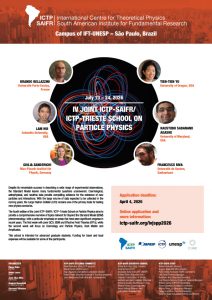
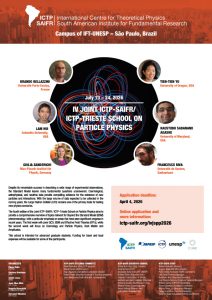
IV Joint ICTP-SAIFR/ICTP-Trieste School on Particle Physics

July 13 – 24, 2026
São Paulo, Brazil
ICTP-SAIFR/IFT-UNESP
Home
Despite its remarkable success in describing a wide range of experimental observations, the Standard Model leaves many fundamental questions unanswered.
Cosmological, astrophysical, and neutrino data provide compelling evidence for the existence of new particles and interactions.
With the large volume of data expected to be collected in the coming years, the Large Hadron Collider (LHC) remains one of the primary tools for testing new physics scenarios.
The fourth edition of the Joint ICTP–SAIFR / ICTP–Trieste School on Particle Physics aims to provide a comprehensive overview of topics relevant for Beyond the Standard Model (BSM) phenomenology, with a particular emphasis on areas that have seen significant progress in recent years. The first week will cover QCD, BSM and Effective Field Theories (EFTs), while the second week will focus on Cosmology and Particle Physics, Dark Matter and Amplitudes.
This school is intended for advanced graduate students. Funding for travel and local expenses will be available for some of the participants.
Organizers:
- Diogo Boito (IFSC-USP)
- André Lessa (UFABC)
- Joan Elias Miró (ICTP-Trieste)
- Rogério Rosenfeld (IFT-UNESP/ICTP-SAIFR)
- Giovanni Villadoro (ICTP-Trieste)
Announcement:
Lecturers
Lecturers:
- Brando Bellazzini (Université Paris-Saclay, France) – Causality and Positivity of Scattering Amplitudes (Topics)
- Lam Hui (Columbia University, United States) – Topics in cosmology: from the early universe to nonlinear structures today
- Francesco Riva (Université de Genève, Switzerland) – Effective Theories
- Kaustubh Sadanand Agashe (University of Maryland, United States) – Theory and Phenomenology of Extra Dimensions (Topics and Useful reference)
- Tien-Tien Yu (University of Oregon, United States) – Dark Matter (Topics)
- Giulia Zanderighi (Max-Planck-Institut für Physik, Germany)
Registration
Program
Posters
- ., Priya (Central University of Himachal Pradesh, India): Type III Seesaw Mechanism in Non Holomorphic Modular Symmetry and Leptogenesis
Recently, Qu and Ding, have proposed a formalism where modular invariance is extended to non-supersymmetric scenario considering Yukawa couplings as non-holomorphic functions of modules field $\tau$. Adopting this formalism in this work, we propose a Type-III seesaw model as a unified framework to explain lepton masses and mixing and baryogenesis via leptogenesis. $\chi^2$ analysis is performed to fit the neutrino oscillation data from NuFIT~6.0 leading to a normal hierarchical pattern of neutrino masses and constrained $CP$ phases. Furthermore, we analyze the generation of the observed baryon asymmetry of the Universe via thermal leptogenesis where the decays of the lightest fermion triplet $\Sigma_1$ into lepton-Higgs final states produce a $CP$ asymmetry $\varepsilon_{CP}$. The complex modules $\tau$ is responsible for the $CP$ asymmetry produced during leptogenesis. The resulting $B-L$ asymmetry, $Y_{B-L}\sim 10^{-9}$ successfully reproduces the baryon-to-photon ratio demonstrating the model’s capability to link low-energy neutrino data with the baryogenesis. The strong gauge-mediated washout of fermion triplets necessitates a leptogenesis scale of $\mathcal{O}(10^{12}\,\mathrm{GeV})$ ensuring compatibility with both the Davidson-Ibarra bound and the thermal history of the Universe. Future pursuits remain open to the exploration of novel avenues aimed at lowering the energy scale associated with leptogenesis.
- Belas, João (Instituto Superior Técnico – Universidade de Lisboa, Portugal): On Flavour Invariants of the N Higgs Doublet Model
In this work, a systematic way of analysing the N Higgs Doublet Model flavour sector will be presented. A complete set of mixing matrices describing the rotation between certain suitably defined bases will be introduced, akin to the Cabibbo–Kobayashi–Maskawa matrix, which describes the relation between the up-quark and down-quark mass bases. The crucial importance played by the charged Higgs basis will be pointed out. It is also introduced for the first time a complete set of weak basis transformation invariant traces of flavour matrices for the general N doublets case. This will be important for studies of the renormalisation group evolution in terms of relevant physical parameters.
- Bezerra, Taísa Veloso Barreto (Universidade Federal de São Paulo, Brazil): Exotic baryons on the S=-2 sector.
Our aim is to study resonances with quantum number of strangeness -2, that can be described as a molecular states, using chiral unitary approach and hidden local symmetry. This work is an extension of ref [1] and the calculation being developed now is the addition of s- and u-diagrams in the future for the pseudoscalar-baryon interactions, which was not included in ref [1]. Within the new amplitudes, we will study observables that were recently measured by several collaborations, such as Belle, LHCb, Alice and BES. We also intend to explore more about the implications of Wenberg-Tomozawa theorem on the S=-2 sector and hope to bring some clarification on the puzzles related to those exotic baryons. [1]. K. P. Khemchandani et al. Phys. Rev. 2018, D 97 034005.
- Biriukov, Kirill (École Polytechnique de Paris, France): Constraining Wilson coefficients through WZ production in proton–proton collisions
We investigate different approaches for constraining Wilson coefficients within the framework of the Standard Model Effective Field Theory (SMEFT) that contribute to WZ production in proton–proton collisions at a centre-of-mass energy of 13.6 TeV. The analysis is performed using multilepton final states, categorized into four exclusive channels according to their lepton flavour composition: eee, μee, μμe, and μμμ. Different state-of-the-art machine learning algorithms are implemented and their performance is systematically compared with that of a traditional bin-by-bin effective field theory (EFT) analysis. The sensitivity of each method to the relevant Wilson coefficients is evaluated.
- Bröker, Henning (Radboud University, Netherlands): The strange World of broken Electromagnetism
The Standard Model of Particle Physics predicts an unbroken U(1) gauge symmetry at low energy, giving rise to electromagnetism as we know it, in perfect agreement with experiment. But that is exactly the point: this prediction should be tested rigorously. For that purpose a theoretical framework is required, in order to describe and quantify a broad spectrum of electric charge breaking effects. I will present an effective field theory (EFT) approach to this problem, consider the perturbative unitarity of that EFT and cover some phenomenology.
- Cunha, Ivana (Universidade Federal do Pará, Brazil): Ultra-Planckian Scattering in Agravity with Matter and Gauge Fields
This research investigates $2 \to 2$ tree-level scattering processes in the ultra-Planckian regime within the framework of agravity, a dimensionless and renormalizable theory of quadratic quantum gravity. By coupling elementary matter fields—including quarks, gluons, charged fermions, and scalars—to a higher-derivative graviton, we provide a comprehensive analysis of gravitational interactions at energies far exceeding the Planck scale.+4In the sector of non-Abelian gauge theory (QCD), we compute the squared amplitudes and differential cross sections for $gg \rightarrow gg$, $gg \rightarrow q\bar{q}$, $gq \rightarrow gq$, and $qq \rightarrow qq$. We demonstrate that these amplitudes scale as $1/s$ at high energies, satisfying the requirements for a UV-complete theory of gravity. Furthermore, we address the issue of perturbative unitarity by examining the positivity of squared amplitudes and show that infrared (IR) divergences in forward scattering are naturally regularized by finite particle masses.+4The study is extended to Abelian gauge theory (QED), where we present compact analytic expressions for a broad set of processes, including photon-photon and fermion-scalar channels. A key feature of this analysis is the systematic inclusion of photon-graviton interference contributions and the explicit verification of results’ independence regarding the gravitational gauge-fixing parameter. Our findings demonstrate how higher-derivative gravity reshapes familiar gauge scattering through characteristic forward/backward enhancements dictated by the $1/p^4$ graviton propagator. Collectively, these results support the viability of agravity as a self-consistent extension of General Relativity, providing the necessary analytic building blocks for exploring UV consistency and quantum effects in the deep ultraviolet regime.
- Dalpino Dias, Joao Pedro (Instituto de Física de São Carlos (IFSC/USP), Brazil): QED corrections for hadronic tau decays
Inclusive hadronic tau decays are well described by QCD and provide a valuable source of information about the theory and its fundamental parameters, such as the strong coupling constant. The extraction of the strong coupling from inclusive tau decays using Finite Energy Sum Rules (FESRs) is one of the most precise methods for determining this important parameter of the Standard Model. In this type of precision physics, the inclusion of subdominant effects, such as electroweak corrections, is essential because, although small, they can compete with certain non-perturbative contributions. However, electroweak corrections are not consistently included in current determinations of the strong coupling. In this work, we evaluate a class of these corrections to inclusive tau decays in a generalized form suitable for QCD sum-rule analyses. Once completed, these results will allow for a more precise determination of the strong coupling.
- De Souza, Caio Cesar (The City University of New York, United States): A Femtouniverse Approach to the Mass Gap Problem
Four-dimensional pure Yang–Mills theory is expected to exhibit both confinement and a mass gap. A proof would require control over the infrared regime. We develop a new approach to study such properties in asymptotically-ultraviolet-free field theories. We implement the full program in the two-dimensional O(3) nonlinear sigma-model, where we apply perturbation theory in a small region of space, called the femtouniverse. We obtain an effective lattice model whose degrees of freedom are unit-length vectors on sites and discrete variables on plaquettes. Strong-coupling expansions in this effective model would be a reliable calculational tool for the original field theory. We hope that someday this program could ultimately be extended to the much more difficult case of four-dimensional pure Yang–Mills theory.
- Diniz Moro, Matheus (UEPG-Universidade Estadual de Ponta Grossa, Brazil): Dirac Oscillator in a curved spacetime background
Derivation of the Dirac equation and the Dirac oscillator equation in a curved spacetime background
- Dos Santos, Gabriel Oliveira (USP, Brazil): Search for di-Higgs production in the HH → bb̄ τ⁺τ⁻ channel with ZZ and tt̄ background
This project focuses on the search for Higgs boson pair (HH) production via gluon-gluon fusion (ggF) in the $HH \to b\bar{b}\tau^+\tau^-$ decay channel. This final state is among the most promising for di-Higgs searches, offering an optimal balance between the branching ratio and experimental sensitivity. A major challenge in this channel is the presence of significant irreducible and reducible backgrounds, particularly $ZZ$ and $t\bar{t}$ production, which closely mimic the signal topology. To address this, our work focuses on improving signal-to-background discrimination through advanced machine learning techniques. Specifically, we implement Graph Neural Networks (GNNs) to effectively capture the complex kinematic and topological correlations of the events. Ultimately, this study contributes to the ongoing efforts to measure the Higgs boson self-coupling and test the Standard Model at the TeV scale, providing enhanced sensitivity to potential deviations that could indicate new physics.
- Duran Gonzales, Jesus Andres (Universidad Federal do Rio de Janeiro, Brazil): Feasibility Study of Measurement of $\eta_c \rightarrow p\bar{p}$ at SPD Experiment
This preliminary study examines the possibility of obtaining measurements, from proton-proton collisions at energy GeV in the context of Spin Physics Detector, SPD, at its final stage. By employing Monte Carlo simulations alongside the spdroot framework we propose the analysis between background and signal decay channels for studying kinematic parameters; invariant mass, transverse momentum, polar angle distributions, momentum distribution, Feynman-x spectra, and cosine of the angle between and. Previous studies, with only Pythia8 event generator, suggest signal/background ratio of . In this preliminary study, we conducted a realistic simulation considering both, the event generation and detector response of the SPD. Future work will expand upon these findings using the lxui cluster from JINR-MLIT.
- Escobar Vergara, Matheo Gumoor (Pontificia Universidad Católica de Chile, Chile): Sub-GeV Long-Lived Dark Higgs Phenomenology and Reinterpretation
The study of long-lived particles provides a promising avenue to probe physics beyond the Standard Model, particularly in scenarios motivated by dark matter production. We investigate the phenomenology of a sub-GeV long-lived scalar, the Dark Higgs, produced in meson decays and leading to displaced signatures. We are working in simulations for its production and decay, and will employ analytical reinterpretation techniques to extract constraints from existing experimental searches across multiple detectors. This would allows us to efficiently probe new regions of parameter space without relying on full detector simulations, maximizing the impact of available experimental data.
- Fernandez, Juan (Balseiro Institute, Argentina): A Custodial Two-Site Composite Higgs Model for Top Electroweak Anomalies
Current experimental measurements, such as Z t tbar observables reported by ATLAS and W t b measurements from CMS, hint at deviations in top electroweak interactions. We study to what extent these corrections can be generated in a custodial two-site Composite Higgs Model in which the Standard Model top quark mixes with vector-like fermionic resonances. Partial compositeness modifies the top neutral and charged current couplings, while custodial symmetry protects electroweak precision observables, in particular the T-parameter and the Zbb coupling. We analyze which representations of custodial fermions and mixing structure generate the effective operators affecting these interactions, and we identify the largest departures from the Standard Model that remain compatible with the symmetry structure and phenomenological constraints. Our results show that this class of models can move the predictions toward the SMEFT patterns favored by current top-quark data, while also highlighting the limitations imposed by custodial protection and precision bounds.
- Figueiredo Trava Airoldi, Lua (Universidade de São Paulo, Brazil): Could a Primordial Black Hole Explosion Explain the Extremely High-Energy KM3NeT Neutrino Event?
A black hole is expected to end its lifetime in a cataclysmic runaway burst of Hawking radiation, emitting all Standard Model particles with ultra-high energies. Thus, the explosion of a nearby primordial black hole (PBH) has been proposed as a possible explanation for the $\sim 220$~PeV neutrino-like event recently reported by the KM3NeT collaboration. If the event originated from a PBH, the source would need to lie at $(1\!-\!7)\times10^{-5}\,\mathrm{pc}$—depending on the assumed effective area—thus within the Solar System. At such proximity, the resulting flux of gamma rays and cosmic rays would be detectable at Earth. By incorporating the time-dependent field of view of gamma-ray observatories, we show that LHAASO should have recorded ${\cal O}(10^8)$ events between fourteen and seven hours prior to the KM3NeT detection. IceCube and KM3NeT \textit{itself} should likewise have detected of order a few hundred events in the range $1~\mathrm{TeV}\!\lesssim\!E_\nu\!\lesssim\!1~\mathrm{PeV}$ during the 24 hours preceding the burst. The absence of any such multi-messenger signal, particularly in gamma-ray data, strongly disfavors the interpretation of the KM3-230213A event as arising from evaporation in a minimal four-dimensional Schwarzschild scenario.
- Guillenea, Agustin (Instituto de Física, Facultad de Ingeniería, Universidad de la República, Uruguay): Heavy Neutrino Physics at Colliders
Heavy neutrino physics at colliders is a particle physics project aimed at advancing our understanding of the origin of neutrino masses. Neutrinos are elementary particles, the second most abundant in the universe after photons, produced in radioactive processes in stars, supernovae, nuclear reactors, the atmosphere, and natural radioactivity on Earth. The existence of neutrino masses requires extending the Standard Model of particle physics for a proper explanation. One approach is the effective extension of the Standard Model (νSMEFT), which not only incorporates mass terms for neutrinos and provides a mechanism explaining the magnitude of the known neutrino masses (the Seesaw mechanism), but also includes interaction terms of heavy neutrinos with other Standard Model particles via effective operators. These interactions could lead to new observable processes at particle colliders such as the LHC. Our group has been working in this research area for a decade, achieving significant progress in the numerical implementation of the effective theory and the phenomenological study of heavy neutrinos through collider experiment simulations. In the present project, we aim to perform updated calculations of heavy neutrino decays and carry out a recasting (reinterpretation) of existing LHC data in terms of the effective theory operators. The goal of this research is to understand how predictions from the effective theory with heavy neutrinos deviate from Standard Model predictions and thereby constrain the possible values of the theory’s parameters based on experimental results. In this poster, we present the νSMEFT framework and the latest advances in our project.
- Haddad, Tárik Guimarães (Centro Brasileiro de Pesquisas Físicas, Brazil): Instanton in Yang-Mills Theories
The Standard Model of Particle Physics (SM), the theory that describes three of the four fundamental interactions of nature, is constructed using Yang- Mills (YM) theories, a kind of generalization of Electromagnetism where the concept of symmetry plays a fundamental role. In particular, the strong inter- actions between the quarks and gluons that compose the hadrons are described in the SM by Quantum Chromodynamics (QCD). Despite the success of per- turbation theory in certain contexts, there are still intriguing phenomena that can’t be explained using such an approach. A very important example is the confinement of quarks and gluons in hadrons, one of the greatest challenges of current physics. It is believed that this phenomena is related to the intricate structure of the vacuum in QCD. The Instantons are classical solutions of the Yang-Mills movement equations with non trivial topology, being a example of a non perturbative effect very relevant to the comprehension of the vacuum of QCD. Indeed, their existence allows a tunneling between different states of minimum energy, modifying the nature of the true vacuum of the theory and maintaining an important relation with the problem of confinement. In this work we will discuss and review what are Instantons, discuss their main properties, as well as explain their role in the construction of the true vacuum of the Yang-Mills theory.
- Incrocci, Andrea (Karlsruhe Institute of Technology, Germany): New Higgs decays to axion-like particles and tau leptons
In this work we investigate the interactions of a light scalar with the Higgs boson and tau leptons, which trigger new rare decays of the Higgs boson into 4 taus, 2 taus + 2 photons, and 4 taus + 2 jets. For these channels, we recast LHC searches to constrain the Higgs-scalar and scalar-tau couplings.
- Kaddachi, Seyf (The University of Alabama (UA), Department of Physics and Astronomy, USA, United States): Holographic Modeling of Real-Time Dynamics in Strongly Coupled Heavy-Ion Collisions
My current PhD research focuses on the real-time dynamics of strongly coupled heavy-ion collisions in a QCD-motivated setting. The main goal is to study the far-from-equilibrium evolution of the matter produced in the collision and to determine the corresponding stress-energy tensor as a function of time. To do this, I use holography as a non-perturbative tool and develop numerical methods in C++ based on spectral methods for the time evolution of the system. This approach makes it possible to follow the system from the initial non-equilibrium stage toward the onset of hydrodynamic behavior. The poster will summarize the physical setup, the numerical framework, and the main observables obtained from the simulation.
- Karaaslan, Inci (University of Chicago, United States): Probing Dimension-6 SMEFT Operators in Rare Z and Higgs Decays at the LHC and Beyond
Motivated by the upcoming High-Luminosity Large Hadron Collider upgrade and the ongoing efforts towards a Muon Collider, we investigate the potential of future colliders to probe beyond the Standard Model physics through rare decay observables, all within the model-independent dimension-6 Standard Model Effective Field Theory (SMEFT) framework. We focus on operators involving electroweak gauge fields or fermionic currents coupled to the electroweak sector to understand their role in rare Z and Higgs decay topologies. We discuss how invariant mass distributions in multi-lepton outgoing particles from these decay topologies can provide a way to enhance the sensitivity of future colliders to these rare decay processes and thus improve constraints relative to existing bounds.
- Kumar, Nitesh (University of Tarapacá, Chile): HIGGS-LIKE INFLATION IN SCALAR-TORSION $f(T,\phi)$ GRAVITY
We investigate Higgs-like inflation within the framework of scalar–torsion modified gravity, described by a general f (T, ϕ) theory where gravitational interactions are encoded in spacetime torsion rather than curvature. This setup extends teleparallel gravity by allowing non-minimal couplings between the torsion scalar T and a scalar field ϕ, identified with a Higgs-like inflaton. Working within the slow-roll approximation, we analyze the inflationary dynamics both analytically and numerically. In the dominant-coupling regime, assuming a power-law form G(T ) ∼ T^s and a non-minimal coupling F (ϕ) = ξϕc, we derive closed-form expressions for key inflationary observables, including the scalar spectral index ns, tensor-to-scalar ratio r, and running αs, as functions of the number of e-folds N . Beyond this regime, we solve the full slow-roll equations numerically without imposing the strong-coupling approximation. We confront the theoretical predictions with recent cosmological observations, including Planck 2018, ACT DR6, DESI DR1, and BICEP/Keck constraints. Our results show that Higgs-like inflation in scalar–torsion f (T, ϕ) gravity is fully consistent with current data, naturally accommodating the observed shift toward higher values of the scalar spectral index ns ∼ 0.97 and satisfying the bound r < 0.036. The model predicts distinctive signatures in the tensor sector and provides viable parameter regions for the torsion–scalar coupling. These results demonstrate that torsion-based modified gravity provides a consistent and observationally viable framework for inflation, with potential implications for primordial gravitational waves and early-Universe phenomenology.
- López Alvernia, Cristian Alexis (University of Pamplona, Colombia): Rare Higgs Decay into a Photon and a Z Boson in Radiatively-Driven Natural Supersymmetry
In this presentation, we report the results for the decay of the Higgs boson into a Z boson and a photon. Within the Standard Model, the decay width is evaluated up to two-loop accuracy, including both QCD and electroweak corrections across four renormalization schemes. In the framework of Radiatively-Driven Natural Supersymmetry (RNS), we study the decay width under variations of the RNS parameters.
- Lünenbürger, Laura Karina (Mainz Institute for Theoretical Physics, Germany): Impact of Leptoquark Interactions on the Baryon Asymmetry of the Universe through Low-Scale Leptogenesis
The observed Universe contains more matter than antimatter [1]. Explaining the origin of this asymmetry is one of the central open questions in cosmology and particle physics. Although the Standard Model contains baryon-number-violating electroweak sphaleron processes [2], it does not provide sufficient CP violation to account for the observed value according to the Sakharov conditions [3], which strongly points to physics beyond the Standard Model. A well-established framework to explain the observed asymmetry is leptogenesis, in which a lepton asymmetry is generated through interactions with right-handed sterile neutrinos and then partially converted into a baryon asymmetry by electroweak sphalerons. For right-handed neutrino masses in the MeV–GeV range, the relevant mechanism is leptogenesis via neutrino oscillations, also known as ARS leptogenesis [4, 5]. In this scenario, right-handed neutrinos are produced out of equilibrium, undergo coherent flavor oscillations, and generate flavor asymmetries in the Standard Model lepton sector. Since only part of the right-handed neutrinos equilibrates with the thermal bath before sphaleron freeze-out, only the asymmetry stored in the Standard Model sector is partially converted into baryon number, while the compensating asymmetry remains in the sterile sector. The final baryon asymmetry is therefore highly sensitive to the production, oscillation, and equilibration history of the right-handed neutrinos. Recent work has shown that higher-dimensional νSMEFT operators can significantly modify this dynamics and thereby enhance or suppress the final baryon asymmetry by several orders of magnitude [6]. However, such an effective-field-theory description is only valid below its cut-off scale and becomes unreliable at sufficiently high reheating temperatures. In this project, we study a concrete ultraviolet completion based on a leptoquark mediator and determine how these additional interactions affect the generation of the baryon asymmetry. In particular, we explore viable parameter regions for low-scale leptogenesis consistent with experimental observations beyond those found in the effective description. [1] N. Aghanim et al. [Planck Collaboration], Astron. Astrophys. 641, A6 (2020). [2] V. A. Kuzmin, V. A. Rubakov, and M. E. Shaposhnikov, Phys. Lett. B 155, 36 (1985). [3] A. D. Sakharov, JETP Lett. 5, 24 (1967). [4] E. Kh. Akhmedov, V. A. Rubakov, and A. Y. Smirnov, Phys. Rev. Lett. 81, 1359 (1998). [5] T. Asaka and M. Shaposhnikov, Phys. Lett. B 620, 17 (2005). [6] K. Fuyuto, J. Harz, and S. Weber, arXiv:2510.24843 [hep-ph] (2025).
- Martín Del Barrio, Javier (Karlsruhe Institute of technology – Institute for Theoretical Physics, Germany): Extending ALP limits with LHCb data
Axion-like particles (ALPs) are well-motivated extensions of the Standard Model that may be connected to some of the most profound open questions in particle physics, including the strong CP problem. ALPs can span a wide range of masses and couplings, leading to a rich and diverse phenomenology at collider experiments. The LHCb is one of the experiments that can probe a combination of the couplings of ALPs to photons and gluons, allowing us to explore more diverse models. In this work we focus on finding bounds for ALP that can be adapted to different models
- Martins Barreto Alves, Lucas (MIT, United States): Reheating Matters: Starobinsky Inflation, CMB Results, and Gravitational-Wave Forecasts
A recent measurement from the Atacama Cosmology Telescope (ACT) seemed to rule out, at the two-sigma level, Starobinsky inflation, one of the simplest and most empirically successful models of the very early universe. However, this result assumes that reheating, the process whereby inflatons decay to produce the standard model, is instantaneous. Starobinsky inflation with non-instantaneous reheating can fit ACT’s data. We perform an analysis to constrain reheating observables with ACT’s data and forecast the model’s detectability by future gravitational-wave observatories.
- Mendoza Marcos, Marco César (Benemérita Universidad Autónoma de Puebla, Mexico): Aspects of the Unruh effect in inflationary cosmology
In this work we study the particle production in the inflationary epoch by Unurh effect, in previous works of the Unruh effect on Minkowski space-time the vacuum state for an accelerated observer is one with particles. We consider a real canonical scalar-field minimlly coupled to the FLRW metric and an accelerated comoving observer to determine how the vacuum state is modified when the solution of the gravitational sector is the d’Sitter solution which is the elementary solution for the gravitational sector in the inflationary epoch.
- Oliveira, Gustavo Adolfo Schwantz (Universidade Federal de Pelotas (UFPel), Brazil): Dark matter on quark stars
Astronomical evidence indicates that about 85% of the matter in the cosmos consists of non-baryonic dark matter, which does not absorb, emit or scatter light at any wavelength. If a large part of the mass of the universe consists of this substance, we can consider the hypothesis that it is capable of mixing with compact objects, like quark stars. This are hypothetical stars consisting of strange quark matter, a theoretical kind of matter composed of quarks up, down and strange. The aim of this work is to solve the Tolman-Oppenheimer-Volkoff (TOV) equations for two-fluid stars, where we have compact objects formed by a mixture of dark matter and quark matter. The properties of these objects are explored by obtaining their mass-radius relation.
- Pavone, Federico (Stanford University, United States): Continuous Spin from Starlight: Astrophysical Bounds on the Photon Spin Scale
In the most general theory compatible with Lorentz symmetry and Quantum Mechanics, the helicity of massless particles is not Lorentz-invariant. How helicities transform under Lorentz is parametrically controlled by the spin scale $\rho$, which is a continuous value with the dimensions of energy, hence the name Continuous Spin Particles. The limit in which $\rho$ goes to 0 reproduces the familiar behavior of massless particles. This raises the intriguing question: is our familiar photon a CSP, but with a very small spin scale? In this work, we investigate the production of the CSP photon in the Sun and other astrophysical environments, deriving the strongest existing bounds on $\rho$.
- Reig Navarro, Javier (Theoretical Particle Physics Laboratory (LPTP), Institute of Physics, EPFL, Lausanne, Switzerland, Switzerland): To be decided
To be decided
- Romero Rodríguez, Cecilia (Higher Institute of Technologies and Applied Sciences (InSTEC), Cuba): Chiral Polarization in the Neutral Electroweak Sector.
We study the effects of chiral asymmetry on the electroweak sector of the Standard Model at finite temperature and density. A nonzero chiral chemical potential $\mu_5$ parametrizing the imbalance between left- and right-handed fermions, is known to induce anomalous transport phenomena in quantum field theories. We show that, in the neutral sector, $\mu_5$ induces a mixing between the Higgs scalar and the neutral gauge boson, leading to a modification of the Higgs mass in the high-temperature limit. In addition, we find that chiral imbalance affects the Higgs sector.
- Russo, Alessandro (Stanford University, United States): The Cosmic Axion Background
Is axion dark matter? Maybe, but that is not essential here. If axions exist, they will inevitably be produced in some amount in the early Universe. This generic expectation leads to the concept of the Cosmic Axion Background (CAB). The CAB is a relic population of relativistic axions, analogous to other cosmological backgrounds, that free-stream from the early Universe and encode information about its high-energy history. For this poster, I will outline the main production mechanisms of the CAB and discuss how it might be detected today, focusing on axion–photon conversion and related observational strategies. A key question is whether the CAB is yet observable or remains a subtle but unavoidable prediction of axion physics.
- Santos, Mateus (Universidade Estadual de Santa Cruz, Brazil): Exploring the hadron-quark phase transition in dense strongly interacting matter
In this work, I investigate the properties of neutron stars using quark matter models to describe the equation of state at high densities. The study focuses on constructing phase transition diagrams between hadronic and deconfined quark matter by analyzing thermodynamic equilibrium conditions. These equations of state are then employed to solve the stellar structure equations and obtain the corresponding mass–radius relations. The goal is to explore how different quark matter descriptions influence the onset of deconfinement and the global properties of compact stars. This ongoing research aims to improve our understanding of dense matter and the role of quark degrees of freedom in the internal composition of neutron stars.
- Shameer, Dargi (International Institute of Information Technology, Hyderabad, India): Λb → Λℓ+ ℓ− and Λb → Λ∗ ℓ+ℓ− decay to polarized leptons.
We present an analysis of lepton polarization observables in the rare flavor– changing neutral current decays Λb → Λ(→ N π)ℓ+ ℓ− and Λb → Λ∗ ℓ+ ℓ− . We study single lepton polarization asymmetries, double lepton polarization asym- metries, and polarized forward–backward asymmetries within a effective Hamil- tonian framework. The observables are derived based on the helicity method and expressed in terms of the transversity amplitudes. Employing state–of–the– art form factor inputs, we analyze the q2 dependence of the polarization observ- ables for both ground–state and excited Λ∗ final states. We show that several polarization asymmetries exhibit enhanced sensitivity to the chiral structure of the effective operators and provide complementary information to unpolarized angular observables. Our results demonstrate that lepton polarization observ- ables in Λb → Λ(∗) ℓ+ ℓ− decays constitute theoretically clean and experimentally promising probes of possible physics beyond the Standard Model.
- Shekari Tousi, Marzieh (University of Tehran, Iran): Semileptonic decays of doubly heavy baryons
We investigate the semileptonic decays of baryons containing double charm or double bottom quarks, focusing on their transitions to single heavy baryons through three-point QCD sum rule framework. In our calculations, we take into account nonperturbative operators with mass dimensions up to five. We calculate the form factors associated with these decays, emphasizing the vector and axial-vector transition currents in the corresponding amplitude. By applying fitting functions for the form factors based on the squared momentum transfer, we derive predictions for decay widths and branching ratios in their possible lepton channels. These findings offer valuable insights for experimentalists exploring semileptonic decays of doubly charmed or bottom baryons. Perhaps they can be validated in upcoming experiments like LHCb. These investigations contribute to a deeper understanding of the decay mechanisms in these baryonic channels.
- Srivastava, Surabhi (Indian Institute of Science Education and Research, India): Cosmological Constraints on Dark Hypercharge Models
The effective number of relativistic species, N-effective, serves as a sensitive probe of the thermal history of the early universe. This quantity is tightly constrained in the Big Bang Nucleosynthesis (BBN) epoch, where excess radiation impacts the primordial abundance of Helium-4 (4He) and Deuterium (D/H). Furthermore, the Cosmic Microwave Background (CMB) power spectrum imposes constraints during the recombination era. Accounting for non-instantaneous neutrino decoupling and QED corrections, the Standard Model predicts a value of Neff = 3.044. Any significant deviation from this value would signal physics beyond the Standard Model (BSM). Precision measurements of the CMB by Planck 2018, and more recently by the Atacama Cosmology Telescope (ACT) and the South Pole Telescope (SPT-3G), reported a precise N-effective measurement of 2.81 +/- 0.12. While the central value sits slightly below the Standard Model prediction, it places very stringent constraints on BSM models with light mediators. In this work, we investigate the thermal evolution of Dark Hypercharge (DHC) models featuring a light mediator that remains in equilibrium with the neutrino bath during the decoupling epoch. Central to this framework are three BSM Majorana fermions naturally incorporated into the DHC sector, where the lightest state serves as a thermal relic dark matter (DM) candidate. Our work identifies the regions of the parameter space where such models can exist without violating the latest observational bounds. We perform a detailed parameter space scan to identify regions consistent with the latest Delta N-effective limits. We anticipate that the target sensitivity of upcoming experiments, such as the Simons Observatory, will allow for a more rigorous test of the Dark Hypercharge parameter space, potentially identifying regions that remain elusive to current observations. Authors: Sk Jeesun, Hemant Kumar Prajapati, Rahul Srivastava, and Surabhi Srivastava (Presenting Author). (Work to be published)
- Strauch Garay, Vicente Antonio (Pontifica Universidad Católica de Chile, Chile): A Long-Lived Dark Higgs from Freeze-In Dark Matter.
We study the freeze-in production of a pseudo-Nambu–Goldstone dark matter candidate in a scalar portal extension of the Standard Model with a complex scalar singlet. The model contains a Dark Higgs, a scalar mediator that mixes with the Standard Model Higgs and may be long-lived. We focus on the regime where the Dark Higgs can decay into dark matter pairs, while including the relevant decay and scattering contributions to the freeze-in abundance.
- Swaminathan, Venkatesh (SRM Institute of Science and Technology, India): Heavy-Quark Symmetry in $B_c \to V \ell \nu$ Decays within the Covariant Light-Front Quark Model
We investigate the semileptonic decays (B_c \to V \ell \nu), where (V) denotes a vector meson, within the Covariant Light-Front Quark Model using the Type-II correspondence scheme. The transition form factors are calculated in the covariant light-front framework and expressed in the BSW parametrization (V(q^2)), (A_0(q^2)), (A_1(q^2)), and (A_2(q^2)). Using the transformation relations of Heavy Quark Effective Theory, we examine whether the heavy-quark symmetry relations among these form factors are reproduced in the model. The corresponding HQET functions are extracted and compared to assess the degree to which heavy-quark symmetry is realized. A comparison between the Type-I and Type-II correspondences is also performed to evaluate the impact of the internal mass replacement (M!\to!M_0) on the resulting form factors and their HQET behavior. Deviations from the symmetry relations are discussed in terms of finite-mass effects within the covariant light-front framework.
- Vargas Pradinett, Randall Hell (Instituto de Fisica Teorica (IFT), Peru): Hyperon-Induced Inhomogeneous Pion Condensation and Moat Regimes in Neutron Star Cores
We investigate the stability of dense nuclear matter against inhomogeneous pion condensation within the Quark Meson Coupling (QMC) model. By analyzing the static pion correlation function in β-equilibrated matter, we show that pseudoscalar density correlations develop a moat regime characterized by a finite-momentum minimum of the inverse pion propagator. While nucleonic matter remains stable, the inclusion of hyperons deepens this minimum and can drive it negative at high densities, signaling an instability toward an inhomogeneous pion condensate. These results indicate that hyperons may trigger spatially modulated phases in neutron star cores and affect the equation of state of dense matter.
- Zamora, Ricardo (Universidad Católica del Norte, Chile): Leptogenesis As An Explanation For The Baryon Asymmetry Of The Universe
The observed baryon asymmetry of the Universe remains one of the central open questions in particle physics and cosmology. In this work, we study leptogenesis as a possible mechanism to explain this asymmetry within extensions of the Standard Model. In particular, we analyze scenarios motivated by SO(10) frameworks and low-scale seesaw realizations, where the generation of a lepton asymmetry can occur through the decay of heavy states and is subsequently converted into a baryon asymmetry via sphaleron processes. We discuss the theoretical framework, the relevant Boltzmann equations governing the evolution of particle abundances in the early Universe, and the parameter regions compatible with the observed baryon asymmetry.
Videos and Files
- 09:00 - Giulia Zanderighi (Max-Planck-Institut für Physik): QCD - Class 1
-
11:00 - Kaustubh Sadanand Agashe (University of Maryland):
Theory and Phenomenology of Extra Dimensions - Class 1
-
14:00 - Francesco Riva (Université de Genève):
Effective Theories - Class 1
- 09:00 - Giulia Zanderighi (Max-Planck-Institut für Physik): QCD - Class 2
-
11:00 - Kaustubh Sadanand Agashe (University of Maryland):
Theory and Phenomenology of Extra Dimensions - Class 2
-
14:00 - Francesco Riva (Université de Genève):
Effective Theories - Class 2
- 09:00 - Giulia Zanderighi (Max-Planck-Institut für Physik): QCD - Class 3
-
11:00 - Kaustubh Sadanand Agashe (University of Maryland):
Theory and Phenomenology of Extra Dimensions - Class 3
- 14:00 - Francesco Riva (Université de Genève): Microscopic Bounds on Macroscopic Theories
- 09:00 - Giulia Zanderighi (Max-Planck-Institut für Physik): QCD - Class 4
-
11:00 - Kaustubh Sadanand Agashe (University of Maryland):
Theory and Phenomenology of Extra Dimensions - Class 4
-
14:00 - Francesco Riva (Université de Genève):
Effective Theories - Class 3
-
16:00 - Francesco Riva (Université de Genève):
Effective Theories - Class 4
- 09:00 - Giulia Zanderighi (Max-Planck-Institut für Physik): QCD - Class 5
-
11:00 - Kaustubh Sadanand Agashe (University of Maryland):
Theory and Phenomenology of Extra Dimensions - Class 5
-
14:00 - Francesco Riva (Université de Genève):
Effective Theories - Class 5
-
16:00 - Francesco Riva (Université de Genève):
Effective Theories - Class 6
-
09:00 - Brando Bellazzini (Université Paris-Saclay):
Causality and Positivity of Scattering Amplitudes - Class 1
-
11:00 - Lam Hui (Columbia University):
Topics in cosmology: from the early universe to nonlinear structures today - Class 1
-
14:00 - Tien-Tien Yu (University of Oregon, USA):
Dark Matter - Class 1
-
09:00 - Brando Bellazzini (Université Paris-Saclay):
Causality and Positivity of Scattering Amplitudes - Class 2
-
11:00 - Lam Hui (Columbia University):
Topics in cosmology: from the early universe to nonlinear structures today - Class 2
-
14:00 - Tien-Tien Yu (University of Oregon, USA):
Dark Matter - Class 2
-
09:00 - Brando Bellazzini (Université Paris-Saclay):
Causality and Positivity of Scattering Amplitudes - Class 3
-
11:00 - Lam Hui (Columbia University):
Topics in cosmology: from the early universe to nonlinear structures today - Class 3
- 14:00 - Tien-Tien Yu (University of Oregon, USA): Illuminating the Nature of sub-GeV Dark Matter
-
16:00 - Tien-Tien Yu (University of Oregon, USA):
Dark Matter - Class 3
-
09:00 - Brando Bellazzini (Université Paris-Saclay):
Causality and Positivity of Scattering Amplitudes - Class 4
-
11:00 - Lam Hui (Columbia University):
Topics in cosmology: from the early universe to nonlinear structures today - Class 4
-
14:00 - Tien-Tien Yu (University of Oregon, USA):
Dark Matter - Class 4
-
09:00 - Brando Bellazzini (Université Paris-Saclay):
Causality and Positivity of Scattering Amplitudes - Class 5
-
11:00 - Lam Hui (Columbia University):
Topics in cosmology: from the early universe to nonlinear structures today - Class 5
-
14:00 - Tien-Tien Yu (University of Oregon, USA):
Dark Matter - Class 5
asdasdasd
Photos

Venue
Venue: The event will be held at IFT-UNESP, located at R. Jornalista Aloysio Biondi, 120 – Barra Funda, São Paulo. The easiest way to reach us is by subway or bus, See arrival instructions here.
Accommodation: Participants whose accommodation will be provided by the institute will stay at Hotel Intercity the Universe Paulista. Hotel recommendations are available here.
Attention! Some participants in ICTP-SAIFR activities have received email from fake travel agencies asking for credit card information. All communication with participants will be made by ICTP-SAIFR staff using an e-mail “@ictp-saifr.org”. We will not send any mailings about accommodation that require a credit card number or any sort of deposit. Also, if you are staying at Hotel Intercity the Universe Paulista, please confirm with the Uber/Taxi driver that the hotel is located at Rua Pamplona 83 in Bela Vista (and not in Jardim Etelvina).
Additional Information
Attention! Some participants in ICTP-SAIFR activities have received email from fake travel agencies asking for credit card information. All communication with participants will be made by ICTP-SAIFR staff using an e-mail “@ictp-saifr.org”. We will not send any mailings about accommodation that require a credit card number or any sort of deposit. Also, if you are staying at Hotel Intercity the Universe Paulista, please confirm with the Uber/Taxi driver that the hotel is located at Rua Pamplona 83 in Bela Vista (and not in Jardim Etelvina).
BOARDING PASS: All participants, whose travel has been provided or will be reimbursed by ICTP-SAIFR, should bring the boarding pass upon registration. The return boarding pass (PDF, if online check-in, scan or picture, if physical) should be sent to secretary@ictp-saifr.org by e-mail.
Visa information: Nationals from several countries in Latin America and Europe are exempt from tourist visa. Nationals from Australia, Canada and USA are required to apply for a tourist visa.
Accommodation: Participants, whose accommodation will be provided by the institute, will stay at Hotel Intercity the Universe Paulista. Hotel recommendations are available here.
Power outlets: The standard power outlet in Brazil is type N (two round pins + grounding pin). Some European devices are compatible with the Brazilian power outlets. US devices will require an adapter.
Poster presentation: Participants who are presenting a poster MUST BRING A PRINTED BANNER . The banner size should be at most 1 m (width) x 1,5 m (length). We do not accept A4 or A3 paper.
Badge: You will receive an identification badge upon registration, which must be used during the entire event. Without the badge, it may not be possible to enter the venue.
Security issues: Although São Paulo is a relatively safe city, be careful when using cellphones on the street, avoid isolated areas at night, and be aware when crossing the street that cars may not stop for pedestrians. Also, please do not leave valuable items like laptops unattended even for short breaks. At the IFT-UNESP, there are storage lockers available and keys can be obtained with our secretaries.