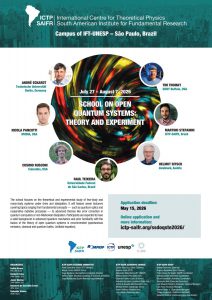
School on Open Quantum Systems: theory and experiment

July 27 – August 7, 2026
IFT-UNESP, São Paulo, Brazil
Zoom ID: 898 8987 8068
Password: quantum
Home
The school focuses on the theoretical and experimental study of few-body and many-body systems under drive and dissipation. It will feature seven lecturers covering topics ranging from fundamental concepts—such as quantum optics and cooperative radiative processes—to advanced themes like error correction in quantum computers or non-Markovian dissipation. Participants are expected to have a solid background in advanced quantum mechanics and prior familiarity with the basics of the theory of open quantum systems is recommended (spontaneous emission, classical and quantum baths, Lindblad equation).
Organizers:
- Dalila Rivero (IFSC-USP, Brazil)
- Herbert Fotso (SUNY Buffalo, USA)
- Jamir Marino (SUNY Buffalo, USA)
- Natanael de Carvalho Costa (UFRJ, Brazil)
- Reinaldo Vianna (UFMG, Brazil)
Announcement:
Application is now closed
Participants list here
Click here for satisfaction survey
Lecturers
Lecturers
- Tim Thomay (SUNY Buffalo, USA) – Counting Photons: Quantum Light, Fock States, and hands-on Photonic Quantum Computing
- Martino Stefanini (ICTP-SAIFR, Brazil) – Is Lindblad for me?
- Helmut Ritsch (Innsbruck, Austria) – Fundamentals of quantum optics
- Raul Teixeira (Univ. Sao Carlos, Brazil) – Experiments on cold atoms and optical cavities
- Cosimo Rusconi (Columbia, USA) – Beyond the Dicke Model: Universality and Geometry in Many-Body Superradiance
- Nicola Pancotti (NVIDIA, USA) – Introduction to modern quantum error correction
- André Eckardt (Berlin, Germany) – Controlling open quantum systems by driving and dissipation
Registration
Program
Posters
First week (Group 1)
- Alberton, Saulo Gabriel (Unicamp/USP, Brazil): Preliminary studies of the impact of terrestrial cosmic radiation on superconducting qubits in Brazil
Terrestrial cosmic rays generate high-energy phonons in superconducting qubit substrates, which in turn break Cooper pairs into quasiparticles that degrade qubit coherence. To investigate this process, we simulate the atmospheric radiation field at a Brazilian quantum laboratory, validate the model against reference neutron flux measurements, and discuss how the simulated spectrum can be used to estimate the fundamental limit that natural radiation imposes on qubit coherence times. We also develop a prototype to indirectly measure the average number of radiation-induced phonons in quantum device chip substrates.
- Alpino Da Silva, Marcos Gabriel (Federal University of Minas Gerais, Brazil): Spectral Leakage as a Diagnostic of Quantum Equilibration
We present a dynamical-spectral framework for the emergence of equilibration in closed quantum many-body systems based on a subspace coarse-graining perspective. The central object is the Leakage Fidelity Function, defined as the probability that a unitarily evolving quantum state escapes the support of its initial subspace. This quantity provides an operational diagnostic of information spreading, memory loss, and effective irreversibility without relying on external reservoirs, ensemble assumptions, or perturbative approximations. For pure initial states, the leakage reduces to the infidelity associated with the survival probability, allowing equilibration to be characterized through the decay and stabilization of returns to the initial state. We derive bounds showing that temporal fluctuations of the leakage around its long-time value are suppressed by the square of the effective dimension, linking equilibration to spectral delocalization in the energy eigenbasis. Beyond this state-dependent measure, we analyze the distribution of fluctuation power over Bohr frequencies and introduce spectral descriptors such as a spectral effective dimension and a Shannon power entropy. These quantities quantify the number and organization of active energy gaps responsible for phase mixing and the suppression of revivals. Numerical results for a non-integrable spin-1/2 Ising-like chain illustrate how different initial states display distinct leakage dynamics depending on their spectral structure. Although the global dynamics remains unitary, this framework offers a perspective closely connected to open-system notions of information flow, memory loss, and coarse-grained irreversibility.
- Fernandes Da Costa, Gustavo (Universidade Federal de São Carlos, Brazil): Reverse engineering of one qubit gates
This work addresses the design of arbitrary one-qubit quantum gates driven by a single linearly-polarized field. By inverting the system’s equations of motion, we demonstrate that any target gate corresponding to a special unitary matrix in $SU(2)$ can be generated by a control field with a closed analytical form. The proposed method provides exact expressions for the time-dependent amplitude and phase of the pulse. We apply this technique to generate fundamental logic gates such as Pauli, Hadamard, and Phase gates.
- Ferrari Melo, Gabriel Fernandez (Universidade Federal do Rio de Janeiro, Brazil): Quantum thermodynamics as a gauge theory
Thermodynamics is based on a coarse-grained approach, from which its fundamental variables emerge, effectively erasing the complicate details of the microscopic dynamics within a macroscopic system. The strength of Thermodynamics lies in the universality provided by this paradigm. In contrast, quantum mechanics focuses on describing the dynamics of microscopic systems, aiming to make predictions about experiments we perform, a goal shared by all fundamental physical theories, which are often framed as gauge theories in modern physics. Recently, a gauge theory for quantum thermodynamics was introduced, defining gauge invariant work and heat, and exploring their connections to quantum phenomena. In this work, we extend that theory in two significant ways. First, we incorporate energy spectrum degeneracies, which were previously overlooked. Additionally, we define gauge-invariant entropy, exploring its properties and connections to other physical and informational quantities. This results in a complete framework for quantum thermodynamics grounded in the principle of gauge invariance. To demonstrate some implications of this theory, we apply it to well-known critical systems.
- Follador, Lorenzo (USP, Brazil): Near-Threshold Quantum Tomography 85 of Hot Rb DOPO
ot cells of alkali atoms are proven sources of entanglement[1], and could prove useful in the generation of states for quantum communications. In this project, we used Homodyning (HD) and Self- Homodyning (SH) to investigate the oscillation of an Optical Parametric Oscillator (OPO) based on a hot cell of 85Rb atoms. The system was set at the Degenerate condition of oscillation, where squeezing from the 4- Wave Mixing (4WM) process was expected near the threshold of operation. Despite careful experimental control, covariance matrix reconstruction from neither the HD nor the SH techniques revealed any squeezing.
- Gomes Silva Honorio, Isabella (Universidade Federal de Juiz de Fora, Brazil): Aprimorando a Confiança em Tecnologias Quânticas: Um estudo sobre Benchmarking Randomizado para dispositivos NISQ
Devido ao desenvolvimento de tecnologias quânticas nas últimas décadas, dispositivos quânticos de escala intermediária (NISQ) ruídosos estão prestes a superar as capacidades da computação clássica. Solucionando, a longo prazo, problemas da indústria que estão altamente fora do alcance dos melhores e mais potentes computadores clássicos. Saímos da infindável busca por um computador quântico de poucos qubits para um presente onde já falamos em encomendar gadgets quânticos comerciais. Processos tomográficos, ou seja, de procedimentos de recuperação total de informação de portas lógicas e circuitos ruidosos são amplamente estudados e apresentados como solução final para esse problema. Entretanto eles enfrentam dois obstáculos não triviais: primeiro, sabe-se que a complexidade da tomografia completa aumenta exponencialmente e, segundo, existe o problema de caracterizar defeitos na presença de outros tipos de erros, como os decorrentes da preparação e medição de estado. Para contornar esses desafios, outras técnicas foram desenvolvidas, como benchmarking randomizado (RB), que permitem a estimativa universal e eficiente de medidas robustas contra erros de SPAM. É aqui que o nosso projeto se encaixa. Em geral, visando o desenvolvimento de uma caracterização universal e eficiente dos NISQs, de baixo custo e de conteúdo nacional, esse projeto se insere no entendimento da estrutura rigorosa por trás do benchmarking randomizado.
- Kronhardt Fritsch, Amanda (UFF, Brazil): Airlink of the Quantum Rio Network
Here we describe the current stage of the Quantum Rio Network, focusing on its implementation and experimental validation. We present the entangled photon source used for free-space quantum communication and evaluate its performance. A key aspect of this work is the characterization of the polarization channel across Guanabara Bay. We perform polarimetric measurements to assess the preservation of polarization states during transmission, which is essential for maintaining the fidelity of quantum information. We also analyze the impact of atmospheric turbulence and optical system imperfections on the link. The associated losses are quantified, and their effects on system efficiency are discussed. These results represent an important step toward the realization of a robust free-space quantum communication network in a metropolitan coastal environment.
- Motta, Octávio Da (Instituto de Física de São Carlos IFSC- USP, Brazil): Minimal-Energy Optimal Control of Tunable Two-Qubit Gates in Superconducting Platforms Using Continuous Dynamical Decoupling
We present a unified scheme for generating high-fidelity entangling gates in superconducting platforms by continuous dynamical decoupling (CDD) combined with variational minimal-energy optimal control. During the CDD stage, we suppress residual couplings, calibration drifting, and quasistatic noise, resulting in a stable effective Hamiltonian that preserves an interaction proportional to ZZ and YY coupling terms, necessary for generating entanglement. In this stable SU (4) manifold, we calculate smooth low-energy single-quibt control functions using a variational geodesic optimization process that directly minimizes gate infidelity. We illustrate the methodology by applying it to CZ, CX, and a two-qubit gate constructed as a CX followed by random single-qubit rotations, achieving virtually unit fidelity and robustness under restricted single-qubit action, with experimentally realistic control fields. These results establish CDD-enhanced variational geometric optimal control as a practical and noise-resilient scheme for designing superconducting entangling gates.
- Obregon Hilario, Wilber Andre (Pontificia Universidad Católica del Perú, Peru): Entanglement Dynamics of X States under Noisy Quantum Channels via Quantum Circuit Simulation
Understanding how quantum correlations degrade under noise is a central challenge in the study of open quantum systems and quantum technologies. In this work, we investigate the dynamics of entanglement in bipartite X states subjected to noisy quantum channels. The action of realistic noise processes is simulated using quantum circuits, allowing us to model the evolution from pure to mixed states under controlled conditions. To quantify the effect of noise, we reconstruct the resulting quantum states via quantum state tomography and evaluate the concurrence as a measure of entanglement. This approach enables us to track how entanglement is progressively degraded as a function of the noise parameters, revealing the interplay between coherence loss and quantum correlations. Our results provide a clear framework for analyzing entanglement dynamics in realistic quantum platforms and highlight the relevance of circuit-based simulations for studying open quantum system behavior. These findings contribute to a deeper understanding of noise effects in quantum information processing and may inform future strategies for mitigating decoherence in quantum devices.
- Rodrigues, Matheus (IFSC-USP, Brazil): Intensity correlations to probe quantum light matter interaction
Cold atoms provide a rich and well-controlled environment for exploring both fundamental phenomena and future applications, such as quantum memories for photonic states, sources of nonclassical light, and ultraradiant light layers. Furthermore, the emergence of collective effects, together with their subradiant and superradiant modes, offers a broad toolbox for achieving high fidelity and efficiency in devices based on cold-atom systems. This project primarily aims at the experimental characterization of light scattered by a disordered sample through statistical measurements of the electric field (g1(τ ) and g2(τ )) in cold atomic clouds, targeting high optical depths and densities, with the goal of developing a framework capable of describing and predicting the emergence of non-classical light behavior from this system. Subsequently, the intention is to link these results to quantum signatures imprinted by the atoms on the scattered light, such as entanglement
- Santos Bento, Pedro Henrique (Universidade Federal de Goiás, Brazil): Dynamical Quantum Phase Transitions and Krylov Complexity in Open Quantum Systems
This poster presents ongoing research perspectives on the extension of concepts from closed quantum many-body systems to the framework of open quantum systems. In particular, we discuss possible connections between dynamical quantum phase transitions (DQPTs), quantum chaos, and Krylov complexity in the presence of dissipation and decoherence. The main goal is to investigate how non-unitary dynamics may affect signatures of critical behavior and operator/state complexity growth. Possible theoretical approaches based on Lindblad dynamics and numerical simulations are briefly outlined. This work is motivated by current efforts to understand non-equilibrium phenomena in realistic quantum systems coupled to environments.
- Santos Junior, André (Instituto de física/Universidade Federal Fluminense, Brazil): Controlling quantum entanglement with classical non-separable light
Here we investigate the quantum frequency conversion of entangled photons driven by a classically non-separable laser beam. We show that the frequency conversion dynamics is described by a quantum channel that stems from the classical drive field through the channel-state duality – the quantum channel is dual to the classical coherence matrix of the drive field. This implies that the evolution of entanglement in the conversion process is bound by the classical non-separability of the drive field, a result that we confirm experimentally. Furthermore, we show that the conversion dynamics can be understood as a swapping operation between classical non-separability and entanglement, unveiling a physical connection between two fundamentally different concepts.
Second week (Group 2)
- Blessed-Agboola, Jesujoba (African Quantum Consortium (AQC), Nigeria): Noise and Dissipation in Quantum Communication: Implications for Randomness and Information Transfer
Quantum communication relies on both the generation of high-quality randomness and the faithful transmission of quantum states. In idealized models, these processes assume isolated systems; however, practical implementations operate in open quantum environments where noise, dissipation, and decoherence are unavoidable. These effects influence not only the integrity of transmitted quantum information but also the quality and security of generated randomness. This work examines the interplay between noise, randomness, and information transfer in quantum communication systems from an open quantum systems perspective. Drawing on quantum random number generation (QRNG) frameworks and communication protocols, we analyze how different noise sources—such as measurement noise and environmental interactions—affect output randomness and transmission reliability. Using Qiskit-based simulations, we compare ideal and noisy quantum circuits to illustrate how noise alters probability distributions and introduces deviations from ideal randomness. Our analysis shows that while quantum processes provide intrinsic randomness, practical implementations require careful consideration of noise contributions to ensure both randomness quality and communication security. This highlights the need for noise-aware models in the design of quantum communication systems and motivates further study into robust and noise-resilient protocols.
- Carvalho, Lorena Dietrich (Instituto de Física da Universidade de São Paulo, Brazil): Optomechanical Dynamics in Microwave-Optical Transducers
Optomechanical systems working in the quantum regime are at the forefront of several scientific and technological developments in the field of quantum information, serving as links between distinct quantum processing units in distributed networks. Several groups are developing microwave-optical quantum transducers to bridge these units, where acoustic degrees of freedom connect microwave qubits with telecom-band fiber circuitry. Despite their potential, implementing these systems remains challenging, since their small dimensions lead to significant heating, generating thermal noise that limits transduction rates and compromises quantum protocol requirements. In this work, we simulate the fidelity behavior of quantum states transfer within an optomechanical cavity under dissipative conditions, modeling the optical-mechanical energy exchange via a beamsplitter Hamiltonian. Specifically, we analyze how thermal noise, cavity decay, and mechanical damping affect the system’s dynamics in the weak-coupling and effective strong-coupling regimes. Our results show that while ideal dynamics exhibit coherent Rabi oscillations, dissipation leads to damped behavior, where state transfer fidelities converge to a stationary plateau. The main goal of understanding this loss of state fidelity due to dissipation in optomechanical systems is essential for optimizing transducers that aim for high-fidelity information transfer with minimal information loss.
- De Assis Almeida, Patricia (Universidade de Sao Paulo, Brazil): Transport signatures of Kondo physics and quantum criticality in kagome lattices with magnetic impurities
Over the past decade, interest has grown in understanding how local moments modify the physics of Kagome systems, which host Dirac cones, Van Hove singularities, and flat bands within their rich band structure. This line of research gained particular relevance after the discovery of the so‑called Kagome metals, recognized as ideal platforms for investigating exotic phases of matter. Despite extensive efforts, progress has been limited in fully clarifying how the physics of local moments manifests in these systems, with relatively few advancements toward a comprehensive understanding of the classical manifestations of this interaction, such as the Kondo effect. We employ the single‑impurity Anderson model together with the numerical renormalization group to carry out our analysis. In this study, we investigate the thermodynamic, spectral, and transport signatures of Kondo physics arising from dilute atomic impurities in Kagome lattices, considering both vacancies and adatoms. We find that if the chemical potential is zero, Kondo correlations emerge only in the presence of a back gate. Furthermore, when the chemical potential shifts the Fermi level toward the Dirac cone, all cases exhibit some quantum criticality.
- Lawal, Opemipo (Ladoke Akintola University of Technology Ogbomoso, Nigeria): Detecting Anomalies with Quantum Autoencoders: A Hybrid Approach to Efficient Pattern Recognition
Anomaly detection is critical in applications ranging from industrial monitoring to cybersecurity, where early identification of unusual patterns can prevent costly failures or attacks. Classical machine learning methods often struggle with complex datasets and subtle correlations, limiting their efficiency and accuracy. In this work, we explore a hybrid quantum-classical approach using quantum autoencoders to efficiently detect anomalous patterns in high-dimensional data. The quantum autoencoder compresses normal data into a lower-dimensional latent space, highlighting deviations that indicate anomalies. We demonstrate this approach on synthetic and small-scale real-world datasets, comparing performance with classical autoencoders. Our results show that the quantum-enhanced method can identify anomalies with higher fidelity and faster convergence, even in limited-data scenarios. This study illustrates the potential of quantum machine learning techniques to provide practical, efficient solutions for complex anomaly detection tasks.
- Libanio De Araujo Yordaky, Artur (Universidade de São Paulo, Brazil): Numerical synthesis of non-classical states in superconducting resonators using SNAP gates
Quantum computing platforms based on superconducting circuits are promising systems for the generation and control of non-classical states of harmonic systems like microwave cavities or mechanical resonators, which are important resources for continuous-variable quantum computation. Since coherent drives alone cannot achieve this in purely harmonic systems, coupling the resonator to a non-linear element, such as a superconducting qubit, enables selective control of oscillator excitations and allows the synthesis of arbitrary quantum states. In this undergraduate research project, we numerically investigate the synthesis of non-classical states – characterized by regions of negativity in their Wigner functions – through electromechanical interaction between superconducting qubits and resonators, using a protocol composed of two types of gates: displacement and Selective Number-dependent Arbitrary Phase (SNAP) gate. Gate parameters are obtained via numerical optimization using gradient-based methods, achieving infidelities for final states below 10-2. We simulate these gates through experimentally feasible Gaussian microwave pulses applied to the qubit and resonator, incorporating phase corrections due to the Kerr nonlinearity of the resonator. Pulse-level simulations reproduce the expected dynamics of the protocol. To address the potentially long duration of SNAP gates relative to qubit coherence times, we employ optimized pulse shaping to reduce gate time while maintaining fidelity. Using master equation simulations, we demonstrate high-fidelity preparation of Fock, GKP, and cubic phase states. Through this, we aim to understand the prospects for experimental realization of these states for acoustic oscillators, connecting our findings with future experimental proposals from our group.
- Manya Suni, Marco Antonio (Universidad Federal Fluminense (UFF), Brazil): Freezing scars
The study of quantum many-body systems out of equilibrium has revealed fascinating phenomena where systems fail to thermalize, even under strong interactions. Among these, “Quantum Many-Body Scars” represent a unique class of states that prevent full ergodicity. This project investigates a phenomenon we term “Freezing Scars,” where individual quantum trajectories in open quantum systems exhibit a transition toward localized, frozen dynamics at long-time scales rather than decaying into a trivial steady state. We model the dynamics of coupled spin ensembles using the Quantum Jump Method (Monte Carlo Wavefunction). Our results demonstrate that under specific collective dissipation channels and initial symmetry-breaking rotations, the system’s trajectories become trapped in metastable manifolds. This “freezing” is significant because it provides a mechanism to protect quantum information from decoherence, as the system effectively bypasses the standard decay routes into the environment. Experimentally, this phenomenon can be observed in platforms such as Atomic Ensembles in Optical Cavities or Rydberg Atom Arrays, where collective emission (superradiance) can be tuned. By monitoring the fluorescence or the total angular momentum of the system over time, the halting of dynamics can be verified. The implications for quantum technology are twofold: 1. Quantum Metrology: Frozen states can maintain high sensitivity for long durations, improving the precision of atomic clocks and magnetometers. 2. Quantum Memories: Understanding how to “freeze” specific states allows for the design of more robust architectures for storing quantum information, leveraging dissipation as a tool for state preparation and stabilization rather than a source of error.
- Pereira Da Silva, Elder Emmanuel (Federal University of Alagoas, Brazil): Transport properties in non-linear systems
This work investigates the transport of wave excitations through defects and interfaces, focusing on the emergence of non-reciprocal transport in non-linear and non-Hermitian systems. Using stationary scattering methods, we model coupled chains to obtain transmission spectra and analyze the influence of controllable defect characteristics. The primary objective is to identify operating regimes for innovative optoelectronic and phononic devices, such as phononic logic gates and diodes. Our current progress involves the analytical calculation of transmission spectra in chains coupled by non-linear defects, exploring how these contributions facilitate non-reciprocal mechanisms. This research provides fundamental insights for the development of new technologies based on controlled wave propagation in low-dimensional quantum systems.
- Pinto, Henrique Gomes (Instituto de Física de São Carlos, Brazil): Universalidade da Escala Temporal de Emaranhamento em Dinâmicas de Tempo Finito
A dinâmica de sistemas quânticos bipartidos interagentes pode ser bastante rica, principalmente sob a ótica de correlações como o emaranhamento. Nesse contexto, trabalhos como os de J. I. Kim et al. [citação] e I-S. Yang [citação] são responsáveis por formalizar uma maneira de se obter perturbativamente escalas de tempo que definem não só a taxa de decoerência como também a taxa de crescimento do emaranhamento entre cada subsistema, ambas a partir da definição de um Hamiltoniano e da condição inicial de separabilidade do estado total do sistema de interesse. Indo além, J. C. Cresswell [citação] demonstra ainda como essa escala de tempo que governa o crescimento de emaranhamento pode ser também avaliada sob a ótica das entropias de Rényi, que por sua vez caracterizam completamente tal correlação quântica sobre estados puros bipartidos. Isso posto, este trabalho visa estabelecer uma equivalência entre as formalizações propostas nos trabalhos citados e, além disso, debater seus desdobramentos sobre o estudo do fenômeno conhecido como morte súbita de emaranhamento.
- Rebelo Pereira, Mirela Beatriz (Universidade Federal do Rio de Janeiro, Brazil): Optimal Control of Quantum Hopfield Networks
Hopfield networks are associative memory models physically isomorphic to spin glass models, characterized by an Ising-like energy function defined on a completely connected graph. The network stores input data as target patterns encoded as stable energy minima by adjusting the network’s coupling constants according to the Hebb rule. The retrieval of these memories is achieved by allowing the network to dynamically relax into these predefined energy attractors. Extensions to the quantum regime are obtained by modeling the network dynamics as an open quantum system and introducing transverse fields. These transverse fields introduce quantum fluctuations, enabling the network to bypass local minima via quantum tunneling and significantly enhancing retrieval efficiency. However, in realistic implementations, environmental decoherence rapidly destroys phase correlations, reverting the dynamics to classical thermal diffusion. To address this limitation, we propose an optimal control framework aimed at mitigating decoherence to an optimal threshold. By applying time-dependent fields, our approach seeks to dynamically suppress noise just enough to preserve the transient tunneling required for coherent many-body interactions, while actively leveraging residual dissipation to drive the network toward the target memory attractor.
- Silva, Luan De Souza (Universidade de São Paulo, Brazil): Anderson localization in disordered open quantum systems
In this work we present signatures of anderson localization in open disordered non-interacting electronic systems, using both Lindblad and Redfield quantum master equations. We show that for strong enough disorder, the currents at nonequilibrium steady state (NESS) exponentially decay, showing that localization persists even outside linear response (ultraweak coupling) regime.
- Silva, Thiago Teixeira Xavier Da (Ufscar-SP, Brazil): Bloch Oscillations in the tight binding regime
We intend to theoretically study and experimentally observe Bloch oscillations in the tight binding regime. Bloch oscillations can be observed via Bragg reflection of light between the counter-propagating modes of a ring cavity in a non-destructive way, provided the periodicity of the optical potential is non-commensurate with the wavelength of the probing laser.
- Souza, Bruno (Universidade Feral de Alagoas, Brazil): Transport Efficiency and Localization Transitions in Boundary-Coupled Aubry–André Quantum Channels
We investigate the interplay between spatial localization and coherent quantum state transfer (QST) in one-dimensional Aubry–André chains embedded in a source–channel–receiver architecture. Our results establish that optimal QST in quasiperiodic systems requires not only operating within the delocalized phase, but also remaining in the ballistic regime (λ < 1), under weak system–lead coupling and for modes close to the band center (E0 ≈ 0).
- Subramaniyan, Sabari (IFT-UNESP, India): Turbulence and Vortex Dynamics in Driven-Dissipative Polariton BECs
Excitations in low-dimensional quantum gases offer a rich platform for exploring nonequilibrium physics in open quantum systems. In this work, we theoretically investigate the emergence of quantum turbulence in exciton-polariton Bose-Einstein condensates (BECs) confined in microcavities. Utilizing the dissipative Gross-Pitaevskii equation, we model the generation of quantized vortices by dragging a Gaussian obstacle through the driven-dissipative condensate. We systematically analyze the resulting vortex dynamics, tracking their nucleation, interactions, and spatial distributions under the competing influences of continuous pumping and decay. To definitively confirm the transition into a robust turbulent regime, we calculate the kinetic energy spectrum and evaluate its adherence to Kolmogorov power-law scaling. By contrasting these driven-dissipative features with classical and closed-system quantum turbulence, our findings clarify how open-system constraints modify nonequilibrium superfluidity and macroscopic quantum phase dynamics. References 1. S. Sabari, R.K. Kumar, L.Tomio, Vortex dynamics and turbulence in dipolar Bose-Einstein condensates, Phys. Rev. A 109, 023313 (2024). 2. S. Sabari, R. K.kumar, P. Muruganandaam and R. Radha, Stability window of polariton Bose-Einstein condensates, Phys. Rev. B 105, 224315 (2022).
- Zheng, Chao (North China University of Technology, China): Quantum simulation of typical non-Hermitian systems and entropic dynamics.
We investigate general NH systems, using the linear combination of unitaries (LCU) in the scheme of duality quantum computing and the unitary expansion (UE) techniques. We uti- lize the linear combination of unitaries technique for nonunitary dynamics on a single qubit to give explicit decompositions of the necessary unitaries, and simulate arbitrary time-dependent single-qubit nonunitary operator () using duality quantum algorithm. We find that the success probability is not only decided by () and the initial state, but also is inversely proportional to the dimensions of the used ancillary Hilbert subspace. In a general case, the simulation can be achieved in both eight- and six-dimensional Hilbert spaces. In phase matching condi- tions, () can be simulated by only two qubits. We illustrate our method by simulating typical non-Hermitian systems and single-qubit measurements. We investigate a novel NH quantum system of PT-arbitrary-phase, pseudo-Hermitian-ϕ-symmetric and -anti-pseudo-Hermitian. We optimize the quantum circuits and calculate the success probabilities. Entropy, which is indispensable in classical and quantum channels, is one of the most important cornerstones in information theory. Non-Hermitian (NH) quantum systems attract research interest increasingly in recent years, among which the PT-symmetric, P-pseudo-Hermitian and their anti-symmetric counterpart systems are focused much more. Many meaningful results and interesting phenomena will appear when we investigate the entropy in quantum systems with NH Hamiltonians. In our work, on the one hand, we extend the application of entropy to distinguish time-evolutions of different classes and phases of typical NH systems. In a general case, we show how to distinguish all the eight phases of the above NH systems step by step. On the other hand, we investigate how to describe the Rényi entropy for NH systems more appropriately. We obtain a concisely and generalized form of α-Rényi entropy, which we extend the unified order-α from finite positive real numbers to zero and infinity. By exploring the mathematics and physical meaning of the negative entropy in open quantum systems, we connect negative non-Hermitian quantum Rényi entropy and negative quantum conditional entropy, paving the way to rigorously investigate negative entropy in open quantum systems.
Short talks
July 27 (Short talks 1)
- Albuquerque, Gabriel Lemos Simão (University of São Paulo, Brazil): Quantum Illumination Using Microwave Photons: A Theoretical Approach
Breast cancer screening remains a major global health challenge, especially in contexts where access to high-cost imaging technologies is limited. Microwave imaging has emerged as a promising non-ionizing alternative, since malignant and healthy breast tissues exhibit different dielectric properties, allowing tumors to be detected through scattered electromagnetic signals. In this work, we propose a theoretical framework for a breast cancer detection system based on quantum illumination using microwave photons. The proposed approach combines concepts from radar-based microwave breast imaging with the quantum illumination protocol, in which correlated signal-idler photon pairs are generated; the microwave signal probes the breast tissue, while the idler is retained as a reference for correlation-based detection. A tumor is modeled as a weakly reflecting dielectric anomaly embedded in a lossy and noisy biological medium. Inspired by classical IR-UWB microwave imaging systems, the model considers breast phantoms, dielectric contrast, backscattered signal acquisition, and image reconstruction strategies such as confocal or delay-and-sum processing. The goal is to investigate whether quantum correlations can improve target detectability under high noise and loss conditions, potentially enhancing sensitivity compared with classical microwave approaches. This theoretical proposal aims to bridge quantum sensing and biomedical microwave imaging, opening a possible route toward portable, non-invasive, and resource-efficient breast cancer screening technologies. Keywords: quantum illumination; microwave photons; breast cancer detection; microwave imaging; dielectric contrast; quantum sensing.
- Botelho Naves, Caio (Stockholm University, Sweden): Non-normality and chaos in open quantum systems
Spectral level repulsion has become a standard diagnostic of chaos in open quantum systems, motivated by the Grobe–Haake–Sommers (GHS) conjecture and non-Hermitian random matrix theory[1,2]. In this work[3], we revisit this paradigm and demonstrate that level statistics alone can be misleading in dissipative quantum dynamics. Focusing on Lindblad master equations, we use integrable and numerically controlled models to show that truncated or boundary-modified systems can exhibit clear Ginibre-type cubic level repulsion and the characteristic “bitten-donut” spacing-ratio distribution[4], despite their dynamics being non-chaotic. We trace this breakdown of the GHS conjecture to strong non-normality and enhanced spectral instability, quantified through eigenvector condition numbers and pseudospectra[5]. By elucidating the interplay between non-normal dynamics, non-Hermitian spectral statistics, and dissipative quantum evolution, our results clarify fundamental aspects of relaxation and stability in open quantum systems. [1] Grobe, R., Haake, F. & Sommers, H.-J. Quantum distinction of regular and chaotic dissipative motion. Physical review letters 61, 1899 (1988). [2]Ginibre, J. Statistical ensembles of complex, quaternion, and real matrices. Journal of Mathematical Physics 6, 440–449 (1965). [3]Naves, C. B., Larson, J. When level repulsion fails: non-normality and chaos in open quantum systems, arXiv 2604.00118 (2026). [4]Sá, L., Ribeiro, P. & Prosen, T. Complex spacing ratios: A signature of dissipative quantum chaos. Physical Review X 10, 021019 (2020). [5]Trefethen, L. N. & Embree, M. Spectra and pseudospectra: the behavior of nonnormal matrices and operators, Princeton university press (2020).
- Lizarraga, Kevin (Center for Quantum Nanoscience, Institute for Basic Science (IBS), Seoul 03760, Republic of Korea, Peru): An ab initio approach to energy alignment and charge-state prediction of adsorbates on ultrathin insulators
The rapid progress of electron spin resonance scanning tunneling microscopy experiments has enabled the manipulation of individual adsorbate spin states physisorbed on ultrathin oxide layers supported on metal substrates. Electron resonance requiresunpaired spin density on the adsorbate, which can be achieved, for instance, through charge transfer from the supporting substrate. This requires the correct energy-level alignment between the energy levels of the adsorbate and the Fermi energy of the substrate. Experiments on molecules and single atoms adsorbed on metal-insulator systems have revealed complex phenomena, including electronic bandgap narrowing, charge transfer, Fermi-level pinning, and the re-ordering of adsorbate orbitals after charge transfer. Despite these advances, a predictive first-principles approach based on accurate methods such as quasiparticle GW, capable of capturing these effects without the prohibitive cost of full adsorbate/oxide/metal simulations, remains an open challenge. In this work, we present a theoretical approach to determine the energy-level alignment of adsorbates on oxide/metal substrates. Our method transparently exposes all physical processes and strikes a balance between computational cost and accuracy. Ionization potentials and electron affinities of the isolated adsorbates are obtained using GW calculations, electronic bandgap polarization is quantified through the quasiparticle renormalization caused by the substrate, Fermi-level pinning is evaluated within the integer charge transfer model, and work function shifts arising from Pauli push-back or from the adsorbate-metal dipole are determined from the local variations of the electrostatic potential. This computationally efficient framework paves the way for high-throughput screening of molecular qubits and organic electronic interfaces.
- Ribas Tandeitnik, Daniel (PUC-RIO, Brazil): Optimal state estimation and control of optically levitated nanoparticles near the Heisenberg limit
Optically levitated nanoparticles in ultra-high vacuum offer a versatile experimental platform for exploring fundamental physics, including stochastic thermodynamics, nonlinear dynamics, searches for new particles and forces, and tests of quantum mechanics. Many of these applications rely on preparing the nanoparticle in its motional ground state, a goal achievable through feedback control operating near the Heisenberg limit. In this poster, we report on the realization of this technology, establishing a state-of-the-art laboratory for levitated optomechanics in vacuum in Rio de Janeiro, Brazil. We detail the development of the experimental apparatus and the implementation of optimal control protocols essential for reaching the quantum regime. Specifically, we demonstrate the use of optimal state estimation via Kalman filtering combined with linear quadratic regulation to minimize thermal motion and robustly stabilize the system.
July 28 (Short talks 2)
- Islam, Tanbir (Universidade Federal Fluminense (UFF), Brazil): Controlling Waiting Time Statistics in Monitored Collective Spins: Mitigating Detector’s Resolution Barrier in Measurement-Induced Phase Transitions
In collective dissipative spin systems, the postselection barrier can be partially mitigated; however, a further obstacle may be posed by the finite temporal resolution of detectors. In this work, we investigate how initial-state inhomogeneities can control waiting-time statistics between quantum jumps, thereby mitigating the detector-resolution problem. We consider a collectively monitored spin model with a boundary time-crystalline phase, introducing inhomogeneity by partitioning the ensemble into two subsystems rotated by an angle θ. We find that the measurement-induced phase transition survives under inhomogeneities, with different entanglement scaling regimes. The waiting time increases with θ, scaling as 1/N but with a prefactor strongly enhanced by orders of magnitude, and in the anti-aligned limit θ=π it remains finite, fully resolving the resolution barrier. This mitigation, however, comes at a cost: the entanglement saturation time becomes significantly longer, partially reintroducing the postselection barrier. Our results highlight a trade-off between detector resolution and postselection overhead, with direct implications for the experimental observation of measurement-induced phenomena.
- Merolle, Alix (Laboratoire Kastler-Brossel (Sorbonne université), France): One-dimensional fluid of light characterization in a resonant atomic medium
One-dimensional quantum fluids display behaviors that strongly differ from higher-dimensional systems, including enhanced fluctuations, collective excitations, and strongly correlated regimes. However, accessing these regimes remains challenging in other experimental platforms, since atomic media require a demanding level of experimental control to achieve low dimensionality, tunable interactions, and access to dynamical observables. In this context, fluids of light offer a versatile platform to explore these regimes by mapping light propagation in a nonlinear medium onto the evolution of an interacting quantum fluid. In this experiment, we create a one-dimensional fluid of light by propagating a near-resonant laser through a hot rubidium vapor. The propagation of light in this nonlinear dispersive medium can be described through a temporal fluid-of-light analogy, where the group velocity dispersion plays the role of an effective photon mass. We first characterize this dispersion using a weak phase modulation of a continuous-wave laser and slow photodetection. During propagation, the modulation sidebands acquire different dispersive phase shifts, leading to oscillations of the transmitted modulation contrast, from which the group velocity dispersion can be extracted. This method allows us to establish the linear response of the system as a first step toward Bragg-like spectroscopy of one-dimensional fluids of light. In the presence of nonlinear interactions, the excitation spectrum is expected to evolve from a single-particle parabolic dispersion to a Bogoliubov-like dispersion, with a phonon regime at low momenta. Moreover, we discuss the role of the nonlocal nonlinear response of the resonant atomic vapor, which can modify the effective photon-photon interaction and the collective excitation spectrum. This work opens new perspectives for probing collective excitations and interaction effects in one-dimensional quantum fluids of light and, more broadly, contributes to the experimental exploration of low-dimensional quantum fluid physics.
- Riveros-Avila, Rafael (Pontificia Universidad Católica de Valparaíso, Chile): Emergence of Rabi-like oscillations in a parametrically driven Kerr dimer
Parametrically driven dimers offer a minimal platform to explore the interplay between nonlinearity, dissipation, and coherent driving in diverse physical contexts. We study an out-of-phase driven dimer near the subharmonic resonance, revealing transitions between stationary, damped, and oscillatory regimes. The emergent oscillations correspond to Rabi-like oscillations resulting from a balance between coupling, Kerr nonlinearity, and drive strength. Using the truncated Wigner approach (TWA), we demonstrate that the structures are robust against quantum noise within the validity regime of TWA, suggesting a route to engineer robust oscillations that may survive at low-excitation regimes. These phenomena may serve as building blocks for multistable optical logic or information-processing units controlled via drive or detuning time modulation.
July 29 (Short talks 3)
- Audi, Gabriel Nogueira (University of São Paulo (USP), Brazil): Quantum Noise Spectroscopy in Non-Markovian Dynamics and Non-Equilibrium Environments
Environmental noise characterization is essential for efficient noise mitigation and optimal quantum control in high-fidelity quantum technologies. Most recent developments in the field determine the pure-dephasing noise spectrum through free coherence decay in Ramsey interferometry. However, these protocols often rely on thermal-equilibrium assumptions to infer the spectral asymmetry, while methods incorporating quantum control to measure the asymmetry experimentally usually assume a Markovian regime through Lindblad equations. In this work, we combine free induction decay and driven control approaches to reconstruct the noise spectrum in non-Markovian regimes without requiring thermal-equilibrium assumptions.
- Dias, Rodrigo Alves (UFJF, Brazil): Qudit Implementation of the Rodeo Algorithm for Quantum Spectral Filtering
Qudits, the multi-level generalization of qubits, provide a natural extension of the binary paradigm in quantum computation and offer new opportunities to enhance algorithmic performance. Beyond their direct applicability to the simulation of multi-level quantum systems, higher-dimensional ancillae can improve sampling efficiency in quantum algorithms by enabling the simultaneous implementation of multiple control operations, thereby reducing circuit complexity. In this work, we pursue three main objectives. First, we present a formulation of the Rodeo algorithm employing a general -level ancilla qudit. Second, we introduce the concept of the \emph{Rodeo kernel}, defined as a two-frequency interferometer, which acts as a spectral filter in the energy domain. Finally, we propose a microcanonical protocol for the Rodeo algorithm. This protocol enables the estimation of entropic quantities through a single energy sweep and admits a natural interpretation as a Gaussian convolution of the density of states. To support the theoretical analysis, we perform numerical evaluations of the corresponding quantum circuit using ancilla qudits of dimensions three, four, and five. The simulations are performed for the one-dimensional Ising model, considering both spin- and spin- particles. The ancilla qutrit implementation exhibits an reduction in fluctuations compared to the qubit implementation. Our results show that the qudits provide a framework for spectral analysis and thermodynamic characterization of multi-level quantum systems.
- Dos Santos Junior, Washington Francisco (Instituto de Física Teórica, São Paulo State university (IFT – Unesp), Brazil): Decoherent Quantum Transport Induced by Many-Body Interactions in Low-Dimensional Systems
Quantum transport problems are intrinsically open quantum systems, where a central device is coupled to external thermal reservoirs. Understanding the interplay between disorder and many-body interactions in these systems is essential for describing realistic nanoscale quantum devices and experimentally observed transport phenomena. To address this problem, we employ a framework based on non-equilibrium Green’s functions combined with Anderson impurity models and the non-crossing approximation (NCA), investigating how electron-electron interactions modify transport properties in low-dimensional systems. Within this formalism, interaction effects naturally generate coherent and incoherent transport contributions associated with dissipation and phase-breaking processes. This approach provides an effective physical picture in which coherent transport is described by electronic propagation between two reservoirs, while many-body interactions introduce an additional quantized scattering reservoir associated with the interaction itself, leading to an effective multi-reservoir open-system description. In this way, the formalism provides a microscopic framework for describing interaction-induced decoherence in nanoscale quantum devices. As applications, we study graphene-based single-electron transistors and disordered graphene nanoribbons. In the first case, incoherent transport contributions become essential for reproducing Coulomb blockade phenomena and experimentally observed transport regimes. In the second, we analyze how the interplay between disorder and electron-electron interactions modifies localization and transport properties in low-dimensional systems. Together, these results highlight the importance of many-body interaction effects and open-system approaches for understanding realistic quantum transport experiments in nanoscale devices.
- Monteiro, Mariana (Instituto de Física, Universidade Federal de Alagoas, Brazil): Spontaneous emission in a coupled cavity array featuring random-dimer disorder
We study the emission dynamics of a two-level atom interacting with a large array of coupled cavities via the central site. The local frequencies of the cavities follow a random dimer model, where two distinct frequency values are sorted across the array, with one value occurring only between pairs of adjacent sites. This configuration results in the coexistence of localized and quasi-extended field modes, which we exploit to measure the Markovian character of the amplitude-damping channel. By tuning the correlation length of the disorder, we observe a transition from non-Markovian to Markovian decay at specific values of the atomic frequency. In this setup, the atom serves as a probe for the localization properties of the array, establishing a connection between the theory of open quantum systems and quantum transport in low-dimensional systems.
July 30 (Short talks 4)
- Coelho, Daniel Siqueira (Universidade Federal de São Carlos, Brazil): Density Effects on Light Diffusion by Cold Atomic Samples Measured by Diffusing Wave Spectroscopy
This project aims to investigate light scattering in cold samples of strontium-88 through the analysis of the first-order temporal correlation function of the electric field, g¹(τ). The research is divided into an experimental component, centered on reestablishing the SrLab at UFSCar and producing a cold atomic cloud, and a numerical component, creating simulations using the Coupled Dipole Model (CDM) to measure collective modifications within the short-range terms of the dipolar interatomic interaction of the correlation function g¹(τ).
- Francisquez, Sebastian (Universidad de buenos aires-QUFIPHI, Argentina): Synchronization of Qubits via the Dynamical Casimir Effect in Open Systems
One of the fundamental predictions of quantum field theory is that time-dependent boundary conditions can induce particle creation from the vacuum. In the case of photons, this phenomenon is known as the dynamical Casimir effect (DCE), first predicted by Moore in 1970. Due to the challenging experimental conditions required for its observation, the DCE has been primarily verified through effective implementations using superconducting microwave circuits. On the other hand, quantum synchronization has recently attracted increasing attention within the scientific community. Synchronization refers to the adjustment of rhythms or phases between weakly coupled oscillators or systems driven by an external source. In the quantum regime, this phenomenon has been highlighted for its potential applications in tasks such as quantum sensing and communication. In this work, we explore the interplay between these two phenomena by studying the synchronization of two qubits induced by the dynamical Casimir effect. We consider a realistic implementation in which two superconducting qubits are coupled to a coplanar waveguide resonator, terminated at one end by a SQUID. Previous theoretical studies have shown that this setup allows for qubit synchronization under resonant conditions mediated by the generated photons. Here, we extend this analysis to the open quantum systems framework by incorporating dissipation, relaxation, and decoherence effects. We show that the unavoidable losses in the system do not prevent the emergence or persistence of synchronization, even in regimes where losses are several orders of magnitude larger than those typically measured experimentally. Additionally, we analyze non-classical correlations, such as entanglement and quantum discord, as functions of time and their relation to the onset of synchronization—an issue currently under active debate—providing further insight into their interplay in open quantum systems.
- Montenegro, Lukas (Institute of Physics, USP, Brazil): Spontaneous parametric down-conversion pumped by spatiotemporal structured light
Here we investigate the all-optical control of spectral correlations in spontaneous parametric down-conversion. We show that when photon pairs are projected onto high-order spatial modes, the spatial structure of the pump field defines the phase-matching function of the nonlinear interaction. Thus, by structuring the pump field in both space and spectrum, the biphoton spectral correlations are fully controlled. Considering a standard periodically-poled crystal as the nonlinear medium, we show that the Gouy phase matching method proposed here can generate both spectrally uncorrelated and high-dimensional spectrally entangled photon pairs, similarly to what is achieved with aperiodically-poled crystals. Furthermore, we show that our method can generate a wider class of quantum states if the pump field is a spatiotemporal wavepacket, that is, if its spatial and spectral structures are correlated.
- Raupp Da Luz, Camila (São Carlos Institute of Physics (IFSC) – University of São Paulo (USP), Brazil): Heating-Cooling Asymmetry in Quantum Systems
It is known that classical thermodynamics fails to explain the thermal relaxation of far-from-equilibrium systems. Recent studies have reported an asymmetry in this regime, where heating is faster than cooling for thermodynamically equidistant initial states. Understanding how quantum systems equilibrate is a fundamental question with implications for quantum technologies, such as state preparation for quantum computing. However, how quantum resources affect this asymmetry is an important open question. In this work, we investigate the heating and cooling asymmetry in discrete and continuous-variable quantum systems. For the discrete case, we study two interacting qubits coupled to a global bosonic bath, focusing on the effects of initial correlations and local non-Markovian dynamics. For the continuous case, we consider Gaussian states and compare the thermal relaxation of displaced and squeezed states. Our results for the discrete case indicate that non-Markovianity may accelerate thermal relaxation, while the initial coherences do not change the equilibration time. In Gaussian systems, applying the displacement operator in the initial states does not affect the asymmetry, but using initially squeezed states can reduce it.
July 31 (Short talks 5)
- De Sales, Rafael Bentes (IFT, Brazil): From micromasers to quantum many-body batteries
Micromasers constitute a promising platform for quantum batteries, capable of reaching high-energy pure steady-states. While single-atom setups are known to host states robust against cavity loss, the role of collective effects in the many-body regime remains an open question. In this work, we generalize the micromaser collisional battery model to multi-atom architectures. We identify novel classes of trapping states in the many-body spectrum, distinct from those found in single-atom setups, which are currently being characterized based on the battery figures of merit. Preliminary results suggest that these multi-atom architectures may offer advantages while maintaining the stability characteristic of the single-atom case.
- Iglesias-Cardinale, Vincent (State University of New York – University at Buffalo, United States): Scalable Quantum Circuits for Many Body Quantum Optics Simulations
We consider a model describing a system of many quantum emitters coupled through a radiation bath. By adopting an efficient mapping of the bosonic modes onto qubits, we implement quantum circuits, compatible with NISQ (Noisy Intermediate-Scale Quantum) era systems, that allow us to investigate the dynamics of the ensemble as a function of various parameters of the ensemble, including the number of emitters, the spectral inhomogeneity in the system, the emission lifetime of isolated emitters and the spatial separation between emitters. The quantum algorithms afford us the capacity to precisely track the emergence of cooperative dynamics, manifested through superradiant emission, as the system is tuned towards optimal coupling with respect to various parameters. These quantum algorithms avoid approximations performed in conventional studies of many-emitter systems and provide a robust and intuitive characterization. Despite being limited to a small number of qubits, they are found to provide a reliable characterization validated by comparison with analytical solutions and classical computation results in their respective regimes of validity.
- Alfred, Favour (Africa Quantum Consortium & Ladoke Akintola University of Technology, Nigeria): From Qubits to Open Quantum Systems: Decoherence, Noise, and the Emergence of Irreversibility in Quantum Circuits
Quantum systems are fundamentally open, continuously interacting with their environment in ways that produce decoherence and irreversible dynamics. These effects define the boundary between ideal quantum computation and physically realistic quantum behavior. This work explores this transition using quantum circuit simulations in Qiskit, treating noise not simply as computational error, but as a representation of open quantum system dynamics. Quantum circuits are analyzed under both ideal unitary evolution and standard noise channels such as relaxation and dephasing. The comparison shows how coherence is progressively reduced as circuit depth increases, and how the transition from quantum to classical measurement behavior becomes more pronounced under environmental interaction. Rather than treating noise purely as a correction to ideal computation, this study interprets it as an intrinsic feature of quantum systems embedded in realistic environments. The aim is to build intuition for how quantum computation behaves under open-system conditions, where irreversibility and decoherence play a fundamental role.
- Salari, Valentin Exequiel (QUFIPHI – IFIBA – CONICET, Argentina): Quantum simulations on hybrid cQED platforms
We study a hybrid superconducting-circuit platform composed of conventional and anomalous transmission lines coupled through a tunable SQUID. The resonant mode structure of the system was characterized, and its dynamical response was analyzed through numerical simulations of coherent hopping and cross-squeezing processes. The results demonstrate that this architecture provides a flexible platform for quantum simulation while remaining robust in the presence of dissipation.
- Vargas Castillo, Daniel Felipe (Universidad de los Andes (recent graduate), Colombia): Characterization of Werner-Like thermal states emerging in a two-qubit system coupled to a thermal spin bath
We study the dynamics and thermalization of a two-qubit system with spin $s=1/2$ interacting with a Markovian thermal spin bath under symmetric system–bath coupling. Due to the equal interaction of both qubits with the bath, the total spin-$s=0$ subspace forms a dark state that remains decoupled from the thermalization dynamics. As a consequence, the system undergoes partial thermalization toward non-Gibbsian equilibrium states. By expressing the dynamics in the computational basis, the dark state is identified with the Bell state $|\psi_-\rangle$, allowing the resulting equilibrium states to be described as a family of Werner-like thermal states parameterized by the population of the dark state. We analyze the properties of these states using information-theoretic and quantum-correlation measures, including negativity, the PPT separability criterion, and quantum discord. In particular, we determine the conditions under which the thermal states remain entangled as a function of the inverse temperature and the energy gap of the qubits. Finally, we investigate transitions between different Werner-like thermal states induced by interactions within the system and by external driving modeled through Lindblad operators. Our results provide a characterization of non-Gibbsian thermalization and emergent quantum correlations in symmetrically coupled open quantum systems.
August 3 (Short talks 6)
- De Souza, Vitória Freitas (Universidade Federal Fluminense, Brazil): Scrambling and Complexity in Time Crystals
Understanding information scrambling in many-body quantum systems is a central problem in non-equilibrium dynamics. In this work, we investigate the spreading and complexity of quantum information in systems exhibiting time-crystalline behavior using complementary diagnostics. We consider the Lipkin-Meshkov-Glick model under periodic (Floquet) driving, and analyze its dynamics through out-of-time-order correlators (OTOCs), Loschmidt echoes, and Krylov complexity. These quantities provide distinct perspectives on operator growth, reversibility, and the buildup of complexity. Our results show how collective interactions and Floquet dynamics shape scrambling and complexity growth, revealing signatures associated with time-crystal behavior and offering a unified view of information dynamics in non-equilibrium many-body systems.
- Ribeiro, Igor Beder Burti (Universidade Federal de Alagoas – Instituto de Física, Brazil): Work extraction from a quantum battery charged through an array of coupled cavities
We investigate the problem of work extraction from a cavity-based quantum battery that is remotely charged via a transmission line composed of an array of coupled single-mode cavities. For uniform coupling along the line we show, via numerical analysis, that the ergotropy of the battery, evaluated at the point of maximum power transfer, decreases with the length of the charging line and vanishes beyond a critical size. By carefully engineering the initial state of the charger, nonzero ergotropy can still be harvested even beyond this critical length. We further examine scenarios in which the charging line is initialized in an entangled state, as well as configurations with nonuniform, parabolically varying, coupling strengths. In the latter case, we demonstrate that high ergotropy values can be restored, highlighting the potential for spatially engineered interactions to enhance quantum battery performance.
- Tsypilnikov, Andrei (Instituto de Fisica, Universidade Federal Fluminense, Brazil): Insights into the recovery of Heisenberg-limited sensing with Floquet time crystals in open systems via quantum trajectory unravelings
Floquet time crystals (FTCs) enable robust AC sensing in closed systems. Exact analyses demonstrate that driving macroscopic cat states resonantly yields Heisenberg-limited quantum Fisher information over exponentially long periods of time. This is accompanied by step-like dynamics due to the structure of the cat subspaces. However, in open systems, decoherence typically degrades this precision. Using the quantum trajectory formalism with continuous homodyne monitoring, we demonstrate that dissipation can be transformed into a resource. Trajectory-conditioned evolution stabilizes the order of the time crystal and restores Heisenberg scaling for quantum Fisher information even in the presence of noise. Our results, illustrated by analytical calculations for a general system and for a FTC across linear regimes in the Lipkin-Meshkov-Glick model, pave the way for practical quantum sensors in realistic open environments.
- Urtubey, Elian (IFIBA – CONICET, Argentina): Analogue Black holes and Hawking radiation in dissipative superconducting quantum circuits
Hawking radiation is one of the main predictions that arose from Quantum Field Theory in Curved Space-time. However, due to the nature of this phenomenon and that of the black holes we have observed until today, this result is impossible to verify. Circuit quantum electrodynamics, which has had unprecedented advances in recent years, presents us with an ideal environment to build analogue systems where the measurement of Hawking radiation is possible. In this project, we utilize these tools to propose two superconducting architectures: one analogue to a Schwarzschild black hole and another analogue to a Jackiw-Teitelboim black hole. We not only verify that they reproduce the characteristic thermal spectrum, but also that it would be possible to measure the entanglement of particle pairs. Finally, we use open quantum systems to study the robustness of the system when typical noise is present in the experiment in order to decide if it is possible to measure the analogue radiation in a realistic setting. We conclude that, given that typical measurements take around 100 ns and the spectrum survives for around 10 us, it would be possible to measure Hawking radiation through our proposed circuits.
August 4 (Short talks 7)
- Beleño Rodriguez, Zamir David (Technion – Israel Institute of Technology, Israel): Violation of Detailed Balance in a Three-Level Repeated-Interaction System with Effective Cyclic Coupling
Detailed balance is commonly associated with thermal equilibrium and is usually enforced in standard weak-coupling descriptions of open quantum systems. Recent work has shown [1] that a system may still thermalize to a Gibbs state even when detailed balance is violated, suggesting the existence of alternative microscopic routes to equilibrium. However, this possibility remains largely unexplored within repeated-interaction models, where thermalization is described through the sequential application of CPTP maps generated by system-ancilla collisions.
We study a three-level quantum system in the presence of a magnetic phase, interacting sequentially with thermal ancillas prepared in Gibbs states at the same temperature. The interaction is chosen within a resonant energy shell where the joint states of the system and one thermal ancilla define an effective three-state basis, analogous to the site basis of an electron hopping on a three-site ring. Within this basis, the interaction Hamiltonian satisfies an energy-conservation condition, allowing the population and coherence dynamics to be treated separately. We construct the corresponding completely positive trace-preserving map and derive the effective transition rates governing the population dynamics after each interaction. From these rates, we define a cycle affinity that compares forward and backward transition probabilities. Our results indicate that, for a nonzero magnetic phase, the map can violate detailed balance at the level of each system-ancilla interaction. Interestingly, preliminary calculations suggest that, after repeated concatenations of the map, the system can still approach a Gibbs state, pointing to a possible route to equilibration without detailed balance at the level of individual interactions.
We also analyze the number of repeated interactions required to approach a target state of the Gibbs form, comparing regimes with and without detailed-balance violation. Preliminary results indicate that the violation of detailed balance can either accelerate or slow down the approach to the target state, depending on the parameters of the model. More broadly, this repeated-interaction setting may provide a useful step toward identifying experimentally relevant platforms where detailed-balance violation at equilibrium could be observed.
[1]Alicki, R., Šindelka, M., & Gelbwaser-Klimovsky, D. (2023). Violation of detailed balance in quantum open systems. Physical Review Letters, 131(4), 040401.
- Dos Prazeres, Luis Fernando (University at Buffalo, United States): Kinetically constrained superradiance
We introduce kinetically constrained superradiance, a form of cooperative emission in which interactions imprint configuration-dependent energy shifts on optical transitions, splitting Dicke superradiance into multiple, frequency-resolved collective decay channels. Each channel selectively radiates from distinct many-body spin configurations, generating a hierarchy of dissipative time scales and sequential relaxation dynamics. Unlike conventional superradiance, where permutation symmetry enforces relaxation to a trivial steady state, configuration-selective emission can trap finite-momentum spin-wave excitations and stabilize long-lived entanglement. Remarkably, these correlations are generated purely by dissipation in the absence of entangling coherent dynamics. Our results point to modern superradiant experiments as scalable resources for dissipative engineering of correlated quantum states.
- Quevedo Farieta, Fabian Felipe (Universidad Nacional de Colombia, Colombia): Continuous Monitoring and Information Extraction in Open Quantum Systems
Open quantum systems described by Lindblad master equations can be continuously monitored through different measurement schemes, including photon counting and homodyne detection. These monitoring strategies generate stochastic measurement records whose statistical properties determine the amount of information available about the system and ultimately the precision achievable in parameter estimation.
We present numerical simulations of continuous monitoring protocols and analyze the statistics of the resulting measurement currents. Motivated by recent theoretical developments on full counting statistics and continuously monitored Gaussian quantum systems, we are extending this framework toward efficient methods for evaluating Fisher information and fundamental sensitivity limits in continuous-measurement quantum metrology.
- Ramos, Kelvin (Instituto Balseiro – Dispositivos y Sensores – Circuitos Cuánticos, Argentina): Gate tunable transmon in the ultrastrong regime
A gate-tunable transmon (gatemon) is a superconducting qubit whose Josephson energy can be tuned in situ thanks to hybrid superconductor – semiconductor – superconductor (S–Sm–S) Josephson junctions [1]. In this architecture, an electrostatic gate voltage applied to a single hybrid junction controls the Josephson energy by modifying the number of Andreev bound states and their transmission. Gatemon qubits have been realized using various semiconductor platforms, including InAs nanowires [1], one-dimensional carbon nanotubes [2], and Ge/SiGe heterostructures [3]. In this work, we present measurements of an InAs-nanowire-based gatemon capacitively coupled to a quarter-wavelength superconducting resonator operating in the ultrastrong coupling regime. The device was fabricated in the Condensed Matter Physics group at Universidad Autónoma de Madrid. We report two-tone spectroscopy of the gatemon–resonator system as a function of gate voltage, revealing the tunability of the qubit frequency in the ultrastrong coupling limit. Furthermore, we present time-domain measurements, including Rabi oscillations, Ramsey interferometry, and Echo experiments. From these measurements, we extract the relaxation and coherence times T1, T2* and T2-echo, and discuss their behavior in the ultrastrong coupling regime. References [1] Feldstein-Bofill D, et al. arXiv:2412:11611v1 [2] Riechert H, et al. Nat Commun 16, 7197 (2025) [3] Sagi O, et al. Nat Comuna 15 , 6400 (2024)
Videos and Files
-
09:00 - Martino Stefanini (ICTP-SAIFR):
Is Lindblad for me? - Class 1
-
10:30 - Martino Stefanini (ICTP-SAIFR):
Is Lindblad for me? - Class 2
-
14:00 - Tim Thomay (SUNY Buffalo):
Counting Photons: Quantum Light, Fock States, and hands-on Photonic Quantum Computing - Class 1
-
15:30 - Tim Thomay (SUNY Buffalo):
Counting Photons: Quantum Light, Fock States, and hands-on Photonic Quantum Computing - Class 2
-
16:30 - Helmut Ritsch (Innsbruck):
Fundamentals of quantum optics - Class 1
-
09:00 - Tim Thomay (SUNY Buffalo):
Counting Photons: Quantum Light, Fock States, and hands-on Photonic Quantum Computing - Class 3
-
10:30 - Tim Thomay (SUNY Buffalo):
Counting Photons: Quantum Light, Fock States, and hands-on Photonic Quantum Computing - Class 4
-
11:30 - ICTP (ICTP-SAIFR):
Short Talks 2
-
14:00 - Martino Stefanini (ICTP-SAIFR):
Is Lindblad for me? - Class 3
-
15:30 - Martino Stefanini (ICTP-SAIFR):
Is Lindblad for me? - Class 4
- 16:30 - Helmut Ritsch (Innsbruck): Fundamentals of quantum optics - Class 2
-
09:00 - Tim Thomay (SUNY Buffalo):
Counting Photons: Quantum Light, Fock States, and hands-on Photonic Quantum Computing - Class 5
-
10:30 - Tim Thomay (SUNY Buffalo):
Counting Photons: Quantum Light, Fock States, and hands-on Photonic Quantum Computing - Class 6
-
11:30 - ICTP (ICTP-SAIFR):
Short Talks 3
-
14:00 - Herbert Fotso (SUNY Buffalo):
Scalable light-mediated operations in Quantum Information Processing
-
09:00 - Martino Stefanini (ICTP-SAIFR):
Is Lindblad for me? - Class 5
-
10:30 - Martino Stefanini (ICTP-SAIFR):
Is Lindblad for me? - Class 6
-
11:30 - ICTP (ICTP-SAIFR):
Short Talks 4
- 14:00 - Helmut Ritsch (Innsbruck): Fundamentals of quantum optics - Class 3
-
15:30 - Helmut Ritsch (Innsbruck):
Fundamentals of quantum optics - Class 4
- 09:00 - Helmut Ritsch (Innsbruck): Fundamentals of quantum optics - Class 5
-
10:30 - Helmut Ritsch (Innsbruck):
Fundamentals of quantum optics - Class 6
- 09:00 - Cosimo Rusconi (Columbia): Beyond the Dicke Model: Universality and Geometry in Many-Body Superradiance - Class 1
- 10:30 - Cosimo Rusconi (Columbia): Beyond the Dicke Model: Universality and Geometry in Many-Body Superradiance - Class 2
-
11:30 - Vitória Freitas De Souza, Igor Beder Burti, Andrei Tsypilnikov, Elian Urtubey (Universidade Federal Fluminense, Universidade Federal de Alagoas - Instituto de Física, Instituto de Física, Universidade Federal Fluminense, IFIBA - CONICET):
Short Talks 6
- 14:00 - Nicola Pancotti (NVIDIA): Introduction to modern quantum error correction - Class 1
-
15:30 - Nicola Pancotti (NVIDIA):
Introduction to modern quantum error correction - Class 2
-
16:40 - Jamir Marino (SUNY Buffalo):
Discussion Time
-
09:00 - Nicola Pancotti (NVIDIA):
Introduction to modern quantum error correction - Class 3
-
10:30 - Nicola Pancotti (NVIDIA):
Introduction to modern quantum error correction - Class 4
-
11:30 - Zamir David Beleño Rodriguez, Luis Fernando Dos Prazeres, Fabian Felipe Quevedo Farieta, Kelvin Ramos (Technion – Israel Institute of Technology, University at Buffalo, Universidad Nacional de Colombia, Instituto Balseiro - Dispositivos y Sensores - Circuitos Cuánticos):
Short talks 7
- 14:00 - André Eckardt (Institut für Physik und Astronomie): Controlling open quantum systems by driving and dissipation - Class 1
- 15:30 - André Eckardt (Institut für Physik und Astronomie): Controlling open quantum systems by driving and dissipation - Class 2
-
16:30 - Cosimo Rusconi (Columbia):
Beyond the Dicke Model: Universality and Geometry in Many-Body Superradiance - Class 3
- 09:00 - André Eckardt (Institut für Physik und Astronomie): Controlling open quantum systems by driving and dissipation - Class 3
- 10:30 - Cosimo Rusconi (Columbia): Beyond the Dicke Model: Universality and Geometry in Many-Body Superradiance - Class 4
- 11:30 - Cosimo Rusconi (Columbia): Beyond the Dicke Model: Universality and Geometry in Many-Body Superradiance - Class 5
- 14:00 - Reinaldo Vianna (UFMG): Witnessing Quantum Causality
- 15:30 - Raul Teixeira (UFSCar): Experiments on cold atoms and optical cavities - Class 1
- 09:00 - André Eckardt (Institut für Physik und Astronomie): Controlling open quantum systems by driving and dissipation - Class 4
-
10:30 - Cosimo Rusconi (Columbia):
Beyond the Dicke Model: Universality and Geometry in Many-Body Superradiance - Class 6
-
11:30 - Nicola Pancotti (NVIDIA):
Introduction to modern quantum error correction - Class 5
-
14:00 - Nicola Pancotti (NVIDIA):
Introduction to modern quantum error correction - Class 6
- 15:30 - Raul Teixeira (UFSCar): Experiments on cold atoms and optical cavities - Class 2
- 09:00 - André Eckardt (Institut für Physik und Astronomie): Controlling open quantum systems by driving and dissipation - Class 5
-
10:30 - André Eckardt (Institut für Physik und Astronomie):
Controlling open quantum systems by driving and dissipation - Class 6
- 11:30 - Raul Teixeira (UFSCar): Experiments on cold atoms and optical cavities - Class 3
- 14:00 - Raul Teixeira (UFSCar): Experiments on cold atoms and optical cavities - Class 4
asdasdasd
Photos

Venue
Venue: The event will be held at IFT-UNESP, located at R. Jornalista Aloysio Biondi, 120 – Barra Funda, São Paulo. The easiest way to reach us is by subway or bus, See arrival instructions here.
Accommodation: Participants whose accommodation will be provided by the institute will stay at Hotel Intercity the Universe Paulista. Hotel recommendations are available here.
Attention! Some participants in ICTP-SAIFR activities have received email from fake travel agencies asking for credit card information. All communication with participants will be made by ICTP-SAIFR staff using an e-mail “@ictp-saifr.org”. We will not send any mailings about accommodation that require a credit card number or any sort of deposit. Also, if you are staying at Hotel Intercity the Universe Paulista, please confirm with the Uber/Taxi driver that the hotel is located at Rua Pamplona 83 in Bela Vista (and not in Jardim Etelvina).
Additional Information
Attention! Some participants in ICTP-SAIFR activities have received email from fake travel agencies asking for credit card information. All communication with participants will be made by ICTP-SAIFR staff using an e-mail “@ictp-saifr.org”. We will not send any mailings about accommodation that require a credit card number or any sort of deposit. Also, if you are staying at Hotel Intercity the Universe Paulista, please confirm with the Uber/Taxi driver that the hotel is located at Rua Pamplona 83 in Bela Vista (and not in Jardim Etelvina).
BOARDING PASS: All participants, whose travel has been provided or will be reimbursed by ICTP-SAIFR, should bring the boarding pass upon registration. The return boarding pass (PDF, if online check-in, scan or picture, if physical) should be sent to secretary@ictp-saifr.org by e-mail.
Visa information: Nationals from several countries in Latin America and Europe are exempt from tourist visa. Nationals from Australia, Canada and USA are required to apply for a tourist visa.
Accommodation: Participants, whose accommodation will be provided by the institute, will stay at Hotel Intercity the Universe Paulista. Hotel recommendations are available here.
Power outlets: The standard power outlet in Brazil is type N (two round pins + grounding pin). Some European devices are compatible with the Brazilian power outlets. US devices will require an adapter.
Poster presentation: Participants who are presenting a poster MUST BRING A PRINTED BANNER . The banner size should be at most 1 m (width) x 1,5 m (length). We do not accept A4 or A3 paper.
Badge: You will receive an identification badge upon registration, which must be used during the entire event. Without the badge, it may not be possible to enter the venue.
Security issues: Although São Paulo is a relatively safe city, be careful when using cellphones on the street, avoid isolated areas at night, and be aware when crossing the street that cars may not stop for pedestrians. Also, please do not leave valuable items like laptops unattended even for short breaks. At the IFT-UNESP, there are storage lockers available and keys can be obtained with our secretaries.